Heaven From Above

Impossible to distinguish sin
from reward for not sinning.
So many plump buttocks up in the air!
And not a harp in sight.

The clouds are green
& appear to be anchored.
Perhaps they are trees
or overflowing garbage skips.

Dogs must’ve been
the true chosen ones,
judging by their noise & numbers
& the scarcity of cats.

All the angels are fallen—
some just a little farther.
Their wings move in unison, shaken
by the same wind.

A saint’s bald pate glimmers
through the hole in his halo:
a newborn crowning, a boil,
a target for the sun.

(note to self)


(watch on Vimeo)

Be sure to expand this to full screen — it’s beautiful footage. I can say that because I didn’t shoot it myself. It’s from the free stock video site Beachfront B-Roll and is licensed under the Creative Commons (Attribution Unported license). But I did go to the trouble to save and upload a true HD version, for once. It actually didn’t take much more than an hour to upload, so maybe I’ll do that more often from now on and stop subjecting y’all to crappy low-resolution videos.

UPDATE 7/8/12: I’ve completely revised the soundtrack to include a somewhat livelier soundscape than the one included in the original video, as well as a more natural reading. Freesound.org is a marvelous resource.

*

(note to self)

don’t be so eager to find yourself

the deer rolls her eye in panic
at your approach
birds take flight
the rabbit’s pelt quivers

consider the possibility
that they’re right about you
those whom we trust to predict earthquakes

stop trying to dot your i’s
broken columns
from a Greek temple
where no one now remembers
the name of the god

Asking the big questions

I have two new, short posts up in the Brewing section of my eponymous website: “What is gruit?” and — even more basic — “What is beer?” In both cases, I kind of feint and dodge. Beer terminology, like brewing itself, is gloriously imprecise, and that’s one reason why I like it. I tried winemaking for a little while, but the results were not too impressive. It turns out that you need a fanatic attention to detail to make decent wine. With brewing, as I proved to my own satisfaction last October, you can avoid measuring anything, throw in extra ingredients on a whim, and still end up with a drinkable beer.

How are these “big questions”? Let the Raramuri — these guysexplain:

“God taught the Raramuri how to make corn beer,” says Guadalupe Espino Palma, the traditional governor of the Norogachi district. “We make offerings of tesguino to God himself, and He drinks it also. We use tesguino for dancing, and we enjoy drinking it.” Even getting drunk is a spiritual act, he explains.

[…]

And during this corn beer communion, in place of “happy Easter,” the Raramuri will say to one another “bosasa” — “fill up, be satisfied, be contented.”

Seon Joon on training to be a Buddhist nun in Korea


Vimeo link.

Regular readers of this blog are probably familiar with Seon Joon as a photoblogger and poet to whom both Luisa and I regularly link. Actually, I’ve been reading her since about 2004, I think, though she wasn’t online for several years while she studied at seminary. She graduated in January and received full ordination in April. Now she’s in Virginia taking a summer intensive language class in Tibetan, but she stopped at the Korea Society in New York on June 6 to give this talk about — as the society’s webpage puts it — “the essential elements of Korean Buddhism and the daily life of women training to become monastics in modern Korea through her personal experience and photos.”

Seon Joon is an entertaining speaker, and the video does an excellent job of showing both the speaker and the photos she shared, with only the minor annoyance of some microphone crackle in the beginning portion. I highly recommend this to anyone with an interest in Buddhism, Korea or communal living. But if you can’t spare the full two hours, I’ve transcribed a few favorite quotes along with their start times.

7:00 The monastic life is first and foremost not an ideal, but something that regular people are trying to live. […] People think we don’t nap. We nap! Believe me. When I was planning this talk, one of the foreign monastics said, “You should show nuns using money, because nobody believes that we do!”

25:23 If I had to say that there’s one thing about the monastic community in Korea that defines it, it is its emphasis on harmony. That learning to get on with others and work with them in a way that is conflict-free is probably more important than any other single ideal. A good monastic is someone who creates no friction in the community.

46:37 We typically pickled about 7,000 heads of cabbage [at Un Mon Monastic College]. And that was considered a small amount! […] Even when I was a postulant in my home temple, I asked, “Why is everyone so stressed about this [kimchee making]?” It was really tense. And they looked at me in astonishment and said, “If this doesn’t go right, we have nothing to eat.”

1:20:48 For us, spoken words are an action. They have the ability to affect reality. So blessing is not just a good feeling because I like you or I hope you feel better, we actually believe and have the aspiration that if done with a pure enough heart and a strong enough intent, you can affect change in this world.

1:43:18 Most of us ordained because we had some desire to live a more clear life. “Enlightenment” is a really big word. Personally, I avoid it because it carries too many ideas with it, and it’s really hard to connect with enlightenment on a daily level, whereas if you say I’m trying to live more clearly, most of us can understand that. “I’m trying to have a little more clarity in my life.”

For me, living in an environment, working in an environment this intensely, taught me a lot about what mental and emotional habits I have — especially surrounding conflict. […] If you aren’t living in a community like this and you have a fight with somebody at work, you fight, 5:00 o’clock happens and you go home. You let it sit for a day. You may not even try and solve it. The next day you might even be able to avoid this person. And so your conflict and whatever you think about it can actually last a lot longer. But in a community like this, you fight. Then you gotta sleep next to this person, shower next to this person, work next to this person, study next to this person, day in, day out, for months on end. You have a choice, and it gets clear real fast: are you gonna hold on to whatever you think is right, or are you going to do what it takes to create harmony?

1:49:12 Something that I never fail to point out to any monk who will give me five minutes is that when men ordain they do not lose their masculinity. Socially. They are still recognized as men societally. When women ordain, we lose our femininity. And we become a kind of neuter. And this brings some other powers, because you’re no longer in the feminine paradigm, or the female paradigm, but then you also lose what power women do have. And in Korea, you know that women have their own power. It’s not obvious and it operates in sort of back channels, but it’s there.

Amos

The Velveteen Rabbi:

Amos stands on a subway platform
littered with stubbed-out cigarettes.
For three sins, even for four,
I will not reverse it!
The commuters
skirt his dirty robes, avoid eye contact.

Un/done

Undone: a fallen limb I thought I’d hauled off, half-buried in myrtle & wild garlic.

Done: any undone task delayed past all undoing.

Undone: the faded myrtle blossoms, the once-tight spring of a garlic top.

Done: a sinker made of lead, dull & toxic. We are all perpetually undone.

Spread Mind

NYRblog:

Manzotti is what they call a radical externalist: for him consciousness is not safely confined within a brain whose neurons select and store information received from a separate world, appropriating, segmenting, and manipulating various forms of input. Instead, he offers a model he calls Spread Mind: consciousness is a process shared between various otherwise distinct processes which, for convenience’s sake we have separated out and stabilized in the words subject and object. Language, or at least our modern language, thus encourages a false account of experience.

Human “thingliness”

The Myriad Things:

What I’ve always loved about the notion of the ten thousand things is that we ourselves are included in their number. Human beings, the Zhuangzi says, ‘are but one item’ amongst the countless things of the world. We are not separated out from the world. We are not a separate creation. I find this restoring of human existence to the thingness of things—this restitution of our status as things in the world, in the same way that cats and telephone poles and supernovae are things—a huge relief after centuries of philosophical labour that sought to demonstrate that we are set apart from other things.

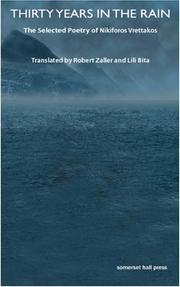
Thirty Years in the Rain: Nikiforos Vrettakos as translated by Robert Zaller and Lili Bita

Thirty Years in the Rain Thirty Years in the Rain: The Selected Poetry of Nikiforos VrettakosNikiforos Vrettakos; Somerset Hall Press 2005WorldCatLibraryThingGoogle BooksBookFinder 
Diamond-like and deceptively simple: that’s how Rachel described the dozen or so poems I had time to read to her from this book today. I concur. These poems combine the plain-spoken lyricism of, say, José Martí’s Versos Sencillos, the fierce affirmation of Jorge Guillén’s Cántico and the pellucid quality and light-drenched landscapes of Eugénio de Andrade’s best work.

Now, you may be saying to yourself, “Who the hell are Eugénio de Andrade and Jorge Guillén?” If so, you’re hardly alone: poetry in translation is an extremely minor concern of American publishers, and few Anglophone poetry fans seem aware of much beyond our own linguistic borders, save for a few luminaries such as Neruda, Rilke and Lorca. That’s a shame, because Greece alone has produced many great poets this past century: C.P. Cavafy, George Seferis, Yannis Ritsos, Angelos Sikelianos, and Odysseas Elytis all deserve a place on any poetry-lover’s shelf. Add to that roster Nikiforos Vrettakos, a member of the “Generation of the 30s” evidently as revered in Greece as any of the others I’ve just listed, but unknown here until Robert Zaller and Lili Bita began to collaborate on the English translations collected in Thirty Years in the Rain. I hadn’t heard of him myself until just last month, when I happened on this blog post:

January 1st marked the centenary of the birth of the Laconian poet, fiction writer, essayist, translator, Athens Academy member, and Nobel Prize Nominee, Nikiforos Vrettakos. Therefore the Hellenic Ministry of Culture and tourism has declared 2012 Nikiforos Vrettakos Year.

Since he didn’t win a Nobel Prize for Literature like his two contemporaries Odysseas Elytis and George Seferis, Nikiforos Vrettakos is less-known abroad. In Greece though, he is a poetry giant, taught in schools, and many of his poems are set into music. People go back to his poetry for “his tenderness and boundless humanism”.

Working my way through Thirty Years in the Rain, I found many things to admire. Vrettakos returns again and again to the rugged massif of his childhood, the storied Taygetos. As a nearly life-long dweller in the considerably less rugged Appalachians, naturally I appreciated this kind of imagery. His most direct treatment comes in “Stone Petals”:

“Taygetos isn’t a mountain.” I didn’t
discover it, but found it beside me
when I was born. It stood by. Later
I dreamt of it as a kind of church—
at the center of the earth.

Its bells chiming, scattering
petals over the nations.

This short poem also demonstrates two other things I liked about the book: Vrettakos seems very comfortable with religion as a repository of mystery and wonder (without necessarily being a believer himself, I gather), and his poetry betrays a certain attraction to the via negativa — which wouldn’t be at all surprising for someone from the Eastern Orthodox homeland. This latter tendency expresses itself in his nuanced appreciation for darkness and silence, which is all the more striking for its contrast with his general heliotropism. Take for instance “Liberation”:

My soul dances today, winged,
looking to alight on a branch
of light, to hear, see, say
whatever can be heard, seen, said.
It’s good to know, and know well,
that the thing you are
was hatched out of darkness.

As for silence, he imagines in one poem, “Beside the Others,” an entire “volume of silence” among his collected works. (Vrettakos was apparently a very prolific author.)

In it is everything I hid
and everything within me that
hadn’t had time for the long journey to the light.
The pages are huge, too heavy
to lift. No one will read it.
God will take it as it is
and put it in his heavenly library.

Nor is silence without its perils:

If silence spoke,
erupted, exploded—it would level
every tree in the standing world.
(“Chorale”)

And in “Inexplicable,” the eyes of an unnamed beloved contain “A silence / filled with what can and can’t / be deciphered.”

Vrettakos was a leftist, like most Greek intellectuals of his generation, but departed from the party line on many issues. I particularly appreciated the poems on peace, which he often seemed to equate with poetry as a natural impulse of all life:

I’m immersed in each brook on whose flow
the word Peace runs like a psalm.
(Because the waters are a thinking sun).
(“Address to a Peace Conference”)

But his apophatic instincts led him to decry the fetishization of peace, too:

All that’s left of peace
is an empty word, a shed garment.
It’s scrawled everywhere, as if
to mock its own countenance:
the divine plenitude, the sap that flows
from flower to flower, the poetry.

Yet still I wouldn’t want
to find it among my own pages,
like a white corpse in a casket.
(“The Empty Word”)

Vrettakos himself describes his work best: he is an overflowing cistern whose waters come “half from / earth’s grief, the rest from its miracle” (“Cistern”). Toward the end of his life, he wrote:

I’ve said my piece,
it’s enough to know that
here and there, now and then,
I’ve added my song to the birds’.
(“All I’ve Said”)

I think I want to be Nikiforos Vrettakos when I grow up.

How to talk

This entry is part 24 of 39 in the series Manual


Download the MP3

Unless you’re in an opera, stop singing. There’s music in speech, true, but it comes from the ground rather than the sky.

Do not attempt to say everything at once. Take advantage of the fourth dimension: time.

Do worry syntax not about, out figure will it they.

Words are like moss: plants without roots that rely on each other for support.

Never think before you speak. That’s tantamount to speaking before you speak—rehearsing everything before an invariably appreciative audience of one.

To start a conversation, it’s not necessary to have something to say. Find someone who looks as if they have nothing to say and ask them about themselves.

True conversation requires listening. A basic audio surveillance bug can be purchased on Amazon for as little as $28.50.

When learning a new language, the second thing to master is the way pauses are filled, the way they say um and ah. Master the shapes and rhythms of the inarticulate and meaning will take care of itself.

The first thing to learn, of course, is how to curse, and the body language that goes along with that.

Only when you understand how to say what can’t be unsaid will the everyday rituals of giving and receiving, welcoming and taking leave, apologizing and expressing condolence begin to make sense.

To speak is to fabricate. This is why so often sociopaths are such charming speakers.

The god of silence, Harpocrates, never wore clothes.