Art beyond sight

honey locust leaves

Descending the stairs at a parking garage yesterday, I was captivated by the sight of honey locust leaves outlined by dew on a flat black roof. What does it say about me that this is my first successful picture of autumn leaves this year?

ideal

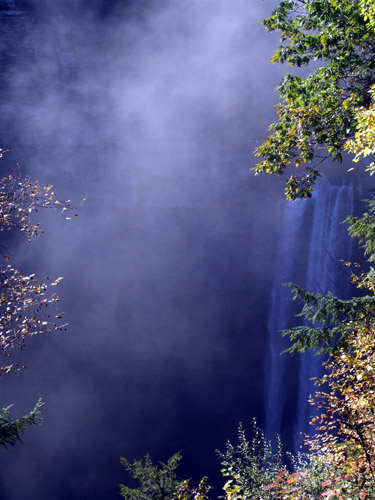
Imperfection, even shabbiness, is far more attractive to me than some idealized view of nature. On a trip to upstate New York last week, I took a number of pictures of the spectacular Taughannock Falls, but the only one that struck me as worth saving (and I still don’t think it’s all that great) features the mist rather than the waterfall.

The trouble is simply that I’ve seen too many photos of waterfalls, too many depictions of hillsides blazing with autumn colors. It becomes very, very difficult to escape the gravitational pull of the clichéd shot and see these kinds of scenes anew. The particularity of the scene becomes lost in translation into our ready-made vocabularies of perception.

French Interior

Yesterday morning, I was led to ponder the process of translating visual art into tactile experience by an exhibit on the interpretation of art for the blind at Pattee Library, University Park, Penn State. (In addition to being Breast Cancer Awareness Month, October is also Art Beyond Sight Awareness Month.)

Queen Mother Head 1

Each of a number of famous works of art was reproduced and described in the manner of this bronze head from Benin: a full-color reproduction at the top, paired with a description for the sighted, then below it, a black-and-white reproduction, giving a sense of what is lost when colors are translated into contrasting textures in the adjacent tactile version — durable paper “printed” with varying kinds of embossed surfaces. A detailed interpretive description in Braille rounds out the display.

Queen Mother Head 2

For works of sculpture, I can’t help thinking that direct contact with the object itself would be far simpler (aside from the obvious fact that the sculpture in question may be located in Lagos). I wonder if there are any art museums that allow people with sight loss to handle more durable pieces of sculpture?

In any case, the “look but don’t touch” mentality of art museums really gets to me sometimes. It is perhaps an inescapable necessity for the public display of artworks that they be placed behind velvet ropes, but with this comes a strong sense that art is something apart from ordinary life. The work of art, we in the West have been led to believe, is as changeless and immortal as a Platonic form. This is of course pure fantasy, enabled in part by the ability of the sighted to gather information at a distance and to preserve it in a static form (as opposed to a sound recording, which cannot be divorced from the time required to listen to it). Those who rely on touch, taste, smell and hearing for their knowledge of the world have no choice but to immerse themselves in the ever-changing flow.

computer room

I wonder if someone blind from birth can even form a conception of the transcendental, predicated as it is upon the possibility of apartness? Does the distinction between objectivity and subjectivity even make sense for such a person? Imagine a world without visual media. Would it be as easy to destroy?
__________

I’m going to West Virginia this weekend. See you on Monday.

Out of the great tribulation

dead man's fingers
Dead man’s fingers

From the Philadelphia Inquirer:

The graves are dug, by hand, and by church members, as prescribed.

Messengers have gone door to door, family to family, to deliver vot, the traditional oral invitations.

Later, the graves will be covered with dirt and marked by simple stones. But before that happens, horses and buggies will bear friends and family to private, home funerals – four today, one tomorrow – as the Amish of this peaceful farming community prepare to bury their lost daughters.

As the funerals drew near, the refrain among the Amish was forgiveness – for the man who collected milk from their farms, who was father to three children, and who took their girls from them.

“The Amish feel very strongly that unless you forgive, you won’t be forgiven,” said Stephen Scott of the Young Center for Anabaptist and Pietist Studies at Elizabethtown College.

The grieving families will select the white dresses, capes and aprons that will be their children’s final clothing, while community members lean on the scriptures that govern their lives.

The belief is “there is a larger picture that is all according to a divine plan, whether we as humans can understand it or not,” said Scott, who has written extensively on Amish culture.

The white clothing is based on biblical references, Scott said, including Revelations 7:14: These are they which came out of the great tribulation, and have washed their robes, and made them white in the blood of the Lamb.

The casket is usually placed in a bedroom for the viewing. Afterward, mourners gather elsewhere in the home and chat about the deceased.

A small family funeral at home is followed by a community funeral. Most Old Order Amish communities – conservative ones, like those whose children attend West Nickel Mines Amish School – do not have church buildings. In good weather, funerals are often held in barns, Scott said.

There will be no mention of the girls’ smiles or the lives they touched. “The Amish would feel that you shouldn’t praise people too much; praise goes to God,” Scott said.

Nor will there be singing, he said. The words to hymns will be read aloud.

During services, a white cloth covers the partially opened casket and conceals the body. Afterward, the cloth is removed, and those in attendance file by, family last. The coffin is then closed.

Triptych

truck Trane

The secret teachings of January smolder in the twelve directions of the clock & turn to fly ash in the alchemist’s spoon, the one with a mother-of-pearl grip like an old-fashioned .38. They are not hidden — their noise is the noise of the world — but they’re easy to miss, just as a painting that moves us once might prove, on subsequent viewings, unable to escape our recollection of being moved. You might hear them & not realize it until the next morning, when the eastern sky begins to prickle under its hairnet of bare branches, the ambiguity of figure versus ground prompting a sudden consciousness of loss. For god’s sake, put the kettle on, says the wren.

cat

And now I am sipping slow clarity with my tea. A half-grown kitten crouches down in the grass and turns to stone. The blacker the cat, the better the chance of its survival in the wild, so what’s all this nonsense about bad luck? If you know me at all, you know how fond I am of the way the world eludes our efforts at interpretation. If reality is my bible, then I confess to the most extreme form of literalism: no bird is an omen. The arrangement of tea leaves in a pot is nothing but art, pure & unrepeatable! The one-sided conversation of a sleepwalker forces us to listen as an infant must; it does no good to drill new ear holes in the mask we long ago acquired as an inducement to love. ‘The music of what happens,’ said great Fionn, ‘that is the finest music in the world.’*

bear

If you can’t decide on a quarry, you’ll never be much of a hunter. Or so I gather. You might be wondering why I started out talking about January, but it’s simply because that’s when the contrasts are sharpest, at least in the Northern Hemisphere. The sun — on rare occasions when it shines — is at the best possible angle for photography. Shadows turn blue against the snow, which can otherwise cause blindness, & a sufficient depth of snow or ice traps blueness for slow release on cloudy days. Sky versus ground: one is as good as the other in my book. Though their tracks are everywhere, seeing a coyote right now would simply be too much to hope for, I remember saying to myself in the last seconds before the shape at the edge of the woods averted its muzzle and hauled ass up the hillside: unmistakeably bear. Inexplicably awake.
__________

*Quote from the Fenian Cycle, translated by James Stephens in Irish Fairy Stories and reprinted in John Montague, ed., The Book of Irish Verse (Macmillan, 1974)

Remembering the original 9/11

I’m guest-blogging about the Satyagraha centenary today at modal minority, a blog focused on the culture of the Global South. Please visit.
Modal Minority was taken down. For archival purposes, here’s the text of my essay.

Satyagraha literally means insistence on truth. This insistence arms the votary with matchless power. […] Such a universal force necessarily makes no distinction between kinsmen and strangers, young and old, man and woman, friend and foe. The force to be so applied can never be physical. There is in it no room for violence. The only force of universal application can, therefore, be that of ahimsa or love. […] Love does not burn others, it burns itself.
–M. K. Gandhi, “Some Rules of Nonviolence” (1931), in Non-Violent Resistance, Shocken Books, New York, 1961

Today is the 100th anniversary of the birth of the Satyagraha movement [popups] at a meeting of delegates from the Indian community of Transvaal Province, South Africa. The events of September 11, 2001 pale in significance next to the birth of the movement that led to the liberation of India, the end of legal segregation in the United States, and so many other successful and ongoing struggles for social and environmental justice around the world.

One of the striking things about Gandhi’s speech to the assembly on the original 9/11 was its ecumenism. Speaking as a lawyer in favor of a proposal that each Indian should take a solemn oath of resistance against a new, racist ordinance, he stated that “We all believe in one and the same God, the differences of nomenclature in Hinduism and Islam notwithstanding. To pledge ourselves or to take an oath in the name of that God or with him as witness is not something to be trifled with.” (M.K. Gandhi, Satyagraha in South Africa, tr. from the Gujarati by Valji Govindji Desai, Navajivan Publishing House, Ahmedabad, 1928)

The courage of those Indian Africans on September 11, 1906 and thereafter consisted not simply in their refusal to bow to a repressive colonial regime, but also in their willingness to forgo the false comforts of moral absolutism. To commit to nonviolence means, among other things, that one remains open to dialogue. One appeals to one’s opponent as a thinking, feeling human being — much more risky to one’s own sense of righteousness and security than simply blowing him up.

It might also be worth remembering how little credence the young M. K. Gandhi gave to the non-rational side of moral conviction. Were it not for popular beliefs to the contrary, he felt, an individual’s sincere pledge should be worth just as much as an oath before God. But one uses whatever language seems most convincing to oneself and others in order to invest one’s words with the force of one’s full intention: Gandhi’s neologism satyagraha combined satya, truth, and agraha, firmness.

Gandhi’s later writings would stress the importance of discipline and self-sacrifice. But his behavior at the September 11th meeting demonstrates the importance of imagination as well as self-abnegation. He had not gone to the meeting with any idea that a mass pledge of resistance might come out of it, but when another delegate suggested it, he immediately recognized its potential to alter the political landscape and spoke out strongly in its favor. A lesser leader might have reacted with caution, sensing a threat to his own power from a rival’s suggestion.

The original 9/11 does have a slight resonance with the events of the same day in 2001. The assembly was convened at the Empire Theatre in Johannesburg, and quite by accident, the theatre burned to the ground the very next day. “On the third day friends brought me the news of the fire and congratulated the community upon this good omen, which signified to them that Ordinance would meet the same fate as the theatre,” Gandhi wrote. “I have never been influenced by such so-called signs and therefore do not attach any weight to the coincidence.” But he was pragmatic enough to recognize the galvanizing influence of the fire on the imaginations of his countrymen.

Can nonviolent action or reasoned dialogue ever prevail against fanaticism? I know of little else that can. Killing fanatics simply breeds more fanaticism. For a good contemporary example of Satyagraha in action, one need look no farther than Yemen, where public theological dialogues have been helping to keep a lid on violent extremism, according the Christian Science Monitor [popups]:

“If you can convince us that your ideas are justified by the Koran, then we will join you in your struggle,” Hitar told the militants. “But if we succeed in convincing you of our ideas, then you must agree to renounce violence.”

The prisoners eagerly agreed.

Now, two years later, not only have those prisoners been released, but a relative peace reigns in Yemen. And the same Western experts who doubted this experiment are courting Hitar, eager to hear how his “theological dialogues” with captured Islamic militants have helped pacify this wild and mountainous country […}

Critical to the Yemeni mullah’s success has been his willingness to listen and to submit to the give-and-take of real dialogue; these are not the shouting matches that pass for debates on American television, I gather. Yemen is hardly what one would call a peaceful society, but it is a society where rhetorical skill is prized almost as highly as martial prowess. In rural Yemen, negotiations to end or stave off violent disputes are often couched in spontaneously composed verses of complex structure known as zamil; exchanges of gunfire often give way to exchanges of poems (see Steven C. Caton, “Peaks of Yemen I Summon”: Poetry as Cultural Practice in a North Yemeni Tribe, University of California Press, 1990).

So in a sense, though they are probably about equally violent, Yemen may be a more fertile ground for Satyagraha-type experiments than a strongly anti-intellectual, entertainment-dominated society like that of the United States. A gifted orator like Martin Luther King, Jr. can only inspire people to action as long as they are able and willing to listen and think and debate. The terms of political discourse in this country have become so impoverished, and the climate so polarized, it’s hard to see how any but demagogues could make their voices heard. Collective acts of remembrance, such as the 9/11/2001 commemorations, occur against a backdrop of profound collective amnesia, with the result that the centenary of the original September 11 goes virtually unmentioned anywhere outside India. It will be interesting to see if any other national politicians join Rep. John Lewis on the steps of the Lincoln Memorial today for the Day of Peace celebration.

Mackerel sky

transformer

Can you read the sky? This one is a sign that means “unreadable” — a mackerel sky.

An altocumulus mackerel sky or mackerel sky is an indicator of moisture (the cloud) and instability (the cumulus form) at intermediate levels (2400-6100 m, 8000-20,000 ft). If the lower atmosphere is stable and no moist air moves in, the weather will most likely remain dry. However, moisture at lower levels combined with surface temperature instability can lead to rainshowers or thunderstorms should the rising moist air reach this layer. There is an old saying, “Mackerel sky, mackerel sky. Never long wet and never long dry.”

Beautiful, isn’t it? Let’s face it, stability and uniformity are boring.

talus rock 3

Take rocks. Rocks are far from the paragons of stability we imagine them to be. Go for a walk across a boulder field sometime — it’s easy to lose your balance. Some rocks like to rock, some rocks like to roll, and you just have to keep movin’ and groovin’, as the song says. There are boulder fields in eastern Pennsylvania full of rocks that ring when struck, emitting clear, resonant tones. People come with mallets and go rock-hopping in search of a perfect pitch. Here on the mountain most of the rocks play dead, but some sleep with one eye open.

talus rock 2

If you can’t put your trust in a rock, what else is there? A cipher, perhaps. The abstract truth of numbers. But somehow the mind rebels, and the numbers begin to take on completely extraneous qualities: sexy 6, owlish 8, 55 a pair of drummer’s brushes. 49 seems inexplicably tastier than 48. We could paint by numbers, green and green and green.

numbered laurel leaves

“It is only when we forget all our learning that we begin to know,” Thoreau once wrote in his journal. “I do not get nearer by a hair’s breadth to any natural object so long as I presume that I have an introduction to it from some learned man. To conceive of it with a total apprehension I must for the thousandth time approach it as something totally strange.”

Total, totally: as if from heterogeneous reality to derive some unity, some gestalt. That too, says my inner Ecclesiastes, is so much empty grasping at the wind.

Mayan head

If each morning you could forget everything, including language itself, and could be reborn in a world free of signs, what would you see? Faces. Everywhere. We make the strange familiar simply by coming to dwell in its fishy midst. We cast our lines skyward, in hopes of landing the elusive holy mackerel.

Pear economics

ThoreauMy mother cut up and froze the rest of the peaches from the box marked “Thoreau” and gave it to me to fill with pears. Alas, there’s nothing remotely Thoreauvian about our pear tree, though we haven’t had to prune it in years. It’s a dwarf, genetically identical to every other Bartlett pear tree in the world, and this year, as most years, it was loaded. We are always amazed that this one, 15-foot tree, which looks especially small standing out in the middle of the field, can pack so much fruit into such an economical space. We planted it back in the mid-70s along with five other fruit trees in that location, but we didn’t fully appreciate the necessity of fencing everything from the white-tailed deer then. The Bartlett was the only survivor.

The pears have to be picked unripe; otherwise they fall to the ground and feed the hornets or the deer. Nor do our hoofed friends limit themselves to windfalls. We’ve actually seen them stand up on their hind legs and hop to reach pears as high as seven feet off the ground. Did Thoreau ever have a problem with deer eating his wild apples? No, he did not. There is exactly one reference to deer in Walden. It’s in Chapter 12, “Winter Animals”:

One man still preserves the horns of the last deer that was killed in this vicinity, and another has told me the particulars of the hunt in which his uncle was engaged.

To Thoreau, living in the hey-day of market hunting, the white-tailed deer was a wilderness animal and a creature of legend. In The Maine Woods, he mentions them in the same breath as bear and moose as a denizen of “Ktadin,” the irony being that in fact central Maine is at the northern edge of the white-tailed deer’s natural range. These days, suburban homeowners in the Concord, Massachusetts area probably think of deer the way most Pennsylvania suburbanites do — as hoofed rats — and some probably even keep their kids indoors in the summer so they won’t contract Lyme disease. If Thoreau were alive today, I imagine he would compromise his vegetarian principles enough to join other ecologically minded folks in becoming an enthusiastic promoter of wild venison.

Another creature whose numbers have mushroomed since the eradication of top carnivores and the severe fragmentation of the eastern forest is the woodchuck. When I picked the pears, I left a dozen or so in the topmost branches, figuring the deer would get them when they eventually fell. Not so. Two days later, my mom told me, she, Dad, and my brother Steve watched a woodchuck climb the tree to eat the remaining pears! This is highly unusual behavior — Mom tells me she’s only ever seen it once before.* They’re nicknamed groundhogs for a reason.

When I heard this, I was doubly glad I hadn’t been greedy and picked every last pear. The value of that one wildlife observation — especially to a naturalist writer like my mother — far out-weighs whatever pleasure we would’ve gotten from those dozen, succulent, top-of-the-tree Bartletts.

That’s the sort of accounting Thoreau excelled at. At the time of his death, he was half done writing a book called Wild Fruits, a contrarian work dedicated to the notion that “the less you get, the happier and richer you are.” Thoreau’s take on economics strikes me as considerably saner than the dangerous fantasies of the Chicago School:

It is a grand fact that you cannot make the fairer fruits or parts of fruits matter of commerce, that is, you cannot buy the highest use and enjoyment of them. You cannot buy that pleasure which it yields to him who truly plucks it. You cannot buy a good appetite even. In short, you may buy a servant or a slave, but you cannot buy a friend.

To me, a good, firm, tart apple is the finest of fruits, and I agree with Thoreau that even wild apples can taste delicious if you come upon them unexpected out in the woods. Pears are a bit like mangoes: soft and sweet and sticky. I enjoy them, but I have a hard time eating more than two or three at a time. Back when I quit smoking, I ate a couple bushels of Stamen Winesap apples in the course of a month, consuming as many as 25 a day and opening my first-ever abdominal savings account in the process. I couldn’t have done that with pears.

But pears were my paternal grandfather’s favorite fruit, and now that Pop-pop’s gone, eating pears from our tree has become an act of remembrance for us. So I filled the Thoreau carton with all the ones I could reach from the ground, then took a second carton up the stepladder, balancing it rather precariously on the top rung.

Since we hadn’t thinned them earlier in the season, many were small, no more than a couple mouthfuls each when they ripen. And of course they will ripen all in a rush, and we’ll do our best to gorge on them, feeling ridiculously wealthy and fortunate — not to mention sticky. And then they’ll be gone, and the box marked “Thoreau” will be put to some other good use.
__________

*This is an update of what I wrote earlier, when I said I thought it was unprecedented.

Don’t forget to send tree-related links to Bev by August 29 for the Festival of the Trees.

Residence in the earth

one of our neighbors in the valley

The way our would-be straight lines fall on the land, whether along the contour or across it, makes me think of clothes on a body — the farther from town, the more natural the fit. From highway to road to lane, it’s the same-size wheels, but then for the crops they must grow, sprout treads. Suddenly escape is no longer an option: if we want to eat, we must slow down and pay attention to every detail.

Why any of this should amaze me is difficult to explain. As long as I’ve lived in the country — almost all my life — I am still a creature of books and screens and flat Cartesian spaces with their promises of freedom. I must continually remind myself that power is round: gears. Coins. Bellies. The sockets in which our animal limbs revolve as we wander the globe.

corrugated pipe

Why Monday and not Saturday, the Amish woman wonders as she hangs out the wash, darks and lights together. The breeze swells a kerchief the same way the earth ripples under the fields. Aren’t weaving and harrowing pretty much the same? Her eyes still lazy from Sunday follow a hedgerow up to where the woods start in earnest — a good thing, because desire works best within limits. It’s a sin to want more than what you can properly attend to. She gazes at the mountain, a long, low ridge nearly identical to all the others she’s known since childhood. Every few miles another mountain, like a permanent Sabbath rising between weeks of fields.

Forbidden fruit

suggestive tomato 1

If I told you that it was reported that a shepherd was killed because his goat wasn’t wearing a diaper, and goats are simply too sexy to be naked, would you believe me? Or if I said that three people were killed because of the provocative way their vegetables were displayed in the market, would that make sense? The celery and tomatoes were deemed too naughty by clerical edict.

–Robin Andrea, The Fertile Naughtiness of the Natural World

suggestive tomato 2
We laugh at such thinking at our peril, we WASPs. A hundred years ago, we too were mortified by such things, teaching our children (for example) that a table or chair had limbs, not legs. Did anyone honestly believe that careless reference to the sexiness of furniture could lead an impressionable mind astray? Where does such prudishness come from?

The great Russian literary critic Mikhail Bakhtin introduced some useful concepts in his book Rabelais and His World, as he strove to bridge the chasm between modern and pre-modern European ways of looking at the body. The predominant imagery of the pre-Lenten Carnival, he found, was grotesque: like the tomato in these photos, it exceeded itself in ways that were both comic and sexual, with a mixing of lower and upper body symbolism whereby, for example, a nose became a penis, and vice versa. Though material rather than spiritual, the grotesque body was, in a sense, cosmic, both literally and figuratively larger than life — “a body in the act of becoming,” as Bakhtin put it. A popular survival from pre-Christian days, it persisted in an uneasy balance with the Body of Christ and what Bakhtin termed the classical body of church and state, which was as finished as the grotesque body was unfinished, closed off to the world and therefore susceptible of that sine qua non of priestly religion: purity.

The European so-called Enlightenment gave the mind-body split a huge boost, in conjunction with the rise of capitalism and the modern nation-state. The classical body dominated the thinking of the emerging middle class, whose members always aspire to better themselves by embracing elite mannerisms and perspectives and turning away from their origins in the village and the soil. But it seems to me that the new, ideal body of the industrial bourgeoisie was even more private and tool-like than the classical body had been, in keeping with new, reductionist ideologies.

Reductionism is the genius of the modern age, the source of our immense scientific and technological power. Religious fundamentalism, though often seen even by its adherents as a rejection of modernity, is equally modern in its insistence on reductionist interpretations of text and doctrine. (Recall that for Islam, the Wahabite and other modern “fundamentalist” movements arose only in the 19th century; Sufic and syncretic movements dominated popular Islam up until modern times.) As oppressive social structures spread their tentacles (a grotesque image!) into every facet of society, one unintended consequence is to inspire ever higher levels of fear and paranoia in its increasingly individuated and isolated members, now reduced to the status of taxpayers, occasional voters and consumers. Modern medicine and industrial warfare promote a diminished vision of human beings as little more than animated cadavers, suicide bombers, collateral damage.

In place of the comic body of Carnival, we have the angry, anonymous mob, summoned up and defined by its fear and rejection of some threatening other: capitalists, immigrants, Arabs, Jews, Shiites, Sunnis, Americans, whatever. The institutionalized religious or insurrectionary mob is like a grotesque body with bulimia. Its obsessive quest for purity, now liberated from the constraints of an empathy-based ethics, feeds a revulsion toward its own members, and purge follows purge. Nazi propaganda defined its undesirables as “life unworthy of life”; Chinese communist propaganda rejected sexual desire itself as anti-Communist. These are of course extreme examples, but I am trying to understand how people can be put to death for displaying suggestive vegetables. The mobocracy instinctively acts to control whatever threatens its supremacy, and what could be more subversive than sexual desire?

It may seem as if North America is relatively free from these impulses, but that’s hardly the case: true freedom and wildness are perceived as deeply threatening by most Americans. Aside from a very few towns and cities, our streets are virtually lifeless, devoid of informal commercial activity, vagrants, even loiterers. The symbol of middle class respectability is the weed-free mowed lawn. Lifestyle ordinances are strictly enforced, even in many rural townships. In place of riotous carnivals, we have parades. The reductionist equation of human being with zygote gains ever more popular acceptance, even as we become more willing to deprive our undesirable members of liberty and life in a vast prison-industrial complex.

Our actual, individual bodies bulge grotesquely in perverse reaction, it seems, to the unattainably attenuated, hard, machine-like bodies pimped by our elite-controlled popular culture. Sex in America now comes in two official flavors, liberal and conservative. Among liberals, sex is seen as a glue for self-fulfilling relationships, a form of healthy exercise, and/or a subject for therapy. For conservatives, it is a time-honored, divinely sanctioned technique for procreation. Both strike me as a radically impoverished understanding of what love-making could and should be.

Humans have, I think, a natural desire for self-transcendence. The physical excesses of the grotesque body of Carnival honored this desire by spoofing it: as Bakhtin somewhere points out, in ancient times and in highly traditional cultures, religion included a healthy admixture of comedy and burlesque. When the belly shakes with laughter or the whole body with orgasm, the line between self and other grows thin — a perilous situation for those whose power depends on anathematizing the other. You want self-transcendence? Make babies. Or wait until after death … and thus the death-dealing at the heart of reductionist ideologies attains an aura of sanctity. Keep your vegetables in line, buddy, or your ass is grass.
__________

Long-time readers of Via Negativa might remember my previous, more comprehensive treatment of these themes with reference to Zuni Pueblo: Laughing in church and Houston, we have a problem.

Psalm for the Rapture

river in November light between bare woods and mountain
This entry is part 1 of 6 in the series Psalms

Farther away — much farther,

Photobucket - Video and Image Hosting

high as a predator drone above the caution tape,
distant as a satellite from the chalk outline on the street,

Photobucket - Video and Image Hosting

safe from the suck of the swamp,
its cottonmouths & mosquitoes,

Photobucket - Video and Image Hosting

free from the burden of earth
& the deadly irredeemable stones,

Photobucket - Video and Image Hosting

beyond the sting of conscience
& the discomfort of moral ambiguity,

Photobucket - Video and Image Hosting

rapture me in the always-now of amnesia,
in the never-enough of consumption, rupture me,

Photobucket - Video and Image Hosting

oh god oh god oh god oh god oh god.

Mizaru Bosatsu

Photobucket - Video and Image Hosting

After struggling to comprehend the needs of so many, his head split into eleven pieces. Amitabha Buddha, seeing his plight, gave him eleven heads with which to hear the cries of the suffering.
Wikipedia, Kuan Yin

The Wikipedia article fails to mention that the eleventh head belongs to none other than Amitabha himself. I suppose you could say it was a meeting of the minds.

In Eurpean mythology, anything with multiple heads is invariably bad news. But then, Europeans were fairly unique; few other cultures were ever quite as removed from, and hostile to, the natural world. To me, the eleven-headed Kuan Yin iconography springs naturally from the botanical metaphor already implicit in the lotus seat.

In Japanese folk religion, though, the many-headed Goddess of Mercy has a Rabelaisian counterpart in the triune Monkey, made famous by its representation at Nikko. Lorianne had some fun with this icon in a recent post:

I had hoped to contribute ten self-portraits to the marathon, so I’m still one shy of my goal…but I have until midnight tonight (or maybe early tomorrow morning?) to post one more attempt.
Until then, though, I’m behaving myself, seeing, speaking, and hearing no evil.
Hoarded Ordinaries (see image)

Seeing a bodhisattva in a thousand-leafed rhododendron — what could be more emblematic of monkey mind?