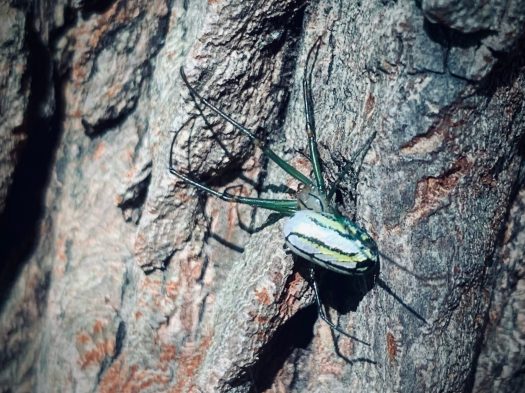
Firefly moon

firefly moon
a rabbit’s high, thin shriek
cut short

***

I keep killing the same fly over and over. Sometimes it’s green; sometimes it’s blue. Its blood is always yellow. And always it returns to the same spot on my knee, rubbing its forelegs together, ready for another taste of my salt.

***

There are still two red squirrels in the spruce grove, one in the trees around Dad’s grave and the other a hundred feet up the hill. This seems unusual given how territorial they are, according to the resident naturalist.

The sandstone slab from down the ridge is doing an excellent job as a reflecting pool. And even when it’s dry, it remains an object for reflection.

***

I’m increasingly coming to prize experiences that I don’t write about and don’t share with anyone. They feel like a form of wealth. Especially after nearly a decade of telling virtually every memorable thing to my then-partner.

***

The first drops of rain start falling just as I reach my front door after a three-and-a-half hour ramble. I stand under the portico watching the sidewalk briefly turn into a pointillist watercolor.

***

I am really feeling this poem by Joanna Klink called “3 Bewildered Landscapes” in Excerpts from a Secret Prophesy. Here’s the third landscape:

STARS, SCATTERSTILL. Constellations of people and quiet.

Those nights when nothing catches, nothing also is artless.

I walked for hours in those forests, my legs a canvas of scratches,

trading on the old hopes—we were meant to be lost. But being lost

means not knowing what it means. Inside the meadow is the grass,

rich with darkness. Inside the grass is the wish to be rooted, inside the rain

the wish to dissolve. What you think you live for you may not live for.

One star goes out. One breath lifts inside a crow inside a field.

“What you think you live for you may not live for.” It’s always such a pleasure to find a poem that says precisely what I need to hear, like meeting a true teacher.

A hummingbird visited the beebalm next to my chair as I was typing that—the last hummingbird visit of the evening. Now a wood thrush is singing from the top of the crabapple tree.

I am still thinking about a photo I took this morning:

Cross, guitar, railroad tracks. All the promise and heartbreak of America in one shot.

I should sell it.

Bad Snufkin, butterfly battle, saved by the privy

mourning cloak butterflies facing off

My interior monologue: I don’t get why people still need mythic archetypes. Are we really so shallow?

Five minutes later: Let’s be honest, you’re still just a Moomintroll who longs to be Snufkin.

And that felt like a pretty solid insight, you know?

The moral of the story: Be sure to expose your children to the Moomin books—they’re pretty great.

There’s much more I could say on all of this but I’m currently (evening of June 28) chasing the sunset up a steep hillside. Which is absolutely not a metaphor for anything.

*

I understand the need for sacred theatre, i.e. ritual, around major life events—especially death, when the survivors are the most earnest in their need to behave as if a truer but less tangible reality exists in which total annihilation can be overcome or evaded somehow.

*

hot tub
laid bare in the woods
a junkie’s pale face

(via Woodrat photohaiku)

*

My interior monologue is heavily laced with sarcasm. I suppose that’s a Gen X thing. (Yes, of course you do. That’s the kind of sophisticated analysis you’re known for.)

Perfectly healthy, I’m sure.

***

“If everyone just thought like me, the world would be a better place” is a hallmark of both imperialism and fanaticism — in fact, they summon each other up, I think.

This is not idle philosophical speculation. Most left-wing revolutions turn repressive because fundamentally the revolutionaries are either too fanatical to accept that there will always be dissent, or too callous to care.

***

The forest is full of mourning cloak butterflies with pristine-looking wings: the new generation has just turned into adults. They will likely be aestivating soon, but in the meantime they’re defending territories in the woods.

I watched two mourning cloaks battling for several minutes on the side of an oak this afternoon. Since tree sap is their main source of food, perhaps this tree is especially good tasting. They used front and middle feet to bat at each other; mouthparts didn’t seem to be involved, and wings only a little. Here’s a brief video of the very end of the fight:


watch on Vimeo

***

Bushwhacking through a Pennsylvania state forest, it’s impossible to stay lost for long. My first sign that a road was near, this morning, was a hunting camp privy. As is so often the case.

At one scenic overlook, a memorial to someone who leapt to his death. I actually remember this. I was a Penn State undergrad at the time.

Someone had spray-painted “no fear” on the retaining wall-like structure:

*

I remember my parents pointing out a “lovers’ leap” place on some family trip when I was a little kid, and how baffled I was. If romance made people jump to their deaths, it struck me as something best avoided.

*

Some trails are notional—made through bushwhacking.

Some trails are roads.

Some trails are the spines of mountains.

And some Snufkins go for a wander primarily to get a new perspective on where they live.

Starting with a thunderclap

morning thunder
a fawn dancing
with deer flies

***

Alaskan poet Erin Coughlin Hollowell posted a Joanna Klink poem to Instagram and I immediately went and dug out my copy of Excerpts from a Secret Prophecy, whence it came. The bookmark was only a third of the way in, but in my defense it had been my second Klink book in a row, and she is not a poet to read quickly.

But my impression from April is soon reaffirmed: she is a poet of unquestionable genius, one of our best. Terrance Hayes uses the term “Rilkean elegies” in his blurb and that’s not hyperbole. In fact Rilke does rather well by the comparison, I think. Here for example is a section of the poem “Novenary”, where my bookmark was parked:

***

roses
between the doe’s teeth
thorns and all

*

dark clouds
the robin revisits
his dawn repertoire

*

downpour
so many memories
smell like the earth

***

If I am only hull to what happens,
let me at least feel more deeply that flitting,
the dead light of stars over my hands,

into my throat. Oar of my body.
Things that were sensed but not known.
Joanna Klink

That’s how “Novenary” ends. And I am reminded that typing out another’s poem prompts a deep reading when you type as painstakingly as I do, with one clumsy finger, on my phone, as if with “the dead light of stars” indeed.

***

They’re still forecasting a high of 90 this afternoon—32C—but at the moment it’s 56F/13C and I am fighting the urge to put long johns on. “Rain stopping in 19 minutes.” That’s global weirding for you.

***

This morning’s earworm is from Blackwater Park, a masterpiece of an album by the progressive metal band Opeth, which I had on in the car last Tuesday. So much great music about serial killers! Bartok’s Lord Bluebeard’s Castle comes to mind.

A cheerful thing to hum while fixing breakfast.

***

One of the great climbing trees of my childhood finally gave up the ghost this spring. Red maples don’t live long but they also don’t die easily.

Enjoy the climb, Virginia creeper! You can’t help that your name makes you sound like a sex offender and an outsider. Hell, I was born in Virginia myself.

***

Stopping to write down a thought, I see that I left another thought unfinished and expand on that instead, forgetting what I had intended to write. As so often in life one redirects energy from one thing to another. Would I have been a more productive poet if I’d had a career, related or otherwise? Undoubtedly. But I always prioritized happiness in the moment.

lucky day
the coins I keep forgetting
in my pocket

***

blowing my nose
a maple leaf’s dry
underside

***

Half-way down the hollow, the sun comes out. And so, I’m afraid, do the midges. Black flies, I suppose we should call him, a call-back to the North Woods of my early childhood. But the white supremacy embedded in that common name makes me more than a little uncomfortable. As does this cloud of midges. Global weirding—what can you do? My nose begins to itch, a psychosomatic reaction as old as my earliest memories of being engulfed by small biting insects.

A small hole in the middle of the gravel driveway which I always thought was the entrance to a chipmunk bureau has filled with water. What an unexpected thing! (The dictation app heard burrow as bureau, and it’s just too perfect to change.)

I decide to head straight up the mountainside to escape the midges. I forget just how many spring wildflowers hide out on the steep slopes where no one ever goes. They’re past blooming now, of course, but it’s good to know they’re here. And I say no one, but in fact I did meet another climber on the way:

red eft

the hollow
between twin oaks
collecting leaves

midsummer—
rain-soaked ghost pipes
steaming

*

This crook-handled umbrella is the best: a cane when I need it climbing a hillside, or a stick to shake rain off vegetation before I walk through it. I was pleased to see, walking with my mother recently, that she uses her folded umbrella to deftly toss fallen sticks off the road just as I do.

*

ghost pipes
sweating through the longest
day of the year


via Woodrat Photohaiku

*

I’m seeing lots of evidence that this year’s much smaller cohort of spongy moth caterpillars has almost entirely succumbed to its main natural control, a fungus. Fingers crossed that oaks won’t be as stressed again as they were in 2020 for a long time—I’m convinced that’s what allowed the caterpillars to build up in sufficient numbers to cause last year’s widespread defoliation, because trees busy fighting drought, after a late hard frost had required them to re-leaf, would’ve had very little energy left over to produce their usual insecticides. Two years later, there are as many dead trees from that frost as there are from last year’s outbreak, though they’re not concentrated on the ridgetops like the latter, but here and there throughout the woods. In either case, just the sort of small openings that are great for overall biodiversity, as long as they don’t presage a new disturbance regime that will turn forest to savanna, as seems to be happening on Plummer’s Hollow’s southeast-facing slopes without oak-hickory cover, where things are kept at a weedy stage of succession—a kind of arrested development—by increasingly harsh ice storms in the winter and thunderstorms in the summer.

If/when sudden oak death aka Phytophthora ramorum arrives here, I may need to be put on suicide watch.

However, it has not escaped my attention that Disturbance Regime would be a great title for something. Or as we GenXers invariably like to joke: if you were ever in need of a rockin’ name for a garage band…

***

At 12:42 the midges find me on top of the ridge. It’s getting hot. The lucky coins are still in my pocket. My feet are damp but the rest of me feels pretty damn good.

The world is always ending somewhere. Today, so far, it’s not ending here and for that I am grateful. North America as a whole might get through the current economic state-change relatively ok, given our economic, natural and demographic advantages. But I fear for friends in other parts of the world. And for wildness and biodiversity dwindling everywhere.

A shadow of a red-tailed hawk passed over me as I was writing that.

(I love augury right up to the point where it stops being about the birds and starts being about us. How dull.)

When I got home, I found a stowaway on my sleeve:

An immature northern true katydid, if I’m not mistaken.

***

For the second day in a row I actually manage a mid-afternoon nap, which is great this time of year when the nights are so short but also so enchanting—and keep in mind that Shakespeare etc. never saw fireflies, which are such a feature of June nights here.

After supper, sitting on the porch to begin editing this post, a fringe of grasses at the edge of my weedy front yard, illuminated by the low sun, caught my eye:

Watch on Vimeo

When I knelt to shoot the video, I looked around to make sure there wasn’t any poison ivy. Instead, I was delighted to discover a baby tulip tree! I had been looking all over for seedlings to transplant a couple weeks ago, because they’re such excellent yard trees—grow straight and tall, are lovely in bloom, and can live for hundreds of years—but couldn’t find a one. So when I’m not looking, one appears. And in a very good spot, too.

I lost no time making a deer cage for it. Blog posts can wait!

Why haiku are hard to write + another walk with the camera

So many otherwise competent contemporary poets struggle to write decent haiku, and it’s worth asking why. Part is miseducation, sure: academic workshops seem to be passing on a view of haiku that’s about 30 years out of date, relying on dodgy translations of the pre-modern masters and helping entrench misperceptions already out there in popular culture (morae=syllables, haiku is a poetic form rather than a genre, haiku must be written in three lines, haiku are easy exercises for beginner poets, etc.). There’s very little awareness that an English-language haiku and tanka tradition even exists. Most academic libraries don’t subscribe to haiku journals. And so on.

But observing my own difficulties even after trying to correct for all of that, I think there’s also a larger problem: modern lyric poets are acculturated into a mindset that is somewhat at odds with the mindset required to compose effective haiku. We’re trained to wrap things up for the reader, to be clever, to aspire to the sorts of insights that could be didactically expressed if need be. We’re better at talking than we are at listening, despite lip service to Pound’s dictum “show, don’t tell,” and many have only the most superficial knowledge of the natural world (to the extent that that’s still central to modern haiku). We’re also trained to look for metaphor and simile—not typically an overt feature of haiku—and to favor in our imagery what Bakhtin called the classical body over the vernacular body, which I think militates agains the kind of earthy realignment between self and other proposed by the best haiku.

Then there’s the problem of how we think of ourselves as writers, strongly favoring the Romantic ideal of a lone creator rather than a collaborator or better yet a participant in creative, game-like exchanges. It’s no wonder that modern haiku culture tends to attract experimental rather than mainstream academic poets.

***

The other day I said something about not being into haiku as a lifestyle. But I don’t know, giving up coffee for green tea and going on long walks whenever possible seems about as haiku-lifestylish as one can get. Maybe what I meant was I’m a loner. That might be true. And as I just alluded to, haiku composition is a fundamentally social art-form. That’s one reason why competitions proliferate, for the festivity and sociability of it. Group composition exercises and similar get-togethers were, and I think still are, at the heart of haiku school formation and publication culture in Japan, and I gather they’re also pretty important in the US, the UK and elsewhere. It’s not unusual for the editors of haiku journals to propose edits even to very well-established writers; the focus is on the haiku rather than the writer, which I quite like.

***

This morning was actually kind of pleasant for walking. The really crushing humidity didn’t come until mid-afternoon.

discovering
another pants pocket…
the sun goes in

vireo nestlings
yellow beaks open wide
for my shadow

via Woodrat Photohaiku

***

The true bards of this era are the advertising jingle writers and political sloganeers. They are the ones whose words infiltrate our dreams and shape our sense of the possible.

*

Thinking about how millennials made, like, a half-turn away from irony. They’re LARPing as sincere people.

(“Is that true, or did you just make it up?” I’m a poet. Take everything I say with that in mind.)

Otherworldliness

box turtle

The other world is shrinking as our own loses species and resilience. Instead of faeries it’s just some nihilistic crypto bros sharing torture porn on the dark web. If technology and society continue to develop along their current trajectories, I expect scientists will figure out a way to read thoughts within a generation, in which case privacy becomes obsolete, and AI will presumably be running most things by then, so at that point I expect any concept of a hidden place, or indeed a sacred place of any kind, becomes literally unthinkable.

Plus, so many people are using hallucinogens now, it shouldn’t be long until all the psychedelic visions are used up, and people will have to watch old Looney Tunes animations instead.

***

Writing without writing

I’ve been accused of having my head in the clouds. Well, today it’s true—my head is in a cloud of mosquitoes. So much so that I am forced to use the microphone to record this, rather than standing still long enough to type it out and turning into a pincushion for bloodsuckers. So far, the dictation software on the iPhone Notes app seems to be working pretty well, although I’m surprised it’s not attempting to transcribe the incessant whining of the mosquitoes.

But it’s certainly an interesting challenge to try to appreciate the beauty of the forest on a rather nice June afternoon from inside a cloud—not the cloud of unknowing mystics talk about, but perhaps a similar sort of impediment. Perceiving beauty amidst misery is kind of what I try to do in my poetry, after all. A winter wren is warbling in his usual spot in the depths of the hollow right above the stream, and just hearing that is nearly worth all the trouble. And it helps that there’s an escape route: straight up the side of either ridge. The mosquitoes peter out about two-thirds of the way up. Then it’s just hot and humid.

***

I wrote a whole lot about haiku and poetry this morning and it felt good to get it out of my system, but for now I just want to share a few more photos from today.

wood turtle on a bridge over the Little Juniata River

eight-spotted forester moth
box turtle

Hiking with the Antichrist

descent path
of a regional jet
wild yarrow

Last night I watched it get dark from the bench at the top of the watershed—the head of the hollow where the old field meets the spruce grove. There’s a very misleading vista of forested ridges, which, because our own mountain is so low, manage to hide nearly all the valleys in between, creating the illusion of a Penn’s Woods with only a few scattered lights of cell towers and scattered farms. All of State College, a small city of around 40,000 in the summer, is hidden by the mid-valley ridge except for one water tower. It’s a good spot to watch the sky and imagine impossible things.

Learning what cumulonimbus clouds do at dusk on a June evening is of vital importance, just as it was earlier to watch the late afternoon light on mature-but-still-young oak leaves in the hollow among which a tanager and wood thrush were performing their greatest hits. I thought I’d spend the spring and summer hiking elsewhere, as I was doing last fall, but so far that hasn’t happened, between the garden needing regular attention and the high price of gas discouraging unnecessary trips.

What is truly necessary, then? Walking, yes, and sitting still from time to time. But when you’re lucky enough to have the run of a private forest two and half miles long, you don’t need to drive somewhere in order to walk. So many urban and suburban dwellers don’t have that privilege; I feel I should use it well and file these reports often.

*

Today, however, I decided to go hike my favorite stretch of Tussey Mountain — the part I see from the aforementioned bench looming off to the east, nearly 1000 feet higher.

dark forest edge—
sassafras extending
middle fingers

A popular spot to get high, judging by all the comfy-looking seats among the rocks. Good thing I’m not an influencer—I’d have to include myself in the photo, and the thing I like about this view is precisely the fact that I’m not in it.

Rock tripe. I love how they curl back as if ready to take flight.

Went off-trail among the ridgetop hemlocks for a while.

mossy rocks
as big as coffins
black-throated green

(That’s the warbler who allegedly sings Trees trees murmuring trees!)

It was worth going off-trail just to get up close and personal with all the contrasting shades of green. This is the true visual treat of late spring and early summer, more than anything blooming right now, even mountain laurel.

The main reason to go into wilder places is to be reminded that pretty much anywhere in the world will, given time, turn into a garden on its own. They’re out there, these aesthetically magnetic places. The fun is finding the small and unofficial ones. And in most cases keeping them to yourself.

What’s fun in the folded Appalachians — the Ridge and Valley section — is that all the places you know have echoes elsewhere, since habitat and forest use patterns tend to follow geology, which keeps running through the same, mostly edge-ways layers. Everything repeats—not necessarily in a Groundhog Day manner, but sometimes that, too. I can find analogues to our ridges at Plummer’s Hollow. In fact, I’m on one now. That’s what makes this so interesting to a stay-at-home nature freak like me: it’s the same but different. I can play detective as I walk, trying to guess the forest history.


Watch on Vimeo

There are an insane amount of black-throated green warblers along this stretch of ridge. I think it’s safe to say that if or probably when all the mature hemlocks succumb to the woolly adelgid, the black-throated greens won’t be nesting up here anymore. Then think of the countless acres of hemlocks as recently as 100 years ago, lost to the logging boom and never likely to come back, and all of the more boreal-type species that have declined or vanished as a result. Think about the trout streams that no longer held trout, and people puzzled that God’s bounty, as they saw it, might actually be contingent on good treatment of the earth and respect for wild and waste places just like it says in Leviticus.

Also, it’s interesting to watch forest succession in places with little history of recent human disturbance. My hiking buddy L. and I discovered this years ago at a very remote, nearly deer-free gorge full of dying old-growth hemlocks, the Tall Timbers Natural Area within Bald Eagle State Forest. It’s deeply sad that we’re losing some of these last fragments of eastern old growth to an introduced pest and a changing climate. But if you happen to have a lifetime’s knowledge of what forests in the Ridge and Valley tend to look like, you can still appreciate the specialness of a place where forest openings are filled not with ailanthus or mile-a-minute vine but mountain ash, sugar maple, or red oak.

Two military jets hurtle past a few hundred yards away, skimming the treetops. What an absolutely terrifying, inhuman howl.

I’m not a Christian but sometimes I think, you know, they might be on to something with the myth of Antichrist. Like, I don’t believe in Christ, but the Antichrist? That’s us. That’s our deathly hand around nature’s throat.

(No, I’m not listening to metal as i hike. That would seem blasphemous even to me!)

A large ground beetle goes into the ground, as is, one supposes, its wont.

I like to watch invertebrates simply because they make up an overwhelming majority of the critters I see on a day-to-day basis. Also they are cool as hell, obviously, and often terrifying if you make the mistake of looking at them through a hand lens. Even so I barely know a fraction of their names. Some of the more obscure ones may still be officially unknown to science, because taxonomy is hard and thankless work.

Damn, it’s chilly up here! Glad I decided to try out this longsleeved merino shirt.

I hate to sound like a fanboy, but I got this shirt for all the obvious practical benefits that people talk about only to discover the real reason for its popularity is that it’s such an unbelievably soft but smooth texture, almost like a second skin. When the wind blows, it feels amazing.

Maybe all athleisure wear is like this, and I’ve been missing out all this time? Too bad my nipples aren’t erogenous zones like a normal person’s. But it does mean less potential for embarrassment in the unlikely event I run into anyone else today.

It’s not silky but silk-adjacent, without the alien feeling of actual silk. It feels like something a mammal made.

Mostly I’m just happy for an excuse to deploy that hilarious, oxymoronic marketing term “athleisure wear.”

*

Garter snake sunning in the middle of the trail. You’ll just have to imagine it, curled into a single stripey loop—it looks much too comfortable to disturb.

I wonder when the last time was that someone went through? Certainly the clump of pale corydalis I found growing in the middle of the trail hadn’t been trampled. The Mid-State Trail may be part of the Great Eastern Trail network, but let me tell you, this ain’t the Appalachian Trail. I saw no one else all day. As usual.

*

We need to stop using the word “picturesque” for things that, upon examination through the back of a camera, turn out to have in fact no good pictures in them. That still trips me up, thinking that just because something looks cool that it’ll make a cool image. That’s like assuming that just because a person is good-looking, they’ll make a good model.

*

Because I’ve also hiked this trail at times when the leaves are down, stopping to take lots of pictures, I know there are way more cool old oaks, birches and hemlocks than i can see now. It definitely heightens the experience just to know they’re there. I mean landscapes are just like people in their uniqueness, aren’t they? No one expects to learn all there is to know about a person in just one visit. The world needs fewer travelers and more lovers.

Just tripped and nearly fell less than a hundred feet from the spot where I tripped and fell last fall. That’s some spooky shit.

I’M ALMOST OUT OF BATTERY. TELL ME GOOGLE HOW TO APPEASE THE UNQUIET GHOST OF A CLUMSY HIKER.

*

Cool, twisted old trees on my right, grouse exploding from dense cover on the left. That’s this hundred feet. It’s constantly changing, and I wish I could be present for the full wonder of it but wonder is exhausting so thankfully rare. I’m having a ridge experience, which is kind of the aesthetic equivalent of being in a perpetual low-level state of arousal due to one’s choice of shirt.

Found a boulder field to eat lunch on, sunning myself on the rocks like that snake, hunched over my sandwich. Boulder fields are cool and all, but these ridges would have fins like sharks had it not been for the icy breath of the glaciers fifty miles away for thousands of years.

Couldn’t find my second sandwich for a few seconds and I almost had a full-blown panic. I am not cut out for the wilderness.

I love the fast wolf spiders that prowl these rocks. I dream of seeing an Allegheny woodrat in the wild some day, but they’re so rare now, I might’ve missed my chance.

ridgetop wind
a black-and-white warbler
hisses back

“Light rain ending in 37 minutes.” If it weren’t for the excitement of failing batteries, technology would suck every last ounce of adventure out of a hike.

A view to the southwest of Plummer’s Hollow nearly hidden by curtains of rain.

Ah, the smell of cow manure, even this far above the valley! That’s how you know you’re in central Pennsylvania.

I hate whoever did this, no doubt choosing to camp under this ridgetop hemlock for its ambience, then carelessly building a campfire on its exposed roots.

Miraculously, it clings to life. Trees are tough up here.

I like trail registries if only for the surrealism of encountering a post office box in the middle of the woods.

My feet are tired but in a good way—that warm feeling they get after a good long hike. What did I learn today? Merino is amazing, and always bring the solar battery charger. Hiking with as much technology as possible is the way to go, really. I simply need to find a good dictation app so I don’t have to keep stopping to write down my thoughts. Then a 360° camera so I can record my hikes for a virtual reality experience. Then I’d be able to relive them someday when my knees are shot and the hemlocks are all gone.

Slug Life

great gray slug on tree hollow

six haiku written while sitting at one spot in the woods

great gray slug on tree hollow

invasive slug
the wood pewee bending
his one note

*

cool morning
the sun catches a spider
patching holes

*

a wasp on foot
the nervous trembling
of her wings

*

ancient seabed
a sudden roar
from the quarry

*

higher pitched
than my memory
first cicada

*

which tree
will be today’s gnomon
great grey slug

*

And here’s the nearly six-minute encounter that fueled all that, for those who have the patience (or a really good prescription):

Watch on Vimeo.

* * *

I just found these coral fungi less than 50 feet from my front porch. Why don’t I ever go back here? I muttered as I crouched down to take a shot.

coral fungi

Then I stood up and saw all the poison ivy. That’d be the reason.

April Diary 31: in conclusion

river in November light between bare woods and mountain
This entry is part 31 of 31 in the series April Diary

Dear April what have we learned from this so-called diary?

  • blogging the way i used to blog is still fun and apparently i still have things to say (not such a surprise since i live alone)
  • it’s possible to create blog posts entirely on the phone by assembling notes, scraps of poems and photos during the course of the day
  • creating this additional daily post did mean i sometimes had to sacrifice a full night’s sleep, so for that reason i’m glad it’s over—finishing the Pepys diary erasure project is a higher priority right now
  • i don’t have a whole lot to say about what i read. i don’t read nearly as much literary criticism as i used to and it shows. sadly (or not) i have no immediate plans to rectify this situation for the simple reason that life is short
  • i’m clearly incapable of separating poetry from other aspects of my life. why i thought i could write a poetry-focused diary is a mystery to me
  • so glad i decided not to try to use the series plugin for the pepys project years ago. it’s still as buggy as ever

today i put in all the cole crop seedings from the nursery. after two years of deep mulching the soil is in much better shape than it was last year, so i have high hopes. i even talked to the seedlings as i tucked them into their little hills

also went for my usual walk but it was work. guess i was tireder than i thought. the best thing i saw was two black-throated green warblers having a sing-off from adjacent trees up on the ridgetop where the canopy is lower so i had pretty good views for once. they’d sing, grab an insect out of the air, sing some more, it was a pretty low-key contest, really

now sitting up in the woods after supper i find that the ethereal beauty of a singing hermit thrush becomes almost unbearable the moment i recall some of the unimaginable human suffering elsewhere on the planet. maybe this is why when i do listen to recorded music it’s something harsh and pounding. it makes the heavy truths of the world a little easier to face

(but most of what i hear in the course of a day is natural sound, by which i mean ambient sound (but a high proportion of that is nonhuman in origin, which is sadly a huge luxury in today’s world (but really what i hear is words. words in my head words on the page words on the screen audible words on videos words on podcasts words with other actual humans words words words. from the time i wake up till the time i fall asleep. not even my dreams are free of them. but when you listen really listen to something without words, whether instrumental music or the soundscape of a complex natural ecosystem, that can feel like you’re accessing a higher consciousness and i suspect that’s because a lifetime of language use has trained us to associate complex patterned sound with communication. to listen to natural sound means to hear everything as if it were a composition – a practice very akin to seeing natural landscapes as if they were wild gardens, something i do nearly every day. the concept of found art and found poetry goes far beyond art and literature proper, for me)))


this dullness in my head all day. i can’t even imagine writing a haiku right now


some say it was poems that drove him mad. some say henbane

“that’s not the wind it’s just old Mr. Thimblesticks out counting catkins”

April Diary 30: aging in place

This entry is part 30 of 31 in the series April Diary

Dear April today i feel old in a way i haven’t before. old in my bones. the soil’s discourse seems nearly intelligible

this mountain soil has especially hard consonants

i wasn’t working hard i was hardly working playing is more like it messing around in the dirt

tonight i found a new-to-me footpath through our woods which may seem unusual but it is a square mile property and it’s not surprising at all that one of our hunter friends should create an informal path and i not stumble across it for a while. that’s all the boring background to how i had the exciting experience of exploring a new trail in my literal backyard — which i only found because i decided to go off-trail on a whim, tempted by an opening between the trees

going off-trail is actually impossible. how does that Machado poem go?

Caminante, no hay camino,
se hace camino al andar.

wherever you walk creates a path and you step in the easier places which is where other things have stepped and pretty soon you’re drawn into the network of animal trails

this is a path

although i suppose some people might have a hard time recognizing trails if they’re from some highly urbanized environment. those enviable souls get to see the forest with fresh eyes as an adult

which of course is the allure of travel. but seeing the very familiar in a new way is always a worthwhile challenge i believe. it’s the challenge of any marriage or any relationship with a place. most Americans move more often than they change romantic partners. i don’t know if that’s true but it supports my argument so let’s pretend that it is. my contention is that maintaining one’s relationship with a place, or places, is as core to one’s sense of well-being as maintaining human friendships and marriages

i suppose that’s a minority opinion in the country as a whole but in this corner of Appalachia i’d say it’s the norm

shadbush

on the porch listening to a barred owl as i type this. i forgot to tell you of my owl sighting last night: one flew ahead of me repeatedly as i walked back from the far field at dusk. i think i got on its nerves because the last perch it took off from snapped under it and crashed down onto the trail

tonight i was up at Dad’s grave as it was getting dark and i just… felt uneasy. not afraid per se but increasingly uneasy. like i didn’t belong there. so of course i skedaddled


earlier in the kitchen i was remembering something someone had said about Bernie Sanders and the Vicente Aleixandre poem Como Moisés es el viejo popped into my head

Y él agita los brazos y proclama la vida,
desde su muerte a solas.

all that gesturing. “proclaiming the way to live from his death all alone”

apparently i have spanish poets on my mind though it was Zang Di and Shanna Compton that i was reading today. Eleanor Goodman finished up her selection of Zang Di poems with several he’d written in Vermont, which were a great deal of fun—seeing how a major contemporary chinese poet describes iconic american landscapes

so many important poems about america these days are being written by first-generation immigrants it’s easy to forget that shorter-term visitors such as students, lecturers, or tourists may have profound observations as well


today i thought a lot about bears but i’m guessing most bears spent as little time as possible thinking about humans

April Diary 29: wildflowery

This entry is part 29 of 31 in the series April Diary

the air is always clearest on the day after a cold front blows in so my mom and i went down to Trough Creek State Park to see what sorts of spring wildflowers they might have

the redbud was at its height all along the little back roads and in the park too. always a treat to see it. we’re so lucky to live right at the northern edge of its range—it’s one of those shrubs that defines Appalachia, along with pawpaw and shadbush/serviceberry. (didn’t stop the car to snap any photos though, sorry)

native bee pollinating a spring beauty

after poking around the park’s usual medley of eccentric geological offerings we headed off along a trail through the adjacent state forest which had many of the same wildflower species we have in Plummer’s Hollow but some different ones as well, including bluets, early meadow rue, pussytoes, and yellow corydalis—a new one for both of us

yellow corydalis

after a mile we reached an area where the spring beauties carpeted the ground for acres. Mom commented she hadn’t seen it like that since she was a child in the 1940s, visiting relatives in Pottstown. it’s difficult to convey this in a photo of course—they’re small flowers

they also had no shortage of rue anemone:

i was taken by this sphagnum container garden:

and for sheer visual interest, rattlesnake weed is always worth a stop:

back home i went for an after-supper walk along the crest of the western ridge toward sunset. the cherries, maples and witch hazels that have just burst their buds added pointillist splashes of color to the landscape that weren’t there two days ago

just after sunset i had a short sit by the vernal pools—the smallest two of which have nearly dried up, the water that remains heaving with desperate tadpoles—to read a few poems from (CREATURE SOUNDS FADE) by Shanna Compton and they were a pretty good fit. it’s experimental poetry meaning inevitably some results will be more exciting than others but if the experiment is well conducted we can learn from it regardless

that sphagnum bottle has a haiku in it i’ll bet