(Read Part 3.)

Early one morning some two weeks after our Wiltshire trip, we stepped off the overnight sleeper train in Aviemore, in the heart of the Scottish highlands. We had reserved a campsite in the village of Nethy Bridge, a short bus ride away, but check-in wasn’t until late afternoon, so we had plenty of time to kill. A tourist map of Aviemore showed a Neolithic stone circle — one of many in the local area — a few blocks from downtown, so we decided to wander over and check it out.

The site was in a suburban neighborhood, across the street from a fire station. A team of carpet cleaners were at work in the house next door.
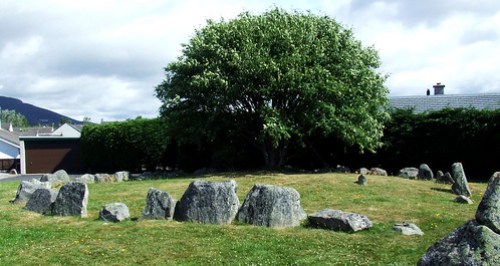
The ambiance was very different from Avebury — and the monument was, of course, infinitely less significant. The only tree on the site was a small rowan that had been permitted to grow next to one of the smaller stones in the ring.

(photo by Rachel Rawlins)
There were, however, other visitors when we arrived, so we made our way to the back of the site and flopped down to rest, trying not to stare at the middle-aged woman sitting in Buddhist-style meditation at the center of the ring. A man of the same age waited near the street, while a teenaged girl we took to be their daughter sat with with her back against a stone, her facial expression and body language a comical mixture of boredom and acute embarrassment.

While the woman meditated, we each found things to photograph.

Rachel became entranced by a head of grass,

while I stalked some of the outermost stones.

They were most cooperative models, and beautiful in their variegated coats of lichen.

Finally the woman got up, and they all left. But we weren’t alone for very long. A few minutes later, a friendly black cat appeared.

What most impressed us about this site was its setting, best captured in this panoramic photo of Rachel’s (click to see a larger version on Flickr). In the heart of a residential area, surrounded by close-cropped lawn, the stones retained as profound a sense of presence and individuality as anything I ever saw in a Zen garden in Kyoto. Especially to an American, it’s astonishing to realize that the landscape is dotted with 4000-year-old stone monuments, and few people make a big deal of them. A few hours later, when we mentioned the stone circle to the woman in the train station who was watching our luggage for us, she admitted that she’d never gone to see it, despite having lived her whole life in the town.

So it seems that at least the less impressive Neolithic monuments in the U.K. are of intense interest to a small subculture, and are otherwise taken for granted — given some level of care and protection as sites of historical interest, but that’s about it. And stones, let’s face it, are not especially demanding things to look after. As for their suitability as meditation partners, the Visit Avebury website claims that “During a period of 20 to 30 minutes, you may feel deep peace, bliss and gain some truly amazing insights,” and they link to a wild “Avebury vision” by intuition consultant and healer Suzanne Askham. The specific content of the visions she describes may provoke skepticism, but I kind of like her central insight: “It is not the stones themselves that matter. It’s the spaces in between.” After an experience of oneness and bliss, she writes,
Gradually, as if from above, I become aware of the pattern of the stones again. I understand now how they act as a locus. The circular structure is helpful for returning back to your body.
We can think [of] it, perhaps, as a Neolithic landing pad for the soul.
And then I am back again, sitting on baked bare earth, the sun on my face, cool stone behind my back.
“A Neolithic landing pad for the soul.” Sure, why not?

I have a feeling the cat would agree.
(Continue to Part 5.)