Rut

10-point skull

After six days of being sick and sleeping in odd patterns (if at all), what a joy to wake up well before light and sit out on the porch with my coffee again! It’s good to get back into the old rut. Sirius glows balefully above the trees to the south. A great-horned owl calls once from the same direction. Water gurgles in the ditches on both sides of the yard with a pleasing stereophonic effect — something I might not notice if it were daylight.

The deer are restless this morning. All the while I sip my coffee — some twenty minutes — I hear them crashing back and forth through the woods on the other side of the driveway. It’s not a bear or a coyote that’s spooked them, I don’t think; I don’t hear any alarm snorts or stamping of front hooves, and the mad dashes seem too frequent and too short. What I hear instead are the strange, low grunts of a buck in rut. At one point, there’s a higher-pitched vocalization, almost a moan. I wonder if I might be hearing some advanced stage of the mating game. More likely, though, it’s the sound of rival bucks contending for the privilege of servicing a doe in estrus.

Imagine what it would be like if human beings went into rut and estrus like white-tailed deer: if males were obsessed with sex for only two months out of the year instead of all twelve, and females for just one day! The economy would collapse. Without the dependable lure of sex and all the anxieties attending the quest for personal sex appeal, how would you get consumers to spend money? And with nothing to sublimate, who would bother to farm, make widgets, or write blog posts?

It’s funny, every year brings fresh evidence that most of the vaunted properties of the human heart and mind that were once thought to set us apart actually differ only in degree, not in kind, from the mental abilities of other animals. Tool-using? Complex problem-solving? Language? Altruistic behavior? Reverence for the remains of dead relatives? Warfare? Peace-making? All these and more can be found in other species. Symbolic language still appears uniquely human, and I suppose you can consider that a difference in kind if you want to. But what most separates us from other animals lies not in our minds but in our bodies — specifically, in women’s bodies. They don’t go into estrus. Along with our close relatives the bonobos, humans are virtually the only species that’s physically capable of making whoopie any time of the year.

Which is not to say that many other species don’t enjoy genital stimulation — including (gasp!) with members of the same sex — throughout the year; they simply aren’t fertile then and can’t engage in coitus. On the positive side, the virtually unique sexiness of the human female seems closely linked with the complexity of our social systems and the concomitant expansion in brainpower (I hesitate to say “consciousness,” since that’s such a nebulous and loaded term). Many researchers now suggest that extended human longevity, especially for post-menopausal females, derives from the competitive advantages enjoyed by those with the best daycare arrangements (‘Hey, Grandma…’). On the downside, liberated from the solar cycle, human females became shackled to the rhythms of our lifeless companion planet instead. Free to have sex whenever they want, they became vulnerable to sexual predators year ’round. [UPDATE: see comments section for discussion of rape among other animals.] And once we became smart enough to figure out how to eliminate or fend off our natural predators, human populations were free to grow exponentially.

In a nutshell, then: to be human means, above all else, to be uniquely capable of love. Or from another perspective, which strikes me as equally valid, to be human means to be uniquely fucked.

After I go back inside, I grab my copy of Appalachian Autumn and look up “Deer: white-tailed: mating behavior of” in the index. (Fortunately, my mother took the time to compile good indices for all four of her Appalachian Seasons books.) I refresh my memory with this passage, from November 24:

At the Far Field thicket I found more evidence of the rutting season — several secondary scrapes littered with deer tracks and feces. Again I conjured up a vision, this one of bucks and does meeting here and pairing off, an anthropomorphic idea totally at odds with what really happens between bucks and does. Although does can be choosy, they usually mate repeatedly with only one buck. Two days before a doe is actually ready, she begins seeking out a buck by leaving a trail of urine and pheromones. While every buck in the area may track her down, usually only the dominant buck, which drives off the others, claims her by “tending” her until she comes into estrus. Then he may copulate with her anywhere from once or twice during her twenty-four hours of receptivity to many times (one researcher reported eight times during the daylight alone). Since most breeding is done at night, actual figures are hard to come by. Once her time is up, though, the buck heads off to find another receptive doe. During the sixty-day rutting season, a mature buck may breed with between four and twenty does. On the other hand, after her twenty-four-hour fling, assuming she has conceived, the doe has no more interest in bucks.

It may sound as if the bucks are having all the fun. Perhaps they are, but like humans on alcoholic binges, they pay a heavy toll at the end. The prolonged stresses of the rut leave them depleted of energy stores right at the onset of winter. Many of them will linger through till February or March only to die miserable deaths from starvation and/or hypothermia. With luck, they’ll fall to the sharp fangs of a predator or a well-aimed bullet instead, but one way or another, their bodies will return to the food chain. The herd simply doesn’t need all those bucks. Contrary to the fond beliefs of many more romantic folks, nature is not a loving mother.

I suppose some people will read this and wonder why I have such a bleak worldview. I can hear it now: “Dave, you just need to get laid!” (Well, maybe I do, but that’s irrelevant. My beliefs are carefully thought out and entirely rational!) The thing is, the world doesn’t feel bleak to me. If you believe, as I do, that the only paradise that matters must be sought in the present moment, than what does it matter if in the long run we are all somebody else’s dinner? Right here, right now, the coffee is good, the stars are beautiful, and the night is alive with primal music — the flow of water, and the urgent and wondrous and terrifying dance that attends the creation of new life. Regardless of how attentive or distracted I may be, the ability to draw breath at such a moment feels like pure grace. I wouldn’t want things any other way.

boulder

***

Speaking of grace, this week for some reason Via Negativa has been getting an unusual number of interesting comments, which have been a welcome source of diversion to me. Maybe it’s just because the sorts of things I’ve felt up to writing about (sickness, politicians and toilet seats) are a bit more inviting than my usual fare. Actually, I rarely mind the relative paucity of comments here; nine times out of ten, I don’t comment on the blogs I read, either. I tend to do my blog reading late in the day, when my creative energies are at a low ebb, and besides, I figure I’m doing my part to support other blogs and bloggers through my Smorgasblog project, the Festival of the Trees, and qarrtsiluni. But if one doesn’t leave comments, one can’t expect to get very many in return, which is why I feel especially blessed that Via Negativa still gets so many of such high quality.

The message string for my post on toilet seats was an eye-opener for me. I had no idea that toilet seats could evoke such passions. Don’t miss your chance to weigh in, if you haven’t already, on this weighty and multi-faceted subject.

Even more recently, what do you use to keep your place in a book? If you thought the answer was “a bookmark,” you may be mistaken. Don’t miss the great contributions of Joan and butuki, among others, to the riddle thread, where the elusive sylph also makes a brief reappearance, gesturing enigmatically with a cat’s whisker.

Riddle

Useful friction,
slender leaf among leaves,
I divide the seen from the unseen
like some haphazard stand-in for the present.

Though I may bear an epigraph,
my true purpose is to stand watch over silence
like a caesura, or a rest in a score.
I’m a solitary scarecrow buried up to its neck
in a field of white, warding off
the crows of forgetfulness,
which are also (of course) white
as a blank page.

I mark where the mind left off,
where the lips ceased their murmur,
where the eyes fell shut.
My exact form is incidental, so long
as I am flat as the tongue of an angel,
for whom all flavors are one, & sturdy
as the hope of continuance.

We meet often, you and I,
but only under the covers.
You use me & set me aside.
In a previous life, I may have been
a paperclip, a shopping list, a postcard,
the receipt from a cash register —
some briefly useful crutch.
Riddle me.

__________

See also Penn’s Creek Riddles and The World of the Riddle.

New seat

The seat on the new toilet cracked after less than a year. No more cheap shit, we resolved.

Just for the record, it wasn’t me that split it. I’m not going to name the culprit, but he has broken his share of chairs, as well — not because he’s too heavy (he isn’t), but because he can’t sit still.

There are some things it just doesn’t make sense to be impatient about, you know? Like meditation — the whole point is to practice stillness and letting go, right? Only one side of the O-shaped seat split, though, so it still held together well enough for my daily practice, such as it is. The bit of a jagged edge helped prevent me from getting too comfortable, kept me focused.

But this is a guesthouse, and the owners — my parents — became concerned that some of their guests might not take it as lightly as I do. So this afternoon, Dad finally splurged and bought a new seat. It’s a 16.5″ (42 cm) WestportTM Designer, “Hard,” with Lift-OffTM for Easy Cleaning and Quiet Slow-CloseTM Action.

The old seat came off without too much trouble. I like jobs that require nothing but a screwdriver, because that’s the only tool I have in the house. If I need a hammer, I have to go borrow one from my parents. Though sometimes I can get by with a rock.

It felt a little odd to be putting a toilet seat in a garbage can.

One thing I wondered as I put the new seat on is why public restrooms always have U-shaped toilet seats, while toilet seats for use in the home are O-shaped? Perhaps the latter is more of an invitation to solitary contemplation, suggesting by its very shape both completeness and emptiness. I mean, I can think of some practical reasons for not having the seat connect in front for toilets with a high rate of usage, but I’m curious about why no one ever installs that kind of seat at home. I suppose the U-shape is too closely associated with public restrooms, and people are after a different ambience at home. After all, for the average American household, the bathroom is the most often redecorated room in the house. It’s not just a place to shit, shower and shave, it’s a place to nest. Maybe lay an egg or two.

The new seat appeared most commodious, and I could hardly wait to take it for a test-sit. But if you don’t have to go, you can’t go, you know? (And just think how much simpler our lives would be if things were always that way — if we were incapable of doing anything unnecessary! Heck, if my mind worked half as well as my digestive system, I’d be in deep nirvana by now.)

So I contented myself with trying out the Quiet Slow-CloseTM Action a few times, and I have to admit, I was pretty impressed. Push the seat or the lid down as hard as you want; they still won’t slam. Instead, they sink slowly and ever so quietly into position, as if to remind us that we have all the time in the world. Just sit.

Those people

A couple weeks ago, many political commentators made hay out of Sen. Trent Lott’s statement about Sunni and Shiite Muslims:

“It’s hard for Americans, all of us, including me, to understand what’s wrong with these people,” he said. “Why do they kill people of other religions because of religion? Why do they hate the Israelis and despise their right to exist? Why do they hate each other? Why do Sunnis kill Shiites? How do they tell the difference? They all look the same to me.”

Image Hosted by ImageShack.usBut of course, coming from a conservative white male politician from Mississippi, the ludicrous bigotry here seemed pretty much par for the course. Who knows why those people are all such racists!

If only ignorance were the exclusive property of idiots. On the opinion pages of yesterday’s New York Times, Jeff Stine described an informal survey he’s been conducting:

For the past several months, I’ve been wrapping up lengthy interviews with Washington counterterrorism officials with a fundamental question: “Do you know the difference between a Sunni and a Shiite?”

The results have been troubling, he says.

[S]o far, most American officials I’ve interviewed don’t have a clue. That includes not just intelligence and law enforcement officials, but also members of Congress who have important roles overseeing our spy agencies. […]

At the end of a long interview, I asked Willie Hulon, chief of the [FBI’s] new national security branch, whether he thought that it was important for a man in his position to know the difference between Sunnis and Shiites. “Yes, sure, it’s right to know the difference,” he said. “It’s important to know who your targets are.”

That was a big advance over 2005. So next I asked him if he could tell me the difference. He was flummoxed. “The basics goes back to their beliefs and who they were following,” he said. “And the conflicts between the Sunnis and the Shia and the difference between who they were following.”

O.K., I asked, trying to help, what about today? Which one is Iran — Sunni or Shiite? He thought for a second. “Iran and Hezbollah,” I prompted. “Which are they?”

He took a stab: “Sunni.”

Wrong.

Al Qaeda? “Sunni.”

Right.

And to his credit, Mr. Hulon, a distinguished agent who is up nights worrying about Al Qaeda while we safely sleep, did at least know that the vicious struggle between Islam’s Abel and Cain was driving Iraq into civil war. But then we pay him to know things like that, the same as some members of Congress.

Take Representative Terry Everett, a seven-term Alabama Republican who is vice chairman of the House intelligence subcommittee on technical and tactical intelligence.

“Do you know the difference between a Sunni and a Shiite?” I asked him a few weeks ago.

Mr. Everett responded with a low chuckle. He thought for a moment: “One’s in one location, another’s in another location. No, to be honest with you, I don’t know. I thought it was differences in their religion, different families or something.”

To his credit, he asked me to explain the differences. I told him briefly about the schism that developed after the death of the Prophet Muhammad, and how Iraq and Iran are majority Shiite nations while the rest of the Muslim world is mostly Sunni. “Now that you’ve explained it to me,” he replied, “what occurs to me is that it makes what we’re doing over there extremely difficult, not only in Iraq but that whole area.”

Representative Jo Ann Davis, a Virginia Republican who heads a House intelligence subcommittee charged with overseeing the C.I.A.’s performance in recruiting Islamic spies and analyzing information, was similarly dumbfounded when I asked her if she knew the difference between Sunnis and Shiites.

“Do I?” she asked me. A look of concentration came over her face. “You know, I should.” She took a stab at it: “It’s a difference in their fundamental religious beliefs. The Sunni are more radical than the Shia. Or vice versa. But I think it’s the Sunnis who’re more radical than the Shia.”

Did she know which branch Al Qaeda’s leaders follow?

“Al Qaeda is the one that’s most radical, so I think they’re Sunni,” she replied. “I may be wrong, but I think that’s right.”

Did she think that it was important, I asked, for members of Congress charged with oversight of the intelligence agencies, to know the answer to such questions, so they can cut through officials’ puffery when they came up to the Hill?

“Oh, I think it’s very important,” said Ms. Davis, “because Al Qaeda’s whole reason for being is based on their beliefs. And you’ve got to understand, and to know your enemy.”

It’s not all so grimly humorous. Some agency officials and members of Congress have easily handled my “gotcha” question. But as I keep asking it around Capitol Hill and the agencies, I get more and more blank stares. Too many officials in charge of the war on terrorism just don’t care to learn much, if anything, about the enemy we’re fighting. And that’s enough to keep anybody up at night.

Actually, I’m afraid I won’t be losing sleep about this, because it’s exactly what I would’ve expected. Bush’s War on Terror is by definition a struggle against an amorphous enemy. Those few public figures who have made a sincere effort to understand the motivations of the enemy, like Country singer Steve Earle, have been denounced as traitors by the right. The very invasion of Iraq was premised upon an absurdly ignorant expectation that the Iraqis would greet the invading army as liberators. And now, in the quiet build-up to a possible strike against Iran, only a similarly stunning inability to imagine how others might feel — combined with, one suspects, a nearly complete ignorance of Iranian history and culture — can explain the reported assumption of many in the Bush regime that bombing the bejezus out of Iran would undermine, rather than reinforce, support for their own bigoted leader.

Feeding a cold

I wake in the middle of the night to the sound of rain on the roof and a dripping nose. The cold must be nursed. I feed it with distractions, reading about an anthropologist in New Guinea and a Russian mathematician. I croak a lullaby of my own invention about a mechanical bird made from pressed sawdust. One morning it came to life when a colony of termites took up residence in its gut. I have a thick stack of recent New Yorker magazines, which I got late last week at the very same time I contracted the virus, I think — their previous owner was dizzy with it. For some reason they are just what I want to read right now, as the virus glides like a slug on a carpet of mucous from room to room in my head. I remember my favorite Spanish word, otorrinolaringólogo — an ear, nose and throat doctor. A tragicomic word, especially with the scratchy bass o‘s one can only make with a cold in one’s throat. Of course, I hardly need a doctor. What I need is some kind of hard candy, such as Uncle Joe’s Mint Balls, which I saw advertised as Pure and Good on an old can that a friend of mine uses for something else entirely. Or maybe a nice cup of slippery elm tea, because who can quibble with the logic of drinking bark for a sore throat? But no decongestants or antihistamines. Histamine is there for a reason, I’d say, though don’t ask me what that reason might be. Besides, if I beat back the symptoms, what keeps me from going out and spreading the cold to others? If everyone took drugs every time they got sick, wouldn’t that just make the viruses stronger and more resistant to treatment, thereby endangering the frailest among us? I prefer this age-old notion of nursing a cold. Growing up, I also heard feed a cold, starve a fever, which may or may not be good advice where fevers are concerned, but it is pure poetry. The virus is my guest, like some incorrigible orphan in foster care, and it’s my duty to make it feel at home. It certainly has a healthy appetite.

Campfire tale

The circle of light from the fire
is one frontier; the fire itself
is another. In place of wolves,
we have terrorists who hate
our freedoms, whose virginal skins,
prickly with moral indignation, must
awaken to the touch of canvas-
wrapped explosives & the thought
of lascivious paradise beyond the flash.
I picture barbarians made of frost,
creatures with heads in the middle
of their chests. I remember, too,
those who used to be unmentionable
except by euphemism — the Good
People
— not to mention the silvery
laughter of imaginary friends, who
by now must be growing tired
of waiting behind some storied stump
that no kids these days would consider
worth leaving the house for, busy
as they are courting boredom
with television & video games.
In the same way that we sit watching
the fire, they stare into screens
aglow with fossilized sunlight from
the forest under the mountain
under the forest. Burning the one,
we lose the others. But hidden
in the wood from the living forest,
our campfire reveals the labyrinthine
plan of some grand city going to ruin
while we watch. Towers crumble.
The wilderness encroaches.
We gather in.

Art beyond sight

honey locust leaves

Descending the stairs at a parking garage yesterday, I was captivated by the sight of honey locust leaves outlined by dew on a flat black roof. What does it say about me that this is my first successful picture of autumn leaves this year?

ideal

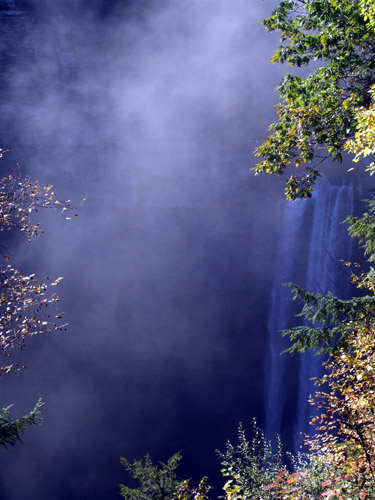
Imperfection, even shabbiness, is far more attractive to me than some idealized view of nature. On a trip to upstate New York last week, I took a number of pictures of the spectacular Taughannock Falls, but the only one that struck me as worth saving (and I still don’t think it’s all that great) features the mist rather than the waterfall.

The trouble is simply that I’ve seen too many photos of waterfalls, too many depictions of hillsides blazing with autumn colors. It becomes very, very difficult to escape the gravitational pull of the clichéd shot and see these kinds of scenes anew. The particularity of the scene becomes lost in translation into our ready-made vocabularies of perception.

French Interior

Yesterday morning, I was led to ponder the process of translating visual art into tactile experience by an exhibit on the interpretation of art for the blind at Pattee Library, University Park, Penn State. (In addition to being Breast Cancer Awareness Month, October is also Art Beyond Sight Awareness Month.)

Queen Mother Head 1

Each of a number of famous works of art was reproduced and described in the manner of this bronze head from Benin: a full-color reproduction at the top, paired with a description for the sighted, then below it, a black-and-white reproduction, giving a sense of what is lost when colors are translated into contrasting textures in the adjacent tactile version — durable paper “printed” with varying kinds of embossed surfaces. A detailed interpretive description in Braille rounds out the display.

Queen Mother Head 2

For works of sculpture, I can’t help thinking that direct contact with the object itself would be far simpler (aside from the obvious fact that the sculpture in question may be located in Lagos). I wonder if there are any art museums that allow people with sight loss to handle more durable pieces of sculpture?

In any case, the “look but don’t touch” mentality of art museums really gets to me sometimes. It is perhaps an inescapable necessity for the public display of artworks that they be placed behind velvet ropes, but with this comes a strong sense that art is something apart from ordinary life. The work of art, we in the West have been led to believe, is as changeless and immortal as a Platonic form. This is of course pure fantasy, enabled in part by the ability of the sighted to gather information at a distance and to preserve it in a static form (as opposed to a sound recording, which cannot be divorced from the time required to listen to it). Those who rely on touch, taste, smell and hearing for their knowledge of the world have no choice but to immerse themselves in the ever-changing flow.

computer room

I wonder if someone blind from birth can even form a conception of the transcendental, predicated as it is upon the possibility of apartness? Does the distinction between objectivity and subjectivity even make sense for such a person? Imagine a world without visual media. Would it be as easy to destroy?
__________

I’m going to West Virginia this weekend. See you on Monday.

[Descriptive title here]

On my way to the bathroom at 2:43 a.m., I paused to jot down some lines that had just popped into my head, carrying my pocket notebook over to the kitchen counter so I could write by the nightlight’s light.

Denied membership
in the exclusive club
of the deceased,

I wrote, then went on in to the bathroom and emptied my bladder. I tried to remember what sort of dream had prompted this, with only partial success. Some anxiety-ridden storyline involving a distant, vaguely threatening government or deity, I think. The usual baseless paranoia. But I think the lines above were more likely influenced by the blogs I had been reading just before bed, which contained much discussion of cliques and in-groups. Someday we’ll all be in the Six Foot Under Club, the original Skull and Bones. Living entities need not apply. Everybody’s just dying to get in.

Yesterday I tried to write a poem, but got no further than a few, fragmentary images.

untrimmed toenails clicking against the sidewalk

caress of a knife

songbirds in August
half-bare from the molt

barn cat in the rain, skinny enough
to fit between the drops

Today, again, I won’t have time to write anything substantial. So if anyone else would like to try and write a poem in my stead, using one or more of the fragments above, feel free.

Another fun activity, if you are a blogger, might be to read this list of rules for good blogging, and see how many you regularly violate. Of the nine rules given, I am usually in violation of at least seven, and unapologetically so. It’s a good list for certain kinds of bloggers, I think, and reflects careful attention to a certain kind of audience. But if you’re not fluent in English; if you’re in too much of a goddamn hurry to focus on the language, and need to be repeatedly snagged with bulleted lists and blockquotes; if you like to be hit over the head with the main point several times in the course of a brief post; or if you crave descriptive titles and precise notification of every change in a post following its original publication, then sorry, this blog’s not for you. If I learned one thing from my mother, it’s this: never pander to your readers. Someone should draw up an alternative list for literary bloggers.

*

[UPDATE (4:40 p.m.)]

Diet Plan

Denied membership
in the exclusive club
of the deceased, I resolve
to do away with wings,
keeping only the wingbones,
like a songbird in August
half-naked from the molt.
Ditto with hams & hambones,
which are only fit for split
pea soup. Human beings
are the other white meat;
pork is a poor substitute.
I resolve to give up bread
& salt & the speaking of truth
or its reasonable facsimiles.
Too many calories. Bad
for the blood pressure.
I’m through with all caresses,
except for the caress of the knife,
which is so good at making
a mouth that can’t talk back.
I’m swearing off history
with its urgent ticking, like
untrimmed toenails clicking
against the sidewalk. I want
to live in the perpetual present
otherwise known as wartime,
so I need to get lean & mean
as the old barn cat trotting
up the gravel driveway
in the rain, skinny enough
to fit between the drops
of God’s own ordnance.

Bystander

“Have you met each other before?”

“No, I don’t think we have,” I lie, seeing the lack of recognition in the other person’s eyes. Why risk embarrassing them by telling the truth?

This happens twice in one evening. It’s a relief, really, to find myself so forgettable.

But when I try to breeze past the chancellor, assuming more of the same, she interrupts her conversation to hail me.

And of course I find that a bit unsettling.

Another awkward moment comes when I am introduced for the second time to someone I have nothing to say to. That’s my fault, not hers: she is given no information about me other than my name, whereas I know one small thing about her, so clearly the onus is on me to initiate a conversation with some pleasant inquiry about her work. Nothing but sheer indolence prevents me from doing so.

But don’t get the wrong impression: I had a lovely evening. Really. The food at the reception was good, the speech beforehand was a tour de force, and it was pleasant to stand around on the periphery of one or more conversations, munching on sweets and basking in the second-hand glow of camaraderie and wit. Earlier in the day, I had been feeling sad for some reason, but the speech was so good and so funny, it put me in a completely different frame of mind.

I noticed one other person not saying much, but she looked awkward about it and left as soon as she could. Which is a pity, really — I could have gone over and talked to her. We’ve known each other for at least two decades. No introduction would have been necessary.

October in Pittsburgh

Dangerous ginkgo 2

At the Point State Park in Pittsburgh, where British soldiers at Fort Pitt once repulsed hordes of Indians and Frenchmen, a ginkgo tree is fiercely posted with warnings about its felonious fruit. Or rather, its naked seeds.

Ginkgo is a gymnosperm (as opposed to an angiosperm), meaning “naked seed”; its seeds are not protected by an ovary wall and hence, the berry-like structures produced by female ginkgo trees are technically not fruit. […]
Its outer layer (the sarcotesta) is light yellow-brown, soft, and fruit-like. It is plum-like and attractive, but the seedcoat contains butanoic acid and smells like rancid butter (which contains the same chemical) when fallen on the ground. Beneath the sarcotesta is the hard sclerotesta and a papery endotesta and nucellus.

You have to admire a plant with that many testes.

Dangerous ginkgo 3

The Daughters of the American Revolution, who operate the adjacent Blockhouse — sole survivor from the days of the fort and the oldest building in all of Western Pennsylvania — want to make very sure we know just what kind of enemy we’re up against here. Even if they can’t remember how to spell its name.

Inside the bunkhouse, I was charmed by an authentic reproduction of a peace tomahawk. This was a deeply symbolic weapon with dual functions: opposite the sharp blade was a metal pipe bowl, from which one could smoke through the drilled-out handle. Apparently, the order of business was: 1) hack/dismember enemies; 2) following successful negotiation of a cease-fire, clean off blood, load up the bowl with primo weed and pass it around; 3) bury hatchet in the ground to symbolize repudiation of hacking/dismembering and commitment to peace treaty; 4) upon breaking of treaty by whites, disinter tomahawk and repeat.

funicular

October is a nice month to visit Pittsburgh — kind of like April in Paris, minus (as previously mentioned) the French. Tourists like to go up and down a very steep and absurdly short railroad line to nowhere, poetically referred to as the Inclined Plane, to gape at the slowly turning fall foliage. Locals just like to gape at the brightly colored funicular cars gliding silently up and down the tracks, a source of great, if somewhat inexplicable, local pride. Best of all, though, are the newspaper boxes, like autumn all year long.

newspaper boxes

I was unaware of the fact that October is Breast Cancer Awareness Month. The aforementioned Point State Park marks the occasion by turning the fountain pink. The shape of the fountain remains resolutely phallic, however. And there’s no signage to enlighten the perennially clueless, like myself. Where are the Daughters of the American Revolution when you need them?

Point Park fountain 1

The color is achieved not with Pepto Bismal, as it might appear, but with fifteen gallons of environmentally safe dye, according to a newspaper article from last year that I found on the web after I got home. As public art goes, this is didactic in the extreme — it’s no Christo installation. Still, many Pittsburghers seem to enjoy the aesthetic effect.

Erin Coen, 19, of the North Side, maybe liked it the most. She wore a pink Hello Kitty backpack, shoelaces interwoven with pink strands, and sported red hair. “I used to have pink hair,” Coen said. She took photos of the fountain, hoping something thrilling would happen. “I was hoping kids would go crazy and begin jumping in it,” Coen said.

Point Park fountain 2

The Point in question, by the way, is a little, pubic-shaped triangle of open space between the Allegheny and Monongahela Rivers, right where they merge to form the Ohio — hence its strategic importance back in the day when global superpowers battled for control of the beaver trade. Being, as I said, unaware of the significance of the color of the water, my best guess was that the dye was meant to symbolize the blood of Indians and Frenchmen and/or the vanquished foes of the Steelers, whose home stadium is right across the river. Some sort of Columbus Day commemoration, I figured. Yeah, I know, it sounds kind of wacky, but in Pittsburgh — as in Paris — almost anything seems possible. Dude, pass the tomahawk!