Along the Ecliptic

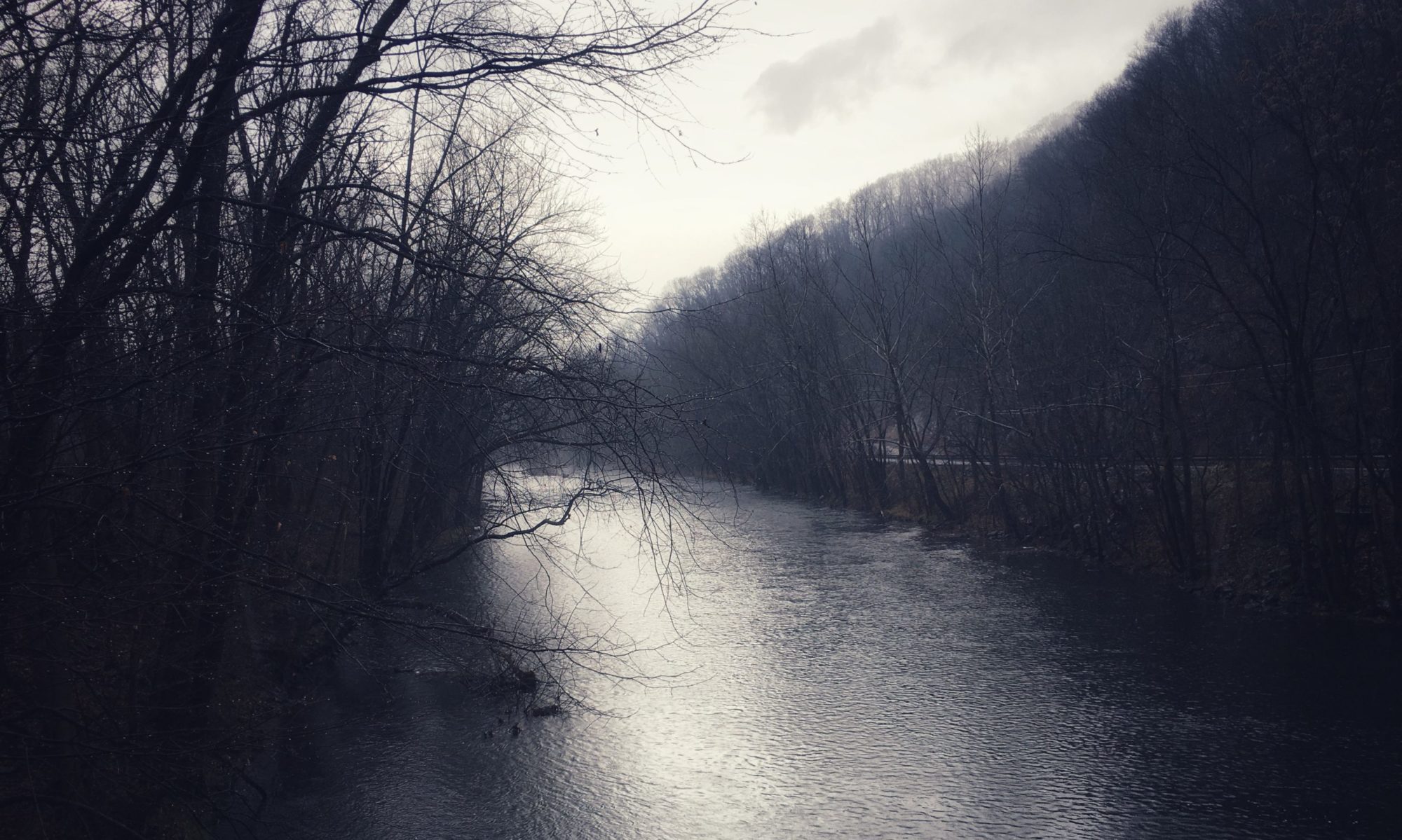
river in November light between bare woods and mountain
There are stories that read like a straight
line: A to B to C to The End; and others

in which either everything happens or nothing
happens, meaning epiphany is elusive or we

are stubborn— we insist that significance
is the only way we could justify existence.

Tonight is the night of a large planetary
parade, the evening alignment of six planets

along the ecliptic. It's tempting to think
this is magical or ominous or fortuitous,

but science merely says these events can happen
every hundred years or so. A neighbor who never

smoked a day in her life dies from lung cancer,
and a wife-beater winds up mayor of his town.

What is the plot in such stories and where
does the tension come to a head? Does it ever

resolve? In myths we're trained to anticipate
how irresolvable dilemmas are turned into

figures on the landscape or in the sky—
A girl in danger turns into a tree, another

becomes the orb-webber who will eternally
hang by her own thread. Certain gods, if you

believe in them, uphold their idea of order
in the cosmos. Who do you pray to at night?


In time

Sam Pepys and me

To the finishing of the Treasurer’s accounts this morning, and then to dinner again, and were merry as yesterday, and so home, and then to the office till night, and then home to write letters, and to practise my composition of musique, and then to bed. We have heard nothing yet how far the fleet hath got toward Portugall, but the wind being changed again, we fear they are stopped, and may be beat back again to the coast of Ireland.

to count is to practice
composition of music

we hear the wind change
back into fire


Erasure poem derived from The Diary of Samuel Pepys, Tuesday 21 January 1661/62.

Monday

river in November light between bare woods and mountain
(MLK Day 2025)

The days have been dark, and I
don't know what else to do to lift
that kind of darkness. So I was going
to mail a care package to my daughter.
Little things— a box of tea, two
sweet buns and snacks from the Filipino
bakery. I forgot the post office
is closed, and the UPS store; children
aren't in school; federal workers have
a day off. It's freezing cold again:
we leave the hot water tap on as a thin
drizzle. All morning, I have felt
the sort of heaviness that sometimes
remains, even after a long bout
of crying. I listen to a livestream
where the panelists speak of ways
we might lift each other up when we
feel like that. One of them says,
hard as it seems, we must laugh
together, even be silly. Feed each
other, come together, hold
each other up. We can still burn
bright as the burning hills. We
can burn even brighter.

Poetry Blog Digest 2025, Week 3

Poetry Blogging Network

A personal selection of posts from the Poetry Blogging Network and beyond. Although I tend to quote my favorite bits, please do click through and read the whole posts. You can also browse the blog digest archive at Via Negativa or, if you’d like it in your inbox, subscribe on Substack (where the posts might be truncated by some email providers).

This week: Grand Theft Hamlet, a fountain dying of thirst, smeuses, the Poet Laureate of Pajamas, and more. Enjoy.

Continue reading “Poetry Blog Digest 2025, Week 3”

Getting to the bottom of it

Sam Pepys and me

This morning Sir Wm. Batten and Pen and I did begin the examining the Treasurer’s accounts, the first time ever he had passed in the office, which is very long, and we were all at it till noon, and then to dinner, he providing a fine dinner for us, and we eat it at Sir W. Batten’s, where we were very merry, there being at table the Treasurer and we three, Mr. Wayth, Ferrer, Smith, Turner, and Mr. Morrice, the wine cooper, who this day did divide the two butts, which we four did send for, of sherry from Cales, and mine was put into a hogshead, and the vessel filled up with four gallons of Malaga wine, but what it will stand us in I know not: but it is the first great quantity of wine that I ever bought. And after dinner to the office all the afternoon till late at night, and then home, where my aunt and uncle Wight and Mrs. Anne Wight came to play at cards (at gleek which she taught me and my wife last week) and so to supper, and then to cards and so good night. Then I to my practice of musique and then at 12 o’clock to bed.
This day the workmen began to make me a sellar door out of the back yard, which will much please me.

examining the unreal
at a fine dinner for four

as hogs make a cellar
out of the yard


Erasure poem derived from The Diary of Samuel Pepys, Monday 20 January 1661/62.

Finders, keepers

Sam Pepys and me

(Lord’s day). To church in the morning, where Mr. Mills preached upon Christ’s being offered up for our sins, and there proving the equity with what justice God would lay our sins upon his Son, he did make such a sermon (among other things pleading, from God’s universal sovereignty over all his creatures, the power he has of commanding what he would of his Son by the same rule as that he might have made us all, and the whole world from the beginning to have been in hell, arguing from the power the potter has over his clay), that I could have wished he had let it alone; and speaking again, the Father is now so satisfied by our security for our debt, that we might say at the last day as many of us as have interest in Christ’s death: Lord, we owe thee nothing, our debt is paid. We are not beholden to thee for anything, for thy debt is paid to thee to the full; which methinks were very bold words.
Home to dinner, and then my wife and I on foot to see Mrs. Turner, who continues still sick, and thence into the Old Bayly by appointment to speak with Mrs. Norbury who lies at (it falls out) next door to my uncle Fenner’s; but as God would have it, we having no desire to be seen by his people, he having lately married a midwife that is old and ugly, and that hath already brought home to him a daughter and three children, we were let in at a back door. And here she offered me the refusall of some lands of her at Brampton, if I have a mind to buy, which I answered her I was not at present provided to do. She took occasion to talk of her sister Wight’s making much of the Wights, who for namesake only my uncle do shew great kindness to, so I fear may do us that are nearer to him a great deal of wrong, if he should die without children, which I am sorry for. Thence to my uncle Wight’s, and there we supped and were merry, though my uncle hath lately lost 200 or 300 at sea, and I am troubled to hear that the Turks do take more and more of our ships in the Straights, and that our merchants here in London do daily break, and are still likely to do so.
So home, and I put in at Sir W. Batten’s, where Major Holmes was, and in our discourse and drinking I did give Sir J. Mennes’ health, which he swore he would not pledge, and called him knave and coward (upon the business of Holmes with the Swedish ship lately), which we all and I particularly did desire him to forbear, he being of our fraternity, which he took in great dudgeon, and I was vexed to hear him persist in calling him so, though I believe it to be true, but however he is to blame and I am troubled at it. So home and to prayers, and to bed.

each creature has
the whole world to hold

bold words
continue to lie

next door to God
is a midwife without children

and we lost at sea take more
and more to be true


Erasure poem derived from The Diary of Samuel Pepys, Sunday 19 January 1661/62.
Intergenerational

river in November light between bare woods and mountain
trauma decants from one

vessel to another. Imagine a long
line of flasks ranged across a dusty

sill. Who set down the first piece? Who
took it up and tipped the liquid into

the mouth of another? Every pour tries
to manage its load of amber without

disturbing the sediments at the bottom;
they ripple upward anyway, murky with promise

and repetition, swollen with char. We can't seem
to float free. Though we could change the water

and feed it lavender and rosemary, each seems
as dear as a child we're unwilling to orphan.

Reader

Sam Pepys and me

This morning I went to Dr. Williams, and there he told me how T. Trice had spoke to him about getting me to meet that our difference might be made up between us by ourselves, which I am glad of, and have appointed Monday next to be the day. Thence to the Wardrobe, and there hearing it would be late before they went to dinner, I went and spent some time in Paul’s Churchyard among some books, and then returned thither, and there dined with my Lady and Sir H. Wright and his lady, all glad of yesterday’s mistake, and after dinner to the office, and then home and wrote letters by the post to my father, and by and by comes Mr. Moore to give me an account how Mr. Montagu was gone away of a sudden with the fleet, in such haste that he hath left behind some servants, and many things of consequence; and among others, my Lord’s commission for Embassador. Whereupon he and I took coach, and to White Hall to my Lord’s lodgings, to have spoke with Mr. Ralph Montagu, his brother (and here we staid talking with Sarah and the old man); but by and by hearing that he was in Covent Garden, we went thither: and at my Lady Harvy’s, his sister, I spoke with him, and he tells me that the commission is not left behind. And so I went thence by the same coach (setting down Mr. Moore) home, and after having wrote a letter to my Lord at 12 o’clock at night by post I went to bed.

getting to meet
our made-up selves

we spent time among books
turned into many things

and I have stayed in that garden
left behind by the clock


Erasure poem derived from The Diary of Samuel Pepys, Saturday 18 January 1661/62.

Self-Portrait with Lunar Reflection

river in November light between bare woods and mountain
There are days that feel like over-
ripe fruit: bruised, sitting
sadly in the bowl after having been
handled then returned, or
peeled after hesitation only to be
discarded. I want them
to simply be the way they should— skins
mostly unblemished, gently rounded,
with only a hint of acid or
bitterness should they still
be green but torn open before
their time. There are days
that feel heavy on my palms, as if
something hardened their sweetness
into a pit at their core; and I must find
the right instrument to extricate
its heart before it darkens. Night falls;
leaves rustle. I hear insects
begin to tune their instruments and want
something to break open all
that's stony; I want to call out
and know it will be answered— whether
by owl or foghorn or animals lowing in
the fields, just as the lake's
surface reflects the moon's face
as it looks upon it, upon me.

Unnatural disaster

Sam Pepys and me

To Westminster with Mr. Moore, and there, after several walks up and down to hear news, I met with Lany, the Frenchman, who told me that he had a letter from France last night, that tells him that my Lord Hinchingbroke is dead, and that he did die yesterday was se’nnight, which do surprise me exceedingly (though we know that he hath been sick these two months), so I hardly ever was in my life; but being fearfull that my Lady should come to hear it too suddenly, he and I went up to my Lord Crew’s, and there I dined with him, and after dinner we told him, and the whole family is much disturbed by it: so we consulted what to do to tell my Lady of it; and at last we thought of my going first to Mr. George Montagu’s to hear whether he had any news of it, which I did, and there found all his house in great heaviness for the death of his son, Mr. George Montagu, who did go with our young gentlemen into France, and that they hear nothing at all of our young Lord; so believing that thence comes the mistake, I returned to my Lord Crew (in my way in the Piazza seeing a house on fire, and all the streets full of people to quench it), and told them of it, which they are much glad of, and conclude, and so I hope, that my Lord is well; and so I went to my Lady Sandwich, and told her all, and after much talk I parted thence with my wife, who had been there all the day, and so home to my musique, and then to bed.

the news broke me
hard as my life is

its great heaviness
and nothing of you

my house on fire
and all the streets of sand


Erasure poem derived from The Diary of Samuel Pepys, Friday 17 January 1661/62.