Vigilant

Sam Pepys and me

Waked this morning with news, brought me by a messenger on purpose, that my uncle Robert is dead, and died yesterday; so I rose sorry in some respect, glad in my expectations in another respect. So I made myself ready, went and told my uncle Wight, my Lady, and some others thereof, and bought me a pair of boots in St. Martin’s, and got myself ready, and then to the Post House and set out about eleven and twelve o’clock, taking the messenger with me that came to me, and so we rode and got well by nine o’clock to Brampton, where I found my father well. My uncle’s corps in a coffin standing upon joynt-stools in the chimney in the hall; but it begun to smell, and so I caused it to be set forth in the yard all night, and watched by two men. My aunt I found in bed in a most nasty ugly pickle, made me sick to see it. My father and I lay together tonight, I greedy to see the will, but did not ask to see it till to-morrow.

I died in my boots
me and my corpse

in a coffin watched by two men
greedy to see tomorrow


Erasure poem derived from The Diary of Samuel Pepys, Saturday 6 July 1661.

Houses

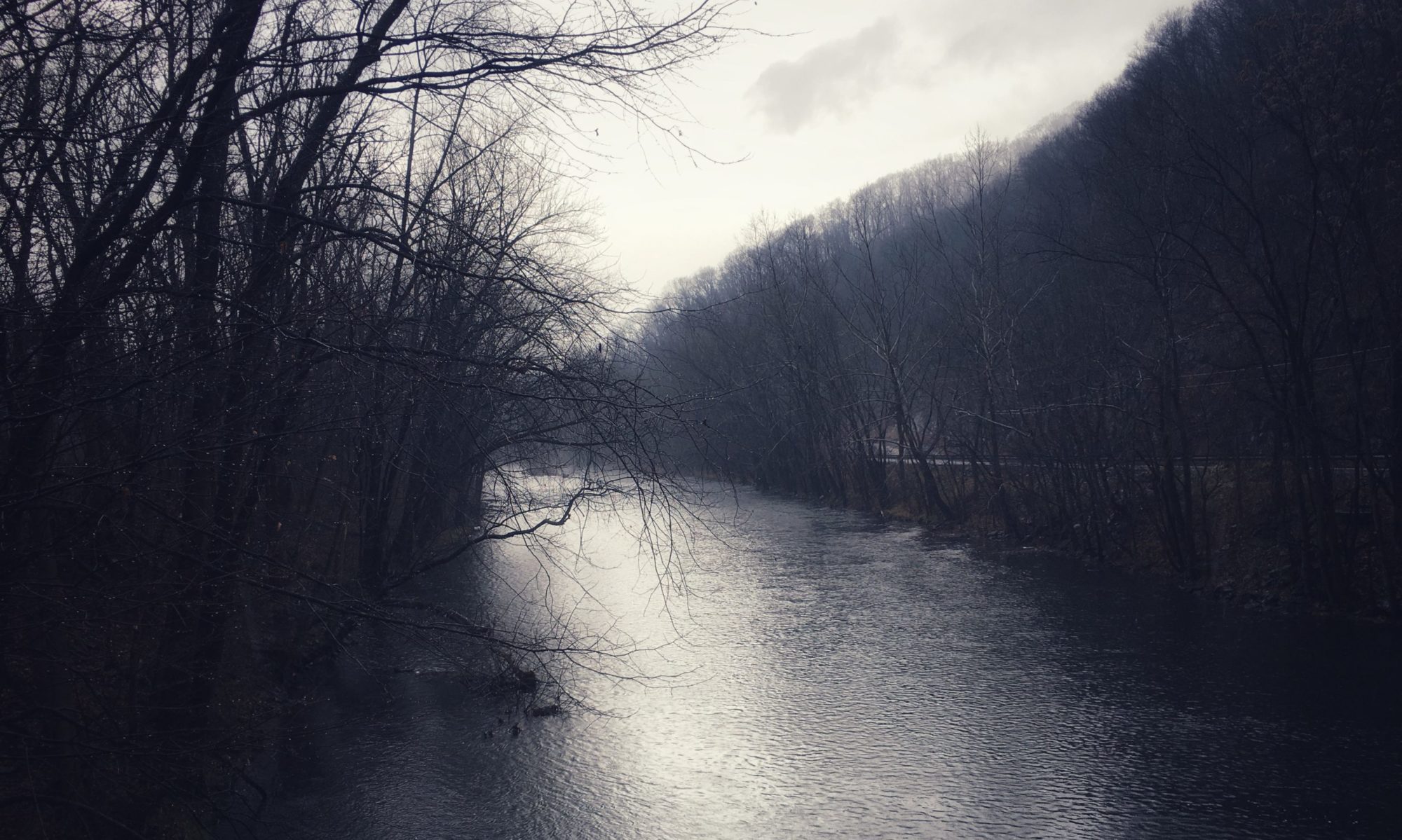
river in November light between bare woods and mountain
Some houses are a universe of breakable,
brightly colored glass. Others like to give off

an air of solidity: armchairs with massive backs,
table legs carved out of uncut pieces of wood.

The heavier, the better: none of that slap-it-together-
from-a-how-to-sheet nonsense. Like others, we've

filled ours with the collectibles of a lifetime—
mugs from every vacation, sweatshirts with school

logos; but also, stoneware plates and bowls, woven
blankets that smell of sleepy towns in the north.

Pictures of our living and our dead—how does anyone
find it easy to throw away a letter written in cursive,

though the paper has long yellowed? When the house
goes to sleep, we will also have gone to sleep.

Hatted

Sam Pepys and me

At home, and in the afternoon to the office, and that being done all went to Sir W. Batten’s and there had a venison pasty, and were very merry. At night home and to bed.

in the noon of a hat
we had a past

we err at night


Erasure poem derived from The Diary of Samuel Pepys, Friday 5 July 1661.

Audacity is a Kind of Hope

river in November light between bare woods and mountain
The days are getting hotter and the rains 
are falling harder somewhere else. In the yard,

the grass still grows rampant, not knowing
anything about crowds crushed to death

in a stampede, or newborns suffocating in blow-
torch heat. What can one do now, given it's

impossible to look too far ahead into a future?
And yet we plan on making a trip to celebrate

a wedding, to visit the park with a giant silver bean
and water fountains. We make plans for dinner

and a show, a visit to the museum to look up
at a fossil's 67-million-year old bones. Whatever

you call it, that spirit rolls up its brightest clothes into
the luggage, leaving a bit of room for the unknown.

Public Servant

This entry is part 33 of 51 in the series Une Semaine de Bonté

Page 33 of Max Ernst’s Une Semaine de Bonté

As if all the night’s eyes had flown open at once and were trained on me—and who can say they aren’t? Given that I am suddenly unable to move, some paranoia may be justified. But those dull throbs must be my beloved’s heartbeat. That’s the cat purring at our feet. It’s all just a nightmare, not some untimely end for the head of a regime. I expect to wake up at any moment.

Operatic

Sam Pepys and me

At home all the morning; in the afternoon I went to the Theatre, and there I saw “Claracilla” (the first time I ever saw it), well acted. But strange to see this house, that used to be so thronged, now empty since the Opera begun; and so will continue for a while, I believe. Called at my father’s, and there I heard that my uncle Robert continues to have his fits of stupefaction every day for 10 or 12 hours together.
From thence to the Exchange at night, and then went with my uncle Wight to the Mitre and were merry, but he takes it very ill that my father would go out of town to Brampton on this occasion and would not tell him of it, which I endeavoured to remove but could not.
Here Mr. Batersby the apothecary was, who told me that if my uncle had the emerods (which I think he had) and that now they are stopped, he will lay his life that bleeding behind by leeches will cure him, but I am resolved not to meddle in it.
Home and to bed.

empty since the opera
a tin ear of stupefaction

I endeavor to move but
who told me that bleeding will cure

I am resolved
to meddle


Erasure poem derived from The Diary of Samuel Pepys, Thursday 4 July 1661.

On Longing

river in November light between bare woods and mountain
If growing old is a growing 
into a less fraught relationship with the world,

I don't feel it—not yet. Will we still be here
to witness that arc of the universe as it bends

only toward light, as it props up every crumbling
wall with a trellis of jasmine flowers, the kind

that always stop me in my tracks with their heady
scent when I'm walking down the street near

a café whose name, in Latin, means It's all my fault
or I am to blame? I wish taking public responsibility

for a wrongdoing were as easy as saying I'd like one
iced pistachio rose latte with oatmilk to go. I wish we

could follow the arc of our own longings and know where
they'll come to rest in a just universe, in this lifetime.

Dear Human at the Edge of Time & Caulbearer

river in November light between bare woods and mountain

A couple of days ago, chatting briefly on Messenger, Dave wondered why I’d not posted anything about my forthcoming book Caulbearer . . . or even about the anthology which I was lead editor for, along with Aileen Cassinetto and Jeremy S. Hoffman— Dear Human at the Edge of Time: Poems on Climate Change in the U.S., Paloma Press, 2023. The Foreword was written by the wonderful Claire Wahmanholm, and the Afterword by Dr. Sam Illingworth, Associate Professor at Edinburgh Napier University in the UK (whose work and research have long focused on science communication through poetry and games).

I guess it felt a little awkward to be tooting my own horn. But it’s exciting to see how warm the reactions have been to our anthology, and how this little book keeps rolling along and finding more and more audiences. Joe Biden sent a congratulatory letter; the book even won the Best Poetry Anthology Award at the 2023 American Book Festival. We were invited to participate in the AGU (American Geophysical Union) December conference in the Bay area; and in April, the Science Creativity and Climate Futures Conference (UC Berkeley) built a conference day around Dear Human. PoetsForScience, Traveling Stanzas and David Hassler at Kent State University’s Wick Poetry Center helped us launch an interactive microsite where anyone can contribute to the ongoing “Community Poem” in response to the Fifth National Climate Assessment Papers (NCA5).

In less than two weeks, we’ll be making a call for submissions to a brand new anthology project—I’ll be sure to post a call here too!

In the meantime, I’m so pleased to let you know that the pre-order link for my newest book Caulbearer is LIVE! (There’s even a Study/Discussion Guide that you can click on and download, which my daughter Gabriela helped to create.)

Recipient of the 2023 Immigrant Series prize, Caulbearer will be released from Black Lawrence Press in August 2024.

It would mean the world to me and my publisher if you pre-order the book now, instead of waiting until August (pre-orders will be accepted until midnight of July 30, 2024).

To end all wars

Sam Pepys and me

To Westminster to Mr. Edward Montagu about business of my Lord’s, and so to the Wardrobe, and there dined with my Lady, who is in some mourning for her brother, Mr. Saml. Crew, who died yesterday of the spotted fever. So home through Duck Lane to inquire for some Spanish books, but found none that pleased me. So to the office, and that being done to Sir W. Batten’s with the Comptroller, where we sat late talking and disputing with Mr. Mills the parson of our parish. This day my Lady Batten and my wife were at the burial of a daughter of Sir John Lawson’s, and had rings for themselves and their husbands. Home and to bed.

the war died of fever
a Spanish one

we sat late disputing
at the burial


Erasure poem derived from The Diary of Samuel Pepys, Wednesday 3 July 1661.

Biofeedback

This entry is part 32 of 51 in the series Une Semaine de Bonté

Page 32 of Max Ernst’s Une Semaine de Bonté

Perhaps I have meditation
all wrong, and it isn’t about
finding the off switch. The way

trees swaying in the wind
stay so firmly seated makes me
think I too need to delegate

all decision-making to mushrooms.
Collecting sunlight could be
my whole vocation; never mind

the masked vigilantes running riot
in my imagination. Not every trip
unfolds according to plan. But

I have acquired an apparatus
dearer to me than any pet
with which to concentrate the mind.

So sleek a device—plastic married
to metal. If only I could remember
how to turn it on.