Custodial

Sam Pepys and me

This day I went to my Lord, and about many other things at Whitehall, and there made even my accounts with Mr. Shepley at my Lord’s, and then with him and Mr. Moore and John Bowles to the Rhenish wine house, and there came Jonas Moore, the mathematician, to us, and there he did by discourse make us fully believe that England and France were once the same continent, by very good arguments, and spoke very many things, not so much to prove the Scripture false as that the time therein is not well computed nor understood. From thence home by water, and there shift ed myself into my black silk suit (the first day I have put it on this year), and so to my Lord Mayor’s by coach, with a great deal of honourable company, and great entertainment.
At table I had very good discourse with Mr. Ashmole, wherein he did assure me that frogs and many insects do often fall from the sky, ready formed.
Dr. Bates’s singularity in not rising up nor drinking the King’s nor other healths at the table was very much observed.
From thence we all took coach, and to our office, and there sat till it was late.
And so I home and to bed by day-light. This day was kept a holy-day through the town; and it pleased me to see the little boys walk up and down in procession with their broom–staffs in their hands, as I had myself long ago gone.

the Lord and I were once
the same continent

where frogs and insects
often fall from the sky

ready for our holy
procession with brooms


Erasure poem derived from The Diary of Samuel Pepys, Thursday 23 May 1661.

Donnybrook

Sam Pepys and me

To Westminster, and there missed of my Lord, and so about noon I and W. Howe by water to the Wardrobe, where my Lord and all the officers of the Wardrobe dined, and several other friends of my Lord, at a venison pasty. Before dinner, my Lady Wright and my Lady Jem. sang songs to the harpsicon.
Very pleasant and merry at dinner. And then I went away by water to the office, and there staid till it was late. At night before I went to bed the barber came to trim me and wash me, and so to bed, in order to my being clean to-morrow.

war where the soft
end in a song

water to ice
night to ash
order to a row


Erasure poem derived from The Diary of Samuel Pepys, Wednesday 22 May 1661.

Waterman

Sam Pepys and me

Up early, and, with Sir R. Slingsby (and Major Waters the deaf gentleman, his friend, for company’s sake) to the Victualling-office (the first time that I ever knew where it was), and there staid while he read a commission for enquiry into some of the King’s lands and houses thereabouts, that are given his brother. And then we took boat to Woolwich, where we staid and gave order for the fitting out of some more ships presently. And then to Deptford, where we staid and did the same; and so took barge again, and were overtaken by the King in his barge, he having been down the river with his yacht this day for pleasure to try it; and, as I hear, Commissioner Pett’s do prove better than the Dutch one, and that that his brother built.
While we were upon the water, one of the greatest showers of rain fell that ever I saw.
The Comptroller and I landed with our barge at the Temple, and from thence I went to my father’s, and there did give order about some clothes to be made, and did buy a new hat, cost between 20 and 30 shillings, at Mr. Holden’s. So home.

with water for company’s sake
I miss the boat

and taken in a yacht
I miss the water

a shower of rain fell
from my new hat


Erasure poem derived from The Diary of Samuel Pepys, Tuesday 21 May 1661.

Revelation

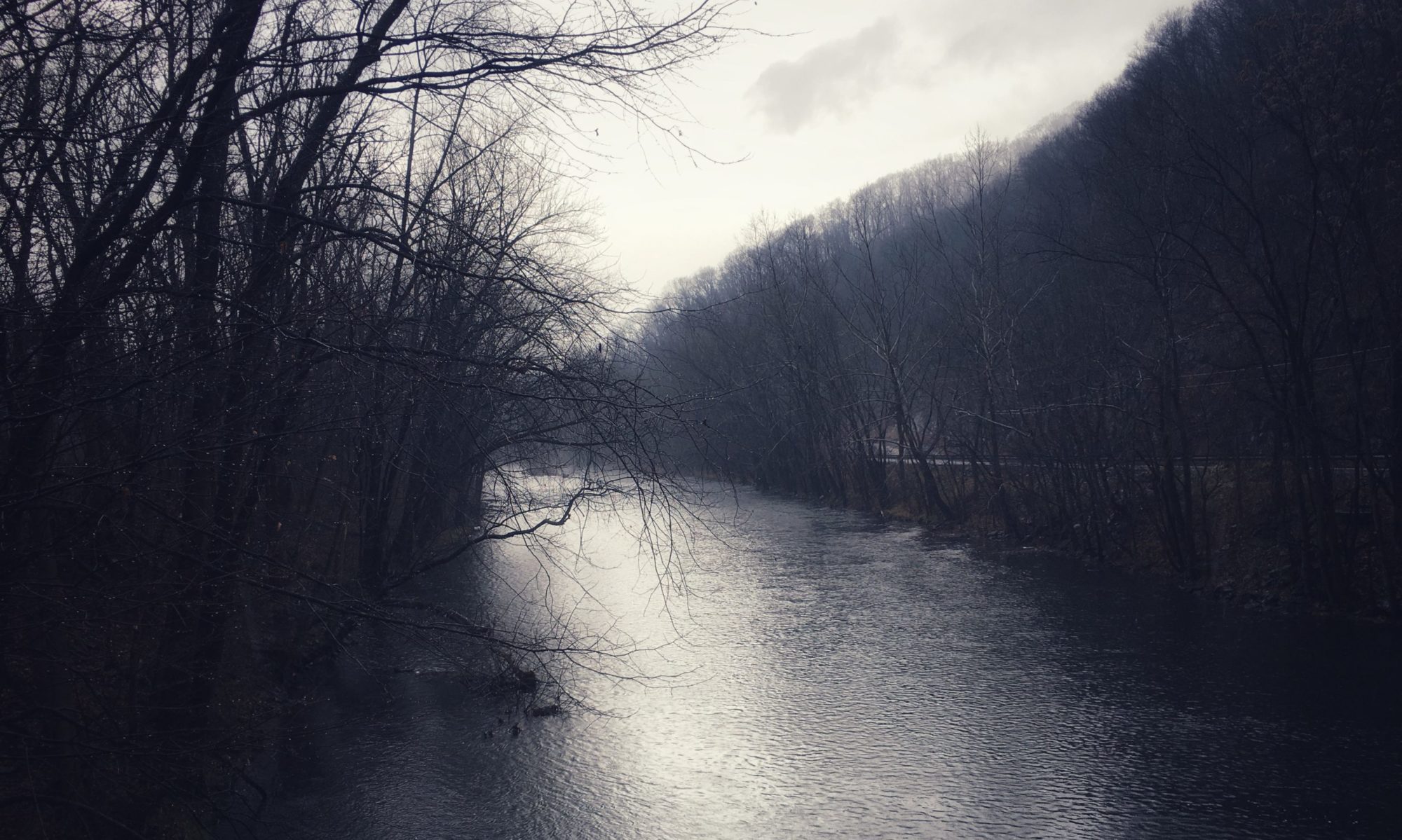
river in November light between bare woods and mountain
Before the lamb leaped 
into the arms of the woman

with seven diadems and orange
groves flowered beneath

the mountains' hems, our hearts
were forged in the fire

that could never be
extinguished. But then

our hearts folded into boats
as the waters rose, and all the fish

in the world recalled the bones
they'd once given up to fill out

our forms. We've made our own
way since then—trying to keep

the flicker of heat alive,
trying not to surrender to the call

of the owl or the mourning
dove. When we stand

in a shower of rain
or falling leaves, when

we're struck with the gold
of certain days, our hearts

burst from within; our faces,
tongued by the kiss of time.

Poetry Blog Digest 2024, Week 20

Poetry Blogging Network

A personal selection of posts from the Poetry Blogging Network and beyond. Although I tend to quote my favorite bits, please do click through and read the whole posts. You can also browse the blog digest archive at Via Negativa or, if you’d like it in your inbox, subscribe on Substack (where the posts might be truncated by some email providers).

This week: grief’s alphabet, moon menders, insect-poets, a paradise of sentences, and more. I challenged myself to quote just one paragraph from each blog post, and mostly kept to that. I’ll probably return to my usual pattern next week, but it was fun to court brevity for a change!

Continue reading “Poetry Blog Digest 2024, Week 20”

Relics

river in November light between bare woods and mountain


Even the most insignificant detail is a petal
detached from the more florid arrangements

of history. For instance, it’s not a coincidence
that the puffy-faced, butterfly-sleeved widow

of a deceased dictator says, There are two most
important men in my life and both of them are


presidents
. There’s a whole line of women
installed to power by their sons who were

emperors. Mothers, certainly, but also ambitious;
knowledgeable in the poisonous properties of mush-

rooms, the power of relics to inspire processions,
where loyalty and ardor are on lavish display.

In our town, mothers fought for their daughters’
places in the Santacruzan’s entourage of queens—

The most important: Reyna Elena who found
the true cross, mother of Constantine the Great.

The rest of us were First or Second Princesses,
stumbling in long sequinned dresses; or stand-ins

for made up or biblical characters. Reyna Justicia,
Reyna de la Paz, Reyna Esperanza; Reyna Mora, Reyna

Cleopatra. Reyna Judit—red-stained sword aloft in one
hand, the other dangling a doll’s decapitated head by its hair.

Troll

Sam Pepys and me

At home all the morning; paid 50l. to one Mr. Grant for Mr. Barlow, for the last half year, and was visited by Mr. Anderson, my former chamber fellow at Cambridge, with whom I parted at the Hague, but I did not go forth with him, only gave him a morning draft at home.
At noon Mr. Creed came to me, and he and I to the Exchange, and so to an ordinary to dinner, and after dinner to the Mitre, and there sat drinking while it rained very much. Then to the office, where I found Sir Williams both, choosing of masters for the new fleet of ships that is ordered to be set forth, and Pen seeming to be in an ugly humour, not willing to gratify one that I mentioned to be put in, did vex me.
We sat late, and so home. Mr. Moore came to me when I was going to bed, and sat with me a good while talking about my Lord’s business and our own and so good night.

low as my low bridge
I sat drinking
while it rained

choosing to be
in an ugly humor
in my own good night


Erasure poem derived from The Diary of Samuel Pepys, Monday 20 May 1661.

An ill wind

Sam Pepys and me

(Lord’s day) I walked in the morning towards Westminster, and seeing many people at York House, I went down and found them at mass, it being the Spanish ambassodors; and so I go into one of the gallerys, and there heard two masses done, I think, not in so much state as I have seen them heretofore. After that into the garden, and walked a turn or two, but found it not so fine a place as I always took it for by the outside. Thence to my Lord’s and there spake with him about business, and then he went to Whitehall to dinner, and Capt. Ferrers and Mr. Howe and myself to Mr. Wilkinson’s at the Crown, and though he had no meat of his own, yet we happened to find our cook Mr. Robinson there, who had a dinner for himself and some friends, and so he did give us a very fine dinner.
Then to my Lord’s, where we went and sat talking and laughing in the drawing-room a great while. All our talk about their going to sea this voyage, which Capt. Ferrers is in some doubt whether he shall go or no, but swears that he would go, if he were sure never to come back again; and I, giving him some hopes, he grew so mad with joy that he fell a-dancing and leaping like a madman.
Now it fell out so that the balcone windows were open, and he went to the rayle and made an offer to leap over, and asked what if he should leap over there. I told him I would give him 40l. if he did not go to sea. With that thought I shut the doors, and W. Howe hindered him all we could; yet he opened them again, and, with a vault, leaps down into the garden:— the greatest and most desperate frolic that ever I saw in my life. I run to see what was become of him, and we found him crawled upon his knees, but could not rise; so we went down into the garden and dragged him to the bench, where he looked like a dead man, but could not stir; and, though he had broke nothing, yet his pain in his back was such as he could not endure. With this, my Lord (who was in the little new room) come to us in amaze, and bid us carry him up, which, by our strength, we did, and so laid him in East’s bed, by the door; where he lay in great pain. We sent for a doctor and chyrurgeon, but none to be found, till by-and-by by chance comes in Dr. Clerke, who is afeard of him. So we sent to get a lodging for him, and I went up to my Lord, where Captain Cooke, Mr. Gibbons, and others of the King’s musicians were come to present my Lord with some songs and symphonys, which were performed very finely. Which being done I took leave and supped at my father’s, where was my cozen Beck come lately out of the country.
I am troubled to see my father so much decay of a suddain, as he do both in his seeing and hearing, and as much to hear of him how my brother Tom do grow disrespectful to him and my mother.
I took leave and went home, where to prayers (which I have not had in my house a good while), and so to bed.

down in the garden by myself
talking with the wind

what if I could crawl
but could not rise

pain is a new room
great pain is a lodging

the king’s musicians present
a symphony of decay

I hear rot grow
where prayers have not


Erasure poem derived from The Diary of Samuel Pepys, Sunday 19 May 1661.