Mourning Cloak

moss like sadness
hiding old wounds

a mourning cloak butterfly
touches down

accompanied by a hydraulic drill
hammering at the quarry

and the screech of steel
from a passing coal train

the butterfly’s dark wings
edged in white look immaculate

after months secluded under
some loose flap of bark

all systems shut down
cells flooded with antifreeze

now come miraculously back
to green unshaded moss

waiting for the sun to open
her bluest wings
of pure grief

Translations

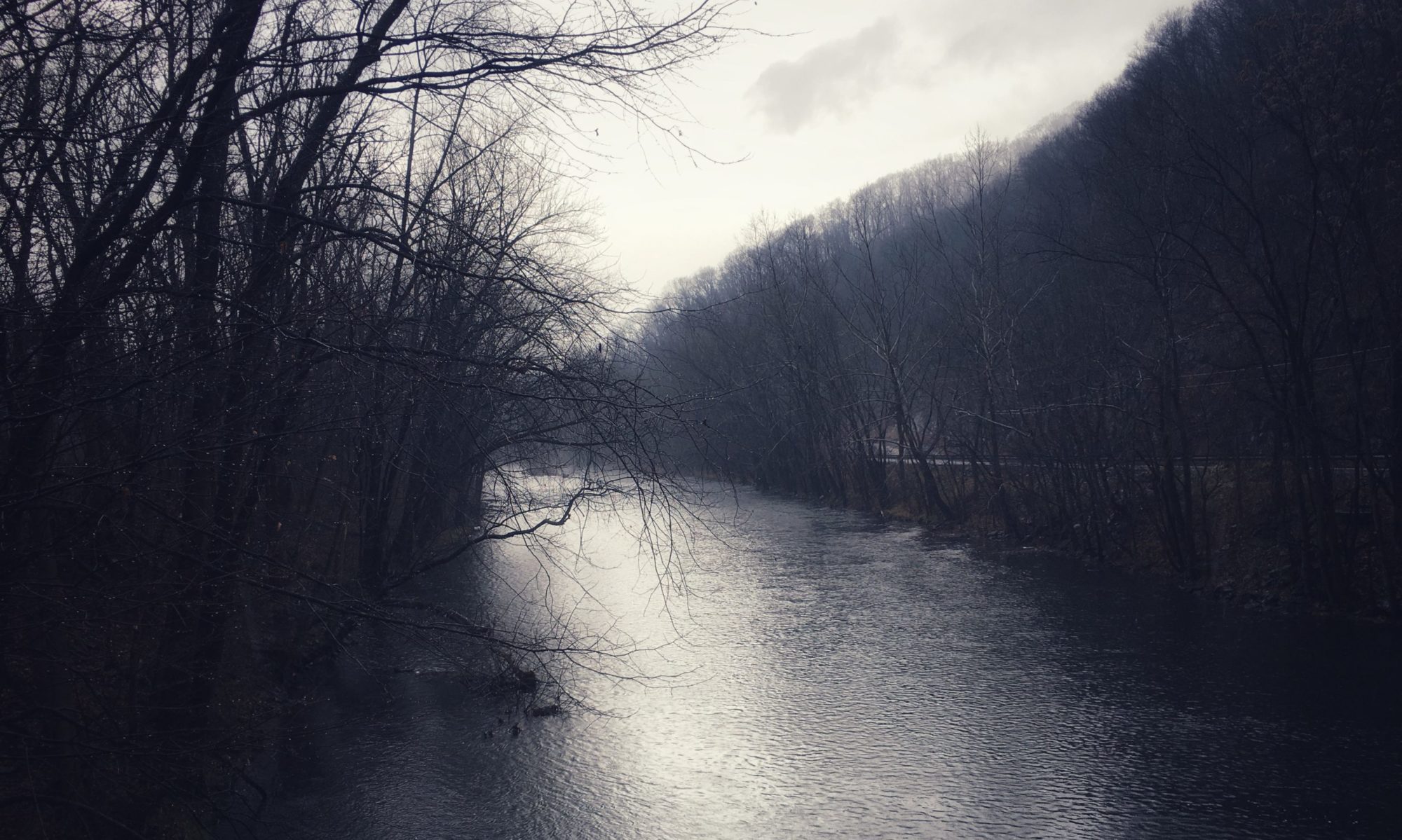
river in November light between bare woods and mountain

"Aanhin ang damo pag patay na ang kabayo?"
(What good is the grass to a horse already dead?)
                                         ~ Filipino proverb

Don't be a goody two-shoes, my father said: ma-
among tupa, head bowed meekly, just following

the herd. And don't be balat sibuyas: skin thin
as an onion, tearing up at the slightest injury. Malayo 

sa bituka, he'd pronounce—as long as the hurt lands far
from the gut, you won't die. Muster up a thick hide—balat

kalabaw.  But remember that nothing comes to those who
don't burn their eyebrows either—magsunog ng kilay, working

hard until dawn. Do you want to succeed, or do you want 
to wind up among those kalapating mababa ang lipad? 

Beware of scammers and sweet-talkers, those with matamis 
na dila. They'll hack their way into your soul and make off 

with everything, including the smallest nail, your cheapest 
piece of furniture. Don't cry. Don't let anyone see you

cry. You make a wrong turn, you get back in 
the saddle. You steer yourself right back again. 

Spokesperson

Sam Pepys and me

This morning Sir Williams both went to Woolwich to sell some old provisions there.
I to Whitehall, and up and down about many businesses. Dined at my Lord’s, then to Mr. Crew to Mr. Moore, and he and I to London to Guildhall to see the seamen paid off, but could not without trouble, and so I took him to the Fleece tavern, where the pretty woman that Luellin lately told me the story of dwells, but I could not see her.
Then towards home and met Spicer, D. Vines, Ruddiard, and a company more of my old acquaintance, and went into a place to drink some ale, and there we staid playing the fool till late, and so I home.
At home met with ill news that my hopes of getting some money for the Charles were spoiled through Mr. Waith’s perverseness, which did so vex me that I could not sleep at night. But I wrote a letter to him to send to-morrow morning for him to take my money for me, and so with good words I thought to coy with him. To bed.

I sell visions
about any sin without
too pretty a story

but I see the war more
my old acquaintance
in drink

playing with ill news
getting the spoil
into good words


Erasure poem derived from The Diary of Samuel Pepys, Thursday 7 March 1660/61.

The End of Suffering

river in November light between bare woods and mountain
In the matter of children—I didn't want
to inflict on mine the kinds of expectations

children of my generation unfailingly got from our
own parents: you will be a doctor, you will be a nurse,

you will be a lawyer or else; you will enter the nunnery 
or become a priest so there will be someone who 

can plead our case in the afterlife. At least one
of mine says she doesn't want to have any children,

given the state of the world. Which is to say, 
the decimation of human and nonhuman life,  

the terrible cruelties and hatreds that daily fly 
through the air— landing as spit on the dusky 

cheek of a woman on a train, falling as a rain 
of bombs on the defenceless sleeping in refugee 

camps. A grandfather kicked in the shins, a woman
thrown to the ground in the street—hate and harm,

harm and hate, their letters almost interchangeable.
A poet told of traveling through the nearly impossible 

dark where a deer lay rigid on a mountain 
road, the unborn fawn still warm inside her. 

Why is the end of suffering promised as a heaven 
no one can see, but that many seem so certain of?

Fog-bound

Sam Pepys and me

At the office all the morning. At dinner Sir W. Batten came and took me and my wife to his house to dinner, my Lady being in the country, where we had a good Lenten dinner.
Then to Whitehall with Captn. Cuttle, and there I did some business with Mr. Coventry, and after that home, thinking to have had Sir W. Batten, &c., to have eat a wigg at my house at night. But my Lady being come home out of the country ill by reason of much rain that has fallen lately, and the waters being very high, we could not, and so I home and to bed.

morning came
in a white wig

a country of rain
fallen late and high


Erasure poem derived from The Diary of Samuel Pepys, Wednesday 6 March 1660/61.

Garter Snake

what i had taken for a path
you knew to be home

your long striped road of a body
coiled in last year’s leaves

poised for whatever the first
day of spring might bring

to a hill scarred and scoured
by centuries of exploitation

i study your legless stance
you gaze off to the north

your tongue flickering
i hold out marshmallow hands

show me how to inhabit
one thought at a time

even if i cannot simply
crawl out of an old skin

i could hone my cravings
till they’re small and sharp

Little Mother

river in November light between bare woods and mountain

I want to know how and when you came to be called
this—for even in the diminutive, it is a burden.

From watching you I learned each day was a race:
fifteen minutes' walk to the market, back at just past

the half hour, on your face the sheen of exertion
but also of pride. Early, rather than late. Fingers flew

over every one of our needs—we were blessed 
with nourishment, buttoned up to our chins, nothing

we could possibly want in addition to what you gave. But
I don't know what secrets you carried, besides me. When I 

look into the camera's eye I tilt my head like you. I smile 
without baring all my teeth. The part in our hair is where 

a brush or a comb moved through this little patch of 
darkness into which we climbed every night for rest.

High time

Sam Pepys and me

With Mr. Pierce, purser, to Westminster Hall, and there met with Captain Cuttance, Lieut. Lambert, and Pierce, surgeon, thinking to have met with the Commissioners of Parliament, but they not sitting, we went to the Swan, where I did give them a barrel of oysters; and so I to my Lady’s and there dined, and had very much talk and pleasant discourse with my Lady, my esteem growing every day higher and higher in her and my Lord.
So to my father Bowyer’s where my wife was, and to the Commissioners of Parliament, and there did take some course about having my Lord’s salary paid tomorrow when the Charles is paid off, but I was troubled to see how high they carry themselves, when in good truth nobody cares for them. So home by coach and my wife. I then to the office, where Sir Williams both and I set about making an estimate of all the officers’ salaries in ordinary in the Navy till 10 o’clock at night.
So home, and I with my head full of thoughts how to get a little present money, I eat a bit of bread and cheese, and so to bed.

we met in a bar
the din and discourse

with my yes growing
higher and higher

my high body off
out of my head


Erasure poem derived from The Diary of Samuel Pepys, Tuesday 5 March 1660/61.
Poetry Blog Digest 2024, Week 9

Poetry Blogging Network

A personal selection of posts from the Poetry Blogging Network and beyond. Although I tend to quote my favorite bits, please do click through and read the whole posts. You can also browse the blog digest archive, subscribe to its RSS feed in your favorite feed reader, or, if you’d like it in your inbox, subscribe on Substack.

This week: the shadows of children, a different kind of faith, ellipses like off-ramps, poets as secret agents, and much more. Enjoy.

Continue reading “Poetry Blog Digest 2024, Week 9”

Letter to La Generala

river in November light between bare woods and mountain
Gabriela, saying your name like this will make
people think I'm writing to my youngest daughter. 

And yes she was named after you, but also after 
my father—himself named after the announcing

angel, the angel of prophecy and visions. As for us,
our visions are no less heraldic, touched by fire and 

the recurring dream of freedom known by whatever 
kind of name. Do angels have to sacrifice, Gabriela? 

When one falls in battle, does another take his place 
the way you moved without hesitation to the helm

of your husband's army after his assassination? 
It was 1762;  the British had just captured Manila.

He had hoped to overthrow the Spanish government 
in Ilocos, replacing it with native leadership. Gabriela, 

townspeople called you La Generala—fiery angel with
sword aloft, astride your horse, leading the charge on 

Vigan. It was not to be. Captured, you and your soldiers hung
like bells in the plaza. Even now, your name is resistance.