Tag Archives: Poetry Reading Month 2011

Whimper

Can’t… read… one… more… book… of… poems…

It doesn’t help that I’m trying to get ready for a two-week trip to the U.K., leaving Sunday. It’s getting very hard to concentrate. Which is a pity, because I still have four lovely books to blog, two of which just arrived in today’s mail. Maybe when I get back.

trout lily

Posted in Poets and poetry | Tagged | 7 Comments

Inside the Money Machine by Minnie Bruce Pratt

Inside the Money Machine coverReading these fierce, true poems about life under capitalism, I wonder why anyone ever thought that politics were incompatible with lyric poetry. Even as she focuses on the physical and psychological costs of hard work for little pay, Pratt makes the writing seem effortless: the poems catch you up in thumbnail portraits or brief narratives and generally don’t let you go without a gasp or sigh.

Two women lean into each other, staggered by catastrophe,
The plant fence out of focus behind them. They hold up
a crumpled paper, like the photo of some beloved lost to murder
or to war, the evidence of what lived a few minutes before:
My job, my other self.
(“Getting a Pink Slip”)

While some of the books I’ve read this month did not adapt themselves well to the book-a-day pace, this one did: not because the poems were always easy to grasp, but because reading them all in one sitting created a powerful gestalt, like the “field full of folk” at the beginning of Piers Plowman. Blue-collar, white-collar, resource extraction, manufacturing, service industry, retirement, unemployment, gamblers, demonstrators, the half-tired and the fully exhausted: it’s all here, the world of trying-to-get-by. Political messages are sometimes overt but rarely didactic, as in the conclusion of a poem that began with a female toll-taker:

…past the docks at sunset along the water, the cranes asleep
for the night, while the climbers, door-unlockers, thumb-
and-finger doers, the people who sat and thought high up
in the glass forehead during the day, have now gone home—

Past the ticket collector in the Turnpike booth, the woman at the end
of her shift, the woman who can raise, who can lower the barricades.
(“Distribution”)

And when there is didacticism, it’s expressed with disarming simplicity, no hint of unearned ideological posturing:

Jobless, I never thought I’d hear
our niagra of sound going up the stairs again, never step,
immersed, into tens of thousands rushing to work. One molecule
in the many, carried along toward the purpose of our day.
It’s never really about the money, except for the guys at the top.
They know how to make money off of us. We know
how to make things with each other. That’s what we do.
(“Standing in the Elevator”)

Whether or not political poetry in general deserves its bad reputation (do we condemn love poetry just because 99 percent of all love poems ever written are dreck?), like many other kinds of poetry it can lead its practitioners into one or two habitual modes of discourse. Inside the Money Machine is much more catholic than that, with room both for an angry denunciation of the Army guy piloting unmanned drones from thousands of miles away (“The New Commuter War”) and for an understated poem of mourning for a temp worker’s inability to put down roots:

A Temporary Job

Leaving again. If I didn’t care, I wouldn’t be
grieving. The particulars of place lodged in me,
like this room I lived in for eleven days,
how I learned the way the sun laid its palm
over the side window in the morning, heavy
light, how I’ll never be held in that hand again.

As I was making my way through the book, my brother sent along an AP story about the nearest small city to us, where he works: “Altoona, PA changes name to Spurlock movie title.”

About 31,000 central Pennsylvanians will soon be living in a joke.

Beginning at 1 p.m. Wednesday, the city of Altoona will change its name to “POM Wonderful Presents: The Greatest Movie Ever Sold,” after the latest film by sarcastic documentarian Morgan Spurlock.

The city is changing its name for 60 days to make some money — and to help Spurlock make a point about the proliferation of advertising in American life.

Altoona isn’t broke, but it can sure use the money, and hey, the name-change is only ceremonial and temporary. What’s a little loss of dignity? We’re all like the sales clerks in “Selling the Brand,” willing to do whatever it takes to remain solvent, even if it means acquiring a new wardrobe, down to the underwear.

I was pleased to see two poems about issues close to my heart: “Tegucigalpa,” about the Honduran coup of 2009, and “Burning Water,” about hydrofracking for natural gas and last year’s oil spill in the Gulf. In the latter, I like how she focused on microorganisms rather than something more charismatic:

We hung our legs into strange bioluminescent foam
flung up by our wake, if we’d scooped the water
up with a glass jar as we did the air for fireflies,
we’d have caught eighty species, galactic diatoms
invisible to the eye, to us just some murky water
from the Gulf, which is licked over today with oil
from the blown-out rig…

Pratt has been around for a while — this is her tenth book — but she doesn’t show any sign of losing her sense of wonder at the nonsensical way we live.

How can it be that we are all going to carry our plastic bags
out the snapping doors, and get in our cars, and leave each other,
drive away to eat in twos or threes or one alone, me in a blue room
with a map of India to study, a novel open next to three sunflowers
in blue plastic bottles on the table…
(“Eating Alone”)

Posted in Books and Music, Poets and poetry | Tagged , | 2 Comments

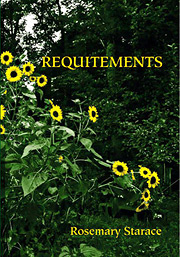
Requitements by Rosemary Starace

Requitements coverI’ve read the poems in this slender volume at least four times in the past eight months and they have yet to lose their affective power for me — which is strange, since I would not seem to be the target audience for a collection about adoption or being an adoptee. Then again, I’ve been listening to blues music for 25 years and I wasn’t exactly the target audience for most of that, either. Who hasn’t felt, at one time or another,

double like wings
this rainy day folded
patient and oily
shedding a sky
(“I Am Double”)

or marveled at robins at daybreak?

Robins

A trickle of sweetness
out of the quiet emerges,
announcing what night
had again prepared.

How darkness works.
You come to know this
each time you are taken by it
and released.

See what I mean? These are poems with mountains in them, blackeyed susans, crows, boats and grackles. The moon joins other mythical figures in a list of famous adoptees, and you think, me too! The broken heart is not merely universal, but a key to the universe:

Creation falls to me. Its vast taxonomies,
the drifts of my ancestors. Home
is the Nebula, grandfather crab.
(“Confession”)

This is a poetry very much like the blues, full of lacrimae rerum, and reading it, hearing it, I feel the tension unknotting in my gut and a weight lifting in my chest that I didn’t know was there. How does that work? There are certain metaphors, I think, that are very close to the root images of language: when things fall from the sky, for example, something beyond mere sadness or gratitude is triggered, and natural objects such as wings and flowers are so intimately bound up with our perceptions of the world, it may be more accurate to say, for example, that the face is a flower symbol than vice versa. And:

Dark careening flecks
possess the pull of fine words,
those understudies
for the thing missing—
“snow-calm” and “trees,” too,
tug the heart out from its cave.
(“Arrival”)

Dig deep into language and emotion, as Starace does, and thought itself — “something like wind” (“Fifty Grackles”) — may become a luminous presence. Einstein in a dream says: “All space is compassion” (“Sunflower Ramble”). An absence which is more than an absence: entire religions have been built around less.

There is
no other music like this song
you can walk through, these cries
that every day erect a new cathedral
over daily streets.
(“Blue Hour”)

It’s been a long holiday, and I’m tired; I regret I can’t give this marvellous chapbook the review it deserves. (Do read the three sample poems on the page from Elephant House Press.)

Posted in Books and Music, Poets and poetry | Tagged , | 6 Comments

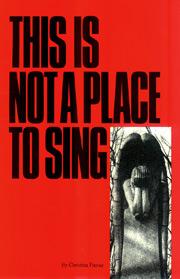
This Is Not a Place to Sing by Christina Pacosz

This Is Not a Place to Sing coverPolish-American poet Christina Pacosz traveled to the homeland of her father’s family in the mid-1980s, and the moving poems in this brief but powerful collection were the result. Published by West End Press in 1987, it’s long out of print, but last fall Christina announced that she had discovered a box of copies in her attic and I asked her to send me one. I’m glad I did. In just 26 poems, she makes the grand sweep of Polish history and many details of its contemporary landscape come alive for me, and I guess it’s the latter that make the former seem bearable, though she doesn’t go out of her way to suggest avenues for redemption.

The title, we learn from the acknowledgements, was something said by a woman in the Auschwitz Museum coffee shop, admonishing some overly boisterous schoolchildren. Pacosz wrestles with this idea throughout the book: how to sing in the face of so much needless suffering and death? “If I open/ my mouth/ I could/ drown,” says Baba Yaga, briefly imagining the life of a pious peasant woman (“Baba Yaga Speculates”). In “The Trumpeter of Krakow,” Pacosz translates the message of the trumpeter’s broken-note song:

Each of us
is invaded
daily, hourly,
minute by minute
by time
and its deadly
arrows.

How to sing
from the highest steeple
and warn the city
with the sounds
that live
in us
and the world?

“Rafting the Dunajec” begins with accordion-playing gypsies and the speaker so grateful they’ve survived the holocaust, she gladly tips them before stepping on the boat. Then:

We come to the gorge
and the wind off the high peaks
washes us with the odor
of spruce, rosemary, pepper.

I say to myself: If
I knew a song
I would sing
and then I hear
a raft of children

singing across the water,
and I am happy,
just like I am happy
when I hear
the water
as it meets
the rocks.

“The Jewish Cemetery, Warsaw” begins with an epigram from Psalm 137: “For there our captors required of us songs, and our tormenters, mirth, saying, ‘Sing us one of the songs of Zion!’” and begins: “Only the trees sing now…” In “Krakow Monument: Another View,” Pacosz notes: “There are always those/ who would kill/ the singer.” And the emotional climax of the book comes in a brief poem for the director of the Jewish Orphanage in Warsaw during the Nazi occupation:

For Dr. Janusz Korczak Who Was Not Afraid to Sing

At the end
of the line
he knew
what
to do.

Walking
from the boxcar
to the gas chamber
he led the children

singing.

Instead of songs and their inevitably inadequate words, Pacosz finds, there are often flowers — ubiquitous offerings, bouquets for every occasion. “Auschwitz: Oswiecim” begins,

We are leaving
flowers like messages
in this awful place:

what else to do
except fall down
with weeping
into a grieving
that will never
be done.

And how to live
in the world then?

So it is calendula
for memory, here
with the children’s
clothing they never
outgrew.

On the feast day for “The Assumption of the Blessed Virgin Mary, August 15,” bouquets are gathered to be blessed in church. Flowers partake of the Virgin’s own dual nature, Pacosz implies, but the blessed bouquets serve a practical purpose, too:

And when the next cow calves,
the dried bloom
will sweeten her
first drinking water,
and Mary’s blessing
flow from her udders.

The book ends with a visit to the speaker’s ancestral homeplace, suggesting the only way out is further in. It is, however, as tough and unsentimental a poem as any in the book. I am left with the music for Gorecki’s Symphony of Sorrowful Songs running through my head. Though the poems in this collection aren’t quite so uniformly mournful, Pacosz understands as well as Gorecki did the power of simplicity and an unflinching gaze.

Posted in Books and Music, Poets and poetry | Tagged , | Comments Off

When the Moon Knows You’re Wandering by Ruth Ellen Kocher

When the Moon Knows You're Wandering coverRuth Ellen Kocher makes being lost sound not only attractive but essential, occasionally with a hint of blues—

If he asks, tell him I am gone.
I am the movement you’re just now forgetting.
Tell him the waves have taken my form.
That I am his past and I am lost also.
(“The White Camel”)

—but most often in language so consistently unpredictable I read with mouth agape. I reach the end of a poem and am not sure how I got there, but it feels right. The paper is thick, almost card stock, so you can’t see through from one page to the next. Each poem feels like another tooth forward on a ratchet. I am just awake enough to appreciate this poetry, but not enough to really do it justice.

What do you say with memory—
that the continents long for each other
just as children who are bundled ghosts
leave their voices as trails in the woods,
the lakes are burdened with notions of ice
and heaviness, just like us.
The things we trust are less
and less true in winter.
(“February Leaving”)

All I can say is I like the way these poems make my mind feel. They satisfy better than most Mina Loy’s definition of poetry — “prose bewitched, a music made of visual thoughts, the sound of an idea.” Listen:

The shadow slant of your own body
somehow takes the ground in,
desperately wanting the surface of grass,
rock of the familiar in the moon’s eye:
light that blues your midnight form.
How many years have you been gone?
And who drove you away—not a man or a stone
seeming to mark some path you run towards,
but a wind that rose in the pink depth of your lung
like first breath, the exaltation in knowing

you are lost. Say your own name backwards to prove
you exist, an ancient tongue that steels the simple evening air on which
you rely like Pharaoh building the tomb for years.
(“When the Moon Knows You’re Wandering”)

I enjoy finding references to local and regional landscapes scattered through the book. Kocher lived in this area for a while some 20 years ago, and even then was one of the most accomplished poets in the State College poetry reading scene, though I lost touch with her after she went out to Arizona to pursue advanced degrees in creative writing and literature. So you can imagine my pleasure when a mutual friend gifted me with this volume last Christmas, and I read a few pages and realized that Ruth has risen more or less into the stratosphere. If we lived in the sort of society that honored its poets, you can bet I’d be bragging up a storm about our old connection.

Appalachians continue
to wear soft layers of moss
down to the rock teeth inside. The river
cuts deeper. Sky descends
to Atlantic storm.

This is where the people sing,
far from me, where winters seem coldest
and the deep call of wilderness
screams through trees into the sore
landscape of quarry cliffs,
where woods turn suddenly into a city
of narrow roads…
(“At Home the People Sing”)

The earth is doing very interesting things in these poems, and I want to know more about that: I will have to re-read soon. In “Herself, in the Window,” for example,

The ground is a black cloth
the white birch climb from. The real woods
died years ago. No matter how hard she looks
there isn’t a song here.

“Lay Down Lilies” made me look at burial in a new light — and how often does that happen? Here’s how it starts:

The sun burned no harder than the moon
the evening we walked a mile to bury the blue fish
that had lived in the freshwater tank we’d bought for it.
The air split when it met our lungs,
swallowed and spewed in half seconds,
a visible breath that went its own way
as the smoke from burning houses departs
from the lives inside them.

These poems are haunted, not only by literal ghosts but by the still-living who are dreaming of elsewhere, fantasizing about war, masturbating in a field. As the title poem puts it: “The moon knows you’re wandering,/ even though the road thinks you’re home.” Take this blog post: it seems nearly complete by any reasonable standard, and yet I’ve barely begun to articulate what I admire about the book. I have not even quoted from my favorite poem, “Sleepwalker on the Mountain” — which is what I’ll become here if I don’t hit Publish soon.

Posted in Books and Music, Poets and poetry | Tagged , | Comments Off

Lines in response to Ren Powell’s Mercy Island

Mercy Island by Ren PowellThis is the third of four books that Kristin Berkey-Abbott and I are encouraging others to also read and blog about this month. (You can order from the publisher before the end of the month and receive 15% off.) Send me the link to your blog post and I’ll update to include it. Posts so far include:

Rachel Barenblat @ Velveteen Rabbi: “Ren Powell’s Mercy Island”

Carolee Sherwood: “reading mercy island by ren powell”

Writing Our Way Home blog: “An interview with poet Ren Powell”

Kristin Berkey-Abbott: “Holy Week Readings of ‘Mercy Island’ by Ren Powell”

Deb Scott @ Stoney Moss: “Reading Mercy Island”

Dorothee Lang @ Daily s-Press: “Mercy Island – Ren Powell (Phoenicia)”

What follows is most emphatically not a review; some of these lines relate only tangentially to Ren’s poems (which is why I don’t name the poems). But obviously it isn’t every book that so moves me to write and to remember.

(p. 1) The head of state, polished to a high sheen, is not the kind of god to submit to questioning.

(2) I remember $24.95 in saved allowance, dimes & quarters stacked on the counter of the camera store in exchange for that black box, my Instamatic! And taking a photo of my shadow beside the pigs.

(3) Grandma had a slingshot she used on the guinea fowl, those perpetually agitated gray commas.

(4) When Elvis died, I knew it was because he had maligned the innocent hounds.

(6) Going home from the pet store, the goldfish on the back seat beside me vibrated in its plastic bag of water. Three days later, it died of loneliness.

(7) The brutal screwing of Muscovy ducks in a muddy ditch was my introduction to reproduction: The enormous male crushing the female, pushing her head under the water, threading her with a white rope.

(8-9) I hated everything about shooting groundhogs, especially when their big soft bodies slid off the shovel or when, wounded, they escaped a second shot.

(11) Starting to drown in the ocean, that second or two of great silence under the waves — yet another project I didn’t finish.

(12) Out of all the days I’ve lived in blessed doubt, the two when I flirted with certainty were enough to make me burn forever.

(13) Behind the barn, behind the barn! The place where chicken-killing dogs were shot. There alone we could curse to our heart’s content.

(15) I measure my life in generations of 17-year cicadas, Brood X. I was 9 the first time. In a jar at the back of a drawer, I still have one or two of those transparent shells with exit wounds in lieu of wings.

(16) Clowning in the lunch room, he pulled the neck of a turtleneck shirt up over his head & in a matter of moments earned the nickname that would follow him to the grave.

(18) My brother yelled “copperhead!” when my foot was in mid-air & I launched into flight. That evening we found the reason why it couldn’t move, its shed skin.

(20) I once paid a statue to talk. She was loud with rust.

(21) In one well we had what we called a mudpuppy, but it was only a newt.

(22) Whoever invented the kaleidoscope must’ve had a childhood like mine: no TV, no visits to amusement parks, plenty of time to look at each odd thing from every angle.

(23) In the 4th Grade I learned that the body is made up of rooms too small to see. I was a city! And there were whole districts that never slept.

(24) We brought one runner sled, red as a red wagon, down with us from Maine in our red VW bus. In summer, we built mazes of tunnels through the tall grass.

(26) Our sky was narrow but dark then. I used to feel sorry for the light of distant stars that had been traveling so long just to enter my eye.

(27) The only thing about highways I didn’t hate was the shimmering water that wasn’t there, what it taught me about thirst.

(28) We had roosters, so our breakfast eggs were always fertile. I dreamt of chicks hatching in my stomach.

(29) Escaped garden plants have taken over half the forest. A curse is nothing but a blessing turned feral.

(30) If a bachelor dreams hard enough, he can give birth to a migraine.

(32) She left a letter with the stain of a dead centipede & several promises.

(34) Ah, romance. I remember corn silk, the wet trail of a slug.

(35) I remember scraping the roosts, nostrils burning with ammonia, and that big black rubber tub bulging with chickenshit.

(36) Feathers falling from the sky are commonplace. What seems incredible now is that Grandpa actually took up arms against a hawk. But Bontas must’ve all been like that once. We drank, we gambled, we owned other human beings, we shot hawks out of the sky.

(41) I was a gardener of little faith. When seedlings came up, I was astonished. I couldn’t bear to thin.

(43) The back of a shy man’s neck is red from scratching. You wouldn’t guess how I know.

(44) We keep calling them mountains, these hills, in the hope they’ll outgrow us.

(46) Birds from the tropics fly here every year to sing. Also to make new birds, yes — & teach them the songs they never sing in the tropics.

(47) Surely the near eradication of lice and fleas on humans has done our species a great disservice. Books & scrolls are a poor substitute for that daily close reading of each other’s primary texts.

(49) I learned early how to hold my breath: at the conference about my unruly behavior, the exophthalmic teacher waiting for me to speak. Strapped in for the orthodontist whose fat fingers tasted like garlic.

(52) Missing for most of my life, I remember being stoned and present for a mother who placed my hand on her child’s bare belly to feel the sickness — blood flukes, perhaps? — like a burl on a tree. I showed her my wallet, already emptied for other mendicants, & said nothing about the belt full of bills against my skin.

(53) We just can’t help stealing each other’s souls.

(54) No sane person looks forward to a trip. I look forward to having traveled.

(55) I miss the two or three male friends I used to open up to, our shared vulnerability over open beers, the layers of blue smoke that wreathed our heads.

(57) You might not believe it, but the part of a woman’s body I most miss touching is the back, below the shoulder blades & above the hips, that flat pastureland with its single ridge.

(58) Tiger beetles anywhere in the world turn my older brother into a predatory beast, one who stiffens, crouches, springs.

(60) That the wind signed its name on our fingertips before we were born — well, I call it wind. Some impersonal force random enough to convey uniqueness.

(63) The idea of the Sahara: not the shadow of civilization but its impact crater.

(64) I used to trace veins of quartz in the local bedrock; now it’s threads of moss that draw my eye. I have left off believing in heaven even as a metaphor. I am homesick for earth.

(65) Night/soil.

(66) Only nonsense can save us now.

(67-68) Garlic & mint, mint & garlic: I would join any church that had that for a catechism.

(69) The trailer where we went one by one for IQ testing at the age of six smelled of new machines & fear. I remember being told I could watch myself on television — a closed-circuit TV, but I didn’t know that. The dim realization that fun was being had at my expense.

(70) The Flavored Nuts sign — conveniently posted at shoulder level — remained a site for teenaged pilgrimage long after the factory closed and cloying smells stopped emanating from its windows.

(75) Like a single Roman letter stretching into a cursive sentence, the great blue heron launched into flight.

(76) Do peaches float? I feel I should know this, I who once publicly embarrassed the author of a book called Stones Don’t Float with a piece of pumice.

(77) A mother grouse doing the injured-wing act led me to the edge of a near-cliff. I wanted to see just what malice she harbored in her speckled breast.

(79) There’s a desert under my floor where rain hasn’t fallen in 150 years — it’s dry as the Atacama. A strange hairy people live there. I hear them thumping rhythmically and moaning now & then.

(80) Grandma was the only person I’ve ever helped bury. She was anti-religious & unsentimental and wanted to be cremated. It still felt awkward to tamp down the soil, hopping on her grave in tight funeral shoes.

(83) Across the gulf of puberty I catch only the faintest echo now of my childhood misery. I wonder though if my frequent, public self-baring wasn’t essential training for the vocation of poet.

(86-87) In a world with lichen in it, nothing is lost. The fungi are farmers, pioneering the most desolate faces of rock.

Posted in Books and Music, Epigrams and Conundrums, Greatest Hits, Memoir, Poems & poem-like things, Poets and poetry | Tagged , | 5 Comments

Ersatz Anatomy by Steven Sherrill

Ersatz Anatomy cover“I hope you find some poems you like in here,” Steve wrote on the cover letter when he sent me the book last November (he’d read a few of the poems on the Woodrat Podcast the previous March and knew of my interest). I quote this because I fancy it says something about his ambitions for his poetry: not necessarily to please all the people (or at least the small subset of people who read poetry) all the time. It might also be a good strategy in general for poets sending out review copies to lower the expectations of reviewers. It worked for me: for every poem that made me say “Huh?” there were at least two others that found me penciling underlines or exclamation points.

It might be interesting sometime to do a comparative study of bestselling novelists’ poetry. I suspect quite a few would choose, as Sherrill has in many of these poems, to regularly confound readers’ expectations with fractured clichés, inconsistent punctuation, willfully obscure references and abundant blasphemy and absurdism. Who but a novelist would write “Our attempts at omniscience comfort me” (“Real Estate”) or “In the Book of Hours/ this moment is denied” (“Why He Wants to Paint the Gate Red”)?

The ordinary reader wants to know what a book is about. Another reviewer resorted to arithmetic to show that Sherrill’s main subject is desire:

The poems in Steven Sherrill’s Ersatz Anatomy use the words “want,” “need,” “desire,” “longing,” and “yearn” 74 times. Those words appear at least once in 36 of the volume’s 74 poems, clearly suggesting that desire is the primary subject of this poetic inquiry.

I’m not going to count them, but I’ll bet there are almost as many references to faith, religion, or God. Like many professed atheists, Sherrill never seems to get tired of arguing with God. His “Psalm of the Malcontent,” for example, contains these memorable lines:

God of the taut larynx, taught— homonym. God
of all that bids me to speak. My question is this:
is it possible that God on the Seventh Day did not
rest, that God instead broke down— terrified?

Even poems not explicitly about religion seem to have been infiltrated by a certain Biblical consciousness — must be Sherrill’s Southern upbringing. Allow me to quote a favorite poem in its entirety:

Hocus Pocus

Deuteroscopy: a thing seen only
on second glance. Take for instance
the dung beetle charading as his heart.
See how the hard gray shell goes red
and pulses softly for your sake.

Some days he can eat the whole Sunday paper
one letter at a time. Other days
the paper eats him. Here is the secret
he cannot let slip: there is an abacus
where his soul should be.
Put your ear to his belly. The incessant
Tick tick ticking will drive you mad.

Replacing the heart with a gold dung beetle was part of the funerary rites of the ancient Egyptians. I didn’t pick up on the allusion until my second reading, appropriately enough.

Somewhere in these 120 pages — I’ve lost the reference — Sherrill (or his narrator) claims not to like nature poetry. If true, I’d say he dislikes it the same way he dislikes religion: the book is chock-full of evocations of nature and landscape. Picking a few almost at random:

Like
the rapture of okra once you succumb
Like the mud dauber’s spastic black dance.
(“Literalist at the Altar”)

Above stratus, above nimbus
Maker and made are the same
Birth, death, and all the other little ecstasies
Occur between wing beats
(“Geese at 9000 Feet”)

I mourn for the alewives
Dead or foundered by the thousands
Scattered in the sand like forgotten parentheses
Rung from the belly of Lake Michigan
Rung by the incessant honesty of Spring
I mourn for their spines at the shore the sun
Climbing nowhere
(“Mosaic”)

Bird delineates its day
with bush, fence line, branch and stone.
How obvious my thick snout
my muddy hooves must appear.
Of your penciled nights’ endless

black acres, I know little.
(“Preamble to the Treatise on Desire”)

The leaves are falling in Pennsylvania
Rothko’s color fields, those luminous
prayers, are fading. My sweet daughter grows.
The bowl is a vessel; fill it or not
Listen. I have nine syllables left
I offer them all to the mountain.
(“Anatomy Lessons”)

Yeah, so I’m finding a lot to like here. Lines that seemed obscure on first reading are revealing a method to their madness. Song-like elements are beginning to emerge from poems I initially read as deranged prose. I don’t personally resonate with Sherrill’s intense and obsessive exploration of sexual desire — not like I did with Diane Lockward’s poems of culinary desire, for example — but I found something to admire on almost every page. I mean, how can you not love a poem titled “Treatise on Desire” that features a grackle flying over a snowy field? It concludes with a seeming aside to the slumming novelist, the storyteller who has done his best to untell stories:

Black

flies the grackle over snowy ground
Tell me a story of the air
between them: glacial, pernicious, buoyant

Posted in Books and Music, Poets and poetry | Tagged , | 4 Comments

An Eye Fluent in Gray by Gabriel Welsch

An Eye Fluent in Gray coverThe power went out this morning and stayed out most of the day, giving me an enforced Sabbath. I went for a walk, shot some video footage of goldfinches in the budding crabapple tree, and at one point this afternoon actually wrote a poem with pen and paper, using my old clipboard. And I extended my poetry-book-a-day pattern a little by reading long sections of a couple of other books before settling on this one. For whatever reason, Welsch’s somber, resonant voice was a perfect match for my mood today, reading in my strangely quiet living room with none of the usual electronic hums or furnace rumblings.

I first read An Eye Fluent in Gray last November, which was maybe a little too much of a good thing since a number of the poems in the book are set in November in Central Pennsylvania (Gabe lives not too far away from me). In general, I share his fondness both for the color gray and the month of November — the latter especially from half a year away. The title of the chap comes from the third poem, “Life in the Northeast, on a Line from Stevens,” which begins:

One must have a mind of winter
and an eye fluent in gray,
ears conversant in the sting
of slowed blood, in the many ways
to hear snow fall.

Welsch has an eye for the run-down, the worn-out, the spare, the harsh and the barren — kind of the Japanese wabi-sabi aesthetic translated into rural Pennsylvanian. This is evident even in the two more summery poems that begin the book, the first focusing on “The Oldest Roller Coaster in the World”—

the whole structure lurched
and groaned, as boards popped out
of their joints and snapped back, as metal
whined with strained age…

—and the second, “Black Raspberry Picking by Route 26, Centre County, Pennsylvania,” musing on the recent discovery of a murdered girl not far from the berry patch.

We wanted enough for a pie. Near dark,
fireflies haunted the woods’ edge by the ponds—
scummy effluvium of the water treatment plant,
the backwash of town edged in raspberries.

Welsch writes feelingly both of deer and of deer hunters, and he rarely seems to lose track of our basic mammalian identity. I was struck by this description of a Christmas caroler from “Ave Maria Outside a Small-Town Diner”:

The power of her throat, the creamy
length her voice implies, the purity
of her sound and its prayer:
everything sacred is of the body—

spirit moves muscle, shapes the eyes,
faith lives in the spark of a brain fed
on the lush fat of the blood
and a body’s cache of longing.

But in “Lovely, Dark and Deep,” the narrator expresses skepticism about his felt connection with white-tailed deer:

To meet their gaze, or to think

we’ve met their gaze, to stare back
as they question a windshield,
all that runs through a mind
seduced by the thought of connection.
As if, because we are both born in blood
and both wear hair, because we both
have time behind us watching woods
stir and darken, we invent
what we see.

Welsch places the poems referencing Stevens and Frost on facing pages, then follows with “What the Deaf Boy Heard” (text available on the publisher’s page; audio at Whale Sound) — one of several poems where listening plays a central role.

These are tough poems, all the more so because of their accessibility. The image I can’t get out of my head comes from “Route 422, Cambria County, Pennsylvania”: the state historical marker for the birthplace of another Pennsylvania poet, Malcolm Cowley, turned into a target for passing motorists:

you hear men
throw bottles at the sign, and the skitter of glass,
dainty as a chime.

Yeah, that sounds about right. As the poem says a few stanzas earlier, “This place … reinvents darkness every night.”

Seven Kitchens Press is offering free shipping on all titles this month. Click on the book cover image above to order this one.

*

I’m reading a book a day for Poetry Month, but I’m also hoping some folks will join me and fellow poet-blogger Kristin Berkey-Abbott to read just four of those books. Details here.

Posted in Books and Music, Poets and poetry | Tagged , , | 4 Comments

Forever Will End on Thursday by Nic Sebastian

Forever Will End On ThursdayReading a book of poetry a day gets easier the longer I do it. It’s writing about it that’s a challenge — like dancing about architecture, as somebody or another said about the closely related task of reviewing music. This is especially true of poetry as musical, enigmatic and utterly captivating as Nic Sebastian’s. It doesn’t help that my lit-crit vocabulary is woefully impoverished. And it’s especially embarrassing to be reduced to near-incoherence in my admiration for the poetry of someone I actually know pretty well online. Surely I owe it to Nic, who’s given so much to the online poetry community over the past few years, to write something. Especially since I can’t dance.

Reading the book was an absorbing experience. I listened to the audio-book version read by Nic and followed along in the print version, which worked pretty well, except for the fact that Nic went too fast — I had to pause the recording after almost every poem for five to ten seconds to let it sink in. Perhaps I would’ve done better just to read the poems one by one on the website and click the individual audio players for each, but I find light text on a dark background too much of an eye-strain.

So why do I like these poems so much? For one thing, because I don’t understand them fully, in the same way I don’t expect to understand a folktale from another culture, but can appreciate its authenticity and utter originality. Nic’s poems are every bit as spacious and surreal as Howie Good’s, but are less dark — or at least their darknesses are more Rilkean. And whereas yesterday’s book — The Doors of the Body by Mary Alexandra Agner — re-worked traditional and sacred tales from a modern perspective, Nic’s project here is almost the opposite: making new myths in the ancient mold, or the beginnings of myths. There’s a soil maiden, a charcoal man, a baobab girl, and a man who marries a great cat. There are “places of happiness” on five continents where the land acts as matchmaker. Naming plays a central role in many of the poems; words have genuine power here, whether to invoke, bless or curse, which is what makes the absence of obvious interpretations for many of the poems so tolerable, at least for me. I am of course aware that for many readers of a more postmodern bent, poems of enchantment are automatically suspect, and Nic seems to anticipate that reaction, too, in poems such as “we have no need of prophets” and “poem for mother’s day“:

you ask why
I write of budding
spring and rising

sap would you rather I wrote
of razor wire and cold
scrubland

mother
the chiseled ivory of your sleeping
face your paper eyelids gliding

shut like
bricks in the wall
of your sleeping

face mother the deep miles
of night sky with no moon

One poem seems to describe some sort of political activist. As with most of the poems in the book, the language keeps luring me back to re-read it until I think I have a pretty firm idea of what it’s about, but who’d want to be sure? See what you think:

underlie

what is it like living with your body
splayed your whole body
spread tense up to the thin wires
of your brown hair the all of you threaded
through the squirming loam
the itching seas of this
planet

a stick figure with pigtails and
squeaky voice runs back and forth
across your muscle across all your pitched
nerve calling in from Zinguinchor from
Dili blogging from Cali from
Baghdad exploding in chipmunk
outrage in small burning
agony

and you
keep the position taken swaying
like the first like the only
hammock

A thoroughly modern subject there, perhaps, but what I find especially attractive are the animistic elements: that squirming loam, those itching seas, even the thin wires and animated stick figure in which I recognize a bit of myself. This is the kind of book that makes me want to seek deeper and more meaningful connections to the earth. It may seem strange to say about a book whose availability in multiple electronic formats is one of its selling points, but after reading Forever Will End on Thursday, I wanted nothing more than to leave the computer and go for a walk in the rain-drenched woods. And so I did.

I’m reading a book a day for Poetry Month, but I’m also hoping some folks will join me and fellow poet-blogger Kristin Berkey-Abbott to read just four of those books. Details here.

Posted in Books and Music, Poets and poetry | Tagged , | 15 Comments

The Doors of the Body by Mary Alexandra Agner

The Doors of the BodyThese poems hit the spot. Yes, they’re very well done, but that’s not the whole story: somehow, too, they caught me in just the right mood this evening, after a day spent slowly walking and driving the back roads of Central Pennsylvania looking at early wildflowers, each with a mythology as rich as the classic tales Agner retells here: hepatica instead of Minerva, spring beauties instead of Sleeping Beauty, bloodroot instead of Queen Tomyris, each with a miniature armory and a brave sail. I’m not always a big fan of midrash on classic myths, but I liked where these poems took me. Here are Penelope and Telemachus, yes, but also Irene Adler goading Holmes into a debate on sexual equality; an elderly Gretel who more than anything craves another taste of candy made from children’s flesh; a Circe who spills the beans on the soldiers she turned not into swine but into female lovers; and a woman in Salem on her way, it seems, to becoming the corn goddess:

My body is maize, bled far in the future,
now ankles aflame with runner bean scratches,
my toes dug in dirt, as I drop down the seed,
wrinkled white kernels. On the horizons, the drought
of adulthood, the sweet singing voice from inside the pyre.
(“Corn Field, Salem”)

As far afield as she ranges in these 22 poems, though, and regardless of whether she writes in the first or third person, Agner maintains a consistent tone — vatic, or perhaps sibylline, with a mixture of indignation and bemusement — and avoids the usual pitfall of such collections: she doesn’t try to make all of world folklore serve some grand new myth. Because you know, reenchantment only goes so far. Some tales could stand a little disenchantment, and Agner seems happy to oblige. Penelope, for example, isn’t exactly overjoyed at the return of her trickster husband:

Gone two decades, almost ghost
in my memory, I recognize right
away the hitch in your voice, inhaling
for time to find the perfect
lie. You’re home for good.
(“Yarns”)

Sleeping Beauty manages to escape her enchantment almost immediately:

Let the spurned witch-sister
and the so-called fairy godmothers
duke out what history is writ.
Poor planning lets fates devour
the happy story here-and-now.
Destiny wants purity and light
and most of all submission, so
the scullery maid fisted me to ecstasy.
The curse broke like the chiming of a clock.
(“Sleeping Beauty”)

A closer examination of delicate-seeming wildflowers reveals an earthier and more interesting reality of steamy sex and caustic chemicals, as I’ve had occasion to explore at some length in my own work. It makes sense to me that a close reading of traditional and sacred tales would turn up similar secrets. The world of dreams has its own self-consistent reality, and like the world of science, it’s a little beyond what our minds can easily encompass. And of course the sexist warp of most societies creates an acute need for re-dreaming. Agner includes an homage to all the anonymous female songwriters, poets, and storytellers, “Old Enough”:

Tying sayings up like string, rhymes of advice still practical,
sense so common, on all lips, attributed to no one maker and every maker.

A horse and a reed whistle and a vast continent are not disaster.
Eighteen verses of silk and loneliness outlast their maker.

Always so many more unnamed, unmarked and in their absence, perhaps unmade.
Anonymous, prime your pens and prick your needles. Name yourselves makers.

—Which reminds me of the translation we published today at qarrtsiluni: the only poem to survive, in a dead language, from an otherwise unknown, 12th-century female troubadour, Azalais de Porcairagues. Just one poem, plus a fanciful sketch in an illuminated manuscript! To anyone who loves the written world, it’s maddening to think of all the Mary Alexandra Agners of millennia past who didn’t even have that much to survive them. No wonder this slender volume with the glossy, perfect-bound cover seems so large and full.

I’m reading a book a day for Poetry Month, but I’m also hoping some folks will join me and fellow poet-blogger Kristin Berkey-Abbott to read just four of those books. Details here.

Posted in Books and Music, Poets and poetry | Tagged , | 2 Comments
Page 1 of 3123