
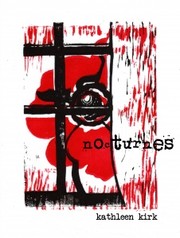
Nocturnes by Kathleen Kirk

Nocturnes NocturnesKathleen Kirk; Hyacinth Girl Press 2012WorldCatLibraryThingGoogle BooksBookFinder
This was the perfect companion for a quiet, rainy spring night. Kathleen Kirk‘s latest chapbook gathers 20 night-themed poems that together trace a landscape of loss and yearning, peopled by memories, dreams, ghosts, lovers and various errant moons. The book begins in Cuba, with a striking image of women wearing fireflies in their hair nets (“Cucuyo”) followed by several pieces from the perspective of a Cuban exile’s family, culminating in the grotesque “Our Son Dreams of the Beast Shark.” It then segues into “Stargazing with My Son,” introducing an astronomical theme that continues off and on throughout the book, mingled with, increasingly, poems about love and desire.

All of which is to say that the book is very well put together. As someone who has written several themed collections myself, I can attest to the difficulty of maintaining a good balance between unity and diversity, as Kirk does here.

Three of the poems are ekphrastic, responses to Whistler’s “nocturne” paintings — not surprising, considering that Kirk is poetry editor for Escape Into Life, a magazine devoted to the intersection between visual and literary arts. But even poems that weren’t sparked by paintings abound with painterly details: “A grey glob” of mortar “lands wet and heavy / on the plastic sheet / like a body part” (“Losing Cuba”), and the narrator’s skin is likened to “these moon-colored leaves (touch them!) / trembling in the moments / just before rain” (“Last Leaves”).

“Almost an Aubade” references Edward Hopper, his subjects “shining in their loneliness,” but unexpectedly turns into a love poem: “After the sharp dream of another, I come back to you…” The book is full of such artful inversions. Possibly the most unexpected poem, “When We Lived at Night” — my favorite in the collection — goes deep into our pre-human past, when “there was no time, / only the moment” and “we lay along the wide limb / of our new existence / in the trees, nocturnal together.”

What’s left of my reptilian brain
still longs to live in the moment,
that wretched clawing in the dust
suspended forever.
But there was no forever.

I relate to the poems about sleeplessness, “Acorns Rolling Off the Roof” and “Naked Dance”:

It’s three oh three,
I’ve dreamed a giant red poppy,
tall as a small tree …

It’s good to be lonely

at a time like this.
I wouldn’t want to wake the sleeping world
from its soft desserts.

There’s only one explicit reference to blues in this book, but if you love blues music as I do, the dominant mood should feel very familiar, that same mix of melancholy and exultation. Like good blues, these poems are never lugubrious, and aim to turn losses into something salutary: “When the time comes, / juncos will feast on this cold” (“Almost Winter”). Or as Kirk says at the end of “Cosmonaut”:

This shining loss is now a thing to be praised,
as stunning as a comet’s tail
or a transit of Venus,
or a black hole swallowing up life as we know it
and spitting it back out whole
somewhere else, without any teeth marks.

Kudos to Hyacinth Girl Press for their selection of this surprising and delightful book.

Character recognition

The Storialist:

It’s getting harder to prove you’re not a robot
to the computer. You can robot-proof
your website by warping the text like wrought
iron, twisting it. The troubled youths
of the internet have robot brains. They want
to sell you pills to enhance your desire
or suffocate your appetite.

A Woman Traces the Shoreline by Sheila Squillante

A Woman Traces the Shoreline A Woman Traces the ShorelineSheila Squillante; dancing girl press 2011WorldCatLibraryThingGoogle BooksBookFinder 
First read: WTF? Is that it?

Second read: Oh, I get it. It’s about trying to write a pregnancy poem, and merely “tracing the shoreline,” while seated in a soulless retail shopping environment — specifically a bookstore cafe next to a Bed Bath & Beyond still under construction and covered by scaffolding. A little meta, but O.K. “This is ritual.” There are seagulls and a woman picking through a dumpster. There are dreams and cravings for poems by women, and there’s a desire to “include too much.” The shoreline when it first appears is a metaphor for “the edges of heat rash … from shoulder to fingertips.” A few pages later “She waits, tracing the shoreline of her body, a heat rash of expectation.” And two pages after that, “I trace the shoreline of my own exhaustion. It grieves me to prepare so effectively.”

Interlude: I hear a barred owl through the closed door and step out onto the porch to listen. It’s gotten a little cool out. Venus glimmers in the west. After a minute or two, the owl calls again; it’s very close. Who cooks for you? Who cooks for you-all? A pause of another couple minutes, then it calls again, still from the same location. That expectant feeling, attention focused but relaxed, staring into the darkness as if that will aid the hearing — then, intellectual that I am, analyzing this, still clutching the open book in my left hand like a talisman against the night. Once more the owl calls, then silence. Is that it? Yes. Yes it is.

Third read: This spare prose-poem spread out over 17 pages is about expecting, in the broadest possible sense. It only makes sense then that it would challenge our expectations of what a poem (or sequence of untitled poems?) should be. Is it, are they, finished? Clearly not. “I coexist. I am becoming, they tell me, ‘wholer.'” “This rash, these shore birds. Scaffolded, skeletal.” Shorelines themselves are never finished, perpetually under construction by waves and currents. One stands on the shore to wait for the ship, for the hero without or within. “I feel the hero fighting. I am the hero fighting.”

Waiting is a kind of kenosis. Her cookies eaten, the narrator faces “the empty plate, page.” She stares at her “belly and breasts, crumbling shoreline of retail need.” The last words on the last page suggest that this has, after all, been a quest narrative: “We quest and billow. We wait.”

With just a few sentences marooned in the top part of each page, it occurs to me I’ve been following a shoreline back and forth through this oddly affecting and thought-provoking book.

Mountain Haibun

…paths worn ever-steeper by joy and sorrow.

Sometimes, on the one-lane road ascending through the cordillera, the vehicle is merely inches from the edge of the ravine. We listen for the sound of gravel, expect their skittering to hit the faces of rock below, but nothing: only the sound of the wind combing through pine, the trickle of a distant waterfall. The slightest press from fingers of fog, and the bashful mimosa curls, leaf by leaf, into itself. Before the sun goes down, the driver pulls up at a lean-to and the women and girls file out, squat behind its corrugated shingle. The men stand in a row, impassive before a length of limestone. This is a bathroom stop. It is at least four more hours before the township comes into view with its rest houses, cantinas, a lake whose name in the local tongue simply means “water.” Someone startles a flock of blackbirds in the bushes; there is laughter, the smell of cold bread rolls shaken out of paper sacks. Only the tungsten yellow lights from the bus cut through the darkness and the fog, arcing with each turn.

We’ve journeyed so far, suffered so much on this road.
Only the lizard, if it fell through these oceans
of fog, might live to tell the tale.


In response to Cold mountain 37.

Jennifer Schlick visits Plummer’s Hollow

Jennifer Schlick in action

Naturalist, blogger and photographer Jennifer Scott Schlick visited Plummer’s Hollow earlier this week, and has just posted a short but stunning set of macro photos of some of our wildflowers. She was especially charmed by the rue anemone and fringed polygala (AKA gaywings), neither of which she’d encountered in her area of upstate New York (Jamestown and environs, just north of the northwest corner of Pennsylvania). It was also the first time she’s seen pink and yellow color variants of red trillium — one of the flowers included in our photo-poem collaboration last year. I’ve embedded her Flickr slideshow below, but if you can’t see it, here’s the link.

I had a hunch that Jennifer’s slideshow-talk “Confessions of a Reluctant Birder” would make a good presentation for our local Audubon chapter’s annual spring banquet, and I was right. Turns out she’s a highly entertaining, down-to-earth speaker. She does this sort of thing more or less for a living, along with banding birds, introducing high school kids to nature, mobilizing hundreds of volunteers to remove invasive plants from a 600-acre wetland, and yes, writing the occasional grant to support the Jamestown Audubon Center & Sanctuary, for which she serves as program director.

It was fun following Jennifer through our woods and introducing her to some of my favorite fellow inhabitants. Seeing the hollow through the eyes of a visitor is always a treat, but never more so than when the visitor has advanced training in looking at the natural world. And if you’re wondering whether Jennifer has blogged about the visit yet herself, the answer is of course.

Dreaming in Red by Howie Good

Dreaming in Red Dreaming in RedHowie Good; right hand pointing 2011WorldCatLibraryThingGoogle BooksBookFinder 
Howie Good’s latest full-length collection, his fourth, is the first book issued by the online magazine right hand pointing, and it was produced to benefit the Crisis Center in Birmingham, Alabama. 100 percent of the profits, about $5.50 per book, go to support the center’s work, which includes suicide counseling, services to victims of sexual assault, day treatment for the indigent mentally ill, and other services. You can get it through Lulu.com.

Is the book worth reading, though? If you like spare, haunting poems with dystopian themes and a healthy dash of surrealism, absolutely. As with most of the other books I’ve been reading this month, I read it to Rachel over Skype, which was an interesting experience for both of us. While I’ve read many of Howie Good’s books and chapbooks over the years, this was her first — and the first one I’ve read out loud. My pauses were rarely long enough for the full meanings to sink in. It made me appreciate just how much time is required to absorb Howie’s poems.

Rachel admitted to confusion about some of the leaps between stanzas or sections of poems, but said she was impressed by how well the poems captured the sort of everyday paranoia in which we are all enmeshed. As a volunteer at a similar organization to the Crisis Center, she fields phone calls from true paranoiacs and other highly disturbed people on a daily basis, and said she thought the book did a great job of illuminating the very fine line between ordinary thinking and madness.

I doubt the poems were chosen with the Crisis Center in mind; Good just happens to be a very noir-ish poet. Dreaming in Red is an excellent title, though: blood or the color red figure in many of the poems. 20th-century nightmares mingle with 21st-century premonitions of worse to come. “The city is full of smoke, dust, fever, flies, parading and singing and holding banners aloft” (“History is Silent”), and “To get red, you need dust and haze. Pollution makes the sky so beautiful” (“A Walk on the Moon”).

Instead of a standard review, I thought I’d try an imitation of Howie’s style as a kind of homage to this very distinctive poet whose poetry and work ethic are such an inspiration to me. Following that, I’ll embed a video that the Belgian artist Swoon Bildos made for three of the poems in the collection. Enjoy.

Good Times

after Howie Good

1.
All the clocks have guilty faces because they are being watched by secret police. You show me the new finger you had grafted on in prison, still red and slightly swollen. When we shake hands I feel it twitching spasmodically, a dog dreaming about its previous owner who shot things with it and made it point.

2.
It’s always disconcerting to learn that you’ve been blind from birth, and everything you thought you saw was merely something suggested by the prosecuting attorneys of your better nature. Then again, here on Mars, two colors capture everything. Paradise has been postponed indefinitely due to the shortage of fruit.

3.
The information paradigm followed by the mass media is fundamentally Euclidian, you said. We were cleaning out the rabbit pens with an air compressor. Even the dried blood wanted to fly. The monastery had switched from bells to sirens, so a 3:00 a.m. siren could mean fire, prayer, or both. Time hasn’t been the same since it was used to regulate trains.

*

Watch on Vimeo

Rituals

This entry is part 21 of 54 in the series Morning Porch Poems: Spring 2012

My hair has thinned, but it’s grown longer. I run a sheen of oil across the ends after a bath. That warm haze outside is pollen: floating archipelagos of amber, speckled marcasite, frosted orange. From the closet, I pick a blouse of cotton voile so it might breathe, another skin against my skin. A crow flaps up from the blackcurrant bushes: my first letter of the day! Later, the wind lifts the light higher. A green blush deepens on the hillside. Names of the dead sough through the branches, like needles of pine raining through the air.


In response to an entry from the Morning Porch.

Return of the Mari Lywd

Clive Hicks-Jenkins’ Artlog:

Today, all uninvited, the beast conjured from skull and sheet and ribbons, that haunted my father and through him came to haunt me, arrived not by night in the dead of winter, as it once did with him, but in the back of a car on a bright, sunny morning. And not to do battle this time, but stepping out of the distant past to tread a stately pavane with me under the holly tree in our orchard. Jack barked and proffered his frisbee for play. The rooks called and collared doves fluttered softly about their nests. The circle has closed, at last.

We Are Clay by Russell Evatt

We Are Clay We Are ClayRussell Evatt; Epiphany Editions 2012WorldCatLibraryThingGoogle BooksBookFinder 
The title poem, I learn from Google, was originally titled “That We Are Clay.” Would it be too far-fetched to suggest that losing the “that” is emblematic of this poet’s progress from the slough of bull-slinging toward a firmer ground of revelation? Yes, it would. Still, winning the first chapbook contest from a magazine called Epiphany ought to count for something — especially when the hand-sewn, letterpress-printed result is as beautiful as this one is. And the element of bull still present in the otherwise unaltered text of the poem could well constitute an evasive maneuver. It begins:

We Are Clay

I am a city pigeon. One
step ahead
of dogs. Always
on the lookout
for bread.
Don’t test me.

He’s kidding himself, right? Clay pigeons are targets for shotgun practice. But this pigeon tries to distract us by retreating into the realm of the theoretical:

I wonder what you are
if I am a bird.
The lady throwing
bread, breaking it off
in pieces? The crumbs
falling to the ground?
This is sex. I’m not
the pigeon. I’m
the clown
with the camera.

Clowns were once numbered among the priests and shamans; clowning can be a serious business. “The bigger the room, the louder God’s voice.” That’s the whole of a tiny poem titled “Huge Catholic Cathedral.” Another poem, “A Playground Skirmish as the Beginnings of War,” betrays the influence of Vasko Popa’s Games:

The men stand in a circle until they realize
this isn’t a conducive scrimmage
and disband. One plays hopscotch. Another jumps
a thick rope.
Still another does the hula.
One man sees this and tries it with barbed wire.
Doesn’t work.

In “Man,” the games become more serious yet. A boy dislocates his little finger in a neighborhood game of football, and his father turns away from his Sunday television and “wrapped his arms around the boy so he couldn’t move as the pinkie was popped back into place.” The boy thinks he hates football now, but soon enough he’s back playing with his fingers taped together “because that’s just what he needed, to get back out there, not let anything stop him.” So American, this vignette. Especially given its placement in the collection between “Victims’ Bodies Arrive at Airport” and “Bad Water.”

One of the things that sets the U.S. apart as a developed nation, of course, is the extent to which religious discourse and belief permeate our society. It’s always bothered me that so few of our poets seem willing to grapple with this aspect of the culture. So I was especially pleased to see Evatts returning time and again to religion, as in “Ancient Civilization”:

When you say
missionary

I think of sex
then God.

Is this important?
Is the hour

upon us?

This is in the context of a relationship between lovers who do not want to commit and barely manage to communicate, which might or might not be a metaphor for something else. In “Noise Control,” the poet himself pauses to wonder if the central image is a metaphor, which I might’ve found annoying if that image (of a deep-sea “monster” that may be killed simply by bringing it to the surface) hadn’t been so compelling. Still, this kind of mock-wrestling with meaning is all too common these days, especially among younger poets, and therefore probably wouldn’t interest me so much if it weren’t for the counterpoint it offers to the truth claims of religion referenced in so many of the poems. The book ends with a shopping trip for “Groceries in the Afterlife,”

a place where you wander, pushing a cold steel cart in front of you with a stuck wheel, a place where the lights flicker and the freezer units hum hum hum.

I read the book to Rachel over Skype, and we each liked a number of the poems, but often not the same ones — which is unusual for us. I think that speaks to the high level of experimentation here. Evatt rarely plays it safe, and he never shows all his cards. How seriously are we to take poems such as “Huge Catholic Cathedral,” or one called “I Told You So Sonnet” with its 14 extremely short, unrhymed lines about what would happen if the sky actually fell? Is he putting us on? Does it matter?

Perhaps we readers are like the people in “Sketching People” — but which ones? Because, as the protagonist explains, there were two kinds of people: those whom he tried and failed to depict on paper, and the ones he actually did depict who failed to appear, and may not even exist. “My drawings would not change this.” It’s the kind of thing you’d expect to hear from a failed god — which is to say, a clown.