Heartache Ghazal

This entry is part 20 of 54 in the series Morning Porch Poems: Spring 2012

There’s the sky’s bright wound again, open, gaping.
What time is it? Too long, too heavy, too much.

One can’t properly cook with a toaster oven. Tea with crackers isn’t much
for sustenance. But there are those with the gall to say that’s too much.

Would you really begrudge an elder a share of bread and board?
Would you yell at her: Turn off the lights, the bill’s too much?

There’s the sky’s bright wound again, open, gaping. And its eyes
are bottomless wells, staring. Too naked, too raw, too much.

How much evidence is needed? Here’s fortitude, and making do,
and doing without. At the end of the day, the ache of too much.

I’ve been flame for you, tinder, clay pot. I’ve been the fuse and the hunger,
the ticket and the ticket box. At the end of the day, all too much.


In response to an entry from the Morning Porch.

Silverfish

The Marvelous in Nature:

An individual silverfish can live as long as two to eight years. Think about that. If you moved in the last few years, there might be silverfish in your house that have lived there longer than you have. Fortunately, they’re not that prolific; a female may lay fewer than 100 eggs in her lifetime. And a healthy household population of earwigs, spiders and house centipedes will also help keep their numbers down.

Birds Nobody Loves by James Brush

Birds Nobody Loves Birds Nobody Loves: A Book of Vultures & GracklesJames Brush; Coyote Mercury Press 2012WorldCatLibraryThingGoogle BooksBookFinder 
This evening was our local Audubon chapter’s annual spring banquet, featuring a presentation called “Confessions of a Reluctant Birder” by naturalist-blogger Jennifer Scott Schlick, so how better to prepare myself this morning than by reading another blogger-friend’s graceful and entertaining new book of poems about grackles and vultures? James Brush is from Austin, Texas, where grackles are almost as despised as the Texas state legislature, though I think they are in session at least twice as often. Years ago, when my brother Mark was getting his M.A. from the University of Texas, I took the bus down to visit him a couple of times and was deeply impressed by the size of the grackle flocks and the variety of interesting sounds the birds could produce. Watching them come into roost along the riverbank at dusk was an impressive sight, rivaling as a spectacle the emergence of the Mexican free-tailed bats from underneath the Congress Avenue Bridge on the other side of the river. Oddly, though, few of the people gathered to wait for the bats did more than glance in the grackles’ direction. Why not?

James Brush’s poems offer a few clues. A humorous haibun, “The Grackle Tree,” begins: “After a few days under the grackle tree, the blue sedan began to develop a white pox, which spread with each passing night.” People fire shotgun blanks into the tree with little effect, and

After a month, no one remembered what color the car had been, and no one ever discussed its owners or what became of them.

grackle tree
boughs shake and chatter
at the cars

Brush uses hyperbole to good effect. In one poem he imagines fundamentalists from Kansas coming down to Austin to demonstrate with signs that read “God hates grackles.” In another, “Quiscalus Mexicanus,” the Mexican great-tailed grackles come under fire on right-wing talk radio:

Grackles are socialists. They weren’t born in the U.S. Grackles do what Hitler did. Shouldn’t even call ’em passerines; they’re not even birds. Sub-birds at best.

Another poem describes the reactions of various people when Brush tells them his greyhound Joey ate a grackle: “Yuck, but your dog will be fine,” says animal emergency. “Ewww,” says another veterinarian. And a friend relishes the dog’s new appetite: “Thank goodness. Grackles are awful.” For his part, the author simply notes how much more attentive Joey has become to his daily filling of the fird feeders. Dog and master share a new tie, bound by their appreciation for this “bird nobody loves.”

Grackle poems alternate with poems about turkey vultures and black vultures — both species that we have here in central Pennsylvania, as well. I don’t know that these birds are as disregarded by serious birders as Brush says they are in Texas, perhaps because we’re on the Eastern Flyway and people at the spring and autumn hawk watches tally migrating vultures with as much enthusiasm as anything else. Also, there’s nothing more elegant in flight than a turkey vulture, its wings curved up in a very shallow V, rocking back and forth in the wind or circling on thermals but rarely flapping. Brush captures some of this grace in his micropoem sequence, “A Committee of Vultures”:

shadows
across a brown field
vultures       circling

[…]

in a cloudless sky
a vulture circles the prairie
seeking an ending

Of course, vultures can be somewhat repulsive, too: “We shit on our own feet,” begins “Creed for Cathartes Aura.” And black vultures clustered around a corpse seem to be plotting how to hone their predatory skills.

Straightening their ties, they discuss
elaborate plans to go public. Someday,
they claim, they will become hawks or eagles.
(“Good Authority”)

Since some of the poems are autobiographical, I couldn’t help wondering whether Brush might’ve put a bit of himself in “Lines Discovered in an Aging Ornithologist’s Field Journal”:

When the end comes, don’t
plant me in the ground, trapped
in just one piece of earth.

Why not leave me by
the highway for the vultures
and maybe for the crows
who will take my unseeing eyes.

Then, at last, I could soar,
finally fly on dusky wings
outstretched,

buried in the sky.

This is a fun book, and light-weight enough to slip easily in a knapsack with the field guides.

Ghazal, a la Cucaracha

This entry is part 19 of 54 in the series Morning Porch Poems: Spring 2012

Cooler and more overcast today; but in the parking lot at work,
a Blue Bunny ice cream truck circles, playing “La Cucaracha“—

Which makes me think of my friend Pinky, whose favorite way of saying
someone’s acting nutty is: Ay! she has a case of the cucarachas.

We know of course about cockroaches: in other places they go by
palmetto bug, croton bug, waterbug— all the same, a cucaracha.

An ant might walk with exquisite slowness; but have you ever
had to duck in fear of an armor-plated, dive-bomber cucaracha?

Fun facts: a cockroach can go without water for two weeks, without food
for a month. Squished, their slime might resemble green tea matcha.

And how about this: some female cockroaches only mate once and stay
pregnant for life
! That would definitely make me crazy, you betcha.

When I read this: Immature American cockroaches look like wingless adults
for a while it seemed we were no longer just referring to las cucarachas.

In my childhood home we kept potatoes and other dark-loving tubers beside
the rice bin under the sink, until a dark brown army swarmed over the kabocha.

It may have been the year I learned the Mexican Hat Dance for Field Day at school,
felt silly twirling a skirt with cellophane ruffles to the refrain of “La Cucaracha.”


In response to an entry from the Morning Porch.

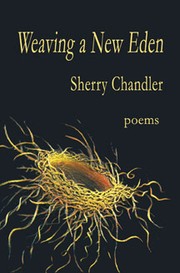
Weaving a New Eden by Sherry Chandler

Weaving a New Eden Weaving a New EdenSherry Chandler; Wind Publications 2011WorldCatLibraryThingGoogle BooksBookFinder 
Weaving a New Eden is two books in one, with an additional prologue and epilogue. The first major section, “The Grandmothers,” consists of poems about — and mostly in the voices of — the author’s female ancestors, who were pioneers and rural women in the hills and hollows of Kentucky. This is followed by “The Frontier,” which reimagines the life of Rebecca Boone, Daniel’s wife. In addition to the common setting, Chandler uses the imagery of weaving to connect these sections into a more cohesive whole, as she points out in her prose introduction.

I also found myself writing weaving forms of poetry — sestinas, pantoums, a sonnet crown — and I consider the weaving chorus of voices in “The Grandmother Acrostics” a tapestry of Kentucky history.

Chandler’s mastery of poetic forms is rivaled only by her command of Kentucky history and genealogy. And when I say “mastery,” I mean she makes it seem effortless. In less expert hands, the exigencies of poetic forms sometimes force odd constructions and word choices, which can of course be made to seem edgy or hip — it’s always easier to be difficult than to be clear. But there’s no way such an approach would’ve worked with poems about what the Foxfire books used to call “plain living.” “How to Cook a Chicken,” for example, for all that it conforms to the intricate arrangement of a traditional sestina, never deviates from plain-spokenness. Here’s the penultimate stanza:

Disjoint the legs, first step in cutting up a chicken,
bend the thigh joint till the bones shine through the skin
like a knuckle, aim the shining edge of the dark
blade at the highest, whitest part, cut. Plunge
blade into flesh at the breastbone’s high point, dress
out the wishbone, later to be split by daughter’s hands.

This unforced quality was equally present in the aforementioned “Grandmother Acrostics,” a 10-page, 17-poem sequence that was the high point of the book for me, and easily could have made a satisfying chapbook by itself. And many of the women whose voices we hear in this sequence also appeared in other poems earlier in the section, adding to the impression of interwovenness.

Chandler isn’t just a traditionalist, though: the book includes two found poems, as well, suggesting perhaps the influence of Charles Reznikoff. One was a series of postcard messages from her grandmother on a Greyhound bus trip out to California in 1957, with “original spelling and grammar transcribed as written.” Given the “lost Eden” theme of the book, “Card 8: Greetings from Paradise” seemed especially resonant:

Then on October 9 Elezbith Aunt Nanie Mae
and I went to Pardise
we saw the gold Minds
and Elezbith and I helt hands and looked down in the minds

Throughout the book, Chandler is keen to give voices to the overlooked and forgotten, both among her own ancestors and in the more well-known narratives from Kentucky history: a nameless “old Dutch woman” from an Indian captive story; a slave woman named Dolly; the Boone family cat; the mysterious Ellen Tingle whose name, birthplace, number of children, appearance and manner of death have all been forgotten by her descendents. I was fascinated to see how Chandler dealt with the gaps in knowledge. The cat plays its bit part, mentioned in the chronicles,

Then Jemima came running in. “Daddy!” she cried
and I disappeared again into the fogs of history.

“Calloway’s Dolly” and “The Old Dutch Woman” both actively question the official record — how reliable can it be, if it couldn’t even supply them with proper names? The latter refuses to confirm or deny whether she harbored cannibalistic impulses toward her more famous fellow escaped captive Mary Draper Ingles, as Ingles claimed.

She says I tried to murder her. She says
I wanted to eat her. That may be true.
[…]
I could blame it on the roots we dug.
Who knows what poison we ate to stop our guts
from cramping. I could blame the bloddy flux,
the fever. Or I could blame the story. Always
the strong hero must have a weak companion.

Ellen Tingle protests more plaintively about the forgetfulness of her descendents:

They’ve forgotten how I looked, how I smelled, how
I held them against my heart and kissed away their fears.
No, surely once I tingled in Ben Lusby’s blood.
Give me that.

Even “Rebecca Boone’s Loom Has Its Say” in a six-stanza pantoum:

Though Boone’s Ticklicker wove the tales men love,
those Long Knives would turn tail with breechless butts.
My cloth provided cover for a conquest.
Wilderness can’t be tamed when men run bare.

Historical poetry is a fascinating genre. As with historical fiction, the leeway it provides for the exercise of the author’s imagination can make the past come to life in a way it seldom can in straight history. I’ve certainly read books of historical and biographical poetry that were more lyrical, more rich in metaphor and simile than Weaving a New Eden, but I can’t remember any that felt as comprehensive, or wove together as many different moods and modes: comic as well as lyric, elegy as well as ballad, limerick, ode. Reading it in one sitting, out loud, as I did this afternoon, might not be the best way to take it in, however. Its complex tapestry rewards the slow and attentive reader.

Ghazal, with Bird Singing in the Dark

The child says: At five, I wake because
the bird starts singing in the dark.

The wind is wordless when it peals, unlike
cathedral bells struck to ringing in the dark.

What does it say? she wants to know. Empty
your pockets, begin unburdening in the dark.

I’ve slipped from one love to another— some robes
are tight; it’s hard undoing stays in the dark.

And the bridal-wreath bush glows brighter than the sheen
of a rising moon, clearing the tops of trees in the dark.

What is the wind saying now? Leave your personal history behind
like a too-small shoe, or else you’re always fumbling in the dark.

And what of the bird? It’s always there. It never leaves. Old age,
sickness, death underline its caroling— Dear child, awake in the dark.

In response to Cold mountain 36: Old age, sickness, and death and an entry from the Morning Porch.

Luisa A. Igloria
04 16 2012

Dear animal of my deepest need, you want to linger

This entry is part 18 of 54 in the series Morning Porch Poems: Spring 2012

in the shoals, harness dangling, haunches wet.
You want to stand just like that, mouth hanging open,
blinking, stupefied by all the light, deepest gold
and apricot just before it shades to velvet, thick sludge
of indigo poured into the inkwell. You want to trail
your tongue along the braided silt of the estuary,
send your moans running with the tide between the banks,
not caring whether the tourists in their little paddle boats
might hear. Days without end of the same gray dawns,
the same dun noons;
petal flutter of small white moths
against half-closed eyelids. I don’t want to be the animal
caught in amber, relic before its time, beautiful in ruin.
The smallest tokens of life undo me: filmy lattices
of pink-white blossom; sweetshrub, pale froth of sea
holly. Tell me please before the light goes in:
where do I go, where can I run, from here?

Luisa A. Igloria
04 15 2012

In response to cold mountain 34, 35 and an entry from the Morning Porch.

Wuppertal

Parmanu:

I still don’t know what form the Wuppertal experience will take, but writing this post has made me curious once more about this unusual city and my encounters during the visit. I went there to watch Kontakthof, a performance about meetings between people, but I came away with the feeling that I was in such a performance, and others were watching me.

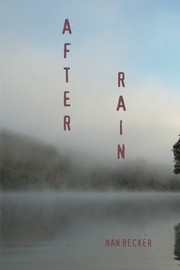
After Rain by Nan Becker

After Rain After RainNan Becker; Elephant Tree House 2011WorldCatLibraryThingGoogle BooksBookFinder 
“After great pain, a formal feeling comes,” wrote Emily Dickinson in one of her most celebrated poems. Many of the poems in After Rain seem to be situated just a little past that “hour of lead,” apparently in the wake of a painful separation or divorce. I say “seem to be” because they are poems of great delicacy and, like the lake pictured on the cover and frequently evoked in the course of the book, often suggest a hidden drama or turmoil beneath their calm surfaces. I was reminded strongly of ancient Japanese court poetry (which I read quite a lot of at university) in the way Nan Becker writes about the natural world, simultaneously celebrating it as a source of beauty and solace and using it as a mirror or metaphor for human emotions. I was so impressed that three hours after my first reading, I picked it up and read it cover-to-cover a second time.

One advantage we moderns have over those ancient Japanese poets is a greatly expanded body of knowledge about the natural world. So in “Dragonfly,” for example, Becker can observe that the eponymous insect “swishes / and skims a still river,” then add that it is

Being, and going on,
under doubled wings
come late in life.

“Migration,” too, is a subject about which we know so much more than even writers a generation ago, enlarging the scope of an age-old wonder:

A pipit flies across the water
into a cover of leaves losing green.
Jays scatter about and shout.

High up, geese score lines south,
speaking of elsewhere—pulled
as water to the moon.

Of course, this attention to the natural order has its pitfalls, too. If you’re writing surrealist poetry, no one will complain if you get some detail “wrong” — poetic license covers it. But the one off-note in this otherwise terrific collection, for me, was the implication in “Pileated Woodpecker” that Dryocopus pileatus is migratory (“Year after year / spring after spring / the Pileated returns”). In fact, the mated pairs stick to their home territories year-round.

That’s a minor quibble, though — just one poem out of 50. Of all the books I’ve read so far this month, I think After Rain has the smallest percentage of poems that just didn’t work for me. Becker is especially good at evoking psychological landscapes, often suggested by little more than the title — “How Farewell Feels,” “Over,” or “Of What Must Have Been”:

What it was,
was some large carp
bouyed upon the water,
—it was a sodden log,
a shade of errant current.

Each true in the weight
of its moment,
real as any thing
on this page.

Elsewhere, the treatment of inner states is more direct and philosophical. Becker compares “The Way Grief Breaks,” for example, to the way “a bird breaks before flight,” which she calls a “sudden loosening.” Another favorite, “Nostalgia,” is worth quoting in full:

While I was not watching at all, I saw
a bear, black as a hole in shadow,
rocking in place, shifting within without,
as if in conversation with the ground,
with words I haven’t yet learned,
a way to ask and answer.

There’s an implicit narrative arc to this book; the poems speak to each other, and the beginning and the end of the collection are carefully constructed to set the scene and offer resolution, respectively. Working my way through the second time, I was moved perhaps more than I should admit, remembering half-submerged things I hadn’t thought about in years. “And what does it mean now,” the narrator of “Redemption” asks, “how / seldom I think of you?” In “Absence,” she wonders, “Is there a plain truth? A clean knowing?” and concludes in the following poem, “Diminuendo”:

This unastonished, unremarkable landscape weighs
almost nothing, which is what is meant by enough.

Quoting blurbs is probably frowned upon by serious book reviewers, but I think Gillian Cummings got it right: Becker’s poems “encompass the world: the world as it exists outside, simply, of itself, and the world as experienced so deeply within the self.” The way After Rain manages to explore both simultaneously is a rare accomplishment for a modern Western poet.

Visit the book’s page on the publisher’s website to read the rest of Cummings’ review, as well as to read three complete poems from the book.