This is all you have, this life, this patch of ground marked by wood and water, a little strand of caterpillar silk caught on low shrubs at the wood’s edge. Everything happens here, or doesn’t happen, or is about to change. Shadows lift at dawn, noon strikes the top of the stone cherub’s head in the middle of the square. Pigeons blend in among the cobblestones. It’s not much, you think: a sleepy town, the cats in the alley, the same old men playing chess in the park; the row of tailor shops, the bakers pitching bread into the fire. The loaves get a little smaller every year, though they remain as sweet. The lovers with only one place to walk. The seawall. The pier. The post office at one end of the main street, the market at the other. Rain drips down every house post and gutter. Flowers and whitewash on grave markers. You can leave if you want, rent a room in some city crisscrossed by wires and steel. On every rooftop, gargoyles opening their mouths to the rain, drinking it all in but never filling, never filled. Crossing the street, you turn, distracted by a scent— flowering wisteria, japonica, spilling their urgent message over a stone boundary. Nothing leaves, merely decants to color, to sediment, to underlying pulse.
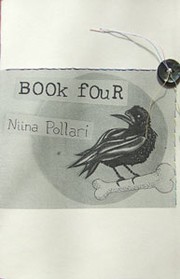
Book Four.Niina Pollari; Hyacinth Girl Press 2011WorldCat•LibraryThing•Google Books•BookFinder
What are we to think of books of poetry that are deliberately odd? Book Four, for example, does not appear to be preceded by Books 1-3 by the same author. The editor/publisher, Margaret Bashaar, has added completely non-functional stitching and a large button to the cover (and varies this from one copy to the next — compare with the photo on the ordering page). And the poems are replete with metaphors and similes that confound rather than elucidate, following a strategy I’ve come to think of as “surrealism squared.”
This was, more or less, the question that Rachel and I found ourselves grappling with this afternoon as we read our way through the collection. I think our most common response was: “I really liked that, but I’m not sure why.” Which is, to my way of thinking, perfectly fine: it’s my reaction to most modern art, for example. Why hold the verbal arts to a tougher standard of immediate accessibility? It definitely helped to have a reading partner, though, to help suss out many of these poems. And reading them out loud clarified not only the aesthetic appeal of the language, but the extent to which the poems do seem to cohere, even if their coherence is not immediately obvious.
That’s a funny thing, because with Gary Barwin the other day, there were a number of poems where the imagery and language appeared to be somewhat random. That wasn’t the case with these poems. Even when we didn’t entirely understand what they were saying, they still seemed to be going somewhere — they had not only energy but gravity and direction.
When it moved like a pterodactyl inside you,
you knew the world you knew was leaving
and left. You tore the world like a ligament
still in you, and still, somehow. In the memorial
plaza of body parts, there are never enough heads.
(p. 21)
Naturally we had our favorites. Let me quote the short poem on page 10 (they’re all untitled) in full:
Turn antisolar. To a hill you’ve never been down.
Thunder and wildness, maybe the end of the world. On the horizon,
a raw wound’s labium: the bristling day blinks shut
like a cat eye, concealing the blaze-bulb pupil. Now that you’ve left it, you know
what home is like.
Pollari returns to a number of images in multiple poems, lending them a certain talismanic quality — and helping to unify the collection. She seems especially fond of edges, pits, oil, birds and secrets. Her landscapes are stark and often frightening, ablaze with visions which she seems unwilling either to affirm or deny: “I contain // an upside-down rain,” says one poem. Another laments “all these inconvenient spells.” An interlocutor sees angels and wants the narrator to share his/her doubts. “You wanted fuck your faulty / eyes, it was nothing like that. Which I couldn’t give.”
I don’t think I’m imagining an environmental consciousness at work in many of these poems — another thing that added to my pleasure. Here for example is how the poem on page 7 begins:
When the green world begins to leak
is when it begins. Someone pours buckets of black oil
into a canal. Liquid clings to things with skins and pores
and feathers, a girl turns white and sick just watching it.
The fact is that the world doesn’t make sense, and it isn’t necessarily the job of poets to invent new stories so we can continue to feed our delusion that we understand much of anything. Sometimes we learn more by living with the questions, even — or especially — when they’re unsettling, and implicate us in the world’s continual undoing.
Watch the broken down TV
in the dark, drink down the dark
malt liquor: it’s nobody’s
fault, we’ve all just stopped
in here, lit as a TV, blooming like tissue
in a trash fire. […]
How does an ecosystem sustain.
Where can I drive to. What sweet
buds do we have left to pick
my love, my love.
(p. 14)
Perhaps the oddness isn’t as deliberate as I thought; perhaps it’s unavoidable. And for all I know, this really is Niina Pollari’s fourth book. I’ll certainly be keeping an eye out for whatever she publishes next.
The thing is, the realization that death is death is immensely comforting. Were there an off-world heaven to which the dead, non-corporeal me was consigned, I’d do my best to obtain conscientious objector status. I love this planet: why would I want to spend a conscious eternity looking at it through a veil of gauzy clouds? Far better to ooze, insensate, into the world, to become part of the tree’s flesh and the coyote’s fur and the bighorn’s helmet.
outdoor lamp, impossible blossom; bronze
target we can never hit dead center
with knives— you clear the ridge
faster than smoke: only your saffron
thumbprint among dust motes in the leaves.
BalanceRobbi Nester; White Violet Press 2012WorldCat•LibraryThing•Google Books•BookFinder
It’s always a relief when a friend’s collection of poems turns out to be terrific. I got this one when it came out a couple months ago, so this morning’s reading was my second time through these poems. And I was even more impressed than I had been the first time.
It helps that I like poetry books that are illustrated and thematically unified. Each of the fifteen poems in Balance describe a different yoga pose, helpfully and adroitly illustrated on facing pages by Nina Canal’s inkbrush paintings. And I think it says something about the quality of the poems that even someone like me with no particular interest in yoga should find them engrossing.
Essentially what these poems do is document a rediscovery of the human body. In “Paschimottanasana,” for example,
I am rowing my boat
along the quiet river.
My ribs open like a magnolia
flower, its stiff white petals
only this morning furled
in the burnished bud.
Legs strung tight as sails,
I hoist myself up …
Or as another poem, “Uttananasana,” puts it:
I am an explorer,
entering the ancient city,
descending into another world.
Nester’s imagery is cosmic — in a Nerudean rather than a New Agey sense. The narrator takes the planet itself, the moon and “the hills / [that] undulate under the clouds like fish / in the shallows” as her teachers; travels back to her childhood to become a “god of volts and ohms” and a “curious dolphin”; imagines herself as aspen and fern fiddlehead, whelk and two-headed snake. Nearly every image feels necessary, and the language is just as terse and taut as one would wish, given the subject matter. These poems are very well-made things.
Much as I liked the illustrations, I can’t help wondering what I would’ve gotten out of the book if I didn’t have them there, not knowing otherwise what the names of the poses mean. What would I have imagined based on the poems alone? Would it have made that big a difference? Maybe not, but I don’t think I’d fully appreciate the lack of arbitrariness in most of the imagery, the precise and delicate fit between metaphor and pose.
My favorite poem is all about fit — which is to say, fitness, if that word can still be redeemed from shallow consumerist notions of the body, in which we are continually exhorted to be more (or perhaps less) and different from what we are. I hope the publisher and author won’t mind if I quote it in its entirety:
Baddhakonasana
These feet have seldom met.
all lifetime long, fated to tread
their single paths on yielding earth,
to press parched soles against
unsympathetic streets, they
desire only new routes, never
dreaming what they truly seek.
Yet arch to arch, each toe
pressing its long-lost opposite,
these feet have met their match.
Bound in a forced embrace, they find
a blessing in this union, welded
in a prayer to all things lost,
to what was always there.
Too many of us literary types spend too much time in our heads — I know I do — and in any case distraction is urged upon us from all directions, even (I’m told) at the gym, where screens beckon and iPods abound. That must be why I found this collection so refreshing. I’m only sorry it wasn’t longer. By poem 15, I can feel my breathing beginning to slow and deepen. Lord knows how fit, how well-balanced and rooted in my body and in the cosmos I’d feel after 15 or 20 more.
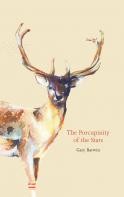
I’ve been dipping into The Porcupinity of the Stars off and on for a week now, and when I went to read it in a more methodical fashion this morning, I was a little abashed to realize how heavily my poem of last night, “Garden Party,” had been influenced by Barwin’s imagery. There’s no mystery where that nearly forgotten memory of buried TVs came from: the book fairly bristles with images of televisions and burial, and even the burial of televisions. Here, for example, is “Planting Consent”:
I carried my TV down the stairs
buried it on a hill
with a beautiful view
by spring a small antenna
sprouted in that place
somewhere under the earth
wispy clouds and the wingbeats of birds
Barwin is a surrealist, as this example demonstrates, and my favorite poems in the book were those that explored just a few images, as “Planting Consent” does. Some of the poems failed to cohere for me — which isn’t to say I didn’t still enjoy reading them. More than anything else, this book is fun, and even the craziest or most experimental poems have memorable lines and images. For example, the opening stanza of “A Roof Floored” —
the stone hopes for flight
the way a goose
wants power chords
— made me chuckle, thinking of Aldo Leopold’s treasured “goose music” turned into heavy metal. And I loved its closing lines, too:
we sit before the mirror
use night as a balast
So my inability to make complete sense of the poem as a whole is almost beside the point. I’ve read countless more accessible poems that didn’t make as big an impression.
Surrealism often serves decidely bleak poetic visions — I’ll be blogging at least one example later this month — but Barwin’s vision in these poems seems more comic than tragic. When dismemberments occur, they are more in the spirit of Rabelais than Goya. Nor is the comic worldview unequal to the global crises of the 21st Century, as Barwin shows in poems such as “We Are Family”:
an organism which sleeps
soft as a cloth
a baby in a bed full of babies
and the earth full of babies
“Glacier”:
I wake and switch on the bedside light
there’s a glacier in my bed
ice, it says
snow, it says
it turns and presses its cold mouth on mine
and “Shopping for Deer”:
when I die, I will remember the deer
I will remember its wheels and antlers
I will remember its flesh and lightning
its womb of silver bones
The title poem was a bit of a disappointment, being entirely too random for my taste, but the longer poem immediately preceding it, “Small Supper,” was a masterpiece, beginning with what I took to be a variation on the age-old conflation of human souls with birds — “we placed our shadows inside birds / where they couldn’t be found” — and ending with “a bird’s small shadow … in my chest”. Even in such a potentially serious poem, though, humor crackles in lines such as “The shadow of a shadow / is my friend” and “it’s not so much that Polly wants a cracker / but that the lark wants its small supper of sky”.
Barwin employs a large vocabulary of cultural references, ranging from the Old Testament to jazz to, in one poem, “old testament jazz.” I read a number of these poems to my friend Rachel, who felt that some of them evoked for her — and perhaps betrayed the influence of — specific surrealist painters. They’re certainly very vivid. I guess my take-away impression is of a wildness that seizes and infects, an ensorceling that is by turns grotesque and cybernetic.
I’ve barely begun to quote my favorite poems from the book; suffice it to say I’ll be returning to it often. I do want to mention one other thing about it that pleased me: it’s printed on very good quality paper, the kind with a grain. (Sorry, I don’t know much about paper!) So while the publisher does offer ebook options, I’d recommend paying a few dollars extra for the print edition. Also, it may not be apparent from the small image above, but the deer on the cover is wearing athletic socks. Which is almost as cool as the deer in the video Barwin made: