
Deconversion

(Office day). This day my father came to dine at my house, but being sent for in the morning I could not stay, but went by water to my Lord, where I dined with him, and he in a very merry humour (present Mr. Borfett and Childe).
At dinner: he, in discourse of the great opinion of the virtue—gratitude (which he did account the greatest thing in the world to him, and had, therefore, in his mind been often troubled in the late times how to answer his gratitude to the King, who raised his father), did say it was that did bring him to his obedience to the King; and did also bless himself with his good fortune, in comparison to what it was when I was with him in the Sound, when he durst not own his correspondence with the King; which is a thing that I never did hear of to this day before; and I do from this raise an opinion of him, to be one of the most secret men in the world, which I was not so convinced of before.
After dinner he bid all go out of the room, and did tell me how the King had promised him 4000l. per annum for ever, and had already given him a bill under his hand (which he showed me) for 4000l. that Mr. Fox is to pay him. My Lord did advise with me how to get this received, and to put out 3000l. into safe hands at use, and the other he will make use of for his present occasion. This he did advise with me about with much secresy.
After all this he called for the fiddles and books, and we two and W. Howe, and Mr. Childe, did sing and play some psalmes of Will. Lawes’s, and some songs; and so I went away.
So I went to see my Lord’s picture, which is almost done, and do please me very well.
Hence to Whitehall to find out Mr. Fox, which I did, and did use me very civilly, but I did not see his lady, whom I had so long known when she was a maid, Mrs. Whittle. From thence meeting my father Bowyer, I took him to Mr. Harper’s, and there drank with him. Among other things in discourse he told me how my wife’s brother had a horse at grass with him, which I was troubled to hear, it being his boldness upon my score.
Home by coach, and read late in the last night’s book of Trials, and told my wife about her brother’s horse at Mr. Bowyer’s, who is also much troubled for it, and do intend to go to-morrow to inquire the truth.
Notwithstanding this was the first day of the King’s proclamation against hackney coaches coming into the streets to stand to be hired, yet I got one to carry me home.

Ice is a house I could
not stay in, the answer to
a tune I never hear.

Tell me how I promise forever
in the present, with fiddles and songs
and an old horse at grass.

Which trouble
is the truth, coming into the streets
to stand?


Erasure poem derived from The Diary of Samuel Pepys, Wednesday 7 November 1660.
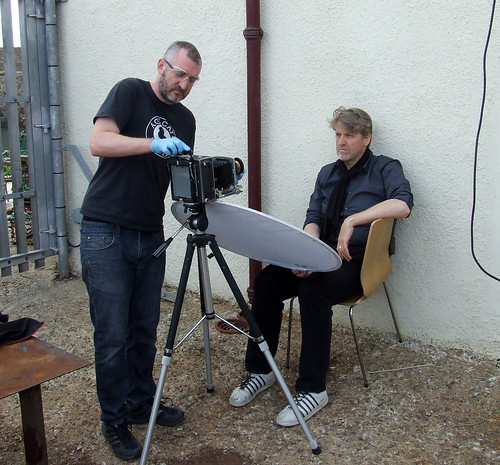
Ancestral photography

Alastair Cook prepares wet plate to photograph Marc Neys
Alastair Cook prepares a wet plate to photograph Marc Neys

The photographer dons safety glasses and blue rubber gloves. His friend the other photographer takes his glasses off and sits for his tintype, the back of his head pressing a cup to the wall. In his lap, the tilted reflector like an absent-minded mirror that has forgotten how to hold an image. Meanwhile, the wet plate primed with chemicals slides into the camera and waits for the takeaway, its quick supper of shadows.

photographer as mummer
the photographer as mummer

Assistants hold a black cloth behind the sitter’s head. The photographer assumes his crouch, a red hood cloaking his moment of intimacy with the camera. Only the bellows and brass eye protrude, like the horse-skull head of a Mari Lwyd without the grin.

Rachel sitting for her tintype portrait

To a sitter who has practiced meditation, the enforced and urgent stillness feels familiar.

finished tintypes sit in water
finished tintypes of me and Marc sit in the water

Then follow the photographer down to the darkroom and watch your face emerge like Lazarus from the murk. Warm colors appear dark and cool colors light, due to the wet plate’s appetite for blues. No negative intercedes.

The details are so fine and the eyes so strange, you startle. You have seen this face before in a gilt frame. Except that your ancestors wore high, starched collars to try and hide the shame of sunburnt necks, and here you are in t-shirt and ball cap, wearing an expression you can’t begin to read.

Chance: Six More From a Tarot

This entry is part 11 of 13 in the series Chance: A Poetic Tarot

61

On the grass before
noon: a hundred circles
with the sheen
of pearl—

62

Such grit
that roughens
the dwelling-
place of years—

63

And if I hardly
gave you gifts,
that is their
rarity.

64

A metal
goblet will
hold water
colder.

65

Tears are a sign
the body misses
its last warm
appointment.

66

The sky’s wide
boat, this seat
under the tree
that silvers me—


In response to Via Negativa: Oysterous.

Oysterous

In the morning with Sir W. Batten and Pen by water to Westminster, where at my Lord’s I met with Mr. Creed. With him to see my Lord’s picture (now almost done), and thence to Westminster Hall, where we found the Parliament met to-day, and thence meeting with Mr. Chetwind, I took them to the Sun, and did give them a barrel of oysters, and had good discourse; among other things Mr. Chetwind told me how he did fear that this late business of the Duke of York’s would prove fatal to my Lord Chancellor.
From thence Mr. Creed and I to Wilkinson’s, and dined together, and in great haste thence to our office, where we met all, for the sale of two ships by an inch of candle (the first time that ever I saw any of this kind), where I observed how they do invite one another, and at last how they all do cry, and we have much to do to tell who did cry last. The ships were the Indian, sold for 1,300l., and the Half-moon, sold for 830l..
Home, and fell a-reading of the tryalls of the late men that were hanged for the King’s death, and found good satisfaction in reading thereof.
At night to bed, and my wife and I did fall out about the dog’s being put down into the cellar, which I had a mind to have done because of his fouling the house, and I would have my will, and so we went to bed and lay all night in a quarrel. This night I was troubled all night with a dream that my wife was dead, which made me that I slept ill all night.

I took a barrel of oysters
and observed how they cry:
An Indian sold the moon.
Men were hanged for a dog
fouling the bed. All night
I dream that my wife
made me ill.


Erasure poem derived from The Diary of Samuel Pepys, Tuesday 6 November 1660.

Chance: Six More From a Tarot

This entry is part 10 of 13 in the series Chance: A Poetic Tarot

55

Curved timber
cruck, arms of wood
meeting at the center:
a holding in or out.

56

Flowering
storm, larger
than the compass
of an archipelago.

57

Briefest brush
of mouth to ear or chin:
one leaf to tell of how
I’ve missed you.

58

Rooster crowing
in the yard: a caravan,
our caravan of ragged
belongings!

59

Hands and mouths
to help us empty
storehouses filled
with grain and sound.

60

In the barn
I found a book
held open: a planet
with one rose.


In response to Via Negativa: Tithe Barn.

Schadenfreudian

(Office day). Being disappointed of money, we failed of going to Deptford to pay off the Henrietta to-day.
Dined at home, and at home all day, and at the office at night, to make up an account of what the debts of nineteen of the twenty-five ships that should have been paid off, is increased since the adjournment of the Parliament, they being to sit again to-morrow. This 5th of November is observed exceeding well in the City; and at night great bonfires and fireworks. At night Mr. Moore came and sat with me, and there I took a book and he did instruct me in many law notions, in which I took great pleasure. To bed.

Disappointed
at home and at the office
I count ships

and at night, fires,
many in which I took
great pleasure.


Erasure poem derived from The Diary of Samuel Pepys, Monday 5 November 1660.

Chance: Six More From a Tarot

This entry is part 9 of 13 in the series Chance: A Poetic Tarot

49

Pebble by pebble
it becomes
possible to widen
the river’s eddy.

50

On its banks
tall grasses hide
such monuments
of sound.

51

Listen in
the deep of night:
what softens
the cheek of silence?

52

Do not say
farewell— this
bridge is not
for burning.

53

I miss most
the flavor
of mornings
at ease.

54

First the dough
must rise; you punch
it down so doubled,
it can rise again.


In response to an entry from the Morning Porch.

Dark Angelic Mills

(Lord’s day). In the morn to our own church, where Mr. Mills did begin to nibble at the Common Prayer, by saying “Glory be to the Father, &c.” after he had read the two psalms; but the people had been so little used to it, that they could not tell what to answer. This declaration of the King’s do give the Presbyterians some satisfaction, and a pretence to read the Common Prayer, which they would not do before because of their former preaching against it.
After dinner to Westminster, where I went to my Lord’s, and having spoke with him, I went to the Abbey, where the first time that ever I heard the organs in a cathedral! Thence to my Lord’s, where I found Mr. Pierce, the surgeon, and with him and Mr. Sheply, in our way calling at the Bell to see the seven Flanders mares that my Lord has bought lately, where we drank several bottles of Hull ale. Much company I found to come to her, and cannot wonder at it, for she is very pretty and wanton.
Hence to my father’s, where I found my mother in greater and greater pain of the stone. I staid long and drank with them, and so home and to bed. My wife seemed very pretty to-day, it being the first time I had given her leave to wear a black patch.

Mills nibble at prayer.
So little satisfaction!
I hear organs and a bell,
and wonder at the pain of the stone.


Erasure poem derived from The Diary of Samuel Pepys, Sunday 4 November 1660.

Chance: Six More From a Tarot

This entry is part 8 of 13 in the series Chance: A Poetic Tarot

43

Madam, I’ll serve
your interests,
contingent on
your currency.

44

A pearl will do
as well as a bond—
The first one heralds
a string: loss leader.

45

Implacable
promise: your word
on this piece
of paper.

46

Twilight
of perforations
that we call
stars—

47

Have a seat
at my table
and tell me what
you would not eat.

48

On the Day
of the Dead, we collect
the softest bones
of tallow.


In response to an entry from the Morning Porch.

Single-handed

Saturday. At home all the morning. In the afternoon to White Hall, where my Lord and Lady were gone to kiss the Queene’s hand.
To Westminster Hall, where I met with Tom Doling, and we two took Mrs. Lane to the alehouse, where I made her angry with commending of Tom Newton and her new sweetheart to be both too good for her, so that we parted with much anger, which made Tom and me good sport. So home to write letters by the post, and so to bed.

Sat all afternoon on the hand
I took to the alehouse,
where I made her and her sweetheart part
and go home to write.


Erasure poem derived from The Diary of Samuel Pepys, Saturday 3 November 1660.