Birds Nobody Loves by James Brush

Birds Nobody Loves Birds Nobody Loves: A Book of Vultures & GracklesJames Brush; Coyote Mercury Press 2012WorldCatLibraryThingGoogle BooksBookFinder 
This evening was our local Audubon chapter’s annual spring banquet, featuring a presentation called “Confessions of a Reluctant Birder” by naturalist-blogger Jennifer Scott Schlick, so how better to prepare myself this morning than by reading another blogger-friend’s graceful and entertaining new book of poems about grackles and vultures? James Brush is from Austin, Texas, where grackles are almost as despised as the Texas state legislature, though I think they are in session at least twice as often. Years ago, when my brother Mark was getting his M.A. from the University of Texas, I took the bus down to visit him a couple of times and was deeply impressed by the size of the grackle flocks and the variety of interesting sounds the birds could produce. Watching them come into roost along the riverbank at dusk was an impressive sight, rivaling as a spectacle the emergence of the Mexican free-tailed bats from underneath the Congress Avenue Bridge on the other side of the river. Oddly, though, few of the people gathered to wait for the bats did more than glance in the grackles’ direction. Why not?

James Brush’s poems offer a few clues. A humorous haibun, “The Grackle Tree,” begins: “After a few days under the grackle tree, the blue sedan began to develop a white pox, which spread with each passing night.” People fire shotgun blanks into the tree with little effect, and

After a month, no one remembered what color the car had been, and no one ever discussed its owners or what became of them.

grackle tree
boughs shake and chatter
at the cars

Brush uses hyperbole to good effect. In one poem he imagines fundamentalists from Kansas coming down to Austin to demonstrate with signs that read “God hates grackles.” In another, “Quiscalus Mexicanus,” the Mexican great-tailed grackles come under fire on right-wing talk radio:

Grackles are socialists. They weren’t born in the U.S. Grackles do what Hitler did. Shouldn’t even call ’em passerines; they’re not even birds. Sub-birds at best.

Another poem describes the reactions of various people when Brush tells them his greyhound Joey ate a grackle: “Yuck, but your dog will be fine,” says animal emergency. “Ewww,” says another veterinarian. And a friend relishes the dog’s new appetite: “Thank goodness. Grackles are awful.” For his part, the author simply notes how much more attentive Joey has become to his daily filling of the fird feeders. Dog and master share a new tie, bound by their appreciation for this “bird nobody loves.”

Grackle poems alternate with poems about turkey vultures and black vultures — both species that we have here in central Pennsylvania, as well. I don’t know that these birds are as disregarded by serious birders as Brush says they are in Texas, perhaps because we’re on the Eastern Flyway and people at the spring and autumn hawk watches tally migrating vultures with as much enthusiasm as anything else. Also, there’s nothing more elegant in flight than a turkey vulture, its wings curved up in a very shallow V, rocking back and forth in the wind or circling on thermals but rarely flapping. Brush captures some of this grace in his micropoem sequence, “A Committee of Vultures”:

shadows
across a brown field
vultures       circling

[…]

in a cloudless sky
a vulture circles the prairie
seeking an ending

Of course, vultures can be somewhat repulsive, too: “We shit on our own feet,” begins “Creed for Cathartes Aura.” And black vultures clustered around a corpse seem to be plotting how to hone their predatory skills.

Straightening their ties, they discuss
elaborate plans to go public. Someday,
they claim, they will become hawks or eagles.
(“Good Authority”)

Since some of the poems are autobiographical, I couldn’t help wondering whether Brush might’ve put a bit of himself in “Lines Discovered in an Aging Ornithologist’s Field Journal”:

When the end comes, don’t
plant me in the ground, trapped
in just one piece of earth.

Why not leave me by
the highway for the vultures
and maybe for the crows
who will take my unseeing eyes.

Then, at last, I could soar,
finally fly on dusky wings
outstretched,

buried in the sky.

This is a fun book, and light-weight enough to slip easily in a knapsack with the field guides.
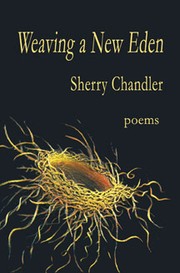
Weaving a New Eden by Sherry Chandler

Weaving a New Eden Weaving a New EdenSherry Chandler; Wind Publications 2011WorldCatLibraryThingGoogle BooksBookFinder 
Weaving a New Eden is two books in one, with an additional prologue and epilogue. The first major section, “The Grandmothers,” consists of poems about — and mostly in the voices of — the author’s female ancestors, who were pioneers and rural women in the hills and hollows of Kentucky. This is followed by “The Frontier,” which reimagines the life of Rebecca Boone, Daniel’s wife. In addition to the common setting, Chandler uses the imagery of weaving to connect these sections into a more cohesive whole, as she points out in her prose introduction.

I also found myself writing weaving forms of poetry — sestinas, pantoums, a sonnet crown — and I consider the weaving chorus of voices in “The Grandmother Acrostics” a tapestry of Kentucky history.

Chandler’s mastery of poetic forms is rivaled only by her command of Kentucky history and genealogy. And when I say “mastery,” I mean she makes it seem effortless. In less expert hands, the exigencies of poetic forms sometimes force odd constructions and word choices, which can of course be made to seem edgy or hip — it’s always easier to be difficult than to be clear. But there’s no way such an approach would’ve worked with poems about what the Foxfire books used to call “plain living.” “How to Cook a Chicken,” for example, for all that it conforms to the intricate arrangement of a traditional sestina, never deviates from plain-spokenness. Here’s the penultimate stanza:

Disjoint the legs, first step in cutting up a chicken,
bend the thigh joint till the bones shine through the skin
like a knuckle, aim the shining edge of the dark
blade at the highest, whitest part, cut. Plunge
blade into flesh at the breastbone’s high point, dress
out the wishbone, later to be split by daughter’s hands.

This unforced quality was equally present in the aforementioned “Grandmother Acrostics,” a 10-page, 17-poem sequence that was the high point of the book for me, and easily could have made a satisfying chapbook by itself. And many of the women whose voices we hear in this sequence also appeared in other poems earlier in the section, adding to the impression of interwovenness.

Chandler isn’t just a traditionalist, though: the book includes two found poems, as well, suggesting perhaps the influence of Charles Reznikoff. One was a series of postcard messages from her grandmother on a Greyhound bus trip out to California in 1957, with “original spelling and grammar transcribed as written.” Given the “lost Eden” theme of the book, “Card 8: Greetings from Paradise” seemed especially resonant:

Then on October 9 Elezbith Aunt Nanie Mae
and I went to Pardise
we saw the gold Minds
and Elezbith and I helt hands and looked down in the minds

Throughout the book, Chandler is keen to give voices to the overlooked and forgotten, both among her own ancestors and in the more well-known narratives from Kentucky history: a nameless “old Dutch woman” from an Indian captive story; a slave woman named Dolly; the Boone family cat; the mysterious Ellen Tingle whose name, birthplace, number of children, appearance and manner of death have all been forgotten by her descendents. I was fascinated to see how Chandler dealt with the gaps in knowledge. The cat plays its bit part, mentioned in the chronicles,

Then Jemima came running in. “Daddy!” she cried
and I disappeared again into the fogs of history.

“Calloway’s Dolly” and “The Old Dutch Woman” both actively question the official record — how reliable can it be, if it couldn’t even supply them with proper names? The latter refuses to confirm or deny whether she harbored cannibalistic impulses toward her more famous fellow escaped captive Mary Draper Ingles, as Ingles claimed.

She says I tried to murder her. She says
I wanted to eat her. That may be true.
[…]
I could blame it on the roots we dug.
Who knows what poison we ate to stop our guts
from cramping. I could blame the bloddy flux,
the fever. Or I could blame the story. Always
the strong hero must have a weak companion.

Ellen Tingle protests more plaintively about the forgetfulness of her descendents:

They’ve forgotten how I looked, how I smelled, how
I held them against my heart and kissed away their fears.
No, surely once I tingled in Ben Lusby’s blood.
Give me that.

Even “Rebecca Boone’s Loom Has Its Say” in a six-stanza pantoum:

Though Boone’s Ticklicker wove the tales men love,
those Long Knives would turn tail with breechless butts.
My cloth provided cover for a conquest.
Wilderness can’t be tamed when men run bare.

Historical poetry is a fascinating genre. As with historical fiction, the leeway it provides for the exercise of the author’s imagination can make the past come to life in a way it seldom can in straight history. I’ve certainly read books of historical and biographical poetry that were more lyrical, more rich in metaphor and simile than Weaving a New Eden, but I can’t remember any that felt as comprehensive, or wove together as many different moods and modes: comic as well as lyric, elegy as well as ballad, limerick, ode. Reading it in one sitting, out loud, as I did this afternoon, might not be the best way to take it in, however. Its complex tapestry rewards the slow and attentive reader.

After Rain by Nan Becker

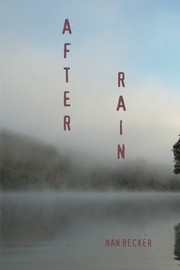
After Rain After RainNan Becker; Elephant Tree House 2011WorldCatLibraryThingGoogle BooksBookFinder 
“After great pain, a formal feeling comes,” wrote Emily Dickinson in one of her most celebrated poems. Many of the poems in After Rain seem to be situated just a little past that “hour of lead,” apparently in the wake of a painful separation or divorce. I say “seem to be” because they are poems of great delicacy and, like the lake pictured on the cover and frequently evoked in the course of the book, often suggest a hidden drama or turmoil beneath their calm surfaces. I was reminded strongly of ancient Japanese court poetry (which I read quite a lot of at university) in the way Nan Becker writes about the natural world, simultaneously celebrating it as a source of beauty and solace and using it as a mirror or metaphor for human emotions. I was so impressed that three hours after my first reading, I picked it up and read it cover-to-cover a second time.

One advantage we moderns have over those ancient Japanese poets is a greatly expanded body of knowledge about the natural world. So in “Dragonfly,” for example, Becker can observe that the eponymous insect “swishes / and skims a still river,” then add that it is

Being, and going on,
under doubled wings
come late in life.

“Migration,” too, is a subject about which we know so much more than even writers a generation ago, enlarging the scope of an age-old wonder:

A pipit flies across the water
into a cover of leaves losing green.
Jays scatter about and shout.

High up, geese score lines south,
speaking of elsewhere—pulled
as water to the moon.

Of course, this attention to the natural order has its pitfalls, too. If you’re writing surrealist poetry, no one will complain if you get some detail “wrong” — poetic license covers it. But the one off-note in this otherwise terrific collection, for me, was the implication in “Pileated Woodpecker” that Dryocopus pileatus is migratory (“Year after year / spring after spring / the Pileated returns”). In fact, the mated pairs stick to their home territories year-round.

That’s a minor quibble, though — just one poem out of 50. Of all the books I’ve read so far this month, I think After Rain has the smallest percentage of poems that just didn’t work for me. Becker is especially good at evoking psychological landscapes, often suggested by little more than the title — “How Farewell Feels,” “Over,” or “Of What Must Have Been”:

What it was,
was some large carp
bouyed upon the water,
—it was a sodden log,
a shade of errant current.

Each true in the weight
of its moment,
real as any thing
on this page.

Elsewhere, the treatment of inner states is more direct and philosophical. Becker compares “The Way Grief Breaks,” for example, to the way “a bird breaks before flight,” which she calls a “sudden loosening.” Another favorite, “Nostalgia,” is worth quoting in full:

While I was not watching at all, I saw
a bear, black as a hole in shadow,
rocking in place, shifting within without,
as if in conversation with the ground,
with words I haven’t yet learned,
a way to ask and answer.

There’s an implicit narrative arc to this book; the poems speak to each other, and the beginning and the end of the collection are carefully constructed to set the scene and offer resolution, respectively. Working my way through the second time, I was moved perhaps more than I should admit, remembering half-submerged things I hadn’t thought about in years. “And what does it mean now,” the narrator of “Redemption” asks, “how / seldom I think of you?” In “Absence,” she wonders, “Is there a plain truth? A clean knowing?” and concludes in the following poem, “Diminuendo”:

This unastonished, unremarkable landscape weighs
almost nothing, which is what is meant by enough.

Quoting blurbs is probably frowned upon by serious book reviewers, but I think Gillian Cummings got it right: Becker’s poems “encompass the world: the world as it exists outside, simply, of itself, and the world as experienced so deeply within the self.” The way After Rain manages to explore both simultaneously is a rare accomplishment for a modern Western poet.

Visit the book’s page on the publisher’s website to read the rest of Cummings’ review, as well as to read three complete poems from the book.

Night Fish by Kristine Ong Muslim

Night Fish Night FishKristine Ong Muslim; Shoe Music Press/Elevated Books 2011WorldCatLibraryThingGoogle BooksBookFinder 
It was only after I finished this chapbook that I realized how peculiarly appropriate it had been to read a book of 13 poems on Friday the 13th. I had thought of Stevens’ blackbirds, but not luck or the lack thereof.

In creating a page for the book at Open Library, I discovered that it had already been ably reviewed five times (should we shoot for thirteen?) which, I thought, rather relieved me of the responsibility of saying anything significant. (I’ve linked them all on the main book page.) But it’s an extraordinary record for a slim book without an ISBN, or any publication info at all aside from the URL on the back cover.

Design-wise, this chapbook has a split personality: the cover design and artwork (by Gordon Purkis) are pleasing, but the interior is a horror: a thin monospace font that’s tiring to read, especially since the commas are hard to distinguish from the periods.  I sat in the strong sun with it, tilting the pages a little to keep the glare manageable.

I liked the majority of the poems. They tend to have unusual premises, which most of the time takes them in interesting directions. “From now on, there will never be any flat land,” the title poem begins, and continues for thirteen lines (though it may be a prose poem; the left-justified, narrow text column makes it impossible to tell), concluding: “The sound of oars cutting the water / clean will be the most familiar sound in the / universe.” This is followed by “Night Swimmer,” which is “after Max Ernst’s ‘Aquis submersis’,” and concludes: “Sometimes, one plunge is enough / to cut the water clean, the splash / merely an afterthought.” So there’s a lot of call-and-response between the poems. Another aquatic one, “Hypergraphia,” is followed by “Heat Stroke,” for example, which begins with hell viewed from above, and ends with yet another reference to the watery theme: “Heat presents itself in the form of waves / melting the world away. Squandering nothing.”

My favorite poems, the ones where I penciled little check-marks in the corners of the pages, were all in the second half. In “House Guest,”

I enter the door marked
for strangers only.

Behind me,
autumn shrinks…

And in the poem that follows it, “December,” the protagonist has become even more of a stranger to herself, concluding from the dense fog of breath coming out of her mouth that she is not alone in her body, but “a sieve for / the soul fermenting inside.” This takes us straight to “Falling,” a kind of how-to for people who find themselves falling from tall buildings. It is, as the kids say, full of win. I’ll just quote a bit of it:

You will notice that the side of the building
has been streamlined to keep its insides
from spilling on the sidewalks.
[…]
A distraction of happiness, a memory perhaps
makes you look away from the ground.
You imagine strolling
on the street below. …

And the poem ends not in the expected manner but with “you” walking away — in imagination, while still falling.

It occurs to me that almost all the protagonists in these poems are in the process of acclimatizing to extreme conditions. The book therefore assumes an almost prophetic tone for the environmentally minded reader, whether or not that had been the author’s intention. Immediately after “Falling,” we have “Extremities,” which recounts
a nightmare vision of limbs reaching out to other limbs ad infinitum, with bodies reduced to noting more than pairs of limbs. A nightmare of inter-connectedness — hmm. Seems familiar, somehow!

Can art save us, or “Dream Villages” with cotton-candy clouds? Muslim seems skeptical. “Art is repulsion floating in a bowl of soup. / Sometimes, it is the soup.” May I have some more, then? Night Fish definitely whetted my appetite. This is one up-and-coming poet who isn’t just dabbling in surrealism because it’s fashionable.

Signals by Ed Madden

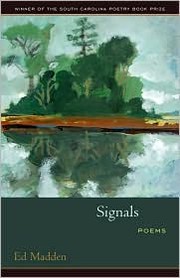
Signals SignalsEd Madden; University of South Carolina Press 2008WorldCatLibraryThingGoogle BooksBookFinder 
I was very lucky that I got to read about three-quarters of this book to Rachel over Skype this afternoon, because the high craftsmanship of these poems really emerges when you read them out loud. Try reading, for example, this passage from “Coastal” about fiddler crabs:

They skitter
sideways, claws raised. The ground is riddled

with burrows, claws extruding. The claw comes out
first—an attitude. Lights come on in the house

behind me. I lift a crab shell, cracked open,
sun-bleached chitin, its ridges crisp and unbroken,

dry husk of history, the inside still pearlescent.
My step raises a hundred claws of threat.

And notice how Madden slipped in that phrase “dry husk of history” without making it sound at all sententious? This is a good example of the kind of mischief he’s up to in this book, his first full-length collection but already the work of a mature poet who knows exactly what he’s doing. The book won the South Carolina Poetry Prize, and appropriately so: many of the poems are set in his adopted state of South Carolina, and he tackles issues of race and sexual orientation in the deftest possible manner. “Coastal” appears in the most explicitly political section of the book, and is the second of a pair of poems in the middle of that section that both hearken back to the calmer waters at the beginning of the book, while also suggesting the degree to which political awareness and activism can color our perceptions of even the most innocent of scenes: a white wedding, a walk along the beach of a barrier island. Here’s how that poem concludes:

A stomp sends them scuttling thru the grass.
I imagine crushing one—the crunch of carapace,

small gush of guts in my fist. And if
I dropped it in the dark, others would find it,

their claws tugging at bits of brother meat.

I got to know Ed Madden originally through an email correspondence about The Morning Porch, and his own attention to the natural world is in evidence throughout the book. I like poets who know the names of things, and I like books that begin outdoors and get the reader situated in the landscape before anything else. Like the Sherry O’Keefe chapbook I blogged about yesterday, this is (mostly) autobiographical, place-based poetry at its finest. Not all the poems are set in South Carolina; in the middle section, Ed and his partner Bert travel to exotic places such as Paris and Pennsylvania (the Mütter Museum!) and in the final section, a couple poems take us back to the author’s childhood in Arkansas.

At the AWP conference in Chicago last month, I attended a panel discussion moderated by the editor of Orion about how poets might write about politics without getting terminally didactic. It was called, I think, “Not With a Bang But a Whisper,” and included Dorianne Laux and Lia Purpura, as well as some great back-and-forth with the audience. I think Madden should’ve been on that panel; certainly his poems follow two of the panel’s strongest recommendations (if I remember correctly): keep it personal and write from where you live (Laux), and cultivate a quality of attention that lets you notice suffering and respond in a human manner (Purpura). And Signals suggests a third strategy: arrange your poems carefully for maximum impact. Madden’s understated attention to natural and human details throughout the book builds up a reservoir of trust in the reader, preparing one to listen more receptively to the awkward truths about race relations in the last part of the book: poems such “Roots: an Essay on Race,” and “Here, or the White Boy on the Bus.”

The latter poem recounts an incident where the African American civil rights and gay rights activist Bayard Rustin gets arrested for refusing to move to the back of a bus in 1942 — a decade before Rosa Parks. Madden personalizes the poem by addressing Rustin in the second person, then imagines himself as the white kid he singled out as he was being led away (“If I move, this child / will not know that injustice is taking place / here”).

I watch

the police lift you from your seat—
Bayard, black angel, troublemaker—

force you to the street. The bus pulls away,
folks turn back to their business,

a white man takes the seat, looks at
that boy, wondering what he knows.

And wondering, it seems to me, is precisely where the understated political poem derives its power, a power so often squandered by those who deal mainly in outrage and don’t let time’s alembic work its magic. You have to preserve some core of wonder or you risk the calcifying of your politics along with your poetry, I think. In the final part, “Transom,” of the somewhat ironically titled “Three Poems on Politics,” Madden focuses at first on “A vase of tulips … pink / anomalies on a table filled with tracts.” Then:

The question that we’re sniffing toward,
said the old black man, is this:

Can capitalism reform itself?
The window above the door is dark—

a thin transparent film to screen
the light. The sun is bright outside.

The clouds boil in slow swirls.

Over the transom they sneak their hard questions in, these poems. I expect they’ll stay with me for a long time.

Making Good Use of August by Sherry O’Keefe

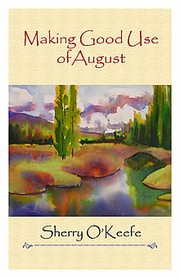
Making Good Use of August Making Good Use of AugustSherry O’Keefe; Finishing Line Press 2009WorldCatLibraryThingGoogle BooksBookFinder 
I read two chapbooks today, of which this was the second and much the more profound despite its lack of pretention (which the other had in spades). I’ve gotten to know Sherry’s writing through her blog, too much august not enough snow, which is consistently wonderful. This book of poems — her first — was no different. Like her nonfiction, her poetry is lyrical, narrative, and deeply rooted in a landscape that most of us think of as a vacation destination, when we think of it at all, but Montana is O’Keefe’s ancestral home. And while she clearly loves the land and spending time outdoors, she doesn’t try to pretty it up. When she was a kid, and her own family struggled to get by, a school-bus friend

lived in a shack with a two inch gap
around the front door. Dark winter mornings
kerosene light leaked out. She stayed warm
by wearing three dresses while she slept.
She told me she switched them so it seemed
as though she changed her clothes.
(“Bus 16”)

O’Keefe’s tales are often laconic and leave the reader with some work to do, which I like. I had to mull over “Approaching Strangers” for a couple of minutes after I read it, and I’m still not entirely sure I understand what the protagonists were up to.

He tells us he is lost.
I reach through the window as though to draw
a map in the margin of yesterday’s newspaper.
How to get to where you never wanted to go.

Add to this necessity of sitting with the poems for a little while to unpuzzle them, the sheer variety of ways in which O’Keefe plumbs the mysteries of human motives, and the book ends up seeming much longer than its 25 pages; there’s a spaciousness to it. What exactly is “the story behind my neighbor’s blue spruce,” you may find yourself wondering on first read of the piece so titled. Does she in fact cut down the tree as she seems to want to, and if so, why? Then the fact that it’s a blue spruce begins to sink in…

I’ve been re-reading the Icelandic sagas lately, something I do every few years, and marveling as I always do that such great works of literature could’ve emerged from a land so rural and thinly settled that there was not a single village, let alone a market town or city — things we tend to assume are essential for literary culture to thrive. But perhaps extreme landscapes select for unique and extraordinary characters. In her bio, O’Keefe “credits/blames her Irish heritage for her story-telling ways,” but what made her ancestors choose to stay in Montana?

For as anyone who’s ever grown up way out in the country can tell you, leaving isn’t hard. It’s choosing to be content where you are that requires a little extra grit. I agreed with “Gas Station Guy.” He likes to describe the weather in terms of distant places:

“There is a touch of Seattle
in the air today, but tomorrow Phoenix
will blow in.” He shook his head ‘no’ when I asked
if he ever wished he could breathe
the real Pacific air, feel the Arizona heat. The trick
to life, he said, is to like it where you live.

In “The Way My Wipers Work,” a cloudburst forces the protagonists to pull over because the windshield wipers in her old pickup truck stop working, as they are wont to do. The travelers decide to take shelter under a tarp in the bed “to listen and share shivers.” In this poem, as in the title poem, a broken thing is regarded as source of good fortune: the couple gets closer under the tarp.

The wind
jostled and the rain dumped down. Thunder
snapped around us. I curled into his quiet
faith of living head-on, trusting
in the storm.

Making Good Use of August, too, is a book to curl up with. I don’t know if I’ll ever get to visit Yellowstone country for real, but reading O’Keefe seems like the next best thing.

Almost “Almost Invisible” by Mark Strand

Almost invisible Almost invisibleMark Strand; Alfred A Knopf 2012WorldCatLibraryThingGoogle BooksBookFinder 
Let’s say that night has come and the wind has died down and a male cardinal, his iconic crest and red feathers invisible in the darkness, flutters overhead in the portico rafters as you step outside and pass quickly to the garden walk beyond to avoid getting shat on, and the noise of the wings reminds you of the riffling of pages by a disappointed reader of a new book, ordered in hardcover because it was on sale at Amazon and how could you go wrong with such an author, who once served as Poet Laureate and who translated one of your favorite Spanish poets, Rafael Albertí — besides which it’s prose poetry, one of your favorite things; and let’s say that your nostrils prickle at the smell of rain and you remember as you sometimes do an incident long ago, in the 4th or 5th Grade, when the fastest runner in the school ridiculed your assertion that rain could have any kind of smell, and because you wanted to like him you said nothing, though his arrogance rankled and this very minor exchange stuck with you and continues to color the pleasure you take in the smell of rain even four decades later, adding a dash of melancholy as you unzip and begin to urinate into the darkness on the far side of the driveway and a sharper, earthier odor begins to take its place, and you recall what your girlfriend said earlier about the poet’s heavy, elephantine playfulness lurching bathetically into a kind of Dr. Zhivago-esque mood which seemed not only out-of-place but unearned, because isn’t that really how this whole spring has felt so far — the absurdly early heat wave followed by a cold April; now let’s say that there is a halogen flashlight in the house and you toy with the idea of fetching it and scanning the edge of the woods, where you’d probably pick up the eye-shine of a deer or two, or possibly a raccoon, but remembering the poet’s words, you intone the dark is my freedom and my happiness, zip up and go back inside to peer into the glowing well of your ancient and cumbersome computer.

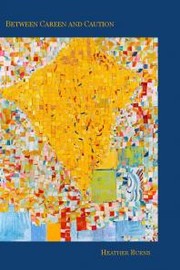
Between Careen and Caution by Heather Burns

Between Careen and Caution Between Careen and Caution: PoemsHeather Burns; Seven Kitchens Press 2011WorldCatLibraryThingGoogle BooksBookFinder 
This is one of the more aptly titled collections of poetry I’ve read in a while. It comes from a line in a poem called “Mile Marker 25,” which begins:

Am I on danger’s road, thoughts in motion
Toward the washed-out bridge around the blind curve?
Quick, choose between careen and caution,
Count what I want most, what I’d lose, now swerve
To miss the fox and clip my ghost instead.

And the book does do some wild swerving between poems that are stylistically and semantically cautious and those that threaten to fly apart at the seams. In the former category is a poem like “Comet,” a perfectly comprehensible and well-constructed pantoum, which I must admit, despite my distaste for pantoums and villanelles in general, makes very good use of the typically claustrophobic effect of all those repeating lines, describing a couple’s failure to get out of their too-small apartment to drive out into the country and view a comet. In the latter category, “Bringing in Laundry Before Storm” begins with a fairly random grab-bag of words, and only begins to make sense in the second stanza:

Thunder bulge tree’s crown
Maroon sky hum surgical thread loom

Porch dark as orchard
Cats flick and thump tails

So suffice it to say that Burns covers a lot of ground in just 21 poems, from the sonnet in the voice of a Confederate soldier that begins the book to the wonderful “At a Loss for Words” with which it concludes. Her favorite image (if that’s the word) is wind and her favorite topic is language and the difficulty of communication — and yes, sometimes they come together, as in the poem “General Delivery”:

I left home because Isabelle asked: What is West?
In part, it’s the porous bone of sky bleached and beached in red sand.

The wind plays its little jokes at the canyon rim,
Hurls itself down like a suicide, then yells for help.
You see it on the other side, laughing at its
Throw-the-voice trick.

(Read the whole poem on the publisher’s website.)

Burns is also good at conjuring shape-shifters, such as the “half-minding thin child” in “A Made Place” who “hides with her shadow / Between sheets on the clothesline” and eventually becomes

green inside,
Springy like crisp grass.
Shimmies the trunk of the skeleton tree
And hangs a picture of the sky on the sky.

The day itself is imagined as a shape-shifter in another poem, “Drunk Sun.”

The moon’s eye is half-shut and day hopes that nag
Won’t be looking for a good time tonight—ah—night’s
Now and day’s misthought its bounds again.

A restless, experimental spirit animates this fine first collection, which in its variety mirrors The Seven Kitchens Press Editor’s Series as a whole. Kudos to editor/publisher Ron Mohring for selecting it… and then working his usual magic on the design and execution.

Exit Strategies: a videopoem chapbook by David Tomaloff and Swoon Bildos

Exit Strategies (A bloodletting)

by Swoon Bildos
Videopoem chapbook for Exit Strategies [PDF] by David Tomaloff (Gold Wake Press, 2011)

Entry. We are submerged in motion, unable to stop or focus. A shadowy figure in the near background draws our gaze — the only still thing, until it starts slowly walking out through what look like waves. The colors are warm and the instruments in the soundtrack seemingly acoustic, though difficult to identify beyond genus. Simultaneous with the beginning of the poem recitation, a female face appears. She too eventually turns away from us and begins moving away. “Exit Strategies.” Is she the same as the first figure at an earlier point in time? Regardless, is this not how we perceive ourselves moving through familiar spaces, memories of previous journeys over-layering, adding thickness and nuance like ghosts of our own past? The poem says:

You are never alone in the being alone, and the wolves will open up, show you the light if you let them. … Steady now, and breathe. A circular motion. The turning of a screw. A radio going silent in the warehouse of a mind.

Wave. In this second video, the movement is more frenetic, swooping, diving, but there’s a pattern to it, a kind of Tourette’s. The colors are darker and redder; it might be sunset. “Maybe the trees will take us for granted. Maybe they already have.” First a fire plug and then a bulbous water tower dance in and out of view. “You and I … you and I…” The refrain-like structure of the poem is echoed by the film’s repeated sequence of a flag or stringless kite billowing and falling to the ground. “Nearer to the edge of the forest” says Tomaloff, and there are trees visible on the screen. This unusual conjunction of word and image seems like an accident, maybe an oversight comparable to Swoon’s misspelling of the publisher’s name in the credits. In the poem, you and I might be returning with our weapons. This might be a poem in which we are stealers of souls.

Drag. (Swoon notes in a feature on this series at the Atticus Review, “I wanted each video to have a title that was a single word from the text of its poem. Those words/titles gave me a first direction about where to go to with these.”) The most painterly of the videos so far, with soft colors and textures. As for the text, it’s my favorite of the six poems.

The buildings are silver bullies in the daylight, hulking graveyards by night. Please send a flare, a map, or a compass. Send me a slingshot, or a prayer. … There is a flood on the horizon tonight, and the guards have begun to desert their towers. THE WATER HAS REVEALED US IN WAYS WE COULD NEVER HAVE IMAGINED.

That last line puts me in mind of New Orleans after Katrina. But throughout the series of videos I feel underwater or at sea. Fortunately, I enjoy that sort of thing — surrendering to time and chance, getting good and lost. At the very end of this video, a snippet of found sound: “Actually trusting my body to do what it’s supposed to do,” a woman says in an unplaceable American accent. She could be from anywhere or from nowhere — which is to say, the suburbs.

Asylum. Black and white, this one, with intrusions of color — a pastel blue, shockingly out-of-place, which turns out to be the dress on a walking figure. Creaking noises in the soundtrack while Tomaloff hints at an interrogation from “the authorities.” Oases of blurred, almost-stillness in which someone might be going out or coming in. Then back to the nervous motion, the walker’s legs crossing thin lines of shadows which, due to the video treatment, seem almost to pierce them. If I didn’t know the text came first, I might’ve thought it was a commentary on the filmmaker’s technique:

I drew pictures of women and men doing their best to relate to one another, like lines drawing lines upon lines, over and over again, insecure. … The rafters are humming; bullhorns, relentless; the fields are dividing; they know me by this name: Penance. Vibrant lights scribble non sequiturs across cracked plaster.

We catch brief glimpses of a face in full color appearing to study something. “The men in plainclothes finish cigarettes while we wait.”

Attic. An uncomfortable head-on gaze of a male face behind the usual elusive moving surfaces, which this time include many brief artifacts from old movies. “Some sort of perdition, some rules for the road.” And: “A team of ghost prayer horses.” Just after the conclusion of the reading the soundtrack begins to catch and stutter, as if overwhelmed by the glut of textures.

Sum. The orchestral beginning almost evokes the swelling soundtrack in a classic movie as the lovers ride off into the sunset. And indeed we are travelling, possibly by train, among soft blurs and warm colors. The fit of text to image is as good as it gets in these videos. The poem begins,

O SOLEMNLY STAY THIS, MY FILM PROJECTOR HEART. I WROTE THAT SENTENCE FOR A FIRE ONCE. I built a fire from a forgotten friend. I drew ghost water from a lover and took it to bed, a train. This is my machina, with its gears softly turning beneath the rolling of a forest floor.

Brief moments of sharp focus startle. Which might be just about the most realistic thing I’ve ever seen in a film, because isn’t that in fact the way we experience our lives? Always dreaming of exit strategies, and very seldom pausing long enough to see where the hell we are. In these videopoems, as in the e-chapbook that spawned them, coherence is fleeting but all the dearer for the effort we must make to achieve it. And the dialogue between filmmaker and poet makes me listen more carefully to poems I might otherwise have dismissed as hopelessly obscure.

*

I feel even more insecure about my film reviewing than I do about my poetry reviewing, but given that this is probably the most ambitious online videopoem chapbook anyone’s yet made, I couldn’t let the month go by without attempting to say something about it, no matter how incoherent. And in case you’re thinking I got off easy today since there were only six poems in the chapbook, I did watch them three times in succession, only reading the text after the first viewing.

Do watch the videos yourself, and check out the feature on the first three at Atticus Review. (I’ll be posting them all to Moving Poems soon.)

The Capable Heart by Ann E. Michael

The Capable Heart The Capable HeartAnn E. Michael; FootHills Publishing 2011WorldCatLibraryThingGoogle BooksBookFinder 
This quietly powerful collection made me care about horses — and not merely because the title derives from a translation of a passage in my favorite work of philosophy, Zhuangzi. Though I have some friends who are into horses, the horse-riding culture has always been pretty alien to me, and on rare close encounters with the beasts I’ve felt a bit intimidated, to be honest. But the narrator, too, was a stranger to horses, as she explains in “Ways We Are Alike”:

I wanted a way to embrace
my daughter’s fascination.

to overcome my own fear, with carrots,
with a lead rope and soft brush.

I touched the withers and the
warm, broad chest;

I held the lead. Let pulsing lips
explore my hands, my jacket.

Horse and author go on to explore each other, in this poem and as the cycle progresses. Michael ponders the attraction that girls and women have toward horses:

Women who have re-centered their lives owing, in part, to horses,
are shy of nothing, strong as horses…
(“Horsewomen”)

She also examines the interplay between domestication or domesticity and rebellion, as in “Domestic Mutinies”:

Sometimes my outrage gallops
hard inside my ribs
and I feel like Chuang Tzu’s
outlaw horses: domesticated, enslaved,
& utterly capable, in their hearts.

“Dancing Horses” come into their own in a snowstorm:

Now
manes are streaming, necks arched,
an unrestrained blizzard
in the corral where they
toss off the long-bred bit
that is obedience.

Sublimating domesticity,
the screaming stallion wind:
their unbroken past.

In “Boss Mare,” a woman named Rosie embodies the strong individualism of a lead horse.

I can just see her cribbing
her stall, bossing the other mares around: stay back,
do things my way.

Not that the other horses mind. She wields the lead ropes,
she calls at the corral gate and most of them come running—
she’s boss mare.

Is it a sign of the author’s own rebellious streak that she never writes the most obvious poem: about riding a horse herself? The rider is always the daughter, and though sometimes the author or narrator takes the place of the horse, as in “Mare’s Nest” —

Notes and
photos, music, a belt
or rumpled jeans, slippers
slipped off, on, entropy
maybe. Lie in straw, back
toward the stall door. Sniff,
huff, wicker, snore.

— other times, as in “The Indoor Ring,” her gaze shifts away from horses, and she turns to watch swallows diving instead, or — in “Watching a Child Ride Horseback Through Snow” — gets distracted by a preening blue jay and loses sight of horse and rider. The domesticity-vs.-rebellion theme is developed strongly enough that a couple of poems, “Housekeeping” and “Anger Good As Hope,” avoid mentioning horses altogether. But even then, the reader feels the warm breath of the horse and hears it nicker.

This is, above all, a wise book — even if the author would probably disavow any personal store of wisdom, and attribute what lessons she’s gleaned to the horses themselves. As in Zhuangzi, they are teachers by dint of the purity of their natures and their connection to the earth over which they fly, but as such they are not to be taken too seriously. “Evolution of the Horse” ends on a pun; “Stray Horses” are capable of “astonishing vulgarity” and are “pitiable, oafish, indelible as my own failures”; and the “big quarterhorse” in the closing poem, “Riding-School Zendo,” mimes a Zen master with his horsehair whisk.

The stories we tell about horses can never encompass the full strangeness of their being, of course, as poems such as “Putting Down the Mare” and “The Difficult Birth” remind us. And this too is a source of wisdom for those who pay attention as well as Michael does:

We survive drought. Or we do not.
The paint goes back to her grazing,
unencumbered by memory. Perhaps,
next May, I will tell a different story.
Perhaps not.