How to be a poet

This entry is part 39 of 39 in the series Manual

Write from a place of deep fear, which the authors of the Old Testament rightly considered the beginning of wisdom. Turn your poems into cunning traps and instruments of fraud. Writer’s block is primordial and best left uncarved; create only in its shadow.

Prize your digressions. Revise nothing, and put all your poems into books that self-destruct after a single reading. Wallow in idleness. Treat inspiration as a sworn enemy.

Practice abstinence; it’s the only way to know what love and hunger are really all about. Find something absurd to believe in and cling to it as passionately as Pound clung to fascism or Neruda to Stalinism. Watch a lot of television.

“First thought, best thought”: get it down and go do something useful, like cleaning the toilet. In lieu of reading, listen to audiobooks. Write about what you don’t know and didn’t think you cared about. Stay in your cave until you start seeing beasts on the walls.

Cultivate suspicion and distrust toward the universe — after all, it is out to kill you. If you must be sociable, avoid poets, for they are boring at best and petty at worst. Hang out with artists and musicians instead.

And for god’s sake, learn HTML.

Luisa Igloria on her daily writing practice

Now it’s the turn of Via Negativa’s other regular contributor to hold forth at Marly Youmans’ blog as part of the ongoing House of Words series there. Fortunately, she’s not quite as prolix as I was! Luisa talks about how she got started using entries from The Morning Porch as writing prompts, and gives three examples of how particular entries sparked the poems they did.

For instance, Dave’s TMP observation on January 28 was “The silence of falling snow. When my furnace kicks on, the three deer digging under the wild apple tree startle and run down the slope.” When I read that, the first sentence, “The silence of falling snow” coupled with the image of “the wild apple tree” had a certain beautiful gravity that felt– and sounded– almost biblical. The wild apple tree and the three deer digging also made me think immediately of medieval tapestries, rich with illustrations of plants and animals. From there it was a short leap to recalling stories in bestiaries like the Physiologus. […]

I find Luisa’s fealty to craft and the creative venture endlessly inspiring. Go read.

Woodrat TV: The Book of Ystwyth poetry reading


The Book of Ystwyth: six poets on the art of Clive Hicks-Jenkins (part 1).


The Book of Ystwyth: six poets on the art of Clive Hicks-Jenkins (part 2).


The Book of Ystwyth: six poets on the art of Clive Hicks-Jenkins (part 3).


The Book of Ystwyth: six poets on the art of Clive Hicks-Jenkins (part 4).

In lieu of a podcast this week, here in video form is the full, hour-long poetry reading I flew to Wales to take part in last month. This was a group reading in support of The Book of Ystwyth: six poets on the art of Clive Hicks-Jenkins, whose launch coincided with a 60th birthday retrospective exhibition of, and monograph on, the contemporary Welsh artist Clive Hicks-Jenkins (who I interviewed in the two most recent episodes of the Woodrat podcast). All six of us — three Yanks and three Brits — had written poems in response to his paintings, and The Book of Ystwyth includes a generous selection, illustrated with full-color details of the paintings in question.

In the reading, ably MC’d by Damian Walford Davies, as you’ll see, each poet appears twice, once on either side of a break (which occurs in part 3), so that the first poet is also the last, the second is the penultimate, etc. Here’s a key to who appears in which video:

Catriona Urquhart (read by Clive Hicks-Jenkins and Ian Hamilton): parts 1 and 4
Andrea Selch: 1 and 4
Callum James: 2 and 4
Marly Youmans: 2 and 3
Damian Walford Davies (as reader): 2 and 3
Me: 3

Anita Mills was the camerawoman. I take the blame for the sound and all the editing. The bookstore’s set-up had the podium in shadow, which meant that the camera often focused on better-lit bookshelves behind our heads. In the process of lightening and increasing contrast on the videos, the color turned spotty, whence my decision to make it black and white. I assure viewers who have never been to Wales that it is a fully modern country now, and almost everything is in color all the time.

The Book of YstwythAs for the book: quite apart from its contents, which are of course scintillating, it’s a beautifully designed object with high-quality paper and image reproduction, retailing at a very affordable $15.95/£9.99. It was published in the U.K. by Grey Mare Press in association with Llyfrgell Genedlaethol Cymru/The National Library of Wales, and in the U.S. by Carolina Wren Press. Click on either link to order.

House of Wordiness: my nearly endless interview at the Palace

This entry is part 16 of 20 in the series Poetics and technology

At her blog The Palace at 2:00 a.m., Marly Youmans has an on-going series of interviews with writers and publishers called The House of Words. One afternoon last February, I sat down and wrote a few thousand words in response to a series of questions she sent me, and promptly forgot about it until a couple months later when the first installment appeared (#20 in the series). Marly posted a few installments, illustrated with photos she found at Via Negativa, then went on vacation for a month… in the midst of which, somewhat surreally, she and I actually met up in Wales. This was the very first time we met, despite the fact that we’ve known each other for several years and are only about a five-hour drive apart over some of the most lovingly maintained highways in the world. Anyway, the interview finally resumed in the third week of May, and just concluded a few days ago. Here are the links to the pieces in order, with a brief quote from each to give you a flavor. If you have comments on specific points I raise in the series, please leave them at Marly’s blog rather than here so as to keep the discussion in one place.

Part 1
Friends started telling me about Blogger that summer, but like most literary snobs I turned my nose up at it, both because of the absurd and ugly word, “blog,” and also because of what I was hearing about blogs in the mainstream media: that they were filled with worthless minutiae of people’s daily lives and/or links accompanied by minimal, uninformed comments. It didn’t seem at all attractive.

Part 2
I’ve come to feel that blogging and poetry writing are an ideal match, at least for those of us who are shameless enough to share imperfect drafts with the world.

Part 3
The push to come up with new content every day was transformative.

Part 4
I feel like a bit of a hypocrite: I run an online journal, but almost never submit my own work to journals unless invited. But mostly that’s because very few journals consider previously blogged material, and I write first and foremost to feed the blog.

Part 5
In general, I think the best medicine for discouragement [at not getting published] is to join a community of writers, online or in real life, and focus on the writing rather than the writer.

Part 6
There are just so many opportunities for collaboration now — I don’t see how any serious writer can fail to be excited by that.

Part 7
Generations of poets have been taught to be absolute perfectionists and struggle against every word, because we all know how mortifying it is to have to look at a poem in print that we’ve long since revised. Being mainly self-published and mainly online does allow for a more fluid conception of one’s work.

Part 8
It gradually turned into a regular magazine, though we’ve never gone so far as to issue periodic issue-dumps, as other online magazines do, preferring instead to remain bloggish, with new material at least five times a week, and comments activated for every post.

Part 9
I fear a lot of people start blogs these days on the advice of editors or agents who neglect to tell them that the most important trait of a good blogger is generosity.

Jack-in-the-boxwood, Wales (photo by Marly)
Jack-in-the-boxwood, Wales (photo by Marly--click on the photo to visit her post)
Marly Youmans and Clive Hicks-Jenkins
Marly Youmans and Clive Hicks-Jenkins take a spin through the art gallery

The Book of Ystwyth

This entry is part 1 of 12 in the series The Temptations of Solitude

The Book of Ystwyth: Six poets on the art of Clive Hicks-Jenkins, which includes all of the poems from my Temptations of Solitude series, is now out. It’s a stunningly beautiful book; you’ll definitely get your money’s worth. Carolina Wren Press does have some review copies available, I’m told, so if you have a well-trafficked blog or magazine, please consider writing it up.

The book was launched on Friday night with one of the best group readings I’ve ever been privileged to take part in, relaxed and well organized, with no bad readers and an overflowing and attentive audience. One of the six poets, the fantastically gifted (and much too modest) Callum James, blogged about the reading as well as yesterday’s launch of the exhibition, which was and is mind-blowing, for anyone who can get to the National Library at Aberystwyth by August.

I expect I’ll have more to say about all this after my return to Plummer’s Hollow and my own computer. I’ve been bothering all manner of people, including Clive, with my audio recorder, gathering material for the Woodrat podcast, and we have video of the reading, so I’ll have my work cut out for me. But for now, I intend to vacate for another week. Wales is spectacular; were it not for the shortage of forests, I think I could live here.

Link roundup: Things I give a flying f*ck about

A few links I’ve shared on Facebook over the past three weeks. With all the poetry reading I did last month, I didn’t have much time for anything else.

Truthout: “Why the United States is Destroying its Educational System”
Chris Hedges, depressingly on-target as usual.

The Atlantic: “Stephen King on the Creative Process, the State of Fiction, and More”
Stephen King has some nice things to say about poets. (But preferring Judas Priest to Black Sabbath? No accounting for taste!)

Harriet: “Death of a Kingmaker: A Critical Evaluation of Silliman’s Blog”
How being a powerful blogger can interfere with writing. I found Silliman very cordial the couple times I communicated with him, a genuine guy with some strong opinions and an equally strong streak of generosity. I wasn’t a regular reader, though.

Poetry Daily: “Casino” by Osip Mandelstam — a new version by Christian Wiman
Probably the single best poem I read all April.

Glenn Greenwald @Salon: “Lessons from Manning’s transfer out of Quantico”

This episode should be a potent antidote to defeatism, as it provides a template for how issues that would be otherwise ignored can be amplified by independent voices creatively using the democratizing and organizing power of the Internet, and meaningful activism achieved.


Not just a gag gift, but a very simple concrete or visual poem. I’m trying to think how I can integrate one into a panel discussion at next year’s AWP.

Woodrat Podcast 39: William Trowbridge

William Trowbridge

William Trowbridge was the last of the four poets Kristin Berkey-Abbott and I read for National Poetry Month (here are my review and hers). We called him up last Monday to talk about Fool and foolishness, humorous versus serious poetry, and why the Midwest produces so many poets, among other things, and got him to read some poems from Ship of Fool, too. Check out his website for a bio and links to all his books.

Podcast feed | Subscribe in iTunes

Theme music: “Le grand sequoia,” by Innvivo (Creative Commons Attribution-Noncommercial-Share Alike licence).

Whimper

Can’t… read… one… more… book… of… poems…

It doesn’t help that I’m trying to get ready for a two-week trip to the U.K., leaving Sunday. It’s getting very hard to concentrate. Which is a pity, because I still have four lovely books to blog, two of which just arrived in today’s mail. Maybe when I get back.

trout lily

Inside the Money Machine by Minnie Bruce Pratt

Inside the Money Machine coverReading these fierce, true poems about life under capitalism, I wonder why anyone ever thought that politics were incompatible with lyric poetry. Even as she focuses on the physical and psychological costs of hard work for little pay, Pratt makes the writing seem effortless: the poems catch you up in thumbnail portraits or brief narratives and generally don’t let you go without a gasp or sigh.

Two women lean into each other, staggered by catastrophe,
The plant fence out of focus behind them. They hold up
a crumpled paper, like the photo of some beloved lost to murder
or to war, the evidence of what lived a few minutes before:
My job, my other self.
(“Getting a Pink Slip”)

While some of the books I’ve read this month did not adapt themselves well to the book-a-day pace, this one did: not because the poems were always easy to grasp, but because reading them all in one sitting created a powerful gestalt, like the “field full of folk” at the beginning of Piers Plowman. Blue-collar, white-collar, resource extraction, manufacturing, service industry, retirement, unemployment, gamblers, demonstrators, the half-tired and the fully exhausted: it’s all here, the world of trying-to-get-by. Political messages are sometimes overt but rarely didactic, as in the conclusion of a poem that began with a female toll-taker:

…past the docks at sunset along the water, the cranes asleep
for the night, while the climbers, door-unlockers, thumb-
and-finger doers, the people who sat and thought high up
in the glass forehead during the day, have now gone home—

Past the ticket collector in the Turnpike booth, the woman at the end
of her shift, the woman who can raise, who can lower the barricades.
(“Distribution”)

And when there is didacticism, it’s expressed with disarming simplicity, no hint of unearned ideological posturing:

Jobless, I never thought I’d hear
our niagra of sound going up the stairs again, never step,
immersed, into tens of thousands rushing to work. One molecule
in the many, carried along toward the purpose of our day.
It’s never really about the money, except for the guys at the top.
They know how to make money off of us. We know
how to make things with each other. That’s what we do.
(“Standing in the Elevator”)

Whether or not political poetry in general deserves its bad reputation (do we condemn love poetry just because 99 percent of all love poems ever written are dreck?), like many other kinds of poetry it can lead its practitioners into one or two habitual modes of discourse. Inside the Money Machine is much more catholic than that, with room both for an angry denunciation of the Army guy piloting unmanned drones from thousands of miles away (“The New Commuter War”) and for an understated poem of mourning for a temp worker’s inability to put down roots:

A Temporary Job

Leaving again. If I didn’t care, I wouldn’t be
grieving. The particulars of place lodged in me,
like this room I lived in for eleven days,
how I learned the way the sun laid its palm
over the side window in the morning, heavy
light, how I’ll never be held in that hand again.

As I was making my way through the book, my brother sent along an AP story about the nearest small city to us, where he works: “Altoona, PA changes name to Spurlock movie title.”

About 31,000 central Pennsylvanians will soon be living in a joke.

Beginning at 1 p.m. Wednesday, the city of Altoona will change its name to “POM Wonderful Presents: The Greatest Movie Ever Sold,” after the latest film by sarcastic documentarian Morgan Spurlock.

The city is changing its name for 60 days to make some money — and to help Spurlock make a point about the proliferation of advertising in American life.

Altoona isn’t broke, but it can sure use the money, and hey, the name-change is only ceremonial and temporary. What’s a little loss of dignity? We’re all like the sales clerks in “Selling the Brand,” willing to do whatever it takes to remain solvent, even if it means acquiring a new wardrobe, down to the underwear.

I was pleased to see two poems about issues close to my heart: “Tegucigalpa,” about the Honduran coup of 2009, and “Burning Water,” about hydrofracking for natural gas and last year’s oil spill in the Gulf. In the latter, I like how she focused on microorganisms rather than something more charismatic:

We hung our legs into strange bioluminescent foam
flung up by our wake, if we’d scooped the water
up with a glass jar as we did the air for fireflies,
we’d have caught eighty species, galactic diatoms
invisible to the eye, to us just some murky water
from the Gulf, which is licked over today with oil
from the blown-out rig…

Pratt has been around for a while — this is her tenth book — but she doesn’t show any sign of losing her sense of wonder at the nonsensical way we live.

How can it be that we are all going to carry our plastic bags
out the snapping doors, and get in our cars, and leave each other,
drive away to eat in twos or threes or one alone, me in a blue room
with a map of India to study, a novel open next to three sunflowers
in blue plastic bottles on the table…
(“Eating Alone”)

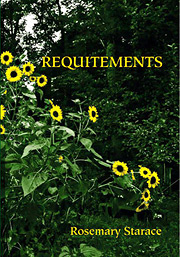
Requitements by Rosemary Starace

Requitements coverI’ve read the poems in this slender volume at least four times in the past eight months and they have yet to lose their affective power for me — which is strange, since I would not seem to be the target audience for a collection about adoption or being an adoptee. Then again, I’ve been listening to blues music for 25 years and I wasn’t exactly the target audience for most of that, either. Who hasn’t felt, at one time or another,

double like wings
this rainy day folded
patient and oily
shedding a sky
(“I Am Double”)

or marveled at robins at daybreak?

Robins

A trickle of sweetness
out of the quiet emerges,
announcing what night
had again prepared.

How darkness works.
You come to know this
each time you are taken by it
and released.

See what I mean? These are poems with mountains in them, blackeyed susans, crows, boats and grackles. The moon joins other mythical figures in a list of famous adoptees, and you think, me too! The broken heart is not merely universal, but a key to the universe:

Creation falls to me. Its vast taxonomies,
the drifts of my ancestors. Home
is the Nebula, grandfather crab.
(“Confession”)

This is a poetry very much like the blues, full of lacrimae rerum, and reading it, hearing it, I feel the tension unknotting in my gut and a weight lifting in my chest that I didn’t know was there. How does that work? There are certain metaphors, I think, that are very close to the root images of language: when things fall from the sky, for example, something beyond mere sadness or gratitude is triggered, and natural objects such as wings and flowers are so intimately bound up with our perceptions of the world, it may be more accurate to say, for example, that the face is a flower symbol than vice versa. And:

Dark careening flecks
possess the pull of fine words,
those understudies
for the thing missing—
“snow-calm” and “trees,” too,
tug the heart out from its cave.
(“Arrival”)

Dig deep into language and emotion, as Starace does, and thought itself — “something like wind” (“Fifty Grackles”) — may become a luminous presence. Einstein in a dream says: “All space is compassion” (“Sunflower Ramble”). An absence which is more than an absence: entire religions have been built around less.

There is
no other music like this song
you can walk through, these cries
that every day erect a new cathedral
over daily streets.
(“Blue Hour”)

It’s been a long holiday, and I’m tired; I regret I can’t give this marvellous chapbook the review it deserves. (Do read the three sample poems on the page from Elephant House Press.)