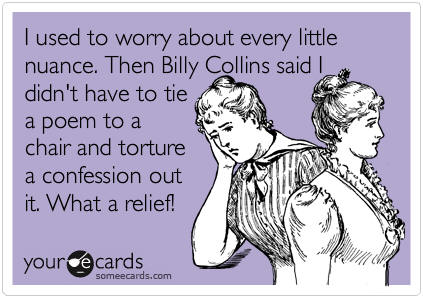
I’m doing one of these a day until the end of April. To send it, copy the permalink or the image file link into an email, tweet, Facebook DM, etc. — or just download and make free with the image.


Purveyors of fine poetry since 2003.
Writing about craft, poetry book reviews and appreciations, and anything else that isn’t an original poem.
I’m doing one of these a day until the end of April. To send it, copy the permalink or the image file link into an email, tweet, Facebook DM, etc. — or just download and make free with the image.

I’m doing one of these a day until the end of April. To send it, copy the permalink or the image file link into an email, tweet, Facebook DM, etc. — or just download and make free with the image.

I’m doing one of these a day until the end of April. To send it, copy the permalink or the image file link into an email, tweet, Facebook DM, etc. — or just download and make free with the image.

I’m doing one of these a day until the end of April. To send it, copy the permalink or the image file link into an email, tweet, Facebook DM, etc. — or just download and make free with the image.

I’m doing one of these a day until the end of April. To send it, copy the permalink or the image file link into an email, tweet, Facebook DM, etc. — or just download and make free with the image.
Publishing houses that will print poetry are almost extinct (I know Dave B. Porcupine would argue that so are readers of poetry), yet the numbers of people writing poetry seem to have grown at an equal or greater rate. Some of them self-publish online or at print-on-demand shops like Lulu.com, but there can be a considerable cost to doing even small numbers in this way.
Just to get a bit low-tech on you for a second: you can hand-bind books yourself.
 When a poet friend, Rachel Barenblat, had a miscarriage earlier this year and worked her way through the trauma and grief by writing poetry, yet wondered how to make these poems available to others going through a similar experience, I suggested a small hand-bound edition. Ten poems, title page, table of contents, acknowledgments: this adds up to 15 pages, plus one blank at the back. The magic 16. (Bookbinders think in multiples of eight and get super excited when all the pages add up to multiples of 32…) We settled on a tall, skinny format which conveniently fit on a standard letter-size sheet, folded in half: a pamphlet.
How to do it
Get familiar with your printer, and with whatever software you use to produce sheets with your poetry on them. (I use Adobe InDesign because I’m a designer but you can do this quite adequately on a word processor.) Always make a dummy and number its pages and then unfold them, so you know where the poems are going to fall. And then put them all together before you run off large numbers to be sure it still works. You can use imposition software but it’s not necessary; what IS necessary is a good understanding of where each page is going to end up after folding. Automatic pagination is not your friend here.
Find the longest line of any of your poems and work backwards in the design of your page from that (if the line will be split, find the longest line that won’t). Try and leave a generous gutter/central space, which should almost never be smaller than the optical margin of the outside when the booklet is held open. Remember to leave a wider margin at the foot of the page than the top and outside margins, to avoid that sinking feeling.
 In terms of typography, remember that you can use a relatively small font size if you allow generous leading (interline spacing). Look at books of printed poetry and see what they do and what you like, and why, and what you don’t like, and why, and use those to guide your page design. Try and identify the character, the personality, of typefaces and match the character of your poetry. Less is usually more with typography… it is almost never a good plan to use more than two typefaces in a book of poetry (or much else), and if you are tempted to do this, ask yourself why. Let the poems sing for themselves rather than be tripped up by clunky type.
You can use a simple sheet as the cover or you can use different paper, or papers. You can do collage, you can paint on them, you can use photos. Experiment. You don’t have a publisher’s marketing department breathing down your neck! Just make sure that the grain of the pages matches the grain of the cover or it will buckle.
There are many online resources for bookbinding.
What you need
A better reader
 As I folded the sheets for Rachel’s book, 176 in all, getting engulfed in the rhythm that comes from doing a repetitive task for love, I started seeing the same lines over and over. A different word would jump forward. I noticed connections within stanzas, within poems, across poems. In short, I was reading the poems in a different way. A better way. Binding poetry makes me a better reader. Try it; I think you’ll discover new things about your poetry — or someone else’s. And you’ll have a few hand-bound booklets to give or keep or even — gasp — sell.
—Alison Kent (Feathers of Hope and Bird by Bird)
***
Still to come in this series, I hope, are guest-written pieces on typewriters, Twaiku, Facebook update poetry, Second Life, and more. If you have an idea for an essay you’d like to contribute, let me know.
—Dave

With apologies to George Clinton.
I’m doing one of these a day until the end of April. To send it, copy the permalink or the image file link into an email, tweet, Facebook DM, etc. — or just download and make free with the image.

I’m doing one of these a day until the end of April. To send it, copy the permalink or the image file link into an email, tweet, Facebook DM, etc. — or just download and make free with the image.

I’m doing one of these a day until the end of April. To send it, copy the permalink or the image file link into an email, tweet, Facebook DM, etc. — or just download and make free with the image.
I woke up yesterday, the first Saturday of spring break, and found Victoria next to me, hunched over her third graders’ papers and humming.
I was about to tell you how good those papers were — how some of them evinced better voice and grammar than many of my ninth graders’ papers, in fact — and to expound on why I think most kids don’t progress much in grammar during the intervening years that lay in bed between us yesterday, the first Saturday of spring break.
But I just decided to interrupt myself, as I often do with my high school writers, and to remind you that you’re here as writers. So, did my first line hook you? And, if so, have I lost you by now? (Be honest. Are you still reading?)
And, dear writer, did you catch the syntax of that first line? A simple sentence [Rait, I think I know why you thought it was compound. Let’s see — what would be the second clause? “And found Victoria next to me”? Well, what’s the subject of that clause? Right — it’s not a clause because there is no subject. The sentence is a single, independent clause with a compound predicate. Fools me too, sometimes.] sporting a nonessential appositive and ending with a participial phrase.
We could talk about “hunched” and “humming,” too [“Is that alliteration or assonance, Mr. S?” “Hell if I know, George.”], but let’s cut to what’s really important: how many characters does my opening sentence have? Those of you besotted by Twitter, a micro-blogging and social networking service, probably have already intuited that my first line is bumping up against 140 characters, counting spaces — the mandatory upper limit of a Twitter post, also called an “update” or a “tweet.” My first sentence has 139 characters, in fact. (A lot of us often write on Twitter like we’re playing a kind of linguistic blackjack: how close can I get to 140 characters without going over?)
I’m teaching diction and syntax with Twitter because micro-blogging helps writers focus on words and sentences.
Twitter has gotten so popular — it is currently growing at a 1,382 percent rate per year – that I think it’s inadvertently making people slightly better writers at the word and sentence level. Even those who use Twitter for more mundane and solipsistic purposes (and that would be just about everybody) (“Cloudy here. Just scratched my ass.”) sometimes feel pushed to improve their dribble to increase readership.
If you want people to follow you, diction and syntax are part of the equation even if you’re writing in fragments or very short sentences, as many Twitterers do. Randsinrepose, a popular blogger, cites The Elements of Style and gives his fellow Twitterers a lesson in diction and syntax in his post “The Art of the Tweet”:
In my head, I’m cutting words from my tweet to give you room to mentally add your own:
BEFORE: If it’s 4am, I know how stressed I am.
AFTER: Stress is how well I know 4am.
Nine to seven words. Slight reorganization, but which says more to you?
Twitter can be a godsend to the close reader as well as the writer. What if Dickens had serialized his novels on Twitter instead of in Harper’s or Master Humphrey’s Clock? He’d still be alive today, certainly, if he wanted to finish Bleak House. But, more importantly, what would his readership have been focused on with each installment, assuming they could have suffered having the plot so slowly torn from them?
Perhaps Dickens’s readers would have heard music in lines larger installments might not have slowed them down enough to notice. (Or maybe it’s simply the duty of a micro-blogging generation to slow reading down. My father heard his music at 78 rounds per minute; maybe I was meant to discover something different by hearing mine at 33 1/3.) Does a single sentence of Bleak House sing its own song? Here’s a sentence I found by clicking “surprise me” on the novel’s Amazon page:
Nor has he anything more to say or do, but to nod once in the same discourteous manner, and to say briefly, ‘You can go.’ (Bleak House 552)
The sentence’s two-letter words, monosyllabic words, and long vowels, combined with the first clause’s internal rhyme (which highlights the clause’s singsong meter), reinforce Mr. Tulkinghorn’s curt dismissal. How much of that did you catch in your college’s Victorian lit survey?
(Not all of Dickens’s sentences would fit on Twitter, of course. Amazon.com reports, though, that the average sentence in Bleak House has only a hundred characters. Even Faulkner, known for his page-long sentences, wrote Light in August at a 79-characters-per-sentence clip. 140 characters are all a ninth grader needs to begin focusing on writing at the sentence level.)
Teenagers loitering outside a sentence on Twitter can relate punctuation rules and basic syntax to their writing, and they can discover how grammar can sometimes foster creativity. Conformity to a form, even to an arbitrary form, can do that. And young writers can learn the art of breaking the rules once they have a handle on the basics.
Before I describe how I use Twitter in the classroom, I’ll give you a précis of my views on teaching syntax and punctuation.
Basic grammar and syntax are like common Western music scales: they are not important in themselves but for where they lead the practitioner once she has achieved some proficiency. Sticking with the form, for instance, I’ve practiced composing complex sentences ending with the subordinate clause and without commas separating the clauses. When one of my writers uses a comma in that situation, I ask myself: is he aware that he’s outside the form? And does he hear music I don’t hear?
Why learn and normally stick with the rules of punctuation and syntax? First, almost all of the rules make sense, even if you might have written them differently were you alive to write those popular grammars two hundred years ago. Second, most of the basic rules carry the force of public morality, so I can expect that my audience is aware of them and will judge me by how well I use them. Third, not having to interrupt myself and explain why I use a comma is as joyous as not having to stop and explain an allusion or a joke. An audience’s grasp of grammar, then, is as beneficial to a writer as its overall cultural literacy (to use E. D. Hirsch’s term).
Nevertheless, deviations from our current rules governing syntax sometimes sing. We hear the music better if we know the rules and understand the deviation as such, because such knowledge adds nuance. Nineteenth century American writers, for instance, often inserted commas before subordinate clauses, before sentence-ending prepositional phrases, and, as Lincoln does below, before the second part of a clause’s compound predicate. In a letter, Lincoln prefaced his reasons for allowing blacks to serve in the Federal Army with this:
I am naturally anti-slavery. If slavery is not wrong, nothing is wrong. I can not remember when I did not so think, and feel.
Though the last sentence’s comma isn’t kosher today, it’s expressive. To me, it draws out Lincoln’s response to slavery and creates a greater emotional distinction between thinking and feeling. Blame me if you get caught doing stuff like that.
I present syntax as a means of making music and improving clarity and concision, and I present punctuation as a means of varying syntax. I don’t teach punctuation for its own sake, so I don’t present all the comma rules (for instance) at once. To do so would disconnect commas from good writing. At least, that’s what happened when I tried it when I first started teaching. (Only recently in my career have my writers started to make considerable progress over my wife’s.)
A good teacher showed me how to present basic syntax using a tree analogy. Sentences that start with phrases or subordinate clauses are left-branch sentences. (E.g., “If it rains, it pours.”) If sentences end with phrases or subordinate clauses, they are right-branch sentences. Mid-branch sentences include appositive phrases and other interrupters. (“Esmeralda, my best friend and confidant, heard me snore.”)
Now that we’re ready again for Twitter, let’s make my writers members. It’s easy. They create a username and password, and they’re on. The only thing I do out of the ordinary is to have them check “Protect my updates” when they sign on for the first time so no one can follow them outside of our class. They then set up their sites — they love decorating them and selecting an icon — and make and accept invitations to follow one another.
After we play around with some left-branch sentences as a class and learn the punctuation rules associated with them, I ask my writers to write a left-branch sentence on Twitter employing some word — let’s use “waffle.” The arbitrary word works as a sentence-level writing prompt, and it creates enough excitement and maybe competition in the classroom to get the juices flowing. (My writers usually come up with better word prompts than I do.)
“You have forty-seven seconds,” I say. “Don’t worry: it’s just a draft.”
After they write and publish their sentences, I have them read one another’s work on Twitter. “Pick two tweets to riff on,” I say.
In Twitter, if you mouse over a tweet, a “reply to” button appears, and if you click it, your next update will start with a link to the Twitter site of that tweet’s author. I have my writers use this button for only one purpose: to publish sentences created in response to other writers’ tweets.
I instruct my writers not to revise weak tweets. Instead, they are to create sentences in response to others’ sentences that inspire them. The resulting sentence may or may not bear an obvious resemblance to its stimulus because the second writer may have been inspired by one of any number of things, including the earlier sentence’s plot, rhythm, and structure.
This way, the first writer does not feel picked on. I am gratified that someone has been inspired by my sentence; I am not mortified that someone has corrected my sentence in front of my peers. If a writer finds a mistake in another’s writing, she is to send him a “direct message.” Twitter’s direct messages are private and are not shown with the updates that all of a writer’s followers can see.
I use a Promethean board — a brand of smart boards that help writing teachers focus on small portions of text — to display a Twitter site to the class in order to examine and celebrate some of the creations. We also “favorite” favorite sentences on Twitter by clicking the star that appears when we mouse over them. By doing that, a user sends a copy of the tweet in question to her “Favorites” page for all of her followers to admire.
You can imagine other directions an instructor could give a class of writers on Twitter to help them play with diction and syntax and learn punctuation and grammatical rules associated with particular sentence structures. (In fact, if you do, would you email them to me?)
I am loath to close (to employ Lincoln’s diction again). I was also going to develop here how obsessed writing teachers, such as my wife, can be and how the better ones often seem to labor in obscurity at the younger grades. I was also weighing an attempt at eliciting your pity for writing instructors in a sort of sub-plot, but I guess I’ll essay to do that over my long summer vacation.
Or maybe I’ll squeeze it all into a single, solipsistic tweet.
—Peter Stephens
***
If you’re on Twitter, be sure to follow Peter’s highly poetic updates. Some of my favorites include:
Speak comfortably to the mulch, son of man. This summer, butterflies will rise from grasses like brown leaves to heaven. (Dec. 31st, 2008)
The grave at sunrise. The grave buried in snow. The grave in recession. The grave at war. (Jan. 27th)
Rabbit: I tend my fire in the sun. Snake: I am the sun. (Feb. 26th)
Dogma falls crisp as hoarfrost, but hormones open new worlds. (Apr. 8th)
Still to come in this series, I hope, are guest-written pieces on typewriters, hand-made books, Twaiku, Facebook update poetry, Second Life, and more. If you have an idea for an essay you’d like to contribute, let me know.
—Dave