Proof of Life

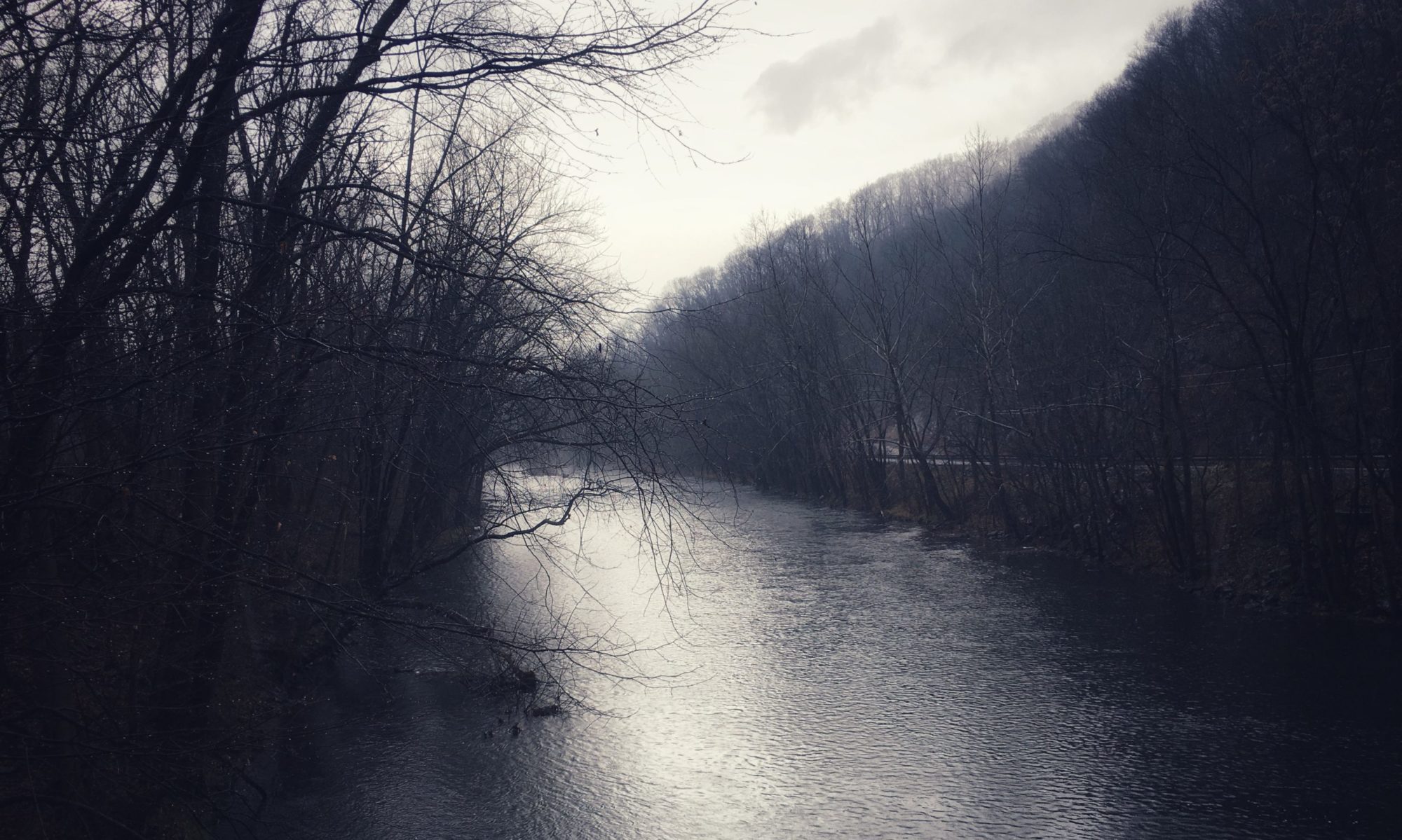
river in November light between bare woods and mountain
That we want to document 
our daily minutiae and keep the torn
halves of tickets to remind us we do
more than just stand in place.
That we keep a fourth of anything
in the freezer while quickly
enjoying the rest. That a tattered
leaf and a finger of mold on tile
is a sign of an active underground.
That the skies can still look
startled rather than just one
uniform shade of blue.

Poetry Blog Digest 2025, Week 25

Poetry Blogging Network

A personal selection of posts from the Poetry Blogging Network and beyond. Although I tend to quote my favorite bits, please do click through and read the whole posts. You can also browse the blog digest archive at Via Negativa or, if you’d like it in your inbox, subscribe on Substack (where the posts might be truncated by some email providers).

This week: nights without boundaries, fireflies and bats, children in bomb shelters, burying a dictionary, and more. Enjoy.

dave

Dust (2)

Sam Pepys and me

Up early, this morning, and my people are taking down the hangings and things in my house because of the great dust that is already made by the pulling down of Sir W. Batten’s house, and will be by my own when I come to it. To my office, and there hard at work all the morning. At noon to the Exchange to meet Dr. Williams, who sent me this morning notice of his going into the country tomorrow, but could not find him, but meeting with Frank Moore, my Lord Lambeth’s man formerly, we, and two or three friends of his did go to a tavern, and there they drank, but I nothing but small beer. In the next room one was playing very finely of the dulcimer, which well played I like well, but one of our own company, a talking fellow, did in discourse say much of this Act against Seamen, for their being brought to account; and that it was made on purpose for my Lord Sandwich, who was in debt 100,000l., and hath been forced to have pardon oftentimes from Oliver for the same: at which I was vexed at him, but thought it not worth my trouble to oppose what he said, but took leave and went home, and after a little dinner to my office again, and in the evening Sir W. Warren came to me about business, and that being done, discoursing of deals, I did offer to go along with him among his deal ships, which we did to half a score, where he showed me the difference between Dram, Swinsound, Christiania, and others, and told me many pleasant notions concerning their manner of cutting and sawing them by watermills, and the reason how deals become dearer and cheaper, among others, when the snow is not so great as to fill up the vallys that they may pass from hill to hill over the snow, then it is dear carriage. From on board he took me to his yard, where vast and many places of deals, sparrs, and bulks, &c., the difference between which I never knew before, and indeed am very proud of this evening’s work. He had me into his house, which is most pretty and neat and well furnished. After a glass, not of wine, for I would not be tempted to drink any, but a glass of mum, I well home by water, but it being late was forced to land at the Custom House, and so home and to bed, and after I was a-bed, letters came from the Duke for the fitting out of four ships forthwith from Portsmouth (I know not yet for what) so I was forced to make Will get them wrote, and signed them in bed and sent them away by express. And so to sleep.

this hanging dust
is made in the country

there is no cheaper
to fill up the house and urn

with I know not yet
what sleep


Erasure poem derived from The Diary of Samuel Pepys, Monday 23 June 1662. A slight revision from 2015.
Reprisals

river in November light between bare woods and mountain
"...in war all
wonder is dead"
~ Dave Bonta


In the kitchen of the Polish
art history professor, the freezer
is stocked with bottles of vodka.
Tables overflow with bread and curry;
in the next room, guests are chatting
with a visiting scholar about the rise
and fall of republics. It's spring,
the air mild with the scent of lilacs
and pink magnolia. I can't remember
how I wind up mentioning to the scholar
that General "Ray-Ban" Douglas MacArthur,
whose remains lie next to those of his second
wife under the marble floor of the MacArthur
Museum downtown, took a sixteen-year old
Filipina starlet as his mistress when he was
fifty. But I remember a Filipino historian
who gave a lecture, once, on the importance
of paying attention to "useless information"
such as this— without which, data would only
be data and give no clue as to the actual
ramifications of conflict or conquest.
On the eve of the Battle of Manila Bay,
what rumors did merchants, fisherfolk, and
water carriers hear? On the first of May,
1898, Commodore George Dewey said "You
may fire when ready, Gridley." The next day,
the entire Spanish fleet was sunk and
the Philippines ceded to the United
States. There is always a price for any exchange.
We, or those like us, are simply collateral
in wars over which we have never had any say.

At war

Sam Pepys and me

(Lord’s day). This day I first put on my slasht doublet, which I like very well. Mr. Shepley came to me in the morning, telling me that he and my Lord came to town from Hinchinbroke last night. He and I spend an hour in looking over his account, and then walked to the Wardrobe, all the way discoursing of my Lord’s business. He tells me to my great wonder that Mr. Barnwell is dead 500l. in debt to my Lord.
By and by my Lord came from church, and I dined, with some others, with him, he very merry, and after dinner took me aside and talked of state and other matters. By and by to my brother Tom’s and took him out with me homewards (calling at the Wardrobe to talk a little with Mr. Moore), and so to my house, where I paid him all I owed him, and did make the 20l. I lately lent him up to 40l., for which he shall give bond to Mr. Shepley, for it is his money.
So my wife and I to walk in the garden, where all our talk was against Sir W. Pen, against whom I have lately had cause to be much prejudiced. By and by he and his daughter came out to walk, so we took no notice of them a great while, at last in going home spoke a word or two, and so good night, and to bed. This day I am told of a Portugall lady, at Hampton Court, that hath dropped a child already since the Queen’s coming, but the king would not have them searched whose it is; and so it is not commonly known yet. Coming home to-night, I met with Will. Swan, who do talk as high for the Fanatiques as ever he did in his life; and do pity my Lord Sandwich and me that we should be given up to the wickedness of the world; and that a fall is coming upon us all; for he finds that he and his company are the true spirit of the nation, and the greater part of the nation too, who will have liberty of conscience in spite of this “Act of Uniformity,” or they will die; and if they may not preach abroad, they will preach in their own houses. He told me that certainly Sir H. Vane must be gone to Heaven, for he died as much a martyr and saint as ever man did; and that the King hath lost more by that man’s death, than he will get again a good while. At all which I know not what to think; but, I confess, I do think that the Bishops will never be able to carry it so high as they do.

in war all
wonder is dead
from church to garden

no going home
to a child already high
for the fall of heaven


Erasure poem derived from The Diary of Samuel Pepys, Sunday 22 June 1662.

Rioter

Sam Pepys and me

Up about four o’clock, and settled some private business of my own, then made me ready and to the office to prepare things for our meeting to-day.
By and by we met, and at noon Sir W. Pen and I to the Trinity House; where was a feast made by the Wardens, when great good cheer, and much, but ordinary company. The Lieutenant of the Tower, upon my demanding how Sir H. Vane died, told me that he died in a passion; but all confess with so much courage as never man died. Thence to the office, where Sir W. Rider, Capt. Cocke, and Mr. Cutler came by appointment to meet me to confer about the contract between us and them for 500 tons of hemp. That being done, I did other business and so went home, and there found Mr. Creed, who staid talking with my wife and me an hour or two, and I put on my riding cloth suit, only for him to see how it is, and I think it will do very well. He being gone, and I hearing from my wife and the maids’ complaints made of the boy, I called him up, and with my whip did whip him till I was not able to stir, and yet I could not make him confess any of the lies that they tax him with. At last, not willing to let him go away a conqueror, I took him in task again, and pulled off his frock to his shirt, and whipped him till he did confess that he did drink the whey, which he had denied, and pulled a pink, and above all did lay the candlestick upon the ground in his chamber, which he had denied this quarter of a year. I confess it is one of the greatest wonders that ever I met with that such a little boy as he could possibly be able to suffer half so much as he did to maintain a lie. I think I must be forced to put him away. So to bed, with my arm very weary.

I made rage
into a creed

hearing the complaints of a whip
the lies that last

to rock and stick
the ground is one great wonder

that it could suffer so much
to maintain a way


Erasure poem derived from The Diary of Samuel Pepys, Saturday 210 June 1662.

Worst Case Scenario

river in November light between bare woods and mountain
What's the worst thing 
that could happen?
is a question
you're told you should think about
when on the brink of anxiety. Loaded
question, that. You might say a truck
throttling down the road could ram
through the front porch and screech
to a stop in the living room. You might
forget to turn off the burner or the water
and come home to cinders or a flood.
A proliferation of irregular blooms
might come to light, encircled by contrast
dye. The worst thing that could happen,
therefore, is that we die. But is anyone
you know— or are you— dead right now?
No? Then perhaps you can go out in the night
and observe what goes on and off, not caring
how many times. Frog calls. Fireflies.

The Fortune You Seek

river in November light between bare woods and mountain
“Yea, and if some god shall wreck me in
the wine-dark sea, even so I will endure..."
~
Homer, The Odyssey


The tossup is always and again
between fate and free will; absence
of choice, versus a universe of unlimited
options. Remember how the cafeteria used
to advertise "Choice of Ice Cold Milk?"
But in the hit movie about multiverses,
the central question that the main
character asks is What if. What if
she had obeyed her father and married
someone else— would she wind up facing
an impending divorce and bankruptcy?
Would her daughter not be stricken
with angst and dysphoria, wear normal
clothes, speak sweetly without yelling?
Sometimes the only possible answer
seems to be Yes. But mostly, this is
the life you've come to know: trash
pickup every Thursday, recycling
every two weeks. Doctor visits,
bloodwork, the uncertainty of
results, the fear of what comes next.
Pizza or Chinese takeout Fridays.
Fortune cookies for dessert.

Recluse

Sam Pepys and me

Up by four or five o’clock, and to the office, and there drew up the agreement between the King and Sir John Winter about the Forrest of Deane; and having done it, he came himself (I did not know him to be the Queen’s Secretary before, but observed him to be a man of fine parts); and we read it, and both liked it well. That done, I turned to the Forrest of Deane, in Speede’s Mapps, and there he showed me how it lies; and the Lea-bayly, with the great charge of carrying it to Lydny, and many other things worth my knowing; and I do perceive that I am very short in my business by not knowing many times the geographical part of my business.
At my office till Mr. Moore took me out and at my house looked over our papers again, and upon our evening accounts did give full discharges one to the other, and in his and many other accounts I perceive I shall be better able to give a true balance of my estate to myself within a day or two than I have been this twelve months.
Then he and I to Alderman Backwell’s and did the like there, and I gave one receipt for all the money I have received thence upon the receipt of my Lord’s crusados. Then I went to the Exchange, and hear that the merchants have a great fear of a breach with the Spaniard; for they think he will not brook our having Tangier, Dunkirk, and Jamaica; and our merchants begin to draw home their estates as fast as they can. Then to Pope’s Head Ally, and there bought me a pair of tweezers, cost me 14s., the first thing like a bawble I have bought a good while, but I do it with some trouble of mind, though my conscience tells me that I do it with an apprehension of service in my office to have a book to write memorandums in, and a pair of compasses in it; but I confess myself the willinger to do it because I perceive by my accounts that I shall be better by 30l. than I expected to be. But by tomorrow night I intend to see to the bottom of all my accounts. Then home to dinner, where Mr. Moore met me. Then he went away, and I to the office and dispatch much business. So in the evening, my wife and I and Jane over the water to the Halfway-house, a pretty, pleasant walk, but the wind high. So home again and to bed.

the forest showed me how
to know by not knowing

took me out of myself
and back like a brook

head like a bauble
bought with some trouble

at night I see to the bottom
of all my accounts


Erasure poem derived from The Diary of Samuel Pepys, Friday 20 June 1662.