

Watch on Vimeo
I’m due to give a poetry reading/multimedia presentation this afternoon in State College (2:30 pm at the newly reopened Webster’s Bookstore Cafe). Among other things, I’ll be reading all eight poems from my Temptations of Solitude series while projecting images of the paintings by Clive Hicks-Jenkins that inspired them (and, of course, hawking copies of the book in which they appear). I’ll also be showing a couple of Swoon’s videopoems from the Manual series, and I wanted to pair those with a couple of videopoems of my own — whence the complete overhaul of the one video I made for the Temptations of Solitude. The footage is the same, but the soundtrack is brand new, and features a reading by Rachel Rawlins which I recorded last night over the phone, in one take, and remixed just a little (along with fragments from her muttering first go-through, which she didn’t realize I was recording).
What heart heard of, ghost guessed:
and wind cleared the tops of trees, and passed;
the sun’s brave tribute dropped beyond the ridge.
On TV, the British laureate talked about the role
of poetry: how solitary events might meet the public
ones, disrupting the quiet of the page. The other
poet spoke of growing up in a town built from
the clanging of car parts, machinery— by the hands
of working men; and of his father’s love of Russian
novels, the ones filled with orchards and train
stations, characters fraught with the drama of too
much thinking and drink; love, desire, both, all
of the above. What is the essence of poetry?
asked the TV host. I didn’t catch their answers,
from trying to remember the scenes that led
the woman in the direction of the approaching
train, from trying to think of what the season
might have been; whether yellow leaves were
pasted to damp ground, or if she wore a coat
with a collar, because the morning was cold.
In response to an entry from the Morning Porch.
In Search of Mariachis by David Shumate
 In Search of MariachisWorldCat•LibraryThing•Google Books•BookFinder Since I blogged about Russell Evatt’s We Are Clay last week, Epiphany Editions have re-launched their website with order buttons, previews for each book and a design much more reflective of the aesthetic of the print editions, which are things of absolute beauty. In Search of Mariachis is a masterpiece of the book designer’s art, so if you are as afflicted with book lust as I am, it might be worth ordering for that reason alone.
I was also pleased to get it for the contents, however. David Shumate is a prose poet of some renown with two full-length collections out from Pittsburgh University Press, which — I should point out for the uninitiated — is one of the best poetry presses in the country. And reading this collection was a pleasure only partly attributable to the fine homebrew with which I lubricated my reading. It had fairly typical proportions of poems I liked a lot, poems that did nothing for me, and poems I thought were O.K. but not earth-shattering: roughly a third in each category. A more exacting reviewer might condemn the book for not being amazing on every page, but I personally feel a lot of poetry reviewers need to chill the fuck out. I enjoy an experimental spirit, which means taking risks and sometimes (often?) not quite making the mark.
One of the things Shumate does in this collection that doesn’t always work for me is play with notions of exoticism, as signaled by the title. In poems such as “Waking Up As a Buddhist,” “Curry” and “Darwin’s Beard,” speculations that are presumably intended to sound humorously ill-informed just strike me as inexcusably ignorant, especially in an age of smart phones, Google and lots of actual Buddhists and Hindus in our midst. I have a hard time seeing these sorts of people as exotic any more, I guess. “Waking Up As a Buddhist,” for example, begins:
Sometimes you may wake up and find you’ve become a Buddhist. You realize its [sic] illogical because you’ve never taken lessons in Buddhism or had a Buddhist sprinkle water on your head or do whatever a Buddhist does to become a Buddhist.
As day goes on the bliss wears off, and that night you even have un-Buddhist dreams.
But in your final dream a deer comes and licks your face and you’re a Buddhist again. Your heart so full of compassion you feel like calling up your enemies and thanking them for being alive.
So at the end “you” recognize compassion as being more central to the religion than bliss, which had proved so transitory. The poem in fact wouldn’t be a bad critique of the mind-set of novice Buddhists, had it not been framed as an exercise in magical realism.
“Talking to the Woman in the Yellow Kimono” finds the narrator “at a loss for words,” which isn’t entirely inappropriate given the extent to which Japanese do in fact idealize wordless communication. The narrator considers raising stereotypical Japanese subjects with his interlocutor: flower arranging, haiku poetry.
But that might appear to be empty flattery. So when she bows, I bow back. And I sip the tea she’s poured for me. Thus we build our little pagoda of silence. Plank by plank. A structure so fragile, a single syllable would bring it crashing down.
Again, a good conclusion for an O.K. poem. But there are a number of poems that kept my interest from start to finish, so perhaps I should mention a few of them instead. “The Immigrant’s First Day of School” is a pitch-perfect mix of the predictable and the unexpected: “You learn the name of the desert you walked across. The history of the night.” And the ending was a little gut-wrenching:
Your teacher points to the place where you are living now. It is green and seems situated in the center of things. You take home a few sheets of paper. Your mother meets you at the bus. She’s wearing her colorful shawl but looks like she has shrunk.
Another poem take the narrator-as-avatar-of-the-exotic-other idea to its logical extreme. In “The Village of Miraculous Happenings,”
We’d like our lives to return to normal. We’d like the rains to fall on their own rather than each time the librarian claps. We’d like our thoughts to be private again. We’d like our deaths to take us by surprise instead of always being foretold. We gather in the chapel to pray for this daily.
The notion of people with lives so magical that they are beset by busloads of tourists being reduced to praying in vain for normalcy is a delightful conceit. The collection is liberally sprinkled with thought-experiments like this. A couple of others that struck me as especially successful were “The Meek,” which supposes that the meek really are going to inherit the earth, but of course are too meek to claim it, and “After They Plundered the Language,” which imagines the aftermath of a marauding barbarian horde which “made off with a thousand precious words.”
There used to be a gentle word we spoke when we wanted to be intimate with a lover. It conveyed both good faith and desire. Now we must paint our faces red. Do a little dance. And set a hat by her door.
As these quotes demonstrate, Shumate has a strong preference for short sentences or sentence fragments. I personally find the effect a bit monotonous, and wish he would have varied the sentence structure a bit more. Still and all, this substantial, attractive and entertaining chapbook assumes a place of honor in my growing collection of prose-poetry.
Ghazal: Some ways to live
One summer we hiked to my grandfather’s farm. Ninety degrees in the shade, sandaled
feet stumbling in carabao dung. I did my best to look as if I knew how to live.
Five days a week I used to teach in the capital, six hours from home. Riding the midnight
bus, I saw families huddled in sleep by the underpass; how was this a way to live?
Every now and then I’ll remember something with a start, like fruit I had in childhood.
Bell-shaped macopa: red skin, cool, spongy hearts. Their taste, hard to re-live.
A cross between indigo and purple— this is the star apple’s signature. A five-
fingered flower, pulp thick and sweet, encasing the seed that might live.
The waiter brings my usual bowl of noodles in clear broth, a pair of battered shrimp.
For the umpteenth time I tell him: soup spoon, not ladle— the mouth’s hinges would give!
I love the way light moves across surfaces: the floor beneath the bay becoming
honey, water rippling itself and what holds it in. A window’s essential, to live.
In a darkened room I stretch out and practice: slow down my breathing, arrange arms
straight by my sides. Imagine how cells quit movement, the compulsion to live.
In response to an entry from the Morning Porch.
Excuse me while I wring this long swim out of my hair, by Sarah J. Sloat
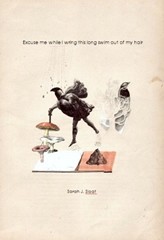 Excuse me while I wring this long swim out of my hairWorldCat•LibraryThing•Google Books•BookFinder
Regular readers of Via Negativa might recognize Sarah J. Sloat as the author of a blog I often link to, The Rain in My Purse, and another chapbook which I blogged about in 2009, In the Voice of a Minor Saint. I didn’t think this chapbook was quite as satisfying as that first one, at least in terms of the percentage of poems that blew me away, but it’s still pretty damn good. Her droll wit and sense of the absurd remain intact, and if this slim collection is any evidence, she seems to be getting more rather than less experimental with age, which is a good sign. She has a third chapbook due out shortly from Hyacinth Girl Press.
Sloat excels at poems in which a critical piece of information is missing, but the rest of it hangs together so well, it seems the better for it, like the Venus de Milo without her arms. Sometimes the execution seems a little too off-hand (heh), as in the title poem for this chapbook. But more typically it makes me chuckle or shiver with recognition, as in “My Money is on Fire,” a wry look at that sense of collective guilt inescapable for sensitive participants in a capitalist economy:
Every time I wear green or live
my secret life, no matter what
innocence I’m up to,
I’m sponsoring a disease
somewhere, making
souvenirs of the populace.
Wait, what secret life? you want to ask, but the poem goes in another direction. Perhaps Sloat refers to the kind of private visions at the heart of the wonderfully bleak “Toy Boat Toy Boat Toy Boat”:
My mug is rimmed with frost, an analgesic.
I peer over its horizon to see a toy boat
wobble on the Biergarten pond.The mug’s a sun going down in my mouth. It alps
up like a snowglobe, mountainous with lipstick
ridges. Inside my father bows, shoveling snow.He looks beyond me, turning to the window,
where my mother stands sucking the life
from an ice cube in her martini.
In “Do Tell,” a dream in which “doubts puckered like peas” throws the narrator off-balance the next morning.
Help me here.
How many mailboxes do you count lining the roadside?
And on whose head does the apple totter?
Things are clearly about to go very, very wrong here. A slightly less dire but still bracing take on domesticity, “Sworn to Observance,” reminded me of my own housecleaning. The dust under the radiator is “busy building a silt / equivalent of desert,” leading evidently to thoughts of the desert mystics in early Christianity, and/or John 8:6:
I sit nearby in my saint suit,
no intention of action.With a finger sometimes
in the dust I draw a circle
to see how God enters into it.
Another poem, “On the Way to Meet My Daughter’s Teacher,” might or might not be about smoking. It begins:
I was about 15 minutes early
so I figured I’d kill myself a little bit.Something more constructive
was out of the question.
But hell if I could handle
15 minutes of thinking.About the whales.
About bedraggle.
About meeting my daughter’s teacher.
Or perhaps it is the cynicism that kills. One way or another, Sloat is like the anonymous artists in “Dictionary Illustrations,” who “don’t dawdle / among the obvious.” When she hums in the kitchen, it is to channel bees, and when she visits “Frankfurt Cemetery,” she remarks: “Not the past, but the present makes me sad.” We are all implicated, and our imagined refuges can’t save us:
Lately my house stands so still
at the back of my mindI’m afraid of myself, here
at the bottom of the sky.
(“From the Back of My Mind”)
If you were ever tempted to think that the welter of literary micropresses on the scene these days exist solely to publish fairly minor talents, think again. Sarah J. Sloat is one example of a widely published poet with a sure voice and mature vision who has yet to get an ISBN of her own. Perhaps she is too busy leading a secret life.
That shore from which we first pushed off, how far away is it now?
In the morning, by the kitchen door, paper-thin strawflowers hold out their yellow bowls. The brass bell I bought from a temple gift shop swings under a branch of dogwood: a little more weight every day, as shoots erupt and buds crack open. Even verdigrised, you’d think the light is mild, is mellow, brings nothing but the gooey oil of blessings. Who’s to say it isn’t so? And yet, and yet. Even when the wind keens like the tool of a glass-cutter bent on dividing surfaces into a liturgy of smaller parts, a screen assembles. Don’t add my name yet to the names of the dead on the wall. Don’t carve their letters edged in gilt on a crypt. Just today, I thought of how, in place of a fence to put up around a yard of my own, I’d plant jasmine— so when its asterisks of scent opened on warm nights, no one could tell where their beauty or their yearning for the other side began.
In response to Cold mountain (41): Whenever their final day arrives.
Devotions
“…Mothers weep in the corners of those paintings
while a man, each morning, sweeps the church floor.”
~ Connie Voisine, “The Altar” by George Herbert
Every day, dirt prints on the kitchen floor,
and under the furniture, thick new pelts
of dust. Perhaps this detritus that gathers
is the sediment of dried-up tears? Taking out
the trash and pushing the bin against the far end
of the driveway, I see petite roses in bloom.
Blood-red, pressed between the fence and the water
meter. Pitimini, once I heard a woman call them:
she made floral arrangements for the church, came in
the side door of the rectory, careful to take off
her shoes and coat in the vestibule. Unrolling sheets
of newsprint on tile, she laid out ferns, divided
showy chrysanthemums from tall gladioli; and, finishing,
tucked the slighter blooms in between the hardier stems—
baby’s breath, those miniature roses. Her hands did not seem
to mind delving into their cache of sharp hooks,
guiding scratchy stems into clear vases filled with water.
I cannot remember whether she was Isabel, or Delia, or Florinda.
She came to freshen the flowers every other day, before the sun
was up. I don’t know why the ghost of her name meets me here
at the end of the driveway, pointing out the flowers.
In response to an entry from the Morning Porch.
I Was the Jukebox by Sandra Beasley
 I Was the JukeboxWorldCat•LibraryThing•Google Books•BookFinder
Sandra Beasley has soul. This is useful to keep in mind the third time you encounter a title following the pattern “Another Failed Poem About X,” or when you labor through a sestina with “ginger” as one of its line-ending words for no good reason that you can see. Yes, genius can be annoying: how many of us would resist the urge to be clever at the expense of emotional impact if we had anything approximating Beasley’s gifts?
Once I asked a broker what he loved
about his job, and he said Making a killing.
Once I asked a serial killer what made him
get up in the morning, and he said The people.
(“Vocation”)
But even her less-than-fully-successful poems are still pretty damn impressive. This book deserved its place on everyone’s top poetry lists last year. I don’t know what made me break my usual pattern of studiously ignoring whatever everyone else is hyping — possibly the fact that Beasley is a long-time blogger, or that she’s a Facebook contact — but I’m glad I did.
Why do I say Beasley has soul? Because she throws her voice like nobody’s business, taking on the personas not only of inanimate objects, plants and dead gods, but also historical events (“The World War Speaks”) and plural beings (“The Sand Speaks”):
Mothers, brush me from the hands
of your children. Lovers, shake me
from the cuffs of your pants. Draw
a line, make it my mouth: I’ll name
your country. I’m a Yes-man at heart.
Because, unlike so many young poets of a surrealist bent, she stays relatively down-to-earth and tends to give the uninitiated reader something to grab on to, even when writing a modern-day allegory (“Beauty”).
That night, something howled outside.
I opened the door. It was Beauty. Beauty
was muddy and senseless. I let her in.
I tried to towel her off, and she bit me.
Because she is so fond of apostrophe, she has written love poems to college, oxidation, and Wednesday.
You are the loneliest of the three bears, hoping
to come home and find somebody in your bed.
(“Love Poem for Wednesday”)
And now and then there’s a poem that appears to be autobiographical nonfiction, such as “Antietam,” and it’s all the more affecting for coming in the midst of wilder and woolier stuff. The narrator is on a school field trip to the Civil War battlefield.
Our guide said that sometimes, the land still let go
of fragments from the war—a gold button, a bullet,
a tooth migrating to the surface. We searched around.
On the way back to the bus a boy tripped me and I fell—
skidding hard along the ground, gravel lodging
in the skin of my palms. I cried the whole way home.
After a week, the rocks were gone.
My mother said our bodies can digest anything,
but that’s a lie. Sometimes, at night, I feel
the battlefield moving inside of me.
I Was the Jukebox has been very widely reviewed, and since I have to go to bed early tonight, I’m going to slack off a little and just point you toward the links on the Open Library page. I do however want to say a little about the book’s packaging, trivial as that may seem. I was a little turned off by the publisher’s decision to put a short blurb right on the front cover, up at the top — that’s just tacky. The cover design is a mess. But both these failings are off-set, for me, by the pleasingly grainy surface of the paperback cover. There’s a lot to be said for a book that feels good in the hands. It won’t slide off the couch as easily easily as a book with a glossy cover. And like sand on the beach, it makes you want to dive in.
Todd Davis on National Poetry Month
And as far as cruelty goes, I think T.S. Eliot was being a bit overly dramatic when he suggested that these 30 greening days in the fourth month of the year were the cruelest. I can think of many other months that offer far more by way of cruelty.
Perhaps as a Midwesterner transplanted to England, Eliot never had the opportunity to walk deep into a northern forest in the first days of March—snows slowly pulling their tongues back into the earth’s mouth—to see winterkill huddled beneath hemlock boughs: the carcasses of deer withered on January’s barren fruit; the corpses of porcupines who weren’t fast enough to evade the brutal teeth of fisher; or even the rare bear who trudged too soon from slumber and found nothing but the empty taste of ashes in its belly.
By April, at least here in central Pennsylvania, the entire ridge-side is burgundy with the tiny blossoms of sugar and red maples. The coltsfoot has already discarded its yellow-fringed flower, and May apple is unfurling the glossy umbrella that will hide its fruit in June and July.
Flowers of a Moment by Ko Un
 Flowers of a Moment (Lannan Translation Selection Series)WorldCat•LibraryThing•Google Books•BookFinder
Tonight, I don’t feel like pretending to be a book reviewer. (Does it really matter what I have to say about a guy who’s been nominated so many times for the Nobel Prize?) Tonight I would rather respond to a few of Ko Un’s brief poems as if he were right here, sharing drinks and conversation.
I have spent the whole day talking about other people again
and the trees are watching me
as I go home
Sometimes I confuse the road with the map and everything on either side with terra incognita.
Exhausted
the mother has fallen asleep
so her baby is listening all alone
to the sound of the night train
The spider spends 99 percent of her lifetime waiting, suspended among her knitting, yet will perish before the first of her children hatch.
Outside the cave the howling wind and rain
Inside
the silent speech of bats filling the ceiling
Today, I read about a study that found that plants emit and respond to sonic vibrations. With their large ears attuned to ultrasonic sounds, I wonder if bats can hear the questing rootlets of the oaks over their heads?
We went to Auschwitz
saw the mounds of glasses
saw the piles of shoes
On the way back
we each stared out of a different window
Every window has its own fragile truth. Once, in a basement dangerous with broken bottles, a thug threw me against a wall and my glasses flew off. I became half-blind and sober at the same time.
Beneath the heavens with their scattered clouds
here and there are fools
Some of us are expanding, some shrinking, some taking a leak with a beer in one hand.
Crayfish, why are you so complicated?
with your feelers
your jaw legs
your hairy legs
your chest legs
your belly legs
and all the rest
My god! How is it that I missed my calling to be an egg?
In the old days a poet once said
our nation is destroyed
yet the mountains and rivers surviveToday’s poet says
the mountains and rivers are destroyed
yet our nation survivesTomorrow’s poet will say
the mountains and rivers are destroyed
our nation is destroyed and Alas!
you and I are completely destroyed
Isn’t there some way we can destroy all these pesky poets?
Look at the nose of a baby rabbit
look at the tail of a dog—
that’s the kind of world I’m living in
Look at those three bs in “baby rabbit,” then look at the small g in “dog” — the alert way a prey animal sits, the alert way a predator lies in wait.
A thousand drops
hanging from a dead branchThe rain did not fall for nothing
Today I watched a crowd of mayapple parasols down by the streambank thrown into disarray by one simple snowfall. Some turned completely over, their flower buds like thumbs pointed at the sky.
One spring night, the sound of a child weeping
One autumn night, the sound of laundry being pounded
This
was a place where people were really aliveAs I passed the field fertilized with their shit
involuntarily I bowed my head
I was going to say that I have never grown anything with compost made from my own excrement, but then I remembered I’m a writer.
From across the river
the sound of a bell reached the two of us
for us to listen to together
The sound of a bell reached usWe had decided to part
but then we decided not to part
I remember the big bronze temple bells in Japan, how they boomed rather than clanged, the sound going on and on: the bells of Mt. Hiei that I listened to with a lover as we gazed into each other’s eyes, and the bell at Ikkyu’s old temple in the country where I trespassed one night so I could stand inside it, whispering hello to the spiders and the thousand-year-old bronze.
No need to know its whereabouts
A small spring in a mountain ravine
is like a sister
a younger sister
like a long lost younger sister
now found again
The whole point of drinking, it seems to me, is that moment of recognition. I’ve had brotherly feelings toward mosquitos sinking their drilling rigs into my arm.
The top is spinning
Yesterday the poet Midang departed
today old Oh from next door departed
How can death concern only one or two?
The child’s top is surrounded by every kind of death
The rubber ball, the spinning jacks — how many can you keep in play? Between one bounce and the next they can all fall down.
A warship moves through the sea
near Paekryong Island in the Yellow Sea
Not one seagull’s in sight
The sea
looks as if someone has disappeared in it
I’m carrying an empty soju bottle
When war becomes permanent, who but a poet or a crackpot remembers the kind of peace that doesn’t involve desolation? The deafening howl of A-10 fighter jets can linger for half a minute after they’ve passed from view, the air like a fresh wound that hasn’t yet learned how to bleed. Then, slowly, the whine of cicadas, and this old wrinkle of earth goes back to being a mountain.