Rift

This entry is part 23 of 54 in the series Morning Porch Poems: Spring 2012

Unto every one that hath shall be given, says the sky:
and so the flowerbeds spread their skirts lined with mulch,
and the odor rose into the air, mold of wood mingled
with the fragrance of budding things. And the frost
that earlier rimmed the outlines of each blade
of grass: overtaken by rain, so many needles
running stitches into the earth.


In response to an entry from the Morning Porch.

Walden by Haiku, by Ian Marshall

Walden by haiku Walden by haikuMarshall, Ian; University of Georgia Press 2009WorldCatLibraryThingGoogle BooksBookFinder

the old pond
not one wrinkle
after all its ripples

That’s one of Ian Marshall’s “found haiku” from Walden, “The Ponds” chapter. Here’s the original passage, helpfully included — as are the sources for each of the haiku from the main section of the book — in Part 2, “Sources and Commentary”:

Nevertheless, of all the characters I have known, perhaps Walden wears best, and best preserves its purity. Many men have been likened to it, but few deserve the honor. Though the woodchoppers have laid bare first this shore and then that, and the Irish have built their sties by it, and the railroad has infringed on its border, and the ice-men have skimmed it once, it is itself unchanged, the same water which my youthful eyes fell on; all the change is in me. It has not acquired one permanent wrinkle after all its ripples. It is perennially young, and I may stand and see a swallow dip, apparently to pick an insect from its surface as of yore. [emphasis added]

If you’re a haiku purist, or if the idea of rewriting a hallowed classic fills you with horror, you won’t like this book. I thought it was a blast, not least because even when I was young and impressionable I found Thoreau a little too long-winded, self-righteous, and apt to treat nature as an excuse to indulge in airy philosophizing (though as Marshall points out, this tendency diminished over time). Transcendentalism is utter crap as far as I am concerned, and nothing could be father from the Zen spirit of haiku as Bashō, Buson, Issa and Shiki practiced it. So to me, Marshall’s distillations offer an almost ideal condensed version of Walden, cutting all the parts I don’t like and highlighting almost everything I do. In essence, he’s applied Thoreau’s famous directive, “Simplify, simplify” to the text in which it appears.

I’ll admit I didn’t read all of Part 2. I would’ve dipped into it much more often if the publisher had made it easier to quickly locate the source and commentary for a haiku in the first half, e.g. by including referenced page numbers in the top margin, as more scholarly books with extensive end-notes often do. Walden by Haiku is kind of a hybrid between a scholarly work of ecocriticism and a popularly accessible primer on haiku, and possibly the author or editor figured it would scare off potential readers to treat Part 2 strictly as end-notes.

Not that the main section of the book is lacking in a critical apparatus, however. Following a very readable 17-page introduction explaining the project and describing haiku aesthetics in general terms, the haiku are presented in the order in which Marshall “found” them in the book, chapter by chapter, each section followed by a few pages of additional commentary expanding on some aspect of haiku aesthetics as it might relate to Thoreau’s writing. It kind of reminded me of one of those volumes from Doubleday’s Anchor Bible translation, with the translation of each passage followed by two or three sections of increasingly arcane commentary and notes.

And in fact translation is how I’d describe this project. As I’m sure I’ve said here more than once before, I’ve personally found translation to be an invaluable aid to attentiveness, kind of the apotheosis of reading, which is why I think every serious poet should give it a shot. It’s clear from Marshall’s commentary that, despite the dozens of times he’s taught the book, the countless times he’s read it and the hundreds of journal articles and books about it that he must’ve read in the course of his career, translating Walden into haiku revealed new puns and other layers of meaning in the text that he’d never noticed before. Though Thoreau himself was unfamiliar with the haiku tradition, like any writer who goes outside of himself for moments of authentic contact and insight, many of his best passages can readily be translated by a skilled poet into approximations of English-language haiku. And Marshall is nothing if not a skilled poet. Here are a few other examples of Walden translated into haiku:

furniture on the grass
white sand and water
scrubbing the cabin floor

fishing for pouts
baiting the hooks
with darkness

a cool evening
the sound of a flute
stars over far fields

mortaring the chimney
our knives thrust into the earth
to scour them

after a cold night
my axe on the ice
resounding

Most of the poetry I’ve read this month has been in the form of chapbooks or shorter full-length collections, but I thought it was worth compromising on my book-a-day pace to fit this one in; I’ve been meaning to read it ever since it came out. Marshall is a friend of the family, so I suppose I should issue a disclaimer — except that many of the authors whose works I’ve blogged about this month have been friends or acquaintances. If I’d read the book and not liked it, I simply wouldn’t have blogged about it. And I’m not sure how much Ian will appreciate my slighting comments about Thoreau! But for the majority of readers who presumably hold more reverent attitudes toward ol’ Hank: I can assure you that there’s hardly a trace of arrogance in Marshall’s commentary. These are not appropriations but homages, I think. He’s very aware of the audacity of this project, his conclusions are cautious, and his general attitude toward his source comes across as an apprentice-like humility. In my translator analogy, he would be a W. S. Merwin rather than a Robert Bly or a Stephen Mitchell: someone determined to try and capture the voice of the original author rather than to impose his own.

Let me conclude with an example of Marshall’s semi-populist, semi-scholarly analysis: part of his commentary on the “old pond” haiku I quoted at the outset. This follows his quote of the source passage.

Again, I cannot help but see this passage and haiku as invoking the most famous and thoroughly analyzed haiku of all, Bashō’s “the old pond / a frog jumps / the sound of water.” Thinking of Walden as Bashō’s old pond [which Marshall also did at the beginning of the introduction] makes this passage as resonant as Thoreau’s “hound, bay horse, and turtle-dove” parable. The pond retains its purity and remains undamaged and unchanging even after all its far-reaching ripples—far-reaching in terms of both time and geography—and even after the ice-men (critics?) have done their skimming. And every time we find something new in Bashō’s old pond, the change is all in us. … Bashō’s pond haiku has been extensively commented upon, imitated, and evoked—as I have done one more time by arranging Thoreau’s comment here in the form of a haiku that echoes once again the sound of water Bashō heard over three hundred years ago. And still—all these wide ripples later—no wrinkles on the pond.

(Note, by the way, that the hardcover edition I’ve linked to at Open Library has been supplemented by paperback and electronic editions. Click on the publisher link for information about all three.)

Founding

This entry is part 22 of 54 in the series Morning Porch Poems: Spring 2012

Of brass and iron, of bronze or bell metal, a house
within which the clapper might sound— What slips

into the wind, sometimes slight as a prayer?
A warbler’s call before it fades,

the curl of incense bearing the names
of all we’ve lost, all we seek—

Hour upon hour is struck: diligent notes that echo
to the yoke and crown, to the waist and lip—


In response to an entry from the Morning Porch.

Words on the Street

Homeless guy with sign: Consuming Mindfully Since 2004


Happy Earth Day. Even if the earth is about to pound the east coast of the U.S. and Canada with a winter storm after weeks of unseasonably warm weather. “Global weirding,” here we come!

Night Watch

And if I say heat, expected rain, lassitude— the hollows of my bones begin to mimic the throats of brittle plants. I was seized by thirst, reading a catalogue of inks: morning glory, transparent blue as raindrops on its cheek; moonlight, brazen crimson of azaleas. Purple berries, named after the lady-in-waiting who wrote the first novel. The names of women were not even recorded in her time. I think of her, restless on her sleeping mattress, mining the indigo shade of night after night for illumination. Green sentinels of bamboo; ochre fields, stalks bursting with grain— each pointed like a nib.


In response to New year's resolutions: the most beautiful thing.

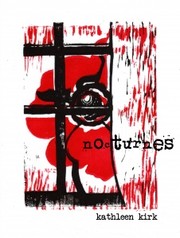
Nocturnes by Kathleen Kirk

Nocturnes NocturnesKathleen Kirk; Hyacinth Girl Press 2012WorldCatLibraryThingGoogle BooksBookFinder
This was the perfect companion for a quiet, rainy spring night. Kathleen Kirk‘s latest chapbook gathers 20 night-themed poems that together trace a landscape of loss and yearning, peopled by memories, dreams, ghosts, lovers and various errant moons. The book begins in Cuba, with a striking image of women wearing fireflies in their hair nets (“Cucuyo”) followed by several pieces from the perspective of a Cuban exile’s family, culminating in the grotesque “Our Son Dreams of the Beast Shark.” It then segues into “Stargazing with My Son,” introducing an astronomical theme that continues off and on throughout the book, mingled with, increasingly, poems about love and desire.

All of which is to say that the book is very well put together. As someone who has written several themed collections myself, I can attest to the difficulty of maintaining a good balance between unity and diversity, as Kirk does here.

Three of the poems are ekphrastic, responses to Whistler’s “nocturne” paintings — not surprising, considering that Kirk is poetry editor for Escape Into Life, a magazine devoted to the intersection between visual and literary arts. But even poems that weren’t sparked by paintings abound with painterly details: “A grey glob” of mortar “lands wet and heavy / on the plastic sheet / like a body part” (“Losing Cuba”), and the narrator’s skin is likened to “these moon-colored leaves (touch them!) / trembling in the moments / just before rain” (“Last Leaves”).

“Almost an Aubade” references Edward Hopper, his subjects “shining in their loneliness,” but unexpectedly turns into a love poem: “After the sharp dream of another, I come back to you…” The book is full of such artful inversions. Possibly the most unexpected poem, “When We Lived at Night” — my favorite in the collection — goes deep into our pre-human past, when “there was no time, / only the moment” and “we lay along the wide limb / of our new existence / in the trees, nocturnal together.”

What’s left of my reptilian brain
still longs to live in the moment,
that wretched clawing in the dust
suspended forever.
But there was no forever.

I relate to the poems about sleeplessness, “Acorns Rolling Off the Roof” and “Naked Dance”:

It’s three oh three,
I’ve dreamed a giant red poppy,
tall as a small tree …

It’s good to be lonely

at a time like this.
I wouldn’t want to wake the sleeping world
from its soft desserts.

There’s only one explicit reference to blues in this book, but if you love blues music as I do, the dominant mood should feel very familiar, that same mix of melancholy and exultation. Like good blues, these poems are never lugubrious, and aim to turn losses into something salutary: “When the time comes, / juncos will feast on this cold” (“Almost Winter”). Or as Kirk says at the end of “Cosmonaut”:

This shining loss is now a thing to be praised,
as stunning as a comet’s tail
or a transit of Venus,
or a black hole swallowing up life as we know it
and spitting it back out whole
somewhere else, without any teeth marks.

Kudos to Hyacinth Girl Press for their selection of this surprising and delightful book.

Character recognition

The Storialist:

It’s getting harder to prove you’re not a robot
to the computer. You can robot-proof
your website by warping the text like wrought
iron, twisting it. The troubled youths
of the internet have robot brains. They want
to sell you pills to enhance your desire
or suffocate your appetite.

A Woman Traces the Shoreline by Sheila Squillante

A Woman Traces the Shoreline A Woman Traces the ShorelineSheila Squillante; dancing girl press 2011WorldCatLibraryThingGoogle BooksBookFinder 
First read: WTF? Is that it?

Second read: Oh, I get it. It’s about trying to write a pregnancy poem, and merely “tracing the shoreline,” while seated in a soulless retail shopping environment — specifically a bookstore cafe next to a Bed Bath & Beyond still under construction and covered by scaffolding. A little meta, but O.K. “This is ritual.” There are seagulls and a woman picking through a dumpster. There are dreams and cravings for poems by women, and there’s a desire to “include too much.” The shoreline when it first appears is a metaphor for “the edges of heat rash … from shoulder to fingertips.” A few pages later “She waits, tracing the shoreline of her body, a heat rash of expectation.” And two pages after that, “I trace the shoreline of my own exhaustion. It grieves me to prepare so effectively.”

Interlude: I hear a barred owl through the closed door and step out onto the porch to listen. It’s gotten a little cool out. Venus glimmers in the west. After a minute or two, the owl calls again; it’s very close. Who cooks for you? Who cooks for you-all? A pause of another couple minutes, then it calls again, still from the same location. That expectant feeling, attention focused but relaxed, staring into the darkness as if that will aid the hearing — then, intellectual that I am, analyzing this, still clutching the open book in my left hand like a talisman against the night. Once more the owl calls, then silence. Is that it? Yes. Yes it is.

Third read: This spare prose-poem spread out over 17 pages is about expecting, in the broadest possible sense. It only makes sense then that it would challenge our expectations of what a poem (or sequence of untitled poems?) should be. Is it, are they, finished? Clearly not. “I coexist. I am becoming, they tell me, ‘wholer.'” “This rash, these shore birds. Scaffolded, skeletal.” Shorelines themselves are never finished, perpetually under construction by waves and currents. One stands on the shore to wait for the ship, for the hero without or within. “I feel the hero fighting. I am the hero fighting.”

Waiting is a kind of kenosis. Her cookies eaten, the narrator faces “the empty plate, page.” She stares at her “belly and breasts, crumbling shoreline of retail need.” The last words on the last page suggest that this has, after all, been a quest narrative: “We quest and billow. We wait.”

With just a few sentences marooned in the top part of each page, it occurs to me I’ve been following a shoreline back and forth through this oddly affecting and thought-provoking book.

Mountain Haibun

…paths worn ever-steeper by joy and sorrow.

Sometimes, on the one-lane road ascending through the cordillera, the vehicle is merely inches from the edge of the ravine. We listen for the sound of gravel, expect their skittering to hit the faces of rock below, but nothing: only the sound of the wind combing through pine, the trickle of a distant waterfall. The slightest press from fingers of fog, and the bashful mimosa curls, leaf by leaf, into itself. Before the sun goes down, the driver pulls up at a lean-to and the women and girls file out, squat behind its corrugated shingle. The men stand in a row, impassive before a length of limestone. This is a bathroom stop. It is at least four more hours before the township comes into view with its rest houses, cantinas, a lake whose name in the local tongue simply means “water.” Someone startles a flock of blackbirds in the bushes; there is laughter, the smell of cold bread rolls shaken out of paper sacks. Only the tungsten yellow lights from the bus cut through the darkness and the fog, arcing with each turn.

We’ve journeyed so far, suffered so much on this road.
Only the lizard, if it fell through these oceans
of fog, might live to tell the tale.


In response to Cold mountain 37.

Jennifer Schlick visits Plummer’s Hollow

Jennifer Schlick in action

Naturalist, blogger and photographer Jennifer Scott Schlick visited Plummer’s Hollow earlier this week, and has just posted a short but stunning set of macro photos of some of our wildflowers. She was especially charmed by the rue anemone and fringed polygala (AKA gaywings), neither of which she’d encountered in her area of upstate New York (Jamestown and environs, just north of the northwest corner of Pennsylvania). It was also the first time she’s seen pink and yellow color variants of red trillium — one of the flowers included in our photo-poem collaboration last year. I’ve embedded her Flickr slideshow below, but if you can’t see it, here’s the link.

I had a hunch that Jennifer’s slideshow-talk “Confessions of a Reluctant Birder” would make a good presentation for our local Audubon chapter’s annual spring banquet, and I was right. Turns out she’s a highly entertaining, down-to-earth speaker. She does this sort of thing more or less for a living, along with banding birds, introducing high school kids to nature, mobilizing hundreds of volunteers to remove invasive plants from a 600-acre wetland, and yes, writing the occasional grant to support the Jamestown Audubon Center & Sanctuary, for which she serves as program director.

It was fun following Jennifer through our woods and introducing her to some of my favorite fellow inhabitants. Seeing the hollow through the eyes of a visitor is always a treat, but never more so than when the visitor has advanced training in looking at the natural world. And if you’re wondering whether Jennifer has blogged about the visit yet herself, the answer is of course.