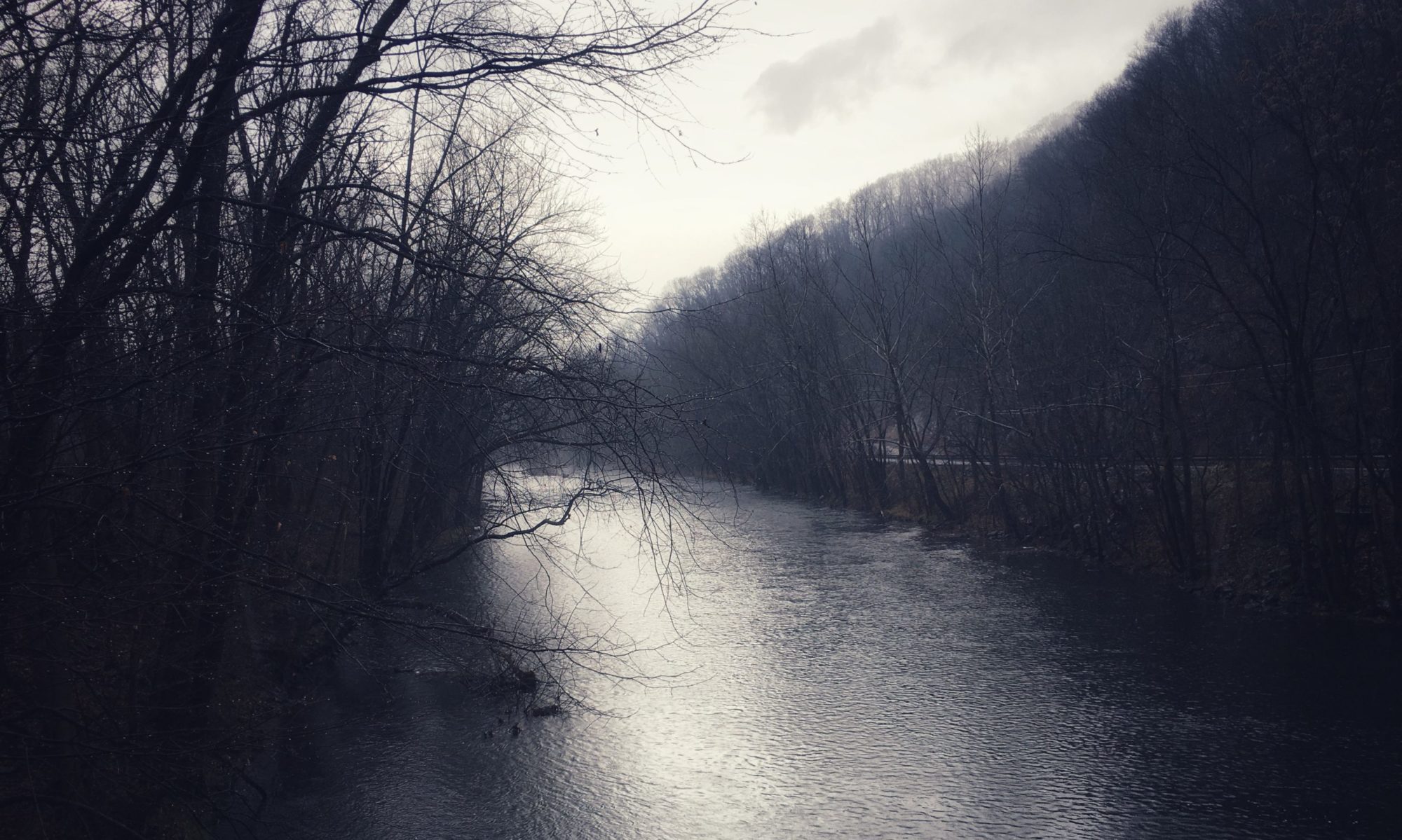


Longing (1)
Longing, we say, because desire is full
of endless distances.
Robert Hass, “Meditation at Lagunitas”
*
JOHNNY TO FRANKIE
I curse you & you come back
for more, your proud lip trembling.
You deny nothing.
There are words that should never be said &
I say them one by one because they are delicious.
Every stunned look has its echo
in the pit of my stomach. It terrifies me
how much of you I have taken in
& how much more I still need.
When a hound feels sick he eats
a little snakeroot, cleans himself out.
I love you beyond reason.
If only you would pay me back in my own coin.
__________
“Frankie and Johnny” lyrics: traditional version, as interpreted by Cisco Houston, Van Morrison and (appropriately, and my favorite) Johnny Cash; Elvis Presley’s first-person version (lyrics by Gottlieb, Karger, Weisman); a review of the soundtrack for the Elvis movie musical is here.
Words on the street

Of fools and poets
A few days ago in The Middlewesterner, Tom was describing a minor discovery he made while visiting one of his target communities, L’Anse, Michigan:
That’s how they get the logs on those log trucks to look as if they have been loaded with such care! I see a fellow atop his load, sawing the logs to an even length along the driver’s side.
If my wife were with me, I suppose she’d say “I knew they did that.” Well, I didn’t know. She understands the world far better than I do. I think when poets like me are born, they’re not given the same program that everyone else gets. We don’t get a program coming in; we don’t get a score card; hell, they don’t even tell us what the game is.
This is a sentiment I can identify with wholeheartedly. My own incomprehension of the way things work remains acute, hard as I’ve tried to educate myself. For example, though licensed to drive, I rarely do, because I find it almost impossible to keep my eyes on the road – that’s where all the boring stuff is. (After reading Tom’s blog for a little while, I concluded that the only reason he avoids accidents is that he lives in a part of the country where the roads are flat and straight. Also, he seems to pull over every few miles to look around more thoroughly.)
My Dad and I often have opposite views about how or whether to carry out any given task. When, several years ago, I was redoing the guest bedroom, I thought that the thing to do would be to paint the walls white and turn them into a permanent record of our guests. We’d keep a supply of crayons in the room and invite everyone who stayed there to draw something, whatever they liked. I couldn’t – and still can’t – see a darn thing wrong with that idea. However, I wasn’t paying for the materials, and I don’t own the house. So the walls ended up papered, instead.
Actually, my Dad frequently solicits my opinion before doing a job, and we’ll joke about the likelihood that I will automatically disagree with whatever he says, and that he will go ahead and do it his way after hearing me out. But sometimes one of my ideas out of left field will strike his fancy. And sometimes, too, his more linear approach turns out to have been twice as crazy as anything I could’ve come up with, and I get to pick on him about it forever after.
It’s not so much that poets are fools, I think, as that natural-born fools are drawn to the practice of poetry and other creative arts. It wasn’t always so. Well into the Middle Ages, the court jester remained a very different person from the bard; the former was allowed far more leeway to criticize and satirize than the latter. Bards are the keepers of tradition and the eulogists of national and heroic exploits, and they tend to identify strongly with the interests of their patrons. (I use the present tense because this is still the case with the griots of West Africa.) I’ve always felt that had we grown up in a more traditional society, it would be my older brother, with his capacious memory and facility with languages, who’d be the poet. I would have been the fool. It’s only since the Romantic Revolt that creative artists have been able to make a virtue out of “marching to a different drummer,” as Thoreau put it. And in the 20th century, it became all but unthinkable for a poet in a free society not to stand with the downtrodden and the oppressed.
If some contemporary poets still act as griots, it is for social movements rather than for individuals: thus, for example, Adrienne Rich (feminism), Gary Snyder (environmentalism), Martin Espada (Puerto Rican nationalism), Linda Hogan (American Indian rights and consciousness), Mark Doty (gay rights and consciousness), etc. But the analogy is weak, because each of these poets is also a strong individualist with her or his own, unique perspective; they are hardly spokespeople. In fact, I think that the bards and poets laureate of centuries past would find their strongest analogue in the modern P.R. flunky.
I should really read up on the history of court jesters. Rulers have always sought the council of sages. When, where and why did it first become necessary to balance the influence of the wise by consulting a fool?
The authors of the Bible were unconfused about the difference between the wise man and the fool. “A thistle got stuck in a drunkard’s hand, and a proverb in the mouth of a fool,” says Proverbs 26:9 in James Kugel’s translation. Kugel, a noted Old Testament scholar, goes on to explain:
A fool, in the world of wisdom, is not someone who is stupid any more than a “sage” or “wise man” is necessarily brilliant. But just as the wise man is someone who walks the path of wisdom – following the canons of restraint and patience that were the pillars of the wisdom outlook – so the fool is someone who does not follow the wisdom outlook, who does not live in accordance with wisdom’s insights. Indeed, “foolish” and “wicked’ are virtual synonyms in Proverbs, as are “wise” and “righteous.” And just as humanity, according to the severe, abstract spirituality of this worldview, is uncompromisingly divided into the righteous and the wicked, so it is divided between the wise and the foolish, with no room in between for intermediates.
(The Great Poems of the Bible: A Reader’s Companion with New Translations, The Free Press, 1999)
Only with the great disillusionments of the Common Era, perhaps – the destruction of the Temple in Jerusalem, Christ’s failure to return, Imam Al-Askari’s failure to return – came the recognition that wisdom and foolishness were not so far apart, and that a fool might be worth listening to. Probably, too, some of the age-old Chinese traditions about crazy, eccentric and inebriated sages traveled west along the Silk Road. Be that as it may, each of the would-be world religions acquired its so-called holy fools. Just the other day I picked up a remaindered copy of Idries Shah’s The Pleasantries of the Incredible Mulla Nasrudin (Penguin Arkana, 1993), Sufi teaching stories credited to, or told about, the most famous fool of them all.
Nasrudin was a real person, a Naqshbandi Sufi from somewhere in Central Asia. (Click here for a lousy photo of a public statue of Mullah Nasrudin astride his donkey in downtown Bukhara, and follow the link to a site with some pretty good versions of Nasrudin stories.) Many of the sayings attributed to him are also credited to others, though, and it’s almost impossible to glean a coherent biography from the morass of inconsistent traditions about his life. According to one tradition, he even served as a court advisor to the conqueror Tamerlane. Another tradition has him serving as a judge:
The Mulla was made a magistrate. During his first case the plaintiff argued so persuasively that he exclaimed:
‘I believe you are right!’
The clerk of the Court begged him to restrain himself, for the defendant had not been heard yet.
Nasrudin was so carried away by the eloquence of the defendant that he cried out as soon as the man had finished his evidence:
‘I believe you are right!’
The clerk of the court could not allow this.
‘Your honor, they cannot both be right!’
‘I believe you are right!’ said Nasrudin.
In Nasrudin’s unique brand of foolishness, it’s not always immediately obvious that any serious point is being made.
Nasrudin entered the teahouse and declaimed:
‘The Moon is more useful than the Sun.’
‘Why, Mulla?’
‘We need the light more during the night than during the day.’
Though his humor was sometimes directed against the arrogant and the deluded, most often Nasrudin sought to teach by counter-example, as it were. Thus, while their perspectives may have been similar, Nasrudin’s approach was much subtler than Diogenes’. Instead of scorning others, he holds himself up for scorn. (As a sometime advisor to a despot, this may have been a simple survival strategy.)
‘I can see in the dark,’ boasted Nasrudin one day in the teahouse.
‘If that is so, why do we sometimes see you carrying a light through the streets?’
‘Only to prevent other people from colliding with me.’
The problem with being a sage or guru, it seems to me, is that other people would want to emulate you – to their and your own ultimate undoing. As the Sufis recognize more than anyone else, it’s all too easy to get up caught up in the inner logic of one’s own stories or beliefs, and forget that they most likely have little to do with the true Story.
The Mulla was walking down the village street deep in thought, when some urchins began to throw stones at him. He was taken by surprise, and besides he was not a big man.
‘Don’t do that, and I will tell you something of interest to you.’
‘All right, what is it? But no philosophy.’
‘The Emir is giving a banquet to all comers.’
The children ran off towards the Emir’s house as Nasrudin warmed to his theme, the delicacies and the delights of the entertainment . . .
He looked up and saw them disappearing into the distance. Suddenly he tucked up his robes and started to sprint after them. ‘I’d better go and see,’ he panted to himself, ‘because it might be true after all.’
Laugh all you want, but that sounds very much like something I would do.
*
Sir, I admit your general rule:
That every poet is a fool.
Though you yourself may serve to show it,
That every fool is not a poet.
(attributed variously to Alexander Pope, Matthew Prior and Samuel Taylor Coleridge)
My eyes have been playing tricks on me lately. Yesterday I was walking across the lawn under the black walnut trees just as a breeze picked up. The yellow leaves started raining down, and I stood watching for a couple moments, entranced. One of the leaves had other ideas – it got to the ground, then took off again, twirling across the lawn. I finally realized it was actually a sulfur butterfly.
Then I took a detour through the shed yard to check on the progress of a clump of gorgeous New England asters. I’m intending to transplant them into my front garden after they die down. A couple of bees were busy pollinating. No wait – yellow jackets. No again: syrphid flies. Bees don’t hover. (You need two wings for that – four’s too many.)
Well, O.K., that’s actually a pretty common mistake; evolution has seen to that. But on Thursday, I thought I saw a college student with two heads. I had just descended the front steps of the library on Penn State’s University Park campus. I noticed a person or persons sitting with his/their back(s) to me on the lawn off to the right, with two heads that seemed almost fused together. My prurient interests were piqued, and I slowed down for a better look. I had to almost stop walking to verify that there was, in fact, only a single torso. Finally, I realized I was looking at a single head with a hell of a lot of very springy hair tied in a ponytail. The rounded ponytail was fully as large as the head.
Probably none of this will make it into a poem. Nor does it mean much of anything, I think. And now that I’ve put it out on the web, I feel my obligations to it are pretty much at an end. If you need any of it – a second head, I mean, or a leaf that turns into a butterfly – you’re more than welcome.
I like the web. You can find all sorts of things you’ve always wanted but not very much. It’s a great place to search for lost keys – not because there are more keys, but because there’s greater visibility. Sometimes I even think up things to lose, just for the joy of looking.
Words on the street

unCaged
My noisy old computer (a Proteva) has just started making a new sound – I mean, just minutes ago. It’s a very up-tempo chicka chicka chicka chicka chicka chicka chicka chicka chicka chicka chicka chicka SHHHHHHH with unpredictable variations in length. Oddly compelling – even energizing!
So this got me thinking about one of my all-time gurus, John Cage. Here are some quotes of his, courtesy of Google. Most of them are new to me, since I have never bothered to read more than one or two of his essays – I never felt I had to. Well, now I feel that way more than ever! These sayings are so consistent with my own beliefs, I could’ve written some of them myself (not to sound immodest or anything). Maybe I should just quit trying to say anything wise from here on out.
The highest purpose is to have no purpose at all. This puts one in accord with nature, in her manner of operation.
*
I certainly had no feeling for harmony, and Schoenberg thought that that would make it impossible for me to write music. He said, ‘You’ll come to a wall you won’t be able to get through.’ So I said, ‘I’ll beat my head against that wall.’ (Hmm, I must admit I had never realized the deep connection between John Cage and Twisted Sister.)
*
If something is boring after two minutes, try it for four. If still boring, then eight. Then sixteen. Then thirty-two. Eventually one discovers that it is not boring at all.
*
I can’t understand why people are frightened of new ideas. I’m frightened of the old ones.
*
Food, one assumes, provides nourishment: but Americans eat it fully aware that small amounts of poison have been added to improve its appearance and delay its putrefaction.
*
As far as consistency of thought goes, I prefer inconsistency.
Ooops, now it’s speeding up. Should I worry? Is it going to explode?
It was at Harvard not quite forty years ago that I went into an anechoic [totally silent] chamber not expecting in that silent room to hear two sounds: one high, my nervous system in operation, one low, my blood in circulation. The reason I did not expect to hear those two sounds was that they were set into vibration without any intention on my part. That experience gave my life direction, the exploration of nonintention. No one else was doing that. I would do it for us. I did not know immediately what I was doing, nor, after all these years, have I found out much. I compose music. Yes, but how? I gave up making choices. In their place I put the asking of questions. The answers come from the mechanism, not the wisdom of the I Ching, the most ancient of all books: tossing three coins six times yielding numbers between 1 and 64.
*
There is poetry as soon as we realize that we possess nothing.
Now the noise has stopped. The computer’s gone back to its normal humming.
Rubaiyat
This one’s for you
September morning just cool enough
to show the soil’s breath. Forest
in fog, new gold under
old green, give me
your delectable frost, fine
web of lines, the wind-
fallen apple that fits
so snugly in the palm
& when I take a bite it bites back.
Who’d want their sugar
straight, without
some tartness? Give it to me
dry, as they say of wine. Impure,
like every true love. And
the must – ah, let it settle
to the bottom
week by week until all
the fog is gone
& the bottle brims
with light!
Words on the street

Notes from a school for solitude
Solitude . . . bears us away
Into its icy comforting, our pain and our happiness.
– Charles Wright, “Half February”
I have been cold. All day yesterday & the day before my hands stayed warm to the touch – or so I would imagine – but inside, behind the knuckles & at the base of the thumbs, a spreading numbness. My enormous kneecaps have begun to ache, poor things, even under long johns. When I climb the stairs they make audible clicking noises. They feel as if they might come unattached, somehow.
Equinox. Who’s there? In last night’s dream, a random remark prompted the poetry teacher to assign the making of masks – right now, drop everything! Some were carved & painted, some forged, some molded in clay or – like mine – built up with flour paste and strips of yesterday’s news. They were glorious.
I find myself longing for another cigarette – it was just this time of year I stopped smoking back in 2000. The cloudless mid-September sky seeps in through every pore. I sit in the woods & listen to the oak trees tapping everywhere with their acorn mallets.
The best tones come from things that are the most hollow: logs, of course, but also certain flat rocks with ant or termite galleries underneath them. Sometimes an acorn strikes another acorn on a lower branch & one hears a rapid tick-tock as both hit the ground.
I watch a mourning cloak butterfly glide from one patch of sunlight to another, dark brown/magenta fringed in white lace. This one will over-winter, I know, will find a suitable piece of bark to crawl behind & let itself freeze solid, the glycerol in its blood keeping ice crystals from growing in the narrow cave of its heart. I’ll see it again on the first warm day in March, wings duller, flight path more erratic.
A chipmunk clucks from six feet away, standing erect like the world’s smallest grizzly. It stares right through me until I begin to question my own presence. A doe and its almost-grown fawn drift in and out of sight among the laurel, chewing loudly. Archery season begins in little over a week.
I decide to stay put until the oaks can incorporate me into their on-going composition. My body’s own distracted percussionist slows to match the chipmunk’s insistent metronome. My scalp begins to tingle, anticipating its Chicken Little moment. With what tact, I wonder, will an acorn strike – a sound I hope to hear inside & out? Or maybe it will merely test for a reflex, a one-two tap on these knees I hug to my chest . . .
Words on the street
