Doppler Effect

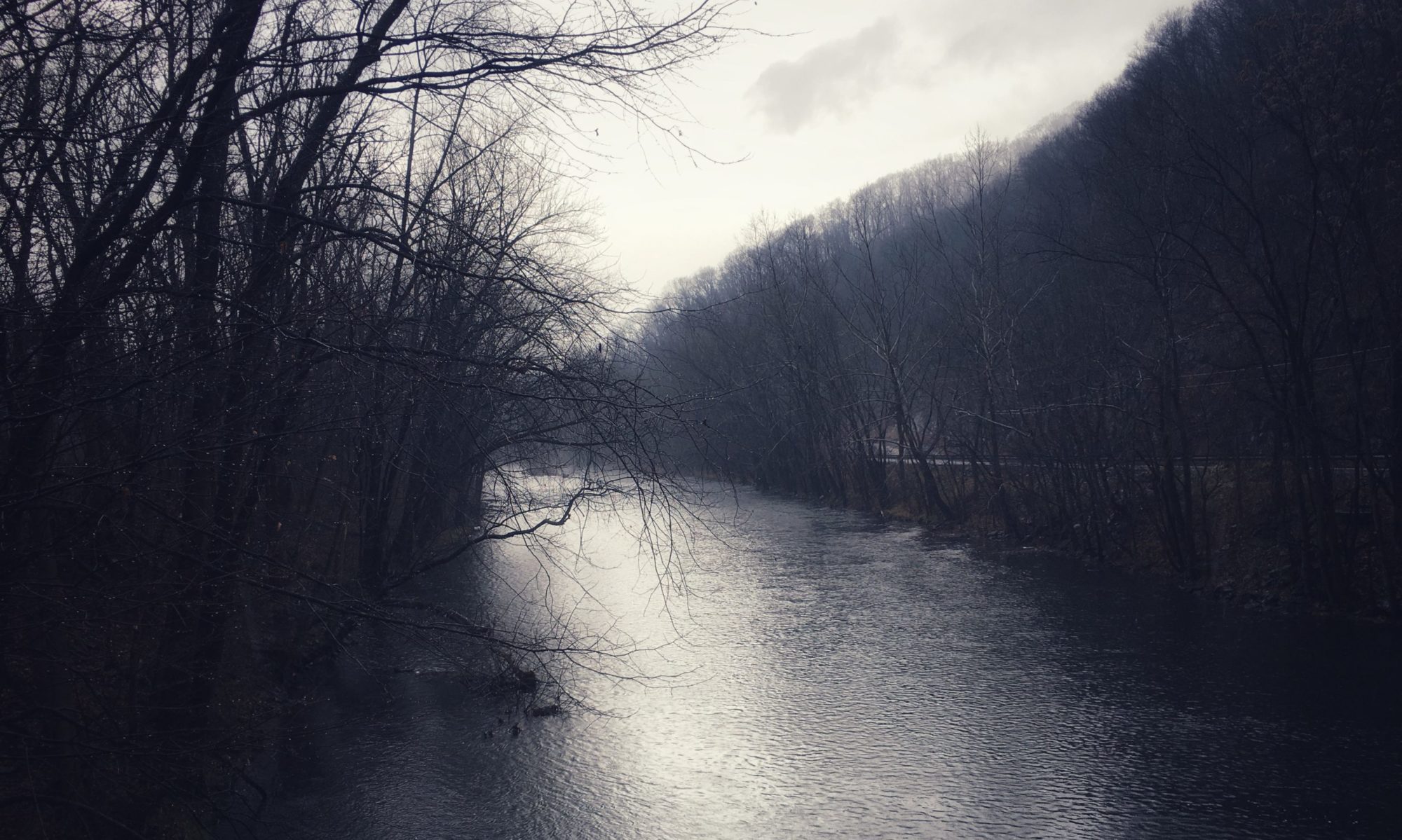
river in November light between bare woods and mountain
At the heart hospital, I lie on the imaging
table, looking up at the bland ceiling
while the technician gets ready to slick
gel on one end of the transducer. In this
soundproofed room, we don't hear the traffic
thickening on Brambleton. But when she engages
the Doppler, waves of gray appear on the bottom
of the screen and a whooshing sound pulses near
my ear— like wind across a beach, waves coming in
and eddying around the twin islands of
my kidneys. The vascular ultrasound machine
has opened this window into my own interior
and suddenly I'm reminded of how my body can feel
spacious or cluttered in ways I forget
on a daily basis— like when I struggle with
the waistband of a pair of old jeans, or feel
the hot burn of spice travel from my mouth, down
through my esophagus. The technician tells me
to hold my breath and I do, while on the screen,
something flickers and pulses, still keeping time
in spite of me. Blue, she tells me, is the track of
blood flowing away; and red, toward the organ.
I am traveler and terrain, vessel and cargo,
the untranslatable rendered legible.

Veined

river in November light between bare woods and mountain
The thin veined leaves— I see 
their undersides as they turn

toward window light. You know you're in
the presence of language that speaks

from the depths when you feel the skin
trying to keep it all in. As soon as my head

touches the pillow, the ghosts of my dead
crowd around me like petals. If they wanted it,

I'd offer my heart to them like a sweet.
But they say they don't. Their fingers comb

through my hair the way wind moves down
the limbs of the crepe myrtle. After a good

shaking, the earth around it is covered
with drifts of pale purple and pink.

Do they offer instruction, warning, hope?
They only circle my head like moons

freed from their usual orbit. I keep trying to break
language into patterns that will mean something

beyond myself. I think of the mulberries I picked
from a friend's garden, how even as half of them

sank into swift ferment, their skin still gleamed.
Night, too, presses its blue bruise against

the house walls. Everything can fold back into itself,
and my ghosts slip back like leaves into the pages of

a book. After, the air feels like it does after someone
has said something so real, it becomes unrepeatable

Arrangements

river in November light between bare woods and mountain
Of course I know it's bait. 
The algorithm seems clairvoyant,
every ad on my feed picking up
on that one time I stopped to read
the made-up stories of silver-
haired couples, probate lawyers,
locked accounts, missing passwords
and how touch and facial recognition
no longer work when you're dead.
It's almost sweet, the way they pitch
the idea of a clean finish. But also
there's threat (think of signatures
aligned like teeth) behind the smooth,
imagined voice that says order now
what you'll need at the end if you really
care for those who'll have to clean up
your mess. I restrain the impulse to buy—
the plot, the planner, the tidy record
keeper— not already gone, not quite
leaving nor convinced I'm turning
into the ghost of me.

The Red-Lipped Batfish

river in November light between bare woods and mountain
 
takes small steps on the ocean floor,
looking overdressed, theatrical,
awkward— I recognize the feeling:
of being visible in ways I can't
control, but moving forward anyway
while pretending nothing's wrong.
But maybe the batfish is a diva.
She can walk on the tips
of her fins and doesn't care
if anyone's watching. And maybe
there's nothing wrong, since shame
is an invention that keeps us
from inhabiting our own joy.
What's gravity when you can tiptoe-
float through water, the spots
on your front and back
rippling with reflected light,
announcing your arrival?

Time: Textures

river in November light between bare woods and mountain
The average lifespan  
is four thousand weeks, give or take.

What should we do
with our allotment?

In this economy of days,
a work week is held in contrast

to paid time off or vacations.
Doing nothing is still

a form of doing and there are many fine
forms of doing nothing— sitting

in a cathedral built of slow
mornings, sleeping while rain

divides into currencies you'll
eventually give up counting.

The days wrap around you sometimes
like a thin clinical gown,

neither cloth nor paper.
You can wear it to open in front

or in the back. Either way, you are
easier to access. Forget your bad

hip, your bum shoulder. They're mere
distractions when you want to take

time peeling an orange, releasing its scent
as you pull pith away from flesh.

Self-portrait at Women’s Health Clinic, with Nail Stickers

river in November light between bare woods and mountain
I tell the specialist I'm exhausted. Not the ordinary 
kind of tired but a tired that feels bone-deep, comes on
suddenly and without warning hands me gears to a machine
I'm now supposed to steer indefinitely. I grit my teeth

just to get through the day. I'm tired not because
I had one too many salt-rimmed drinks, or binged

episode after episode of Grantchester. She scrolls
through my files, and my history pops up like an old
neighborhood: biopsy fifteen years ago, atypical
breast hyperplasia. Menopause, the threshold

I passed, lined with night sweats and mood swings.
She says this late, hormone replacement won't help;

and in fact might increase the risk for strokes,
heart attack, cancer. What can help? I ask. I still
have so many things I want to do! She says I'll have
to discuss this further with my primary care doctor,

explore other avenues. Then— just like that— she pauses
over my hands. Where did you get your nails done?

I tell her they're stickers, a set my daughter ordered
online from Japan. No gel, no ammonia, and they last
at least two weeks. She calls in the resident and
the assistants, delighted. They marvel at the gloss

and artful gradations of color. It's as if I've become
a wonder, an amazing specimen instead of just another

problematic body. She apologizes for not being more
helpful but thanks me for teaching her something new.
I walk back to the parking garage, my tired body
somehow still capable of offering beauty.
Documentation

river in November light between bare woods and mountain
It's what they ask for
when they want to know

what was cut, filled,
altered; removed, taken,

and how much. Trees do
what they do, with or

without witness. Water,
too, will seek its way

through stone. Method
is the preferred way

of building the record,
with language that holds

what it's given to carry.
But there are times

the record is more of
invention: a shift

in the shape of things,
the making of something

that will have no ability
to reply to a question.

Ars Liberalis

river in November light between bare woods and mountain
~ for Drew

A train of thought might begin with overheard
conversation— for instance, on the next thing
in a line of recent decisions over which we
were not consulted, though these will have
a bearing on everything we're expected to do.
Then a colleague posts about getting to this
point in the semester and how it's been a journey
as it's always been, but somehow, each time gets
more lackluster. Lackluster, meaning a lack of shine,
a surface polished only by thoughtless repetition,
a dulling from slipshod use rather than intention.
Jaques uses the word in "All the World's a Stage,"
the same play that gave us gems like Sweet
are the uses of adversity
. A fool's wisdom,
perhaps. And so he plays his part. To look
upon the hour as mere trial, the next car
on the train as just another clone of this one—
wheels on the rails and rumbling into the dingy
station because there's a schedule, and schedules
must be met or someone pays the price.
Now we toil in halls grown airless as balloons
from which the last bit of helium has been
extracted for a profit we'll never see.
Professing beauty and humanity in a time
distracted by speed and efficiency, stubbornly
we practice our own fools' wisdom, sit shoulder
to shoulder in a train lurching forward, ever forward.

Souls on Board

river in November light between bare woods and mountain
Dark oceans across which people are ferried
into captivity— five hundred faces blued
by water pierced by moonlight,

pieced together to form a vessel measuring
twenty-four feet

Even then the sea understands how many
could be lost at once to fire
or storms, in this way becoming souls

Out west, on a runway, a person jumps a fence
and walks directly in the path of Flight 4345

Air traffic control repeats the phrase
for rescuers to confirm the number of people
who might need removal or extraction

The grammar of archives, of our accounting—
more than just the language of the incident report

Dalamhati— grief of the deepest kind,
from the Malay root for interior, something seated
in the liver or the heart

Sorrow as more than affliction, because lodged
in the body

Rendering

river in November light between bare woods and mountain
Rendering, meaning to portray or capture
a likeness in another medium, as when
an artist might render a portrait in oils.
Also, to make or cause; to tear apart or
lacerate. As in I am rendered speechless,
dumb with hurt, heart stricken at the edges
of what suffers but that I don't know how
to fix. Gristle and fat are rendered after
the slow boil and the skimming, as if
that kind of tending might soften bone.
I am afraid to do damage, even when the work
promises to be tender. Like gathering berries
that are ripe and ready— barely any resistance
to fingers plucking them off the branch, then
dropping them into a bowl held in the other
hand. Thick vines spill their unruly fragrance
from the trellis: that, too, can speak to grief.