

These days, the Moomin characters have turned into a global franchise; and yet when I think about my own relationship with these books that were so formative of my imagination, I realise that what I owe these books is something much more private and intimate, a philosophy of sorts. Because in Tove Jansson’s books, when I re-read them now, I find a fierce recognition of the importance of solitude; an expansive sense of friendship—not a friendship that erases solitude, but one that is a kind of mutual recognition within it; a sense of delight in the world, its seasons and its changes, that doesn’t require any form of transcendence; and a hospitable generosity of spirit that manages, in one way or another, to accommodate even the most awkward and tricky of characters—not just eccentrics, stove-dwelling ancestors, hemulens, free spirits and oddballs, but also genuinely alarming creatures such as grokes and philosophers.
Death of the Author
A small pin-striped bird alights
on the dead cherry tree next to the porch
& starts gleaning its breakfast
from crevasses in the decaying wood.
At length I remember its name,
black-and-white warbler—
& in so doing, forget the name of the author
whose Collected Shorter Poems I hold
in my lap. They’re orphaned for more
than a minute by my poor memory.
If I can just get the first letter…
something beginning with a G, perhaps?
That letter like a smile
warped into a grimace…
Or a T, that tall gallows.
The warbler stops to issue his usual
six whispery notes. Bill Knott.
*
I’m the proud owner of 15 new “homepubs”—homemade publications—from the great contemporary poet Bill Knott, who prints them up and bundles them off along with a limited edition print and an original painting to anyone who orders a painting through his website. Check it out. I find I like the whole concept of home pub, especially now that I have a new batch of homebrew ready to drink (more on that soon).
Reading the Icelandic Sagas
The difficult syllables clash
in my mouth. Your knitting
needles make short
work of the yarn,
like the dream-woman
who gave An Twig-Belly
his nickname, filling
his disemboweled gut
with a tangle of twigs
until his intestines could
be put back where
they belonged, in all
their tortuous windings.
We puzzle through
the genealogies, struggle
to picture the raw land
rising behind the words,
yet somehow these grim stories
bring us closer together.
Young men described
as promising will end up
wallowing in each other’s gore—
we know this.
Beautiful women will goad
their thin-skinned mates
into horrific acts.
A shepherd boy is smashed
against the ground so hard
his spine snaps, & two years
after his miraculous rescue
An Twig-Belly dies
a quick & needless death,
split by an unheroic sword.
You frown at your knitting
& decide it too needs
to be unraveled. I watch
the dark garment which was
to have been mine dissolve
in your expert fingers.
You smile.
I feel light as air.
See Rachel’s photographic response: “Seed.”
Braided Creek: reflections on conversation and literature
 Braided Creek: a conversation in poetryWorldCat•LibraryThing•Google Books•BookFinder
This is an old favorite, which I first blogged about back in 2004. I re-read it yesterday, sitting out on my porch on a lovely spring morning and savoring each of its 340 short poems (four to a page), so even though today is May 1, this still counts for my April poetry-reading challenge. I want to say a little bit about both this book and what I’ve learned during this past month, the third time I’ve marked National Poetry Month in this way.
Braided Creek is the result of a poetry correspondence between two old, white male poets at the top of their literary game, struggling to come to terms with aging and all its associated ills. There are no blurbs, no preface or afterword — no background on the project aside from the description on the back cover, so let me quote most of that because, while the poems could still be appreciated without it, knowing how they came into being adds so much more to the reader’s experience:
Longtime friends, Jim Harrison and Ted Kooser always exchanged poems in their letter writing. After Kooser was diagnosed with cancer several years ago, Harrison found that his friend’s poetry became “overwhelmingly vivid,” and they began a correspondence comprised entirely of brief poems, “because that was the essence of what we wanted to say to each other.” […]
When asked about attributions for the individual poems, one of them replied, “Everyone gets tired of this continuing cult of the personality… This book is an assertion in favor of poetry and against credentials.”
I love that last bit especially, and it’s worth pointing out that Kooser was appointed Poet Laureate of the United States for the first of two terms the year after this book was published, so these guys aren’t exactly unknown poetry bloggers.
Bloggers, hell — they wrote letters. I think we’re meant to understand that they literally sent these through the post, on paper, a practice that some younger readers may know about only from history class. I’m not sure that really makes a difference, although from the sound of things Harrison’s cabin may not have had much in the way of Internet access:
The big fat garter snake
emerged from the gas-stove burner
where she had coiled around the pilot light
for warmth on a cold night.
One of the things that makes this exchange work as a collection is that both poets live in rural areas in the American Midwest, Harrison in Michigan and Kooser in Nebraska, so they draw on a common body of imagery. Having read a number of Japanese linked-verse sequences (renga) over the years, I’ve been intrigued by how well a free-verse “conversation in poetry” can work without anything like renga’s welter of rules. Some of the same principles of connection do seem to apply: adjacent poems usually connect in some way, as in renga, often in less than obvious ways that only reveal themselves to the slow, meditative reader. Any two adjacent poems may be read as a two-stanza poem for an even richer reading experience, especially given the way the publisher has placed them on the page, with nothing but a wide space between them.
But aside from those casual resemblances, no one would mistake these poems for traditional Japanese verse. They are very much in the Western micropoetry tradition as represented in the Greek Anthology, the two-line meshalim of the Hebrew Bible, etc. The poems on page 33, for example, are clearly linked by a didactic and not merely an imagistic thread, and they bristle with metaphors:
How can Lorca say he’s only the pulse
of a wound that probes to the opposite side?
I’m wondering if he ever rowed a boat backwards.
The black sleeve falls back
from the scalded fist:
a turkey vulture.
At 62 I’ve outlived 95 percent
of the world. I’ll be home
just before dark.
All my life
I’ve been in the caboose
with blind glands
running the locomotive.
One gets the impression they’ve included the entire correspondence, not weeding out the less-than-successful poems (such as the last one above), which is refreshing. Because they’ve chosen not to attribute the individual poems, a dud here and there shouldn’t tarnish either of their reputations. As on the Internet, it seems that semi-anonymity enables greater risk-taking.
When I watched her hands
as she peeled a potato,
I gave up everything I owned.
As far as I’m concerned this is the most satisfying collection of poems either of them have written — which is saying a lot because Harrison is a genuinely great poet. But he does have a tendency to go on a bit too long, to beat dead horses, and the brevity of the form kept that tendency in check here. Kooser, for his part, has often struck me as a bit too obvious, but epigrammatic verse is too close to riddling for that to be as much of a danger in this collection.
That winter the night fell seven
times a day and horses learned
to run under the ground.
Nice to see the American tall-tale tradition making its influence felt here and there. The frequent self-deprecating humor and wise-cracks also contribute to the distinctly American and Midwestern feel of the collection.
“What I would do for wisdom,”
I cried out as a young man.
Evidently not much. Or so it seems.
Even on walks I follow the dog.[…]
Sometimes fate will steal a baby
and leave an old man
soft as a bundle of rags.
Nor do they shy away from political remarks — side-swipes at the Republican Party, or condemnations of politics in general:
DNA shows I’m the Unknown Soldier.
I can’t hear the birds down here,
only politicians shitting out of their mouths.[…]
All those spin butchers drooling
public pus. Save your first
bullet for television.
Conversation of one sort or another is at the root of inspiration, in my experience. Though like most writers these days I rarely collaborate explicitly, and value solitude for the removal of distractions, I’d have a hard time writing if I couldn’t at least imagine an interlocutor. Ever since the Romantic era, we’ve imagined the lone artist as someone who takes inspiration direct and unmediated from Nature, but that’s nonsense: the cultural template comes first. I don’t think I’m at all unusual in needing often to read something before I write in order to prime the creative pump. Braided Creek has been that something more often than I can count.
We are in conversation with authors whenever we read, regardless of whether we’re writers ourselves. I mean, we let their voices into our heads. How more intimate can you get?
Suddenly my clocks agree.
One has stopped for several
months, but twice a day
they have this tender moment.
This past month, my poetry reading was wondrously improved by the addition of an interlocutor over Skype: a very active listener with uncommonly good short-term memory, whose comments on the poems I read were often more perceptive than my own — and she didn’t have the benefit of the text in front of her. Sharing the poems in this fashion, which I was able to do for at least part of about 2/3rds of the books I read, also made me more attentive to word music (or lack thereof).
This was such a successful experiment, in fact, that I think it’s more than likely we’ll make it a regular (weekly or bi-weekly) thing. In the short-term, though, blogging may be a bit light for the next couple of weeks, as the interlocutor will be gracing Plummer’s Hollow in person.
História Trágico-Marítima (Tragic Maritime History) by Miguel Torga, as put to music by Fernando Lopes-Graça
Watch/listen on YouTube (player shrunk here to minimize distracting and clichéd still images)
I stated a month ago that I wanted to vary my April poetry blogging with some reviews of audio and video texts, but somehow it’s April 30th already and the only non-book I’ve managed to review was that videopoem chapbook by David Tomaloff and Swoon Bildos. So let me include an appreciation of a cantata that I’ve loved for years, Fernando Lopes-Graça’s História Trágico-Marítima — one of my all-time favorite pieces of choral music. I’ve included a player for a YouTubed copy of the same performance I have on record, which is also available through Amazon, used. Gyula Németh conducts the Budapest Symphony Orchestra with Oliviera Lopes, baritone, and the Hungarian Radio Chorus. If, like me, you don’t know Portuguese, it probably won’t be too distracting to listen to the work while reading the rest of this post. Here’s the composer’s description from the liner notes in my LP:
From its formal standpoint the work is articulated as a seven-lieder cycle (following the order and number of the poems by Torga under the same heading), the first and last relating to each other both in material and expressive intentions, as prelude and epilogue of the plot. A kind of idée fixe or recurring theme somehow ensures the unity of the work.
While collaborations between poets and musicians may sometimes seem like an exciting new development of the digital era, they have of course been going on since the dawn of time — if it isn’t too artificial and ethnocentric to presume any fundamental separation between poetry and music in the first place. In the Western classical tradition, librettists haven’t always been recognized as the poets they are, but in this case, Miguel Torga is generally lauded as one of the two or three greatest Portuguese poets of the 20th century, nominated several times for the Nobel Prize — on a par with the composer, who’s similarly among the top three 20th-century Portuguese composers (and in my opinion the greatest). I collected the LP years ago out of enthusiasm for Lopes-Graça, buying up all six records available in a catalogue of international classical music that my brother Mark used to get in the mail. For years — in fact until I could research him on the internet — the name Miguel Torga meant nothing to me, and I still haven’t read any of his work aside from this seven-part poem, included with English and French translations in the liner notes.
The poetic sequence, however, I learned nearly by heart, reading the imperfect translation just often enough to internalize the approximate meaning of the Portuguese. I guess professional-level classical and opera singers do this all the time, though, don’t they — memorize or nearly memorize whole texts in languages they don’t really know, but learn to love through music. The addition of a tune makes it of course so much easier to remember poetic texts. I’ve struggled to memorize even the most regularly metered, end-rhyming poems, yet here I am lip-synching with the chorus:
Vinha de longe o mar…
Vinha de longe, dos confins do medo…
Mas vinha azul e brando, a murmurar
Aos ouvidos da terra o tal segredo…(From far away came the sea…
From far away, from the ends of fear she came…
But she came blue and gentle, whispering
that secret into the earth’s ear…)
There was a video going around last week on Facebook, produced by Oliver Sacks, that shows an elderly man stricken by dementia perk up and begin to speak in full sentences after listening to a few of his favorite songs from when he was young — he hadn’t spoken that much in years, they said. It seems the weave between music, language and memory is even tighter than anyone had imagined. If (God forbid) I ever get that way myself, listening to História Trágico-Marítima might very well help me remember who I am — an odd thought, considering my lack of connection to the country whose own identity and memory are so much at issue here. Miguel Torga’s poem derives its title and some of its material from an 18th-century book by Bernardo Gomes de Brito, an anthology of tales about shipwrecks and other disasters that had befallen Portuguese navigators. Torga’s poem is more than a simple retelling, though. As the liner notes by Nuno Barreiros put it (recasting somewhat the wretched English provided),
It is more of a meditative than an epic evocation of one of the greatest achievements in Portuguese history, presented in a non-triumphalist fashion and seen from an anti-colonialist point of view. Lyrical and dramatic elements merge in a literary style of vigorous strokes with allusions to the popular narrative. The sea is demystified, while preserving the lyrical quality proper to an evocation. Graça’s musical setting stays well within these lines, magnifying the deep universal resonances of the poem.
And I suppose it’s the way in which the sea symbolizes — or more than symbolizes, embodies longing that makes me catch my breath every time the music shifts from the stormy shipwreck in Part 6 to the calm of Part 7 and the chorus singing mar.
Sea!
You had a name no one feared:
It was a soft soil to till
Or some tempting lure…Sea!
You had the weeping of the sufferer
Who cannot either stop, or yell,
Or raise, or stifle the wailing…Sea!
We then went to you full of love!
And you were neither a soil for tilling
Nor a body wailing her pain!Sea!
Deceitful raucous sad mermaid!
It was you who came to seduce us.
And it was you who then betrayed us!
And I always get at least a lump in my throat when the music changes pitch for the last verse and the baritone’s voice rises to near the top of his range for the last two syllables, leaving the melody unresolved, his question hanging in the air:
Mar!
E quando terá fim o sofrimento!
E quando deixará de navigar
Sobre as ondas azuis o nossa pensamento!(Sea!
And when shall the suffering end?
And when on the blue waves
Shall our thoughts cease to sail?)
“História Trágico-Marítima” is an indictment of romanticism that doesn’t try to deny the allure of the romantic; I think that’s what appealed to me when I first heard it as a teenager, and it’s not surprising that I later learned to appreciate American blues music, which is similarly drenched in unsentimental sentiment. The poetic sequence appeared in Torga’s Poemas Ibéricos (Iberian Poems) from 1952, evidently a “reinterpretation of the collective past of Portugal as an Hispanic nation,” within which “História Trágico-Marítima” appears as “an original mythic-symbolic rereading of the Portuguese sea adventure, under the intertextual shadow of the homonym work by Bernardo Gomes de Brito and the shipwreck imagery coming from it.”
Ten year ago, when I was seized with the idea for a book-length anti-heroic poem about culture contact in what is now the American Southwest — Cibola — I think these poems must’ve influenced my decision to preserve the mystery about what really happened, why the Cibolans killed the African conquistador Esteban, and to simply present the reader with multiple alternatives. “O Regresso” (“The Return”), Part 4 of the cantata, features a blind bard who may or may not be telling the truth, and whose retellings seem to be influencing events themselves, as in the observer’s paradox.
The man scanned the horizon…
“Land, land, Captain…”
And the Mother knew no more:
Was it the man at the topsail,
Or the singing blind man?
“My soul is only God’s,
My body shall go to sea…”
And the Mother nodded her head
And waved with her hand…
“The devil burst with a bang,
The wind and sea abated.”
And when the blind man stopped
They were aground beaching the ship…
I love that. But more than anything, I love and acknowledge the lasting influence of Torga’s idea that the dream of being elsewhere is a dangerous thing, at the root of the colonial adventure. In fact, I’ve come to believe it’s the fundamental sickness of urban civilization. But that perhaps is an argument for another day.
Not Coming Back by Dale Favier
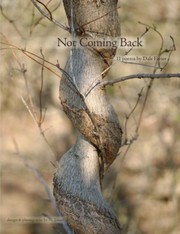 Not Coming Back: 11 poems by Dale FavierWorldCat•LibraryThing•Google Books•BookFinder
If you’re a reader of Dale Favier’s long-running blog mole as I am, you probably don’t have to think twice before ordering a new collection of his poems, because chances are very good you’ve already read them and know you’re in for a treat. This collection especially interested me because it was so unlike any other chapbook-length collection I’ve read in its design and execution. Nina Tovish, who blogs at Something Beautiful, used a service from Hewlett-Packard called MagCloud, set up to produce glossy paper and PDF magazines, and filled it with gorgeous photos chosen to play off Dale’s poems. The result is a poet’s fantasy of a magazine: no ads, no infographics or news notes, just “news that stays news” from front cover to back. Inevitably, some of the groupings of poems and photos work better for me than others, but all in all this is a happy-making booklet.
One interesting side-effect of presenting poems in this format so associated with a different kind of media, I find, is that any oddness in the text seems much more striking. “Spring,” for instance, almost shouts in its white text on a dark green page, and I’m like, whoa! Spring is pissed off.
The strength is coming
back into my hands, and the warmth is coming
back into the soil. Strange rooted things exult
and push into the air; tendrils
cinch on bricks and tear the mortar.Your houses are falling. Your cars
are sliding sideways down the drives;
Your marriages split like melons
dropped from a grocery bag.
I’m back. As if I’d never gone.
In one of my favorite pairings in the book, Nina placed a full-page photo of a riverbank after a flood, with scoured boulders and small trees festooned with dead weeds and grasses, opposite the poem “Clean and Pretty,” which begins:
It becomes familiar, the taste of a household
being dismantled. All its shifts revealed:
the squalid corners no guest ever sees …
Another imaginative conjunction: “Anna’s Hummingbird, Nesting” with a photo of a mimosa bloom, which suggests hummingbird motion and color and is simultaneously a bit nest-like — brilliant! And Dale describes the hummingbird fledgling like this:
She is the stylus of an etch-a-sketch,
the point of a glitter pen;
frantically motionless; hanging; the sky’s
avian crucifixion.
I find I like the fact that I can fold the booklet open at any point and flip it over to read it — something I suppose I could do with any saddle-stapled chapbook, but wouldn’t really want to for some reason (and it wouldn’t stay open if I did). I can roll it into a U-shape in one hand while carrying a mug of coffee in the other. What I’m saying is, the magazineness works for me. I got the PDF too, because it was bundled into the cost of the print edition, but since I don’t have a mobile device, it’s not very portable in that format. Considering how good the color reproduction is, it’s worth paying a few dollars extra for the tactility of the paper incarnation, I think.
The back cover features a macro of water drops on something very red, presumably flower petals, with a poem called “Mouse” superimposed in a cream-colored font. Somehow I missed this when he posted it to mole, but it’s one of the best penis poems I’ve seen. An interesting way to close a collection that begins with a poem about swearing off church, “Outside the Walls”:
Thank you for letting me in.
Thank you for letting me gaze
at your strange and bloody pictures.
Thank you too, Nina and Dale, for much the same thing. And thanks for, in a sense, redeeming the medium. So many magazines are filled with a kind of useless beauty, because who really wants to hold onto them? But it’s hard to throw out something so pretty, so there they sit on dusty shelves or in boxes in the attic. This is one magazine-like thing that I will keep, and add to my book collection, without a qualm.
In Search of Mariachis by David Shumate
 In Search of MariachisWorldCat•LibraryThing•Google Books•BookFinder Since I blogged about Russell Evatt’s We Are Clay last week, Epiphany Editions have re-launched their website with order buttons, previews for each book and a design much more reflective of the aesthetic of the print editions, which are things of absolute beauty. In Search of Mariachis is a masterpiece of the book designer’s art, so if you are as afflicted with book lust as I am, it might be worth ordering for that reason alone.
I was also pleased to get it for the contents, however. David Shumate is a prose poet of some renown with two full-length collections out from Pittsburgh University Press, which — I should point out for the uninitiated — is one of the best poetry presses in the country. And reading this collection was a pleasure only partly attributable to the fine homebrew with which I lubricated my reading. It had fairly typical proportions of poems I liked a lot, poems that did nothing for me, and poems I thought were O.K. but not earth-shattering: roughly a third in each category. A more exacting reviewer might condemn the book for not being amazing on every page, but I personally feel a lot of poetry reviewers need to chill the fuck out. I enjoy an experimental spirit, which means taking risks and sometimes (often?) not quite making the mark.
One of the things Shumate does in this collection that doesn’t always work for me is play with notions of exoticism, as signaled by the title. In poems such as “Waking Up As a Buddhist,” “Curry” and “Darwin’s Beard,” speculations that are presumably intended to sound humorously ill-informed just strike me as inexcusably ignorant, especially in an age of smart phones, Google and lots of actual Buddhists and Hindus in our midst. I have a hard time seeing these sorts of people as exotic any more, I guess. “Waking Up As a Buddhist,” for example, begins:
Sometimes you may wake up and find you’ve become a Buddhist. You realize its [sic] illogical because you’ve never taken lessons in Buddhism or had a Buddhist sprinkle water on your head or do whatever a Buddhist does to become a Buddhist.
As day goes on the bliss wears off, and that night you even have un-Buddhist dreams.
But in your final dream a deer comes and licks your face and you’re a Buddhist again. Your heart so full of compassion you feel like calling up your enemies and thanking them for being alive.
So at the end “you” recognize compassion as being more central to the religion than bliss, which had proved so transitory. The poem in fact wouldn’t be a bad critique of the mind-set of novice Buddhists, had it not been framed as an exercise in magical realism.
“Talking to the Woman in the Yellow Kimono” finds the narrator “at a loss for words,” which isn’t entirely inappropriate given the extent to which Japanese do in fact idealize wordless communication. The narrator considers raising stereotypical Japanese subjects with his interlocutor: flower arranging, haiku poetry.
But that might appear to be empty flattery. So when she bows, I bow back. And I sip the tea she’s poured for me. Thus we build our little pagoda of silence. Plank by plank. A structure so fragile, a single syllable would bring it crashing down.
Again, a good conclusion for an O.K. poem. But there are a number of poems that kept my interest from start to finish, so perhaps I should mention a few of them instead. “The Immigrant’s First Day of School” is a pitch-perfect mix of the predictable and the unexpected: “You learn the name of the desert you walked across. The history of the night.” And the ending was a little gut-wrenching:
Your teacher points to the place where you are living now. It is green and seems situated in the center of things. You take home a few sheets of paper. Your mother meets you at the bus. She’s wearing her colorful shawl but looks like she has shrunk.
Another poem take the narrator-as-avatar-of-the-exotic-other idea to its logical extreme. In “The Village of Miraculous Happenings,”
We’d like our lives to return to normal. We’d like the rains to fall on their own rather than each time the librarian claps. We’d like our thoughts to be private again. We’d like our deaths to take us by surprise instead of always being foretold. We gather in the chapel to pray for this daily.
The notion of people with lives so magical that they are beset by busloads of tourists being reduced to praying in vain for normalcy is a delightful conceit. The collection is liberally sprinkled with thought-experiments like this. A couple of others that struck me as especially successful were “The Meek,” which supposes that the meek really are going to inherit the earth, but of course are too meek to claim it, and “After They Plundered the Language,” which imagines the aftermath of a marauding barbarian horde which “made off with a thousand precious words.”
There used to be a gentle word we spoke when we wanted to be intimate with a lover. It conveyed both good faith and desire. Now we must paint our faces red. Do a little dance. And set a hat by her door.
As these quotes demonstrate, Shumate has a strong preference for short sentences or sentence fragments. I personally find the effect a bit monotonous, and wish he would have varied the sentence structure a bit more. Still and all, this substantial, attractive and entertaining chapbook assumes a place of honor in my growing collection of prose-poetry.
I Was the Jukebox by Sandra Beasley
 I Was the JukeboxWorldCat•LibraryThing•Google Books•BookFinder
Sandra Beasley has soul. This is useful to keep in mind the third time you encounter a title following the pattern “Another Failed Poem About X,” or when you labor through a sestina with “ginger” as one of its line-ending words for no good reason that you can see. Yes, genius can be annoying: how many of us would resist the urge to be clever at the expense of emotional impact if we had anything approximating Beasley’s gifts?
Once I asked a broker what he loved
about his job, and he said Making a killing.
Once I asked a serial killer what made him
get up in the morning, and he said The people.
(“Vocation”)
But even her less-than-fully-successful poems are still pretty damn impressive. This book deserved its place on everyone’s top poetry lists last year. I don’t know what made me break my usual pattern of studiously ignoring whatever everyone else is hyping — possibly the fact that Beasley is a long-time blogger, or that she’s a Facebook contact — but I’m glad I did.
Why do I say Beasley has soul? Because she throws her voice like nobody’s business, taking on the personas not only of inanimate objects, plants and dead gods, but also historical events (“The World War Speaks”) and plural beings (“The Sand Speaks”):
Mothers, brush me from the hands
of your children. Lovers, shake me
from the cuffs of your pants. Draw
a line, make it my mouth: I’ll name
your country. I’m a Yes-man at heart.
Because, unlike so many young poets of a surrealist bent, she stays relatively down-to-earth and tends to give the uninitiated reader something to grab on to, even when writing a modern-day allegory (“Beauty”).
That night, something howled outside.
I opened the door. It was Beauty. Beauty
was muddy and senseless. I let her in.
I tried to towel her off, and she bit me.
Because she is so fond of apostrophe, she has written love poems to college, oxidation, and Wednesday.
You are the loneliest of the three bears, hoping
to come home and find somebody in your bed.
(“Love Poem for Wednesday”)
And now and then there’s a poem that appears to be autobiographical nonfiction, such as “Antietam,” and it’s all the more affecting for coming in the midst of wilder and woolier stuff. The narrator is on a school field trip to the Civil War battlefield.
Our guide said that sometimes, the land still let go
of fragments from the war—a gold button, a bullet,
a tooth migrating to the surface. We searched around.
On the way back to the bus a boy tripped me and I fell—
skidding hard along the ground, gravel lodging
in the skin of my palms. I cried the whole way home.
After a week, the rocks were gone.
My mother said our bodies can digest anything,
but that’s a lie. Sometimes, at night, I feel
the battlefield moving inside of me.
I Was the Jukebox has been very widely reviewed, and since I have to go to bed early tonight, I’m going to slack off a little and just point you toward the links on the Open Library page. I do however want to say a little about the book’s packaging, trivial as that may seem. I was a little turned off by the publisher’s decision to put a short blurb right on the front cover, up at the top — that’s just tacky. The cover design is a mess. But both these failings are off-set, for me, by the pleasingly grainy surface of the paperback cover. There’s a lot to be said for a book that feels good in the hands. It won’t slide off the couch as easily easily as a book with a glossy cover. And like sand on the beach, it makes you want to dive in.
Flowers of a Moment by Ko Un
 Flowers of a Moment (Lannan Translation Selection Series)WorldCat•LibraryThing•Google Books•BookFinder
Tonight, I don’t feel like pretending to be a book reviewer. (Does it really matter what I have to say about a guy who’s been nominated so many times for the Nobel Prize?) Tonight I would rather respond to a few of Ko Un’s brief poems as if he were right here, sharing drinks and conversation.
I have spent the whole day talking about other people again
and the trees are watching me
as I go home
Sometimes I confuse the road with the map and everything on either side with terra incognita.
Exhausted
the mother has fallen asleep
so her baby is listening all alone
to the sound of the night train
The spider spends 99 percent of her lifetime waiting, suspended among her knitting, yet will perish before the first of her children hatch.
Outside the cave the howling wind and rain
Inside
the silent speech of bats filling the ceiling
Today, I read about a study that found that plants emit and respond to sonic vibrations. With their large ears attuned to ultrasonic sounds, I wonder if bats can hear the questing rootlets of the oaks over their heads?
We went to Auschwitz
saw the mounds of glasses
saw the piles of shoes
On the way back
we each stared out of a different window
Every window has its own fragile truth. Once, in a basement dangerous with broken bottles, a thug threw me against a wall and my glasses flew off. I became half-blind and sober at the same time.
Beneath the heavens with their scattered clouds
here and there are fools
Some of us are expanding, some shrinking, some taking a leak with a beer in one hand.
Crayfish, why are you so complicated?
with your feelers
your jaw legs
your hairy legs
your chest legs
your belly legs
and all the rest
My god! How is it that I missed my calling to be an egg?
In the old days a poet once said
our nation is destroyed
yet the mountains and rivers surviveToday’s poet says
the mountains and rivers are destroyed
yet our nation survivesTomorrow’s poet will say
the mountains and rivers are destroyed
our nation is destroyed and Alas!
you and I are completely destroyed
Isn’t there some way we can destroy all these pesky poets?
Look at the nose of a baby rabbit
look at the tail of a dog—
that’s the kind of world I’m living in
Look at those three bs in “baby rabbit,” then look at the small g in “dog” — the alert way a prey animal sits, the alert way a predator lies in wait.
A thousand drops
hanging from a dead branchThe rain did not fall for nothing
Today I watched a crowd of mayapple parasols down by the streambank thrown into disarray by one simple snowfall. Some turned completely over, their flower buds like thumbs pointed at the sky.
One spring night, the sound of a child weeping
One autumn night, the sound of laundry being pounded
This
was a place where people were really aliveAs I passed the field fertilized with their shit
involuntarily I bowed my head
I was going to say that I have never grown anything with compost made from my own excrement, but then I remembered I’m a writer.
From across the river
the sound of a bell reached the two of us
for us to listen to together
The sound of a bell reached usWe had decided to part
but then we decided not to part
I remember the big bronze temple bells in Japan, how they boomed rather than clanged, the sound going on and on: the bells of Mt. Hiei that I listened to with a lover as we gazed into each other’s eyes, and the bell at Ikkyu’s old temple in the country where I trespassed one night so I could stand inside it, whispering hello to the spiders and the thousand-year-old bronze.
No need to know its whereabouts
A small spring in a mountain ravine
is like a sister
a younger sister
like a long lost younger sister
now found again
The whole point of drinking, it seems to me, is that moment of recognition. I’ve had brotherly feelings toward mosquitos sinking their drilling rigs into my arm.
The top is spinning
Yesterday the poet Midang departed
today old Oh from next door departed
How can death concern only one or two?
The child’s top is surrounded by every kind of death
The rubber ball, the spinning jacks — how many can you keep in play? Between one bounce and the next they can all fall down.
A warship moves through the sea
near Paekryong Island in the Yellow Sea
Not one seagull’s in sight
The sea
looks as if someone has disappeared in it
I’m carrying an empty soju bottle
When war becomes permanent, who but a poet or a crackpot remembers the kind of peace that doesn’t involve desolation? The deafening howl of A-10 fighter jets can linger for half a minute after they’ve passed from view, the air like a fresh wound that hasn’t yet learned how to bleed. Then, slowly, the whine of cicadas, and this old wrinkle of earth goes back to being a mountain.
Walden by Haiku, by Ian Marshall
 Walden by haikuWorldCat•LibraryThing•Google Books•BookFinder
the old pond
not one wrinkle
after all its ripples
That’s one of Ian Marshall’s “found haiku” from Walden, “The Ponds” chapter. Here’s the original passage, helpfully included — as are the sources for each of the haiku from the main section of the book — in Part 2, “Sources and Commentary”:
Nevertheless, of all the characters I have known, perhaps Walden wears best, and best preserves its purity. Many men have been likened to it, but few deserve the honor. Though the woodchoppers have laid bare first this shore and then that, and the Irish have built their sties by it, and the railroad has infringed on its border, and the ice-men have skimmed it once, it is itself unchanged, the same water which my youthful eyes fell on; all the change is in me. It has not acquired one permanent wrinkle after all its ripples. It is perennially young, and I may stand and see a swallow dip, apparently to pick an insect from its surface as of yore. [emphasis added]
If you’re a haiku purist, or if the idea of rewriting a hallowed classic fills you with horror, you won’t like this book. I thought it was a blast, not least because even when I was young and impressionable I found Thoreau a little too long-winded, self-righteous, and apt to treat nature as an excuse to indulge in airy philosophizing (though as Marshall points out, this tendency diminished over time). Transcendentalism is utter crap as far as I am concerned, and nothing could be father from the Zen spirit of haiku as Bashō, Buson, Issa and Shiki practiced it. So to me, Marshall’s distillations offer an almost ideal condensed version of Walden, cutting all the parts I don’t like and highlighting almost everything I do. In essence, he’s applied Thoreau’s famous directive, “Simplify, simplify” to the text in which it appears.
I’ll admit I didn’t read all of Part 2. I would’ve dipped into it much more often if the publisher had made it easier to quickly locate the source and commentary for a haiku in the first half, e.g. by including referenced page numbers in the top margin, as more scholarly books with extensive end-notes often do. Walden by Haiku is kind of a hybrid between a scholarly work of ecocriticism and a popularly accessible primer on haiku, and possibly the author or editor figured it would scare off potential readers to treat Part 2 strictly as end-notes.
Not that the main section of the book is lacking in a critical apparatus, however. Following a very readable 17-page introduction explaining the project and describing haiku aesthetics in general terms, the haiku are presented in the order in which Marshall “found” them in the book, chapter by chapter, each section followed by a few pages of additional commentary expanding on some aspect of haiku aesthetics as it might relate to Thoreau’s writing. It kind of reminded me of one of those volumes from Doubleday’s Anchor Bible translation, with the translation of each passage followed by two or three sections of increasingly arcane commentary and notes.
And in fact translation is how I’d describe this project. As I’m sure I’ve said here more than once before, I’ve personally found translation to be an invaluable aid to attentiveness, kind of the apotheosis of reading, which is why I think every serious poet should give it a shot. It’s clear from Marshall’s commentary that, despite the dozens of times he’s taught the book, the countless times he’s read it and the hundreds of journal articles and books about it that he must’ve read in the course of his career, translating Walden into haiku revealed new puns and other layers of meaning in the text that he’d never noticed before. Though Thoreau himself was unfamiliar with the haiku tradition, like any writer who goes outside of himself for moments of authentic contact and insight, many of his best passages can readily be translated by a skilled poet into approximations of English-language haiku. And Marshall is nothing if not a skilled poet. Here are a few other examples of Walden translated into haiku:
furniture on the grass
white sand and water
scrubbing the cabin floor
fishing for pouts
baiting the hooks
with darkness
a cool evening
the sound of a flute
stars over far fields
mortaring the chimney
our knives thrust into the earth
to scour them
after a cold night
my axe on the ice
resounding
Most of the poetry I’ve read this month has been in the form of chapbooks or shorter full-length collections, but I thought it was worth compromising on my book-a-day pace to fit this one in; I’ve been meaning to read it ever since it came out. Marshall is a friend of the family, so I suppose I should issue a disclaimer — except that many of the authors whose works I’ve blogged about this month have been friends or acquaintances. If I’d read the book and not liked it, I simply wouldn’t have blogged about it. And I’m not sure how much Ian will appreciate my slighting comments about Thoreau! But for the majority of readers who presumably hold more reverent attitudes toward ol’ Hank: I can assure you that there’s hardly a trace of arrogance in Marshall’s commentary. These are not appropriations but homages, I think. He’s very aware of the audacity of this project, his conclusions are cautious, and his general attitude toward his source comes across as an apprentice-like humility. In my translator analogy, he would be a W. S. Merwin rather than a Robert Bly or a Stephen Mitchell: someone determined to try and capture the voice of the original author rather than to impose his own.
Let me conclude with an example of Marshall’s semi-populist, semi-scholarly analysis: part of his commentary on the “old pond” haiku I quoted at the outset. This follows his quote of the source passage.
Again, I cannot help but see this passage and haiku as invoking the most famous and thoroughly analyzed haiku of all, Bashō’s “the old pond / a frog jumps / the sound of water.” Thinking of Walden as Bashō’s old pond [which Marshall also did at the beginning of the introduction] makes this passage as resonant as Thoreau’s “hound, bay horse, and turtle-dove” parable. The pond retains its purity and remains undamaged and unchanging even after all its far-reaching ripples—far-reaching in terms of both time and geography—and even after the ice-men (critics?) have done their skimming. And every time we find something new in Bashō’s old pond, the change is all in us. … Bashō’s pond haiku has been extensively commented upon, imitated, and evoked—as I have done one more time by arranging Thoreau’s comment here in the form of a haiku that echoes once again the sound of water Bashō heard over three hundred years ago. And still—all these wide ripples later—no wrinkles on the pond.
(Note, by the way, that the hardcover edition I’ve linked to at Open Library has been supplemented by paperback and electronic editions. Click on the publisher link for information about all three.)