Britain BC with Francis Pryor

This two-part documentary, made for British television, is a great way to get up to speed on the current thinking about prehistoric Britain.


View on YouTube

I’m certain that the people who did this believed in another world, another dimension beneath the ground.


View on YouTube

In this new farming landscape, the cult of the ancestors is born. Their influence was necessary for the continued fertility of the land. For the ancient Britons, the discovery of crops, something that, when you cut it down, can be regrown from the seeds of the dead, must’ve been a kind of magic. And it’s possible that they believed that these ceremonial enclosures were fields for the dead, the place where the ancestors’ souls could, like the crops, grow to life again.

There’s also a book. And Francis Pryor’s blog For the Time Being is very worth following.

Encounters with the Neolithic (4)

(Read Part 3.)

Aviemore ring cairn and stone circle sign

Early one morning some two weeks after our Wiltshire trip, we stepped off the overnight sleeper train in Aviemore, in the heart of the Scottish highlands. We had reserved a campsite in the village of Nethy Bridge, a short bus ride away, but check-in wasn’t until late afternoon, so we had plenty of time to kill. A tourist map of Aviemore showed a Neolithic stone circle — one of many in the local area — a few blocks from downtown, so we decided to wander over and check it out.

Aviemore stone circle stone 3

The site was in a suburban neighborhood, across the street from a fire station. A team of carpet cleaners were at work in the house next door.
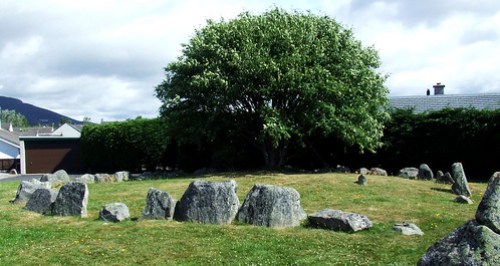
Aviemore ring cairn and stone circle rowan tree

The ambiance was very different from Avebury — and the monument was, of course, infinitely less significant. The only tree on the site was a small rowan that had been permitted to grow next to one of the smaller stones in the ring.

Phatigued fotographer
(photo by Rachel Rawlins)

There were, however, other visitors when we arrived, so we made our way to the back of the site and flopped down to rest, trying not to stare at the middle-aged woman sitting in Buddhist-style meditation at the center of the ring. A man of the same age waited near the street, while a teenaged girl we took to be their daughter sat with with her back against a stone, her facial expression and body language a comical mixture of boredom and acute embarrassment.

Aviemore stone circle stone 4

While the woman meditated, we each found things to photograph.

Grass and stone

Rachel became entranced by a head of grass,

Aviemore stone circle stone 1

while I stalked some of the outermost stones.

Aviemore stone circle stone 2

They were most cooperative models, and beautiful in their variegated coats of lichen.

black cat at Aviemore stone circle

Finally the woman got up, and they all left. But we weren’t alone for very long. A few minutes later, a friendly black cat appeared.

Aviemore stone circle

What most impressed us about this site was its setting, best captured in this panoramic photo of Rachel’s (click to see a larger version on Flickr). In the heart of a residential area, surrounded by close-cropped lawn, the stones retained as profound a sense of presence and individuality as anything I ever saw in a Zen garden in Kyoto. Especially to an American, it’s astonishing to realize that the landscape is dotted with 4000-year-old stone monuments, and few people make a big deal of them. A few hours later, when we mentioned the stone circle to the woman in the train station who was watching our luggage for us, she admitted that she’d never gone to see it, despite having lived her whole life in the town.

Aviemore ring cairn and stone circle

So it seems that at least the less impressive Neolithic monuments in the U.K. are of intense interest to a small subculture, and are otherwise taken for granted — given some level of care and protection as sites of historical interest, but that’s about it. And stones, let’s face it, are not especially demanding things to look after. As for their suitability as meditation partners, the Visit Avebury website claims that “During a period of 20 to 30 minutes, you may feel deep peace, bliss and gain some truly amazing insights,” and they link to a wild “Avebury vision” by intuition consultant and healer Suzanne Askham. The specific content of the visions she describes may provoke skepticism, but I kind of like her central insight: “It is not the stones themselves that matter. It’s the spaces in between.” After an experience of oneness and bliss, she writes,

Gradually, as if from above, I become aware of the pattern of the stones again. I understand now how they act as a locus. The circular structure is helpful for returning back to your body.

We can think [of] it, perhaps, as a Neolithic landing pad for the soul.

And then I am back again, sitting on baked bare earth, the sun on my face, cool stone behind my back.

“A Neolithic landing pad for the soul.” Sure, why not?

A cat may look at a Dave

I have a feeling the cat would agree.

(Continue to Part 5.)

Will Ashford and the art of erasure

If Tom Phillips’ A Humument is the gold standard for artistic erasure poetry, Will Ashford’s new work The Gospel According to Art should be a platinum hit. His erasures are not only image-rich, but use the text in varying ways: often for didactic purpose, but sometimes in more decorative/suggestive ways as well (a rain of “I”s, a swarm of “o”s). If I had a better developed sense of shame, I guess I’d be abashed I’d never heard of Will Ashford until he contacted me yesterday, prompted by a perusal of my Pepys erasures. But I’ve very glad (and flattered) that he did.

There’s a lot of good stuff in the Flash-based portfolio at his main site, too, but I found The Gospel According to Art easier to use at my relatively slow connection speed — and as a fan of the literary charms of the Bible, I was entranced by this re-purposing of the Gospel of Mark. It’s full of wonder, humor and delight. Go have a look.

Deconversion

(Office day). This day my father came to dine at my house, but being sent for in the morning I could not stay, but went by water to my Lord, where I dined with him, and he in a very merry humour (present Mr. Borfett and Childe).
At dinner: he, in discourse of the great opinion of the virtue—gratitude (which he did account the greatest thing in the world to him, and had, therefore, in his mind been often troubled in the late times how to answer his gratitude to the King, who raised his father), did say it was that did bring him to his obedience to the King; and did also bless himself with his good fortune, in comparison to what it was when I was with him in the Sound, when he durst not own his correspondence with the King; which is a thing that I never did hear of to this day before; and I do from this raise an opinion of him, to be one of the most secret men in the world, which I was not so convinced of before.
After dinner he bid all go out of the room, and did tell me how the King had promised him 4000l. per annum for ever, and had already given him a bill under his hand (which he showed me) for 4000l. that Mr. Fox is to pay him. My Lord did advise with me how to get this received, and to put out 3000l. into safe hands at use, and the other he will make use of for his present occasion. This he did advise with me about with much secresy.
After all this he called for the fiddles and books, and we two and W. Howe, and Mr. Childe, did sing and play some psalmes of Will. Lawes’s, and some songs; and so I went away.
So I went to see my Lord’s picture, which is almost done, and do please me very well.
Hence to Whitehall to find out Mr. Fox, which I did, and did use me very civilly, but I did not see his lady, whom I had so long known when she was a maid, Mrs. Whittle. From thence meeting my father Bowyer, I took him to Mr. Harper’s, and there drank with him. Among other things in discourse he told me how my wife’s brother had a horse at grass with him, which I was troubled to hear, it being his boldness upon my score.
Home by coach, and read late in the last night’s book of Trials, and told my wife about her brother’s horse at Mr. Bowyer’s, who is also much troubled for it, and do intend to go to-morrow to inquire the truth.
Notwithstanding this was the first day of the King’s proclamation against hackney coaches coming into the streets to stand to be hired, yet I got one to carry me home.

Ice is a house I could
not stay in, the answer to
a tune I never hear.

Tell me how I promise forever
in the present, with fiddles and songs
and an old horse at grass.

Which trouble
is the truth, coming into the streets
to stand?


Erasure poem derived from The Diary of Samuel Pepys, Wednesday 7 November 1660.

Banjo Origins (3): Jesusland

This entry is part 9 of 34 in the series Breakdown: The Banjo Poems

I made another short video from a poem in my new collection, Breakdown: Banjo Poems. If you missed the other two, I created a new album on Vimeo for Breakdown videos. Or simply scroll down through the latest posts in the Videopoetry category here.

The music for this one, found once again on SoundCloud, is by Tem Noon (tabla) and Christen Napier (banjo), one of seven improvisations they recorded, all licenced under a Creative Commons Attribution Licence.

Thanks to the Prelinger Archives once again for the public-domain footage: a 1928 short documentary called Queerosities: A Negro Baptism (yes, the framing was ever so slightly racist) and two untitled home movies of church camps, one also from 1928 and one from 1970. I wanted to include both Southern whites and African Americans in the scenes of religious enthusiasm, since the banjo, like Pentecostalism, has such a potent history with both groups. I don’t know if it matters that the different source materials in the video are so easily distinguishable in quality. My hope is that that just lends it more of a documentary feel.

Thanks also to Rachel for critiquing an earlier version of this video. (If you’re one of the three other people who watched it before 10:00 PM East Coast time tonight, please watch again.) I think it tells a more coherent story now. I also turned down the volume of the music just a bit.

My dream about being Muslim

Putting hands together in supplication — that unfamiliar gesture from the feudal era — it feels as if I am holding myself to account. Should the fingers interlace? It’s only me and me, baby! But now I am with Muslims who instruct me in their art of prayer: palms open, facing forward on either side of my head. God is greater. Body orienting to the Kaaba like a plant seeking the shade. They speak to God in a holy language, which doesn’t happen to be English. I move my dry lips, go down on my knees when they do, touch my nose and forehead to the ground. I feel small. The ground is almost without limit, and yet we dare to stand on it! This is nothing like therapy. Breathe in: There is no God. Breathe out: But God. I realize that I have never worn more comfortable clothes.