Penn’s Creek riddles

Photobucket - Video and Image Hosting

Last Friday, I accompanied my brother on a quest for the Appalachian tiger beetle (Cicindela ancocisconensis), which inhabits sandy river banks of wilderness-quality creeks and rivers, and is thus rare throughout its range, though locally common. We went to Penn’s Creek, a world-famous trout stream that winds through the Seven Mountains north of State College, Pennsylvania. It’s one of the few places in the state where C. ancocisconensis has been collected. We found one beetle within the first half-hour of searching, but it eluded Steve’s insect net. We spent the next hour and a half clambering over slippery rocks and around huge hemlock trees to search the few, small beaches in the Penn’s Creek canyon in the vicinity of Poe Paddy State Park.

While Steve concentrated on his quarry, I found myself composing riddles in my head about everything I saw. I don’t think these are especially difficult. I’ll post the answers tomorrow in the form of an update to this post Answers are at the end of the post.

*

A dark waterfall of fur
slipping down the rocks at
the river’s edge, soft yoke
no neck will ever wear.

*

Though green, I am no plant.
Two kingdoms live in me, but no ruler.
I’m a colonist of places
where nothing else can survive.

*

Death comes to the hemlock trees
in grayish white clots the size of pinheads.

*

Photobucket - Video and Image Hosting

We combed the banks of a rocky peninsula formed by a sinuous loop of the creek. The water was muddy from the rains the day before, and few fishermen were willing to try their luck in it, so we had the creek mostly to ourselves. The flowering dogwood appeared especially brilliant against the dark hemlocks, and wild geraniums, Virginia bluebells and white wood anemones bloomed among the rocks. Unfortunately, I knew we didn’t have the time or the proper vehicle to drive the rough road up to the view of the gorge, which is quite spectacular.

*

I have lived for two years, but this
is my first full day. I have a mouth,
but no stomach. I will die before dark.

*

Condemned to live outside
my true element, I curl up & hide
until the urge to hunt stretches me
to my full length, & I curve
into the current like an arrow
crossed with a bow.

*

Photobucket - Video and Image Hosting

The roof of one large fishing camp at Poe Paddy makes room for a tree in a manner reminiscent of Frank Lloyd Wright’s architectural masterpiece Fallingwater.

Temporary fishing camps were rising on poles at the state park campground, as well. Solemn-faced men got in and out of pickup trucks, or stood around in small knots by the shore, staring at the turbid water.

*

Rubber udders, two long nipples each,
for the cow called Land to offer its milk of men to the creek.

*

Nymph on a silk leash,
creature of knots,
deadly desire given angelic form.

*

Grain routed through fire, water & air
lands at last on ice: two temporary containers for light
resting in a third, which was once a handful of sand
but now offers smooth resistance to the fingers
& culminates in a screw where lip meets lip.

*

Photobucket - Video and Image Hosting

At last, Steve caught a single specimen in the front yard of the fishing camp pictured above, near where we parked. One of the owners of the camp, who was relaxing on a bench by the water, gave us permission to collect the beetle. Some better pictures of C. ancocisconensis are here. And by the way, in case you’re wondering about the Latin, Steve told me its intended meaning is a complete mystery.

__________

Answers: a wild mink; a green lichen (see here for factoids about lichens); hemlock woolly adelgid; mayfly (see “Ephemeral” at Chronicles from Hurricane Country); northern water snake; hip waders; an angler’s fly; whiskey in a jar (what the old fellow at the fishing camp appeared to be drinking)

Medicine

The LPN believes in being firm. Her daughter is five, and she doesn’t allow her to meet her gaze; she always stares back until the daughter looks away. Give ’em an inch and they’ll take a mile, she likes to say.

*

The woman in the next bed
moans all night: Help me, help me,
somebody, nurse.
The nurse steals in on stockinged feet.

*

When her four-year-old son was an infant, she would sit on him, straddling his tiny torso while her husband changed the diaper. They’re never too young to learn to lie still, she said.

*

In the woods behind the hospital,
trilliums bob in the sun, a white mirage.
The moss cracks open from lack of rain.

*

The 88-year-old great-grandmother looks on with an aching heart. Her mild suggestions carry little weight with her daughter or son-in-law, with her grandson or his wife the nurse. “They all talk to me like a child,” she tells us. “You’re the first people I’ve had an adult conversation with in months.”

*

Those clouds could be anything:
dogwood, hawthorn,
some wild cherry wrapped in caterpillar webs.

*

Expected to look after her great-grandchildren half the week, she tries to make them understand that love need not be accompanied by threats or a smothering embrace. When the four-year-old kicks her, much to his outraged surprise, she hits back.

*

On the abandoned farm, a lawn chair
still sits out under the apple tree.
Petals drift down between the slats.

*

Back in Pennsylvania for a rare visit, she apologizes for not doing a better job of staying in touch. “I’ve been so exhausted. I can’t remember the last time I got a good night’s sleep.”

*

Toothwort,
spleenwort,
bleeding-heart,
hepatica:
we might fall forever if not
for that net of roots.

Epithalamium, with images from the Brothers Grimm

The French woman who received the world’s first partial face transplant has complete feeling in the new tissue five months after the operation, she told a Sunday newspaper.

Isabelle Dinoire, 38, also told the newspaper Le Journal du Dimanche that the hardest part of her recovery appears to be getting to know herself again. When asked if she has accepted her new face, she responded: “It’s too difficult to explain.”
AP

1. Prince Charming
A bad week. She swallowed
pills, eight
little erasers

& while she lay on
the floor with her mind
elsewhere, the golden Lab

brought his famished
tongue across her face.
Unclipped toe-

nails click
on the cold linoleum
as the dog goes

to his bed, comes back
for another lick, & finally begins
to nibble.

He starts with the lips,
like any faithful lover.
That faint half-smile.

2. Mirror, mirror
The only mirror she kept
in her apartment
lies face-down when not in use.

Every day she checks
a small flag of skin that
the doctors implanted

right above her navel: white
or gray would signal
surrender. Every day

when she pulls up
her blouse, she feels
something turn over inside,

some phantom embryo
forming without nose
or chin, the mouth

a permanent wound
no lips can ever hope
to zipper shut.

3. Cinderella story
The organ
donor’s face comes
slowly back to life.

Too young
to have had laugh lines
or crows’ feet,

it was smooth
& as firm at first
as a glass slipper.

Now, after
the delicate diplomacy
of scalpel and suture,

the awkward wedding over,
it slowly fills
once again with feeling,

softens
in the heat
of an unfamiliar dance.
__________

An epithalamium is a wedding poem. For a brief history of the form, see here.

Incidentally, submissions are still open for the current qarrtsiluni theme, “an opening in the body.”

In a nutshell

An empty half-walnut shell lay
upturned on the verandah.
The wren fluttered down
& poked at it with his bill,
hopping all around it
in his big clown feet.

The black walnut half
had two large openings
like holes in a round kayak.
The wren probed one
& then the other, leaving nothing
to chance.

It was time for tea on the verandah,
but nobody came.
The wren flew off.
The walnut shell rocked a few times
& was still, riding high
without ballast
through the long afternoon.

__________

Black walnut (Juglans nigra) produces much harder nuts than the familiar white or English walnut. Its nutmeat is also much tangier – an acquired taste.

The wren here is the Carolina wren (Thryothorus ludovicianus). The poem came out of direct observation, but was also influenced by the poem “The Hollow Walnut,” by the great Chilean poet Gabriela Mistral (translated by Maria Giachetti in Gabriela Mistral: A Reader, White Pine Press, 1993).

Three short poems to inaugurate a new pocket notebook

ravens
climbing into
each other’s sky
circling crying
out

*

Image hosting by Photobucket

above the road bank where
the hepatica has just come into bloom,
the corpse of a porcupine

carrion beetles clamber
through the quills

butterflies cluster on what’s left of its mouth
a hole spanned by the long, curved
railings of its teeth

& down below, the pale blue blossoms
swaying on their stems

Image hosting by Photobucket

*

On Easter morning, I took a plastic
envelope of ale yeast from the refrigerator,
placed it on the floor, & brought all
my weight down on it
to break open the enclosed packet of nutrients.
Within hours, the envelope had swollen up
like a sheep’s stomach
with afflatus from the resurrected yeast.

Now I will feed it malt & honey
& bitter herbs. It will pass
this brew through its multitudinous body
& turn it into beer.
The empty tombs of its spent cells
will drift to the bottom of the bottle’s
brown sea.

Time Lapse with Tess Gallagher

a symmetry of doubt with us
at the center
– Tess Gallagher, “Time Lapse with Tulips”

By the end of the reading it seems natural, this twinning
of incandescent phrase & florescent face.
A female poet must acknowledge the physical
in a way the male poet need not, I suppose,
& Gallagher goes for the aesthetic of surprise, inclining
as if into a strong wind to welcome our applause,
that violent travesty of prayer.

Would she take questions? She would.
And me with my hand over my head, a-twitch
with a question of such naive-sounding sincerity
everyone will laugh, afraid to let our visitor think
we might all be so simple. But she will go ahead
& answer in the same spirit.

There might have been a bouquet in the interim –
roses, carnations, something from
the florist down the street. It all went by so quickly.
It might have been April, the storm drains
suddenly plastered with petals, white, red.

Part of the solution

After weeks of drought,
rain falling in the night
smells so fresh:
wet leaves & ozone
& the soil coming to life.
I keep going outside
to pee off the porch.

Deadhead

She shaved her head to get closer to God, she said,
prompted by a line in a song by a band called Nirvana.
Or maybe that wasn’t the reason, & she simply
thought of it afterwards, running her trembling hands
over all that smoothness. God. Congealed light.
Stones rounded to a shine by ceaseless contact,
saplings stripped of their bark, that arresting blank
that fashion models cultivate in their stare.
White, white, sing a song of skeletons that dance.
She had followed the Dead for five years, she said,
& every concert was different & amazing. It was a lesson
in how to be natural, how to just be there. God
speaks through our impulses. If I get pregnant
or get AIDS, she said, it was meant to be.
She read omens in the flight of birds or the fall of a leaf.
This morning I saw a tree’s shadow lying on the lawn,
perfectly still, & thought about her
for the first time in years. What does it mean,
this absence remembered in the sun’s angular wake?
Is she still alive? Is she being looked after by men
in white coats? It ought to be possible to tell,
I think, suddenly superstitious. I scan the sky
over the ridge. A vulture can follow a rumor
for hundreds of miles without flapping its wings,
as close to God as any appalling truth.

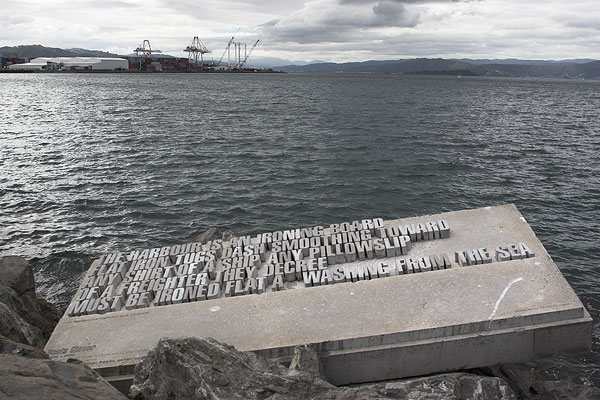
Jetsam

From a blog on the other side of the world
comes an unblogly thing:
a piece of poem set in a concrete slab
at the edge of the sea, cast up on the rocks
like the sole survivor from a wreck of words,
or as if the poet’s voice, like Alberti’s,
couldn’t take fresh water in its gills
& had to be restored to its native salt.

*

Something about a poem in a public place
disturbs me. Every time I’ve spotted one
among the advertisements on a city bus,
I’ve had to look away. It’s like
surprising a couple in flagrante delicto,
or overhearing someone’s cellphone conversation
with their therapist. At least with a reading,
merciful silence follows, & the bare podium.

*

Then there’s this business of objectification.
Poems grow like agates in the dark,
each according to its own mysterious rules.
Like agates, they are common & impossible to market.
But marketing needs the claim of uniqueness
more than anything, so poetry
gets pressed into service to provide ballast
on the ship of foolish products & bland commodities.

*

Poets, however, are taught to value the concrete.
Seeing such weighty jetsam,
I conceive a sudden ambition for my own work:
to see it published up on the ridge
on some ostentatious boulder, enough in the shade
that lichens of every crustose & foliose form
would find my lines ideal for a slow, private,
thoroughly absorbing read.

Fish tales

This entry is part 42 of 42 in the series Antiphony: Paul Zweig

I have been reading Paul Zweig, and responding to his poems with poems of my own. On Sunday, I mistakenly wrote that the eponymous “Eternity’s Woods” was the last poem in that section of Zweig’s Selected and Last Poems, forgetting that there was one more (and hoping, I guess, to make an end of it). Oddly, my poem in answer to “Eternity’s Woods” seems to anticipate the forgotten final poem, which follows. See here for details on this experiment in responsive reading.

The End Circulates in the Wide Space of Summer
by Paul Zweig

I
We hardly speak.
You have been here so long
You are like another leg or arm.
We trot across the ice,
Approach the book, and enter it.

[Remainder of poem removed to avoid violating copyright]

* * * *

The Fish Swims Under the Mountain of the World

Sunrise, & the wren’s song bubbles
up from his feet. He dances on the wall
as the ridge turns crimson. Watching from
the window, I feel the heaviness in my chest
lifting like a field stone flipped by the plow,
turning its unmarked cheek toward the harrow.
This world was never a text. With the spring
plowing, arrowheads swim to the surface
of the field adjoining the large sinkhole
down in the valley where an underground stream
briefly exposes itself to view. You can follow it
back under the bedrock in growing darkness,
hunching farther & farther over until you’re down
on all fours & the water meets the ceiling
with a final gurgle. I think of this whenever
the sky in a poem shivers under the knife
of a wing. Some hide is forever being flensed.
Practiced fingers turn the outside in,
or pull & sever a slick fish-shape from
the mother of flint. What flesh did those stone
points seek, so near the valley’s own gullet?
The hunters left no record on the cave walls
that hundred-year floods wouldn’t have erased,
but elsewhere, a few pecked images remain:
dream creatures carved on riverside cliffs, or
on the spines of ridges hundreds of miles long,
these sinuous swimmers. Yesterday morning,
I walked the ridge crest as far as the gap
& stood watching the sun shimmering on the river
& glancing off the windshields of trucks
in the quarry beyond, back-lighting
their plumes of yellow dust. In a month
& a half, this view will vanish behind
a screen of leaves, & by midsummer,
the field next to the cave will be thick
with the rustle of corn, product of 8,000 years
of continuous editing. I come home to
the blank page with my gaze full of distances,
thinking of a fish buried under a hill
so the Three Sisters – Squash & Beans & Corn –
can sing their names into memory another year,
the pattern of scales replicated in the grain.
I too used to garden that way,
& could again. It’s spring. The first
mayflies are rising. Something leaps.