
Ambition

Image hosting by PhotobucketLast Friday, I wrote semi-facetiously about my poetic ambition. It would be easy to infer from my relative lack of motivation for pursuing publication apart from this blog that I have little or no ambition for my writing – in fact, I’ve drawn that inference myself from time to time. Isn’t “poetic ambition” in fact something of an oxymoron for me?

But when I examine my motivations more carefully, I find no lack of that mix of supreme self-confidence and submission to the demands of craft and inspiration that adds up to ambition in other writers. And it’s not as if I haven’t made concerted efforts to seek publication in the past. A combination of laziness and arrogance convinced me that it simply wasn’t worth the time and effort: sending out 25 submissions for every one acceptance drains the budget for stamps and robs one of time that could better be spent reading, writing or – best of all – going out in search of new material. And the payoff – publication in literary magazines – isn’t really worth it to me, because I don’t happen to enjoy most literary magazines; they strike me as, by and large, pretentious, elitist, and not very much fun.

Image hosting by PhotobucketIn a way, I think I’m very ambitious for my work, in that I’m not content to be read chiefly by other poets. I want to be able to speak to the concerns of so-called ordinary people – at least, those among them who like to ponder the age-old questions about love, death, the place of humans in the cosmos, the nature of our relationship with the numinous, and so forth. A lot of practicing poets seem content to win the approval of their academic peers, or aspire to write truly difficult poems that will intimidate their competitors for a proliferating number of prizes, fellowships and honors. But I’m encouraged by the example of poets like Mary Oliver, Lucille Clifton, or Martin Espada, who refuse to retreat into a privileged world of private meanings and continue to risk everything for the possibility of reaching another heart. What insights they bring to their work are no less profound than the obscurantist ramblings of a Jorie Graham or the remote and threadbare visions of a W.S. Merwin – to say nothing of the nihilistic circle-jerk currently masquerading as an avant-garde. The difference is simply that they haven’t given up on the prime directive of good writing: to communicate in living language.

Image hosting by PhotobucketWell, O.K., I don’t really need to air my poetic prejudices here in order to make my point. Why do I write? At root, it isn’t about changing minds or even reaching other people; it’s about pleasing myself. And this is where the most audacious kind of ambition comes in. If I were ever completely satisfied with the work of any of my poetic masters, I’d have no need to write another poem. But through no fault of their own, they’re not quite writing the poems I want to read, so I have to write those poems myself. This impulse stems not from insecurity and competitiveness, but from a lust for the authentic insight, by definition unique and unrepeatable.

It sometimes seems to me that a world of pure inspiration exists, like another dimension in science fiction, parallel to the familiar world of the senses, and accessible to anyone who pays close attention. Paying attention to language – something almost every minimally competent poet learns to do – is only part of the equation. We also have to learn how to listen, how to see. We have to leave the scriptorium on a regular basis and risk an encounter with the Other, and bear witness to the way in which even the most ordinary things and occurrences can turn strange and slip from our grasp.

Image hosting by PhotobucketI do still aspire to print publication, but on my own terms. I think some of my most successful experiments here at Via Negativa have been those that blur the lines between prose and poetry, and many of what I consider my greatest hits involve a call-and-response combination of photos and text. But I know how expensive it can be to publish books in color. While I don’t rule out publishing a book-length collection of miscellaneous lyric poems, it no longer excites me the way it used to. I have specific ambitions for further narrative poems along the lines of Cibola and for thematically unified anthologies exploring specific questions, but whether they bear fruit will ultimately depend not so much on my desire to write them as on their need to be written. And therein, perhaps, lies the key to this whole puzzle. If there are good, true and beautiful things that can only come into existence through me, then it’s my responsibility to see that they get that chance. If there aren’t, hey – at least I’m staying busy!

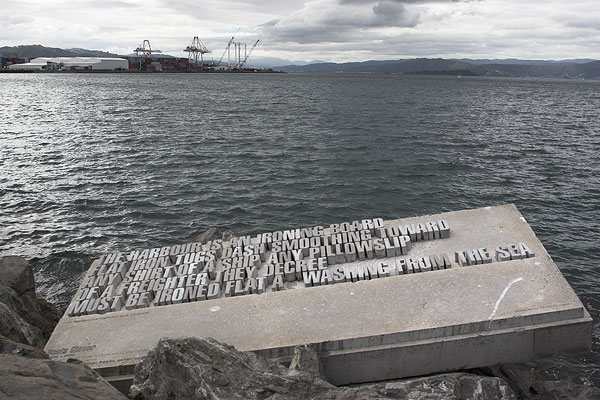
Jetsam

From a blog on the other side of the world
comes an unblogly thing:
a piece of poem set in a concrete slab
at the edge of the sea, cast up on the rocks
like the sole survivor from a wreck of words,
or as if the poet’s voice, like Alberti’s,
couldn’t take fresh water in its gills
& had to be restored to its native salt.

*

Something about a poem in a public place
disturbs me. Every time I’ve spotted one
among the advertisements on a city bus,
I’ve had to look away. It’s like
surprising a couple in flagrante delicto,
or overhearing someone’s cellphone conversation
with their therapist. At least with a reading,
merciful silence follows, & the bare podium.

*

Then there’s this business of objectification.
Poems grow like agates in the dark,
each according to its own mysterious rules.
Like agates, they are common & impossible to market.
But marketing needs the claim of uniqueness
more than anything, so poetry
gets pressed into service to provide ballast
on the ship of foolish products & bland commodities.

*

Poets, however, are taught to value the concrete.
Seeing such weighty jetsam,
I conceive a sudden ambition for my own work:
to see it published up on the ridge
on some ostentatious boulder, enough in the shade
that lichens of every crustose & foliose form
would find my lines ideal for a slow, private,
thoroughly absorbing read.

Woods and water

This entry is part 41 of 42 in the series Antiphony: Paul Zweig

I have been reading Paul Zweig, and responding to his poems with poems of my own. This is the next to last poem in the third (“Eternity’s Woods”) section of Zweig’s Selected and Last Poems, followed by my response. See here for details on this experiment in responsive reading.

Eternity’s Woods
by Paul Zweig

I
I have come to this house
Of soft angular stone, wondering
How much must fall away before I have nothing.

[Remainder of poem removed to avoid violating copyright]

* * * *

Water

I have sought to borrow inspiration
as others borrow comfort
from strange lovers. Let me

press my ear, I said, against
the scallop shell at the base
of your throat. Let me hear

the throb of the surf, & dream
of ships. What were we
talking about, again? I caught

nothing but a swallowed sob,
a corrosive drip. Compostela
remained a day’s walk away from
the Cape of the End of the Earth,

which was of course pure hype.
Right here in the hollow
where I grew up, I have heard
water trickling under the rocks,

& once my brother & I even dug
for it, four feet down through
a jumble of sandstone. When
we quit, the water sounded

just as loud as it had before
we started. I used to search
for a clearing in the woods
where, when the wind stopped,

the only sound would come
from a hidden spring. But
I didn’t want it ever to be found,

not even by me. Solitude
has since become my deadliest habit.
I don’t know what I am doing

here, talking to a dead poet as if to
my better nature, dreaming of poems
that would taste as good as water.

The view from the stoop

Chris Jordan’s powerful photographs of the aftermath of Hurricane Katrina are featured in the on-line environmental magazine Grist (and also in the February Harper’s). I was especially struck by the story that accompanies the slideshow. Jordan describes meeting an elderly black man who had returned to his deserted, devastated neighborhood in New Orleans by November 2005, because he couldn’t bear to be away from his beloved front stoop. There was little left of the house his great-grandfather had built except the stoop.

“They’re paying for me to stay in a motel room in Kansas City,” he told me. “It stinks of smoke and I don’t know anyone. I lost my wife a couple of years ago.” He pointed down the block to a small white building that was pushed off its foundation into the middle of the street. It was still standing, but twisted sideways with its back torn open. “That’s my church. The people are all gone. There used to be people…” His voice stopped as he gestured at the ruined landscape.

After a pause I asked him what he was going to do. “Same thing I’ve always done,” he said. “Sit on my front steps. I don’t belong anywhere else. I’m not going to rot away in some motel. This is where I am from, and this is what I do – I sit on my front steps – so here I am sitting on my front steps.”

As an inveterate front porch sitter, I empathize completely. One reason I think Jordan’s images are so moving is because he has the eye of someone deeply rooted in place and in a particular vantagepoint, and is unafraid to sacrifice aesthetic comfort and commit himself to chronicling what he calls “intolerable beauty.” In an interview elsewhere, he says this:

Journalistic disaster photos portray what is happening in that instant, but those instants have already passed by, and we can’t know what became of the people, or what else happened in their lives, or who they really were, or whether it got better or worse for them, and so on. There are exceptions of course; some photos of people suffering are shatteringly powerful, but not very many that I can think of.

For me, my work is about something different. It is not about portraying other peoples’ suffering, or trying to evoke sympathy for the victims. It is about connecting with a sense of loss that I feel myself, a deep experience of my own grief for what is happening in our country right now. In the destruction of New Orleans and the Gulf Coast, we have all lost something sacred. That is a personal loss, not someone else’s.

A big part of this for me is the fact that Katrina was not an entirely natural disaster. If this were a purely natural event like an earthquake, I would feel differently about it, and may not have photographed it at all. The sense of loss for me has something to do with our collective failure as a society, maybe like the loss a parent might feel if their teenaged child died from a drug overdose. If we had been more aware, we could have done something sooner, but we weren’t, and now it is too late. This would be different than losing a child to an untreatable illness, for example. There is an element of accountability, or shame, or maybe regret, and perhaps an inspiration to be different in the future.

Be sure to read the whole interview; it’s excellent. Many more of Chris Jordan’s In Katrina’s Wake photos are posted at his website, alongside his earlier series Intolerable Beauty: Portraits of American Mass Consumption.

The hole in the lawn

Sleep is finished with me before I am finished with sleep. Isn’t that just typical? I pick up the book I was looking at last night before my eyelids grew heavy, and notice that the words have burned little bare marks in the page’s snow. The sun that shines on the other side of the earth must’ve shone here, too, breaking through leaden clouds. And me lying unconscious all the while, my mind diverting itself with silent movies, with lantern slides. I woke at 1:00 and shuffled into the bathroom, trying to hold on to whatever I had just been dreaming about, so that I might remember it in the morning, but I ended up focusing instead on my effort to focus. Can the motion of the will ever take the place of genuine knowledge? I don’t mean that irritable reaching after fact and reason that Keats maligned, but the shoeless standing-in-the-presence-of, the empty-handed having-without-holding.

Before returning to my book this morning, though, I have to indulge my habit of sitting outside in the dark, where everything happens in the usual minor key: the water gurgling in the ditch, the wind blowing, the faint noise of the highway from over the ridge. A dusting of new snow makes the darkness visible. Usually around this time I get to hear and faintly see the porcupine making his way home to his burrow, but this morning he surprises me, emerging from under the porch and shuffling across the yard toward his favorite elm.

I had just been thinking about the silliness of so many contemporary writers, their sleight-of-hand substitution of pretend epiphanies for a postmodernist relativism. But we live in a culture of the climax, don’t we? The writers are no different from the sex addicts or the ravers, who are simply the most open about what almost everyone has been conditioned to desire: an endless and irreversible peak experience that we can suckle on like a child’s pacifier. What good is God or enlightenment if it can’t be known the way Adam knew Eve, if you can’t see it, touch it, dwell in it until ecstasy becomes your second nature and that prickly neurotic fellow who had usurped your good name is banished to the outer darkness? Until one day when a true ex-stasis occurs – and it is simply jarring or disorienting, not at all euphorogenic. Maybe you are beside yourself with grief, to the point where you treasure every dull glimmer of ordinary life the way someone shipwrecked on a desert island might make a collection of what, under other circumstances, he would regard as so much trash.

A porcupine leaves little pieces of itself here and there throughout the woods; if the quills didn’t come out easily, what good would they be? One afternoon last October, I was walking along one of our old woods roads with my head down, woolgathering as usual, when a small clump of porcupine needles caught my eye. I knelt down to examine them, as if I were a tracker or something. I heard a slight rustle behind me and turned. There right on the other side of the trail was the porcupine himself, or herself. S/he then turned her back to me and raised her quills, in the process showing me her pale butt. Then chattering her teeth she moved slowly off through the woods.

This obviously wasn’t an epiphany in any normal sense of the world. I didn’t come away with any profound new understanding of anything, though I was grateful for such a direct, even rude challenge to my normal self-centeredness. Like many wildlife encounters, it was humbling and a little unsettling – not exactly what most people mean by a peak experience.

So this morning the porcupine comes out right when I am expecting him to go in. On his way to the elm, he blunders into the little circle of fencing I put up last spring to protect a volunteer apple seedling. He circles the fence, then pauses over a shallow hole in the middle of the lawn where one can hear the stream flowing under four feet of rocky fill. What’s he doing, I wonder? It’s too dark to tell. He stays motionless there for more than a minute as if listening, as if trying to recall.

***

Just as I finish writing the above paragraphs, my mom walks in the door. “Hey, you want a good picture? There’s a young porcupine down in the hollow, in the big hemlock tree right before you get to the Waterthrush Bench.”

Half an hour later, it’s still there, chewing away. It doesn’t seem to be in any hurry.

Image hosting by Photobucket

Cover

Seven points in search of an argument

1.
Friday’s photo-essay about windows got me thinking about self-effacement, and how dangerous it can be. Think of guerrillas lying in ambush, or the CIA operative in deep cover. Then, too, privacy issues have been in the air lately with all the discussion about nominations to the U.S. Supreme Court. I don’t know whether the Constitution contains an implicit right to privacy or not, but I’m pretty sure than any government that denies the existence of such a right for its citizens, while multiplying arguments for higher and higher levels of government secrecy, is one badly in need of being overthrown.

2.
I’ve also been following an exchange about blog privacy on a listserve I belong to, and feeling more and more baffled as one blogger after another talks about his or her fear of being read by the wrong person. They talk longingly about anonymous blogs where they would have complete freedom to say what they want.

What’s wrong with me that I don’t feel thwarted by my inability to say what cannot be said? I’d always thought that near the core of every relationship there lay a little bundle of forbidden things – those terrible words that, once uttered, can never be retracted. One’s consciousness of this (or any) taboo creates a kind of tension that is ultimately creative. For me, the challenge is to find the words behind or beyond those terrible ones, which in a certain sense are only fuel for the spark that enlivens and illuminates every authentic, I-Thou encounter. But maybe for others this just sounds like an argument for self-censorship.

3.
I’m wondering whether poetry might not serve as an outlet without which I, too, would feel terribly constrained. Growing up, I had the benefit of a stable and supportive family, where every creative effort, no matter how minor, received praise from one or both parents. But at the same time, we were (and are), like many WASPs, not much given to talking about our feelings. That’s not to say I didn’t emote much; far from it – I was a rage and self-pity junkie. I threw tantrums almost constantly up until the age of twelve, when I began to get good enough at writing poems that I could start channeling my affective energy into that instead.

And what is a poem, after all, if not an attempt to say what is otherwise unsayable? To pick a well-known example: if you want to tell someone you like them, but are afraid of making yourself too vulnerable by baldly saying so, what do you do but write a poem in their praise? Poetry allows us to elevate ordinary discourse, to turn our words into a gift. Writing at that level leads one to focus on something outside oneself. For me, writing is not and has never been about self-expression; I’m not even sure I know what that would entail. Even when I write in prose, my main motivation is to try and share my insights with other people. I’m not interested in anonymous publishing because I don’t think that my words have any value beyond whatever connections they help me forge with a reader.

4.
I must admit, the idea of writing in different, assumed personas or “heteronyms,” Fernando Pessoa-style, has some real attraction, adding another dimension to the game-like back-and-forth between author and audience. But otherwise, apart from the need to elude criticism-intolerant employers or censorious family members, I don’t understand why one would ever need a disguise more impenetrable than one’s given name. I’ve always had this sense that “Dave Bonta” was a completely arbitrary place-marker, and I guess that’s the primary reason why I don’t mind the thought of anyone finding the stuff I put up on the web. I honestly don’t think of it as mine in any essential way; a good poem belongs to itself. If someone tries to assert their own authorship of it, of course I’ll object. But if they tease me about writing it, I’m happy to join in. And if they want to lob brickbats, so much the better: there’s no writing so flawless that it wouldn’t benefit from a strong critique.

5.
I know the kinds of uncharitable things people say about each other behind their backs, and I assume that I must come in for a certain amount of that. On the other hand, I also assume that people have better things to do than to think or talk about me – and 98 percent of the time, I’m sure I’m right. Then I remember that, from 7th through 12th grade, I was more or less the class pariah, and it occurs to me that my outlook on being self-conscious may not be very helpful to anyone else. Basically, I just don’t give a shit whether anyone likes me or not. As long as I can keep churning out poems that please me, as long as I can keep finding excuses to immerse myself almost daily in the bliss of creation, I’m happier than I feel I have any legitimate right to be.

6.
I guess I’ve been influenced enough by my Christian heritage to believe that self-disclosure, confession, and vulnerability are valid, perhaps essential routes to spiritual understanding. To put it another way, it seems to me that whenever we buy into the modern materialist notion of the self as unique, independent, ideally impenetrable interior space, we are much more likely to forget the fragility of the rest of Creation and thereby participate in its abuse. In Christian terms, we go from the imitation of Christ to the imitation of Pilate. In Jewish terms, we resemble the smooth talker Aaron, ready to build a golden calf if our friends want us to, rather than the hesitant, tongue-tied Moses or the inspired Miriam. I very much fear that my shamelessness, thick skin and too-fluid words condemn me to ignorance of something I have little business even speculating about. My friends who, at first blush, strike me as being excessively wary of self-exposure, may in reality be close to some implausible quarry, some unicorn or behemoth, which I, through my heedless whistling and stomping about, have inadvertently frightened deep into cover.

7.
But poetry has taught me that disclosing one thing always entails concealing something else. To find is to lose, and vice versa; the eye remains invisible to itself. No single identity can encompass the mystery of who we are, whether as individuals or as nodes in social, political and ecological webs. Protecting privacy means, above all, preserving the freedom to become whoever we want. And a government that tries to assert the power to know every aspect of its citizens’ lives is one that, as we’ve seen, will stop at nothing to extract ultimately worthless confessions.

At the Charles Simic reading

The aging soundman saunters down front to fiddle with the mike and won’t leave, mimicking the famous poet they’ve all come to see. With his bad posture and offstage clothes, it’s a travesty, compounded by a highly questionable accent. “Well, you know – ” he’ll say, and improvise another droll story about his supposed life in New Hampshire or childhood in Belgrade during the war.

A few stray pieces of paper and two or three books have been left at the podium, and he picks them up one at a time and peers down quizzically, as if addressing several exceptional frogs at the bottom of a well. He ends each poem – if that’s what they are – with an audible sniff and consults his watch. It’s the modern kind, he explains – it doesn’t tick.

The imposter’s grin never quite leaves his face. He holds up the famous poet’s most famous book – printed in large type, you see, so as to take more room on the page – and claims it’s nothing but a doodle in the margins of his memoirs. A likely story! It’s boring to describe what really happened. A writer always prefers to make things up. So you say.

The overflow audience crowds the floor, up to within an arm’s length of his feet. Many of them are here by choice, it seems, and would have every right to feel cheated, but only a few people get up and leave. He goes on for forty-seven minutes, stops, and takes a few tentative steps away from the podium as applause breaks out, mingled with appreciative laughter for an almost fully credible performance.

Robert Hass on poetry and activism

From the on-line environmental magazine Grist comes a brief but thought-provoking interview with California poet Robert Hass.

Q. You studied biology in college, but it seems like today colleges cast students as either science or literature people. In your class, do you find that people aren’t communicating between the two sides of their brain?

A. I think people do try to communicate between those two sides of their brain. I think part of the interest of the intelligent design/evolutionary biology debate is about how the implications of science talk to the rest of our feeling, affective selves. To try to figure out how to put those together is the fun of this class.

My partner, a science professor, gets the poetry people who are worried that they can’t get the science, and I get the science people who are worried they can’t do the poetry. So I’m sitting in my office with some really bright young people who can do neurobiology or astrophysics but say they can’t understand poetry. And I’m inclined to get down a poem off the shelf like Wordsworth’s sonnet, “All things that love the sun are out of doors,” and I say, what don’t you understand about that?

Can poetry save the world? Maybe – but it’s no substitute for activism, says Hass. In either case, we need to start by noticing what’s around us. I agree.

I found a longer, less focused interview with Hass, conducted right after his inaugural reading as Poet Laureate in 1997 and published in American Poetry Review, online here. At one point, Hass advances an argument that should be familiar to readers of this weblog:

I think that to praise or dispraise, to enchant or disenchant, both of which functions art has – you have to include a lot of the one if you’re going to do the other. I think poetry that says yes has to swallow great goblets of darkness; and poetry that says no has to say no in the face of the fact that there must be reasons why the poet has chosen to continue to live in order to say it. I always think in this connection of Monet because I read that his water lily paintings were begun as a response to reports he had read of the dead in the trenches in the first world war.

Grace Cavalieri: Have you used that in a poem?

Robert Hass: No I haven’t used it in a poem. I mean, I think it’s already there. It doesn’t need to be. But the reason those paintings seem to us so supremely great and not wallpaper is that they are full of the dead. They’re full of all those, all those colors, full of the colors of the bodies in the trenches as he imagined them. Poetry that praises the world has to have immense ballast.

Arms and the poet

The political dimensions of warfare are rarely alluded to in [Aztec] poetry; instead, warfare is seen as an artistic act, and the warrior becomes a poet. There are, in fact, two ways to be reborn on earth: in poetry, and in warfare. It is in battle that nobles can achieve their true stature, and their greatest fame, by becoming “eagles and jaguars,” the names for orders of seasoned warriors:

Nobles and kings are sprouting as eagles, ripening as jaguars, in Mexico: Lord Ahuitzotl is singing arrows, singing shields.
Giver of life, let your flower not be gathered! …
You’ve adorned them in blaze flowers, shield flowers.

In these lines, as in many of the war poems, images of natural fertility and harmony are linked to the beauty of art, with shields adorning the warrior in the same way that poems adorn the poet. By this means, the battlefield itself, seemingly a place of death and destruction, is represented as a place of beauty, growth, and fertility. … Singers in the imperial period seem to have vied with each other to create ever more striking images to link beauty and terror…

– David Damrosch, “The Aesthetics of Conquest: Aztec Poetry Before and After Cortez,” Representations Vol. 0, No. 33

If history, as it comes through the historian, retains, analyzes, and connects significant events, in contrast, what poets insist on is the history of “unimportant” events. In place of historian’s “distance,” I want to experience the vulnerability of those participating in tragic events. In other words, Sappho rather than Homer as model. His sacred times, the time of myth, versus her time, which is the moment, forever irreversible. Beginning with Sappho’s insomnia, there’s a tradition of the poem which says “I exist” in the face of all abstractions and cosmos and history, a poem of a passionate desire for accuracy for the here and now in its miraculous presence. I am not talking about confession. The best poetry of this kind is conspicuous by the absence of ego. The most reliable “histories” are told by first-person pronouns who remain subordinate, even anonymous. History teaches humility. My own physical and spiritual discomfort is nothing in comparison to that of those being imprisoned and tortured tonight all over the world.

– Charles Simic, “Notes on Poetry and History”

I came out first as a political poet, even before The Dream of a Common Language, under the taboo against so-called political poetry in the US, which was comparable to the taboo against homosexuality. In other words, it wasn’t done. And this is, of course, the only country in the world where that has been true. Go to Latin America, to the Middle East, to Asia, to Africa, to Europe, and you find the political poet and a poetry that addresses public affairs and public discourse, conflict, oppression, and resistance. That poetry is seen as normal. And it is honored. …

I keep on not wanting to know what I know — Matthew Shepard, James Byrd Jr., the schoolyard massacres. There keep being things I absolutely don’t want to know, and must know — and we as a society must know. I explore the whole idea in a poem in Midnight Salvage called “Camino Real,” while driving this road to Los Angeles, thinking about [accounts of] abuses that I had been reading by people who actually went back to where they had their human rights violated. And how that coexists in the poem with what is for me a journey of happiness. …

Poetry can add its grain to an accumulation of consciousness against the idea that there is no alternative — that we’re now just in the great flow of capitalism and it can never be any different — [that] this is human destiny, this is human nature. A poem can add its grain to all the other grains and that is, I think, a rather important thing to do. …

I think my work comes out of both an intense desire for connection and what it means to feel isolated. There’s always going to be a kind of tidal movement back and forth between the two. Art and literature have given so many people the relief of feeling connected — pulled us out of isolation. It has let us know that somebody else breathed and dreamed and had sex and loved and raged and knew loneliness the way we do. …

One of the things I have to say about this demon of the personal — and I have to take responsibility for my part in helping create this demon, as part of a women’s movement in which we celebrated personal experience and personal feelings — is that it has become a horribly commoditized version of humanity. It’s almost as though the personal life has been taken hostage in some way, and I’m shying away more and more from anything that would contribute to that.

– Adrienne Rich, 1999 interview with Michael Klein

The larva of the tortoise beetle has the neat habit of collecting its droppings and exfoliated skin into a little packet that it carries over its back when it is out in the open. If it were not for this fecal shield, it would lie naked before its enemies.

– Stanley Kunitz, “Three Small Parables for My Poet Friends” (#2)

Henri Cole: poet of the in-between

The May/June 2004 issue of American Poetry Review (Vol. 33, No. 3) contains five poems and an interview with Henri Cole, a prominent American poet I hadn’t spent any time with until now. Finding the poems excellent, I waded through the interview, which presented a stark contrast between an eager-to-impress and full-of-himself interviewer and the very straightforward and humble-sounding Cole. Here are a few quotes that particularly impressed me, followed by a poem.

Sometimes, I prefer the company of animals and flowers to humans, who are often not what they appear to be. But is it possible that male and female desire, including gay and straight desire, is all the same thing? That when we lie in the grass and look at the moon or at the face of the loved one, we (man or woman, gay or straight) see the same thing, which is love – an element as pure as oxygen?

* * * *

I have many artist friends. I envy them the physicality of their work. I admire their wonder and horror before the universe. I love the sensuality of their color. “As is painting, so is poetry,” Horace said. At home and faraway, I see all the paintings I can, not to take something from them, but to try to bring more power to my language. Or to put it in another way, I want to borrow from the concrete world and project it into the realm of the abstract, where the lyric exists. My artist friends constantly challenge me to see in an unformulaic, unsentimental way. I’d trade words for paint in a minute, if I thought I would be any good.

* * * *

Why I write when I do remains a mystery and an adventure – even after twenty-five years. The silences in-between are a greater mystery and, also, a source of anxiety. The two biggest influences on my work are sleeping and reading. I wish I could do them simultaneously. They make the little hamster of the unconscious run wild on its wheel. Szymborska says, “Whatever inspiration is, it’s born from a continuous ‘I don’t know.'” I like the sound of that.

* * * *

The women poets writing today are stronger than the men. This just seems so obvious. We men have written ourselves into a little narrative corner, where we write very confident, professional poems with all the affects of poetry, but the reader feels no explosion of consciousness. This, in my view, is the most dreaded destiny.

* * * *

In my 20’s and 30’s, Allen Ginsberg and James Merrill were gay models of the Dionysian and Apollonian. They were like opposing magnets, and it seemed to me there was nothing in between. Though as a young poet I drank happily from the cup of the Apollonians, as I’ve matured, I’ve sought a hybrid of the two. How to be Apollonian in body and Dionysian in spirit – that is my quest.

* * * *

SELF-PORTRAIT WITH HORNETS

Hornets, two hornets buzz over my head;
I’m napping and I cannot keep my eyes open.
Do you come from far away? I ask, dozing off.
My gums are dry when I wake. A morning breeze
rakes the treetops. I can smell the earth.
The two hornets are puzzling over
something sticky on the night table,
wiping their gold heads with their arms.
Little things are like symbols. My eyes are watery
and blurred. Then I lose myself again.
I’m walking slowly in a heat haze,
my vision contracted to a tiny porthole,
drawing me to it, like flourishing palms.
I can feel blood draining out of my face.

I can feel my heart beating inside my heart,
the self receding from the center of the picture.
I can taste sugar under my tongue.
All the usual human plots of ascent
and triumph appear disrupted.
Crossing my ankles, I watch the day
vibrate around me, watch the geraniums
climb toward the little mountains
where I was born, watch the black worm
wiggling out of the window box,
hiding its head from the pale sun
that lies down on everything,
purifying it. Lord, teach me to live.
Teach me to love. Lie down on me.

Henri Cole