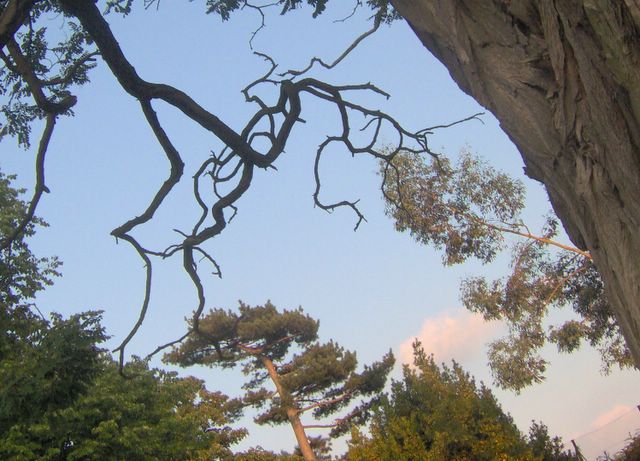
Excerpt of a much larger photo by Cindy Mead
“In the company of trees”
I have always been happiest in the company of trees. When I was a freshman in Houston I used to take my books out to a grove of pine and oak in a forgotten corner of the campus and sit underneath a tree reading in the warm afternoons. Sometimes I would pace back and forth and read my essays out loud. I cannot recall ever seeing another person in that grove. Except for the squirrels and birds I had it all to myself. Years later I think I remember the trees better than the books I was struggling to understand. I would stay there until the light played out and then head back to my dorm along sidewalks set between parallel rows of oaks drenched in Spanish moss. In the waning light the trees seemed dark and mysterious and at the same time compelling.
So writes Bill at prairie point blog. Welcome to the first monthly roundup of blog links to all things arboreal: the Festival of the Trees. Today, I want to showcase as many different ways of looking at trees as possible. Some might complain that this approach results in too long a blog post — “That ain’t no post, it’s a stinkin’ TREE!” But my assumption is that people who like trees are, by and large, given to contemplation rather than hurried skimming and haphazard clicking on links. Also, while most blog carnivals focus on the near present, I’m including some archival material to try and show that tree bloggers, like trees themselves, have been around for a while.
Let’s start with some biology: trees are flowering plants. This simple fact is something we wildflower enthusiasts sometimes need to be reminded of, as a recent post in Rurality demonstrates.
I thought I spied parasitic growths on the palm trees. But no, they were blooming!
Almost all plants bloom in one way or another I suppose, but I tend to think of those with inconspicuous flowers as non-blooming. You never hear anyone rhapsodizing over oak tree blossoms, for example. Before last week I had assumed that palms were the same. Only it turns out that all my previous trips to Florida were just mis-timed to catch them.
From flower, of course, comes seed or fruit. Any recent visitors to frizzyLogic must have seen the new masthead, which features silhouettes of what qB calls her bauble trees — London plane trees, close relatives of the North American sycamore. Here’s a full-color version from a recent post (click on link for larger version).

As many of qB’s tree photos suggest, a closer-than-usual look can turn the most familiar-seeming trees into strange and exotic beings.
Last July, Nuthatch at bootstrap analysis went into delicious detail about something else we seldom pause to contemplate: how leaves are arranged on a branch.
I spend a lot of time in forests. As an ornithologist, I spend a lot of time looking up in forests. With luck, I see the bird I am searching for. If not, my eye will wander the canopy, appreciating the play of light through the leaves. One day, my mind, as well as my eye, wandered. Was there a pattern to this seemingly chaotic riot of green? Nature, I know, is a most efficient master. It seemed reasonable that leaves, as food factories designed to carry out photosynthesis, should probably be positioned in order to maximize their exposure to sunlight.
This is, in fact, the case. It may not always be easy to see, because environmental conditions, physical constraints, injuries, etc. obscure the patterns, but the method of leaf arrangement, or phyllotaxis, on plants is both precise and quite astounding.
Ontario-based blogger Pamela Martin, in Thomasburg Walks, ponders the ability of southern trees to survive a northern winter.
There is another tree in the yard that does not wait: the shagbark hickory. There are two, around the same age as the catalpas; they are about 50 centimetres high (currently lost in the tall grass). Reputed to be hardy to this zone […] this tree is also not at all frost-tolerant, and yet it insists on leafing out first every spring. It freezes, leafs out again (occasionally freezes again), and then, resources spent, it basically rests for the rest of the growing season. The linked article warns nut farmers, “Grown from seed, it can take 10 or more years for hickory trees to start to bear.” In this case, perhaps thirty or forty years.
Pamela wonders whether “an internal clock of some kind” might play a role. As it happens, another contribution to the festival goes into great detail about internal clocks. Coturnix of A Blog Around the Clock reports on the results of a Spanish study that “measured the levels of expression of circadian clock genes in the chestnut tree.” When the temperature and length of daylight together indicated “winter,” they found, the trees shut down entirely. Fluctuations in temperature during the course of the winter had no apparent effect — the trees stayed “asleep” (my word, not Coturnix’s) until the lengthening daylight and warmth of spring together restarted their clocks.
So, the clock is stopped — but is it still sending some kind of signal? Coturnix describes himself as a specialist in circadian rhythms, which makes his conclusions worth quoting in full, I think. Plus, something about the precise language of science is very appealing to me as a writer, even if I don’t always completely understand it.
How can we interpret these data?
Overwintering is the stage in which all energetically expensive processes are minimized or shut down. However, workings of the clock itself are not very energetically expensive, so this is an unlikely reason for the elimination of rhythmicity during winter.
Second interpretation would be that, as the tree shuts down all its processes, there is nothing for the clock to regulate any more. There is also no feedback from the rest of metabolism into the clock. Thus, circadian rhythmicity fades as a by-product of overall dormancy of the plant.
Third, the clock itself may be a part of the mechanism that keeps everything else down. In other words, a clock stopped at (for instance – this is a random choice of phase) midnight will keep giving the midnight signal to the rest of the plant for months on end, keeping all the other processes at their normal midnight level (which may be very low). Thus, the clock may be central to the overall mechanism of hibernation in trees — i.e., the autumnal stopping of the clock is an evolved adaptation.

Bark beetle calligraphy (one of my own photos)
Then there are the mysteries of identity itself, often felt most keenly by the amateur naturalist struggling to pinpoint a species. Let’s remember where that word amateur comes from: while the professional is supposed to be detached, the amateur can be amorous, full of enthusiasm for his/her subject. Pica at Feathers of Hope has just posted a poem that excites my enthusiasm for poetry to an extreme degree. I must reproduce it in full.
Like and Unlike
Botany
keys
yes no one zero
differentiated or opposite
five petals or four
a series of
cancellations
Madrone is not
manzanita
smooth bark
but different leaves
quieter
less showy
hidden in the
chaparral
yes
no
not
a
cancellation,
its bark says
smooth and red
peeled and sheer
me
I’m here
I am
madrone
the sweet smell
in late sun
oak titmice
and ravens
say
oh, sure,
that’s madrone,
not a
nothing
you
blindhuman
afternoon
sun
Madrone
Tree names haunt the streets of towns and subdivisions all across the United States: Maple Vista. Oak Drive. Cherry Lane. Last month, the Middlewesterner had a revealing look at the origin of one of those street names.
I interviewed a man last night, nearly 80 years old, just about my father’s age. He was born in the house he’s living in. He has roots set down like the elm tree he said Elm Street is named after. A great blast of dynamite would not bring that tree down back when they were pouring cement on Highway 44. It took a second great blast of dynamite to topple the tree; the force of it broke windows way across the street at Stellmacher Lumber. Because the blast was directed to the south, the windows of the fellow’s house, just a few doors away, were not affected, though the house shook.
It was a stubborn tree. It had been there a long time and it wanted to stay. The old fellow said: You don’t know what you’ve got til you take dynamite to it and it’s gone.

Porcupine tree (another one of my own photos)
Some urban and suburban forests can be quite lush, though. I remember visiting my brother Mark years ago when he lived in Austin, how refreshing it felt to walk through neighborhoods where a lack of the kind of zoning we have here in the uptight northeast meant that people could let their yards run wild, if they wanted. And down there, let me tell you: stuff grows fast. Another post at prairie point blog, based in north Texas, brought some of that back, for me.
Though I haven’t visited it, Berkeley, California is evidently another place where yards are allowed to run wild, judging from the reports of Katsuri in her blog not native fruit.
our neighborhood is like a park, it’s a horticultural wonder that has sprung up on the grasslands of the berkeley hills. in other words, it’s mostly artificial. but it’s older, and very much overgrown – a feature many newcomers do not like about berkeley – but that’s just it, we don’t ‘manicure’ or ‘spray’ much. (Although that is changing as a more monied group moves in. Berkeley used to be more about idealists of many ilks.) We wanted things to be ‘organic’ and to ‘let nature be nature.’ So we have some mighty tangles here and there around Berkeley, some briars that have gone bananas, but also just a lot of very relaxed-looking plants. I love the plants of Berkeley.
some of our plants are natives: live oaks, redwoods, pines. these are my favorite trees, and they just exude spirit and soul.
You can kill a tree with kindness. Sometimes, a little bit of neglect is just what the doctor ordered. New blogger Ashley Kramer lives in Los Angeles and calls herself a Green Urban FarmGirl.
The first and perhaps key step in saving a peach tree is to know almost nothing about trees. Aside from the trees in your backyard growing up, you really have no experience with growing trees, and even that experience was limited to the fact that you have parents who cared for those trees, and also you paid no attention.
Next, move into a converted art studio that has a big overrun garden and a half dozen fruit trees. Nod knowingly when the owner identifies the trees for you: Avocado, Plum, Fig, pomegranate, Lemon, Lime, Tangerine, oh and that volunteer Peach that never produces good fruit. Agree that the peach tree should be removed to give more space to the Avocado and that weird yellow flower kind-of succulent tree thing that looks tropical.
Up in Vancouver, artist Marja-Leena Rathje finds inspiration in a huge old conservatory.
What a wonderful atmosphere in there, full of tall tropical trees reaching to the top of the dome, trees such as figs, palms, and a lovely African Fern Pine with its very soft needles (left of the palm in the photo above) plus gorgeous flowers, and many colourful tropical birds.

Photo by Jean (larger version here)
And in London, Jean also finds the exotic quite close at hand, as in the subject of the above photo, which she calls “kind of Chinese-looking.”
Living very near to a big, Victorian city park, full of huge old trees, is a constant pleasure. I’ve been there several times a week for 17 years and still look up, look around and see something new.
One of the great things about hosting this festival was finding out about new blogs — and new trees, too. I was surprised to find a blog devoted entirely to trees right here in my home state of Pennsylvania: Arboreality. Like me, the author lives on an old farm dotted with black walnut trees. But the post J L Blackwater selected for this festival discusses an ornamental tree I’d never heard of.
Allow me to introduce you to the tri-color beech (tricolor, tricolour, tri-colour), or tri-color European beech, scientifically referred to as Fagus sylvatica Roseomarginata. […] The tri-color beech tree you see in today’s post has a dark red/purple, a lighter red/brown, and a white shade which isn’t visible in these images. According to my reading, the best way to ensure that all the colors show up on your tri-color beech tree is not to baby it. This tree needs stress and hardship in order to show its truest and most beautiful colors. If a tri-color beech tree is overfed and given too much care and attention, it will lose the variegation in the leaves, and fade into a single reddish color.
Hmm. If only we could introduce J.L.’s beech to Ashley’s peach! They seem to have a lot in common.
Do you have a favorite tree or tree species? For Pablo of Roundrock Journal, it’s the white oak. Nor is he alone in his affections.
White Oak lumber is favored for furniture and barrel staves. Something about the graining allows the oak to remain water-tight. And the forest critters appreciate the tree for its abundant branches suitable for nesting as well as its cavities for denning. White Oaks produce acorns, of course, but the amount of energy required to do this can mean that they may take a half dozen years before they can produce a heavy crop, and in some years they may not produce any acorns at all. Of the ones produced, those not eaten by the deer or the turkeys or the raccoons or the opossums or the other wild things can fall victim to worms. It has been said that it takes 10,000 acorns to produce a single White Oak tree. You can understand, then, why I try to nurture the ones I have.
Urban geographer Jarrett Walker takes us down under and introduces us to a favorite Australian tree, Ficus macrophylla.
Hard plasticlike leaves, brown and hairy underneath, all perked toward the sun. At moments, the tree resembles a thousand-strong flock of birds ready to take flight.
It’s hot, though, so come in underneath. Everything’s upside down here, so the vast buttresses seem to support the earth more than they do the tree. Here is a city of shade, with many secret chambers behind high walls.
There’s room to think here, and just enough darkness that we can see.

Photo of cedars by Cindy Mead (larger original here)
We can’t talk about trees without talking about forests. And we shouldn’t talk about forests without admitting that few of us know what a truly natural forest ecosystem would look like. Back in 2004, I translated a parable from the 4th century B.C. by the Chinese philosopher Mencius — Ox Mountain.
Ox Mountain once was covered by trees. But it had the misfortune of standing too close to a city. People came with their axes and their hatchets; they climbed all over the mountain. They cut down the trees, stripped the mountain of all vegetation.
Nevertheless, the night breeze wafted over its slopes. Rain and dew fell; everywhere sprouts of green began to show. But cattle and sheep had been let loose to pasture on the mountain. Before too many years had passed, it stood gaunt and bare. Today, people see its barrenness and can’t believe the mountain wasn’t always that way.
Who can tell when forests have been altered, cut down with axes, demolished with hatchets? Day after day the trees are cut down. How will the mountain ever recover?
The good news is that, in most parts of the world, it’s not too late; with careful conservation planning, we can bring the forests back, and given the political will, we can preserve much of what’s left, even at the current level of human population. Though Cindy of Woodsong mourns the loss of old growth in Michigan, she hears promise in the songs of blackpoll warblers — and in a recent article by Pennsylvania-based naturalist Scott Weidensaul, whom she quotes:
Sat on my farmhouse’s back step in the low light of dawn, watching two blackpoll warblers — slim, streaky and hyperkinetic — flit through the new leaves of the maples, which the sun turned into tiny lenses of green.
My trees were a way station for these birds, moving between their winter home in South America and their destination to the north — the boreal forest, the vast shield of spruce and aspen, of muskeg and marsh, that stretches from Newfoundland to western Alaska. Larger than even the Amazon, North America’s boreal zone is one of the biggest intact ecosystems left on the planet, with 1.4 billion acres in Canada alone, most of it still in immense, interlocking tracts that make up a quarter of the earth’s remaining original forest.

“Canadian Trees,” by Curt Stump (larger original here)
As some of the previous excerpts have already suggested, wilderness can come as close to home as we let it — if only we can bring ourselves to stop forever cleaning and straightening things up. Hal of Ranch Ramblins, a blog based in the Ozarks of north-central Arkansas, warmed my heart with his passionate defense of standing dead trees, or snags.
The dead wood itself becomes a meal for ants, termites, and wood-boring beetles. These insects, as well as their larvae, in turn become a meal for various species of birds. Raccoons will also visit the snag for a delicious meal made up of insect larvae.
Besides serving as a feeding station, a snag provides cover for a vast array of creatures. The loose bark of a snag provides cover for bats to roost, as well as a cozy spot for caterpillars to pupate. Also taking cover under the loose bark are tree frogs, salamanders, and various types of beetles. Tree holes also provide a place of refuge for a large number of critters, including woodpeckers, owls, bluebirds, nuthatches, chickadees, wrens, titmice, squirrels, raccoons and opossums, to name just a few. It has been estimated that up to one-third of all forest birds and mammals depend on dead trees for either nesting or shelter. The great popularity of providing man-made housing for birds stems from the fact that many species have lost a good portion of the snags that they depend on for their survival. Thus the need for bluebird houses, bat houses, purple martin houses, etc.
It sounds a little clichéd to say so, but in some ways I think folks like Hal are simply recovering an ancient wisdom — one that found hidden order in the apparent chaos of wild nature. If I may be permitted one other translation from my archives, here’s an old Pennsylvania German folksong that conveys something of the attitude my European ancestors had toward trees and forests.
Who lies with this woman?
A very beautiful lover.
Lover in the woman, woman in the bed,
Bed in the feather, feather on the bird,
Bird in the egg, egg in the nest,
Nest in the leaves, leaves on the branch,
Branch on the limb, limb on the tree,
Tree in the thicket, among sticks and leaves.
What grows in the wood? A dense thicket.
That’s what grows in the greenwood.
People from a variety of cultures have felt a continuity between trees and humans that goes well beyond a simple homology of trunk to legs and torso. In ancient Israel, the goddess Asherah — she of “cakes for the queen of heaven” fame — appears to have been worshipped in arboreal form, as the Wikipedia entry makes clear.
[T]he word asherah also refers to a standing pole of some kind, pluralized as a masculine noun when it has that meaning. Among the Hebrews’ Phoenician neighbors, tall standing stone pillars signified the numinous presence of a deity, and the asherahs may have been a rustic reflection of these. Or asherah may mean a living tree or grove of trees and therefore in some contexts mean a shrine. These uses have confused Biblical translators. Many older translations render Asherah as ‘grove’.

“Glorytree,” by Curt Stump (larger original here)
Rabbinical Judaism long ago incorporated a version of this ancient Near Eastern tree reverence into its normal, yearly observances: Tu BiShvat, “the New Year of the trees.” As Velveteen Rabbi explains,
The holiday has its roots in a passage in the Talmud, tractate Rosh Hashanah. […] We mark the new year of trees at the full moon in the middle of the month [Shevat]. Out of the notion that trees have their own new year (originally used to mark the age of trees, to determine when one should begin tithing fruits to God and when one could eat of the fruits oneself) came an elaborate set of holiday traditions, up to and including a mystical journey through the four worlds.
People often compare trees to teachers, parents, or spiritual mentors. Lorianne DiSabato of Hoarded Ordinaries once wrote that way people grouped themselves at a Buddhist retreat reminded her of a forest.
During the talk at the end of the retreat, I mentioned how wonderful it was to sit in the presence of these strong, experienced guides: “This weekend felt like sitting in the shadow of a whole row of Mighty Oaks, tall, strong, gray…” Earlier this year a newspaper here in New Hampshire interviewed me (me!) about Buddhism in the Granite State, and I mentioned this notion of the Mighty Oaks: saplings who are new to practice think Chris and I have been practicing a long time — in fact, they sometimes think we’re Zen Masters. But in truth, we’re mid-sized trees dwarfed by those giants who started practicing long before us. It takes all kinds — saplings, mid-sizers, giant knobby hulks — to make a healthy forest. It takes roots and air and spring showers — and lots and lots of patient sitting — to become a Mighty Oak.

Waves of grain on a fallen log (another of my own photos)
Bonnie Bruno at Macromoments finds in nurse logs an apt image for the people who help guide us through life.
As the wood softens and breaks down, a cushy layer of moss creates a moist carpet atop the log. It provides a fertile home for lichen, moss, mushrooms, and wildflowers — new life from a seemingly useless tree.
Nurse logs provide a sturdy base and nutrients for new trees, too. A keen eye can spot trees that got their start from a nurse log. The old rotted log eventually breaks apart as the tree grows strong and straight.
Rabbi Shai Gluskin, reflecting on a photo from Carpenter’s Woods in Philadelphia, writes,
Our task in this world is to see the connection of life and death clearly. In the photo, I imagine a funeral scene where the young trees are attending to the fallen dead older tree lying before them. The biology of it is that the dead tree is tending to the living ones. It has made some room in the crowded forest canopy for some light to reach the younger trees. And soon the decomposing tree will nourish its comrades with minerals as well.
My kids are 11 and 8–which is a time ripe with seeing them out-do me in a host of physical as well as even some intellectual arenas (my daughter is better than me at Sudoku and Boggle).
In Bava Metzia 59b [in the Talmud], after a vigorous legal debate in which human beings perform miracles and reject heavenly evidence as having no standing, God says, “Nitzchuni banai, Nitzchuni banai.” The literal meaning there is “My children have defeated me.” Most commentators have God proclaiming this with joy.
Bev, at Burning Silo, writes about an ancient sugar maple that she has come to think of as the Oracle Tree.
Upon one’s approach, the most conspicuous feature of this tree is a large, rounded opening leading to a cavity within the trunk. In fact, this feature is what led me to regard this maple as the Oracle Tree — the cavity reminding me of a bottomless well, or some other mysterious natural phenomenon that might have had mystical significance to a culture. In another age, I can picture someone leaving offerings at this tree in exchange for luck, advice, or a piece of knowledge. I may not be the only one to think such a thing as, during a visit in midsummer two or three years ago, I found a thick handful of very long green grass draped over the edge of the opening. There was no grass of this type growing in the vicinity, so someone or something carried it from some distance to place it there. I find it a little difficult to believe that it was deposited there by a bird or mammal. For now, it seems the offering will remain another secret safely kept by the Oracle Tree.

Photos and graphic design by Erika Rathje (see higher-resolution original here)
Over at Rubies in Crystal, Brenda contemplates paper.
The world is papered with knowledge. Burn all the paper in the stoneage firepit of our souls.
Smooth burning words under my fingers.
Forests are the lungs of the planet; and wood dust and water promise of immortality.
In perhaps the most philosophical post submitted to the festival, Paris-based geologist and poet Jonathon Wonham of Connaissances considers a variety of ways in which “something which was once present and has now disappeared may have left a fundamental impact” on present-day reality, preserved somehow in literal or figurative text.
[W]e might think of a tree sticking out of a river bed. As the sediment is transported around it, the tree exerts a fundamental influence on the structures developing in the sediment around it. Yet eventually, the tree is likely to rot and disappear, leaving the sediment that has gathered downstream compacted and preserved. The sediment is the history of that tree that is now no more.
I think these ideas may serve as a metaphor for what happens in poetry. The poet is the tree in the river.
Beth Adams — author of the brand-new biography of Episcopal Bishop Gene Robinson — contributed a post from her old blog about the dismemberment of a favorite old willow tree. I don’t know whether the stark image of the mutilated tree was meant as a Christ-symbol or not, but her conclusion didn’t shy away from religion:
I’ll remember the willow best on those nights, years ago, when I was trying to figure out if God existed. After I’d meditated for an hour, the incense burned down to ash, candle extinguished, I’d come out into the night, and to my polished mind, open, newly innocent, every sensation appeared fresh, important, astonishing. The Milky Way had never seemed so vast, the air so exhilarating, the snow under my feet so white. And there the willow loomed: hugely alive, pulsating with being-ness and a quality of home that strangely did not feel closed to me. I stopped trying to paint it or write about it, but just stood there, night after night, as if it were part of the meditation ritual; looking up, not thinking, I let it tell me whatever it had to say.
Many contributors seem to feel that trees have something important to tell us. But whether they can communicate it in a language we can understand is another question. Tim Burns at Talking to the Owl seems doubtful.
… I leaned in close to hear him speak
And pressed his trunk against my cheek
Yet no noun or verb could I unfold
I had no ear for a tongue so old …
Curt Stump (who, in an ironic name-is-destiny kind of thing, is currently employed “putting dead chipped trees on new young trees”) wrote this spring that he was keeping his window open for
… the cool hiss
of the young
liquid leaves of spring
bringing me that sound
which I swear
when I close my eyes
I couldn’t tell from ocean
washing over rocks …
But what might trees make of our own babble? Dale of mole reports on a recent dream.
I go walking beside them, trying to explain in my turn, but my mouth is all full of a huge, meaty tongue; saliva drips from my mouth, but no words will come out. The trees moan in frustration, fretting the bark of their limbs together. I want to reassure them, but they point at my mouth and shudder. I realize I’m soft and repulsive to them, as a slug might be to us, and that my huge tongue is for them the crowning horror. I want to explain to them — it’s not always like this, I don’t know why it’s this way, this isn’t how people usually are — but I can’t get intelligible words past it, only slaverings and grunts come out, and the trees crowd away from me, muttering in alarm.

Photo by Erika Rathje (higher-resolution original here)
Finally, Florida-based writer of speculative fiction Elissa Malcohn, at Chronicles from Hurricane Country, invokes the myth of Daphne and Apollo in a poem she posted just yesterday. Here are the final three stanzas.
Daily the chicks scream into the wind
For food. Daily their parents oblige, thrusting
Moth and worm down tiny gullets. You take your place
As world-tree, bursting limb after limb through holly
Turned to sacred ground. Hiding that tender profile
Of nest. Letting new lives take root.
Eons away from Apollo’s pursuit, your route
Is not an easy one. The rainforests wind
Down to devastation. Clear-cutting turns green profile
To brown. My kind encroach in droves, thrusting
Like the besotted god into your groves. Let my holly
Be a sanctuary, and when trimmed a hiding place,
Until the thrusting of your holy leaves
Again breach tamed suburban profile, in that place
Where we continue to let our roots run wild.
__________
Thanks to everyone who contributed (including a couple of unwitting contributors)! Thanks are especially due to Pablo for having the idea in the first place. He’ll be hosting the next festival on August 1 at Roundrock Journal. Send all links to him: editor (at) roundrockjournal (dot) com.