Woodrat Podcast 45: A philosophical lunch with Will Buckingham (Part 1 of 2)

Will Buckingham

On my visit to the U.K. last spring, I arranged to meet with the novelist and philosopher Will Buckingham in a restaurant near the Birmingham train station on my way from Aberystwyth to London. I’m a long-time reader of his blog ThinkBuddha (and more recently of his personal blog) and a fan of his first novel, Cargo Fever. So knowing that he was a guy with wide-ranging interests and a gift for translating abstruse ideas into ordinary language, I figured he had to be pretty interesting to chat with. I wasn’t disappointed.

In this first half of our conversation, I got Will talking about the philosophy in the Moomin books of Tove Jannson; the ancient Chinese Daoist text Zhuangzi (actually, I’ve spared you most of that — Will and I share a great fondness for the work, but I realize most listeners won’t have read it); the pervasive sense of loss in the Western philosophical tradition; teaching and writing; Martin Heidegger; why existentialism is no longer popular; Emmanuel Levinas; and parallels between Indian and Greek philosophy.

Podcast feed | Subscribe in iTunes

Theme music: “Le grand sequoia,” by Innvivo (Creative Commons Attribution-Noncommercial-Share Alike licence).

Woodrat Podcast 44: Reversible books


watch on YouTubewatch on Vimeo

The Woodrat Podcast returns from summer vacation with its first ever video episode (but don’t worry, this will remain mostly an audio show). I wanted to do a bit of a show-and-tell with some poetry books published as reversible, upside-down or tête-bêche books, including, most recently, Triplicity by Kristen McHenry and Paper Covers Rock by Chella Courington, forthcoming from Indigo Ink Press.

Additional links:

Podcast feed | Subscribe in iTunes

Theme music: “Le grand sequoia,” by Innvivo (Creative Commons Attribution-Noncommercial-Share Alike licence).

Mole


Watch on Vimeo.

If you’ve been following this blog for even a little while, you must’ve noticed snippets from a blog called mole in the Smorgasblog and seen comments from its author, Dale Favier. Dale’s one of my oldest friends in the blogosphere (we’ve even met twice in person!) and he claims it was my example at Via Negativa that first got him to try his hand at modern poetry. (He had been primarily a fan of Victorian and Middle English poetry before that, so I think “modern” means “anything that doesn’t rhyme.”) Dale’s first collection of poems, Opening the World, is due out in September from the U.K.-based Pindrop Press, and I recently had the pleasure of reading it in manuscript. You can read what Luisa Igloria wrote about it on the publisher’s webpage.

With Dale’s book fresh in my mind, a sighting of a hairy-tailed mole in the lawn in front of my parents’ veranda on Monday morning seemed providential: videopoem material for the mole blogger! (See the Plummer’s Hollow blog for the full, 15-minute video and a few quotes about the largely unknown life of this mammal.) But figuring out which poem to envideo proved surprisingly difficult; several were a pretty good fit, but none was a perfect fit, I thought. Finding the right soundtrack was even more difficult, and consumed many hours. I’m not convinced that the trip-hop instrumental I finally settled on was optimal, but I think it works fairly well. A mole out foraging on the surface after daybreak does seem like an apt choice for a poem about mortality. There are a whole host of predators that could dispatch it at any moment — foxes, coyotes, weasels, fishers, feral cats, owls, hawks — especially considering how blind it is, and how close it let the three of us human watchers get.

I hasten to add that lack of awareness is not a characteristic I associate with Dale Favier! But vulnerability — perhaps, yes. I was a little more succinct than Luisa, but here’s the blurb I wrote:

Dale Favier is a new kind of American Buddhist poet, one less concerned with wisdom than compassion and desire, and as comfortable with the fables and paradoxes of the West as those of the East. His poems sing, chant, weep, declaim and delight. Earnest to a fault, yet always ready to indulge in foolishness and absurdity, Favier wears his erudition lightly and takes risks that few professional poets would take: “They have not written this in books;/ they would not dare; they have their suppers to earn.” Johan Huizinga wrote in Homo Ludens that poetry “proceeds within the play-ground of the mind,” and “the true appellation of the archaic poet is vates, the possessed, the God-smitten, the raving one.” Favier is one of the few modern poets I know who seems to fit this ancient mold. Opening the World documents no mere dalliance with ideas, but a life-long, passionate struggle with gods and mortals, love and death.

Where Bluegrass Comes From (videopoem)


Watch on Vimeo.

See yesterday’s post for the text. And where did the poem come from? As I explained in the comments yesterday, I went to a multi-day bluegrass festival with my banjo-playing cousin and his family this past weekend. That’s the origin of most of the video footage. The first two sentences that I ascribe to the banjo player are in fact pretty close to what I overheard in a workshop for banjo players on Saturday. But I wrote the opening lines in response to footage of a beetle on a blade of grass, shot yesterday morning in front of my garden. So the video and the poem came along together.

I’m more of a fan of older-style Appalachian string band music, but I do enjoy bluegrass, too, when I’m in the mood. Its relentless pursuit of speed combined with its potent nostalgia for a simpler way of life strike me as quintessentially American, though I realize it’s spread all over the world now.

Woodrat TV: The Book of Ystwyth poetry reading


The Book of Ystwyth: six poets on the art of Clive Hicks-Jenkins (part 1).


The Book of Ystwyth: six poets on the art of Clive Hicks-Jenkins (part 2).


The Book of Ystwyth: six poets on the art of Clive Hicks-Jenkins (part 3).


The Book of Ystwyth: six poets on the art of Clive Hicks-Jenkins (part 4).

In lieu of a podcast this week, here in video form is the full, hour-long poetry reading I flew to Wales to take part in last month. This was a group reading in support of The Book of Ystwyth: six poets on the art of Clive Hicks-Jenkins, whose launch coincided with a 60th birthday retrospective exhibition of, and monograph on, the contemporary Welsh artist Clive Hicks-Jenkins (who I interviewed in the two most recent episodes of the Woodrat podcast). All six of us — three Yanks and three Brits — had written poems in response to his paintings, and The Book of Ystwyth includes a generous selection, illustrated with full-color details of the paintings in question.

In the reading, ably MC’d by Damian Walford Davies, as you’ll see, each poet appears twice, once on either side of a break (which occurs in part 3), so that the first poet is also the last, the second is the penultimate, etc. Here’s a key to who appears in which video:

Catriona Urquhart (read by Clive Hicks-Jenkins and Ian Hamilton): parts 1 and 4
Andrea Selch: 1 and 4
Callum James: 2 and 4
Marly Youmans: 2 and 3
Damian Walford Davies (as reader): 2 and 3
Me: 3

Anita Mills was the camerawoman. I take the blame for the sound and all the editing. The bookstore’s set-up had the podium in shadow, which meant that the camera often focused on better-lit bookshelves behind our heads. In the process of lightening and increasing contrast on the videos, the color turned spotty, whence my decision to make it black and white. I assure viewers who have never been to Wales that it is a fully modern country now, and almost everything is in color all the time.

The Book of YstwythAs for the book: quite apart from its contents, which are of course scintillating, it’s a beautifully designed object with high-quality paper and image reproduction, retailing at a very affordable $15.95/£9.99. It was published in the U.K. by Grey Mare Press in association with Llyfrgell Genedlaethol Cymru/The National Library of Wales, and in the U.S. by Carolina Wren Press. Click on either link to order.

The Book of Ystwyth

This entry is part 1 of 12 in the series The Temptations of Solitude

The Book of Ystwyth: Six poets on the art of Clive Hicks-Jenkins, which includes all of the poems from my Temptations of Solitude series, is now out. It’s a stunningly beautiful book; you’ll definitely get your money’s worth. Carolina Wren Press does have some review copies available, I’m told, so if you have a well-trafficked blog or magazine, please consider writing it up.

The book was launched on Friday night with one of the best group readings I’ve ever been privileged to take part in, relaxed and well organized, with no bad readers and an overflowing and attentive audience. One of the six poets, the fantastically gifted (and much too modest) Callum James, blogged about the reading as well as yesterday’s launch of the exhibition, which was and is mind-blowing, for anyone who can get to the National Library at Aberystwyth by August.

I expect I’ll have more to say about all this after my return to Plummer’s Hollow and my own computer. I’ve been bothering all manner of people, including Clive, with my audio recorder, gathering material for the Woodrat podcast, and we have video of the reading, so I’ll have my work cut out for me. But for now, I intend to vacate for another week. Wales is spectacular; were it not for the shortage of forests, I think I could live here.

Inside the Money Machine by Minnie Bruce Pratt

Inside the Money Machine coverReading these fierce, true poems about life under capitalism, I wonder why anyone ever thought that politics were incompatible with lyric poetry. Even as she focuses on the physical and psychological costs of hard work for little pay, Pratt makes the writing seem effortless: the poems catch you up in thumbnail portraits or brief narratives and generally don’t let you go without a gasp or sigh.

Two women lean into each other, staggered by catastrophe,
The plant fence out of focus behind them. They hold up
a crumpled paper, like the photo of some beloved lost to murder
or to war, the evidence of what lived a few minutes before:
My job, my other self.
(“Getting a Pink Slip”)

While some of the books I’ve read this month did not adapt themselves well to the book-a-day pace, this one did: not because the poems were always easy to grasp, but because reading them all in one sitting created a powerful gestalt, like the “field full of folk” at the beginning of Piers Plowman. Blue-collar, white-collar, resource extraction, manufacturing, service industry, retirement, unemployment, gamblers, demonstrators, the half-tired and the fully exhausted: it’s all here, the world of trying-to-get-by. Political messages are sometimes overt but rarely didactic, as in the conclusion of a poem that began with a female toll-taker:

…past the docks at sunset along the water, the cranes asleep
for the night, while the climbers, door-unlockers, thumb-
and-finger doers, the people who sat and thought high up
in the glass forehead during the day, have now gone home—

Past the ticket collector in the Turnpike booth, the woman at the end
of her shift, the woman who can raise, who can lower the barricades.
(“Distribution”)

And when there is didacticism, it’s expressed with disarming simplicity, no hint of unearned ideological posturing:

Jobless, I never thought I’d hear
our niagra of sound going up the stairs again, never step,
immersed, into tens of thousands rushing to work. One molecule
in the many, carried along toward the purpose of our day.
It’s never really about the money, except for the guys at the top.
They know how to make money off of us. We know
how to make things with each other. That’s what we do.
(“Standing in the Elevator”)

Whether or not political poetry in general deserves its bad reputation (do we condemn love poetry just because 99 percent of all love poems ever written are dreck?), like many other kinds of poetry it can lead its practitioners into one or two habitual modes of discourse. Inside the Money Machine is much more catholic than that, with room both for an angry denunciation of the Army guy piloting unmanned drones from thousands of miles away (“The New Commuter War”) and for an understated poem of mourning for a temp worker’s inability to put down roots:

A Temporary Job

Leaving again. If I didn’t care, I wouldn’t be
grieving. The particulars of place lodged in me,
like this room I lived in for eleven days,
how I learned the way the sun laid its palm
over the side window in the morning, heavy
light, how I’ll never be held in that hand again.

As I was making my way through the book, my brother sent along an AP story about the nearest small city to us, where he works: “Altoona, PA changes name to Spurlock movie title.”

About 31,000 central Pennsylvanians will soon be living in a joke.

Beginning at 1 p.m. Wednesday, the city of Altoona will change its name to “POM Wonderful Presents: The Greatest Movie Ever Sold,” after the latest film by sarcastic documentarian Morgan Spurlock.

The city is changing its name for 60 days to make some money — and to help Spurlock make a point about the proliferation of advertising in American life.

Altoona isn’t broke, but it can sure use the money, and hey, the name-change is only ceremonial and temporary. What’s a little loss of dignity? We’re all like the sales clerks in “Selling the Brand,” willing to do whatever it takes to remain solvent, even if it means acquiring a new wardrobe, down to the underwear.

I was pleased to see two poems about issues close to my heart: “Tegucigalpa,” about the Honduran coup of 2009, and “Burning Water,” about hydrofracking for natural gas and last year’s oil spill in the Gulf. In the latter, I like how she focused on microorganisms rather than something more charismatic:

We hung our legs into strange bioluminescent foam
flung up by our wake, if we’d scooped the water
up with a glass jar as we did the air for fireflies,
we’d have caught eighty species, galactic diatoms
invisible to the eye, to us just some murky water
from the Gulf, which is licked over today with oil
from the blown-out rig…

Pratt has been around for a while — this is her tenth book — but she doesn’t show any sign of losing her sense of wonder at the nonsensical way we live.

How can it be that we are all going to carry our plastic bags
out the snapping doors, and get in our cars, and leave each other,
drive away to eat in twos or threes or one alone, me in a blue room
with a map of India to study, a novel open next to three sunflowers
in blue plastic bottles on the table…
(“Eating Alone”)

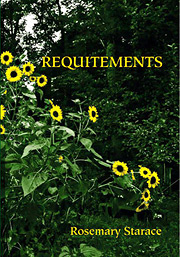
Requitements by Rosemary Starace

Requitements coverI’ve read the poems in this slender volume at least four times in the past eight months and they have yet to lose their affective power for me — which is strange, since I would not seem to be the target audience for a collection about adoption or being an adoptee. Then again, I’ve been listening to blues music for 25 years and I wasn’t exactly the target audience for most of that, either. Who hasn’t felt, at one time or another,

double like wings
this rainy day folded
patient and oily
shedding a sky
(“I Am Double”)

or marveled at robins at daybreak?

Robins

A trickle of sweetness
out of the quiet emerges,
announcing what night
had again prepared.

How darkness works.
You come to know this
each time you are taken by it
and released.

See what I mean? These are poems with mountains in them, blackeyed susans, crows, boats and grackles. The moon joins other mythical figures in a list of famous adoptees, and you think, me too! The broken heart is not merely universal, but a key to the universe:

Creation falls to me. Its vast taxonomies,
the drifts of my ancestors. Home
is the Nebula, grandfather crab.
(“Confession”)

This is a poetry very much like the blues, full of lacrimae rerum, and reading it, hearing it, I feel the tension unknotting in my gut and a weight lifting in my chest that I didn’t know was there. How does that work? There are certain metaphors, I think, that are very close to the root images of language: when things fall from the sky, for example, something beyond mere sadness or gratitude is triggered, and natural objects such as wings and flowers are so intimately bound up with our perceptions of the world, it may be more accurate to say, for example, that the face is a flower symbol than vice versa. And:

Dark careening flecks
possess the pull of fine words,
those understudies
for the thing missing—
“snow-calm” and “trees,” too,
tug the heart out from its cave.
(“Arrival”)

Dig deep into language and emotion, as Starace does, and thought itself — “something like wind” (“Fifty Grackles”) — may become a luminous presence. Einstein in a dream says: “All space is compassion” (“Sunflower Ramble”). An absence which is more than an absence: entire religions have been built around less.

There is
no other music like this song
you can walk through, these cries
that every day erect a new cathedral
over daily streets.
(“Blue Hour”)

It’s been a long holiday, and I’m tired; I regret I can’t give this marvellous chapbook the review it deserves. (Do read the three sample poems on the page from Elephant House Press.)

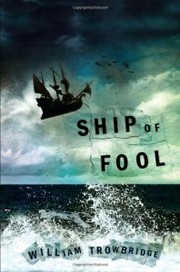
Ship of Fool by William Trowbridge

Ship of fool Ship of fool: poemsWilliam Trowbridge; Red Hen Press 2011WorldCatLibraryThingGoogle BooksBookFinder

This is the last of four books that Kristin Berkey-Abbott and I are encouraging others to also read and blog about this month. Send me the link to your blog post and I’ll update to include it.

Kristin Berkey-Abbott: “National Poetry Month Draws to a Close with ‘Ship of Fool’ by William Trowbridge”

It was really just happenstance that I found myself reading Ship of Fool on Easter. But inevitably I started thinking: is Fool a Christ figure? God certainly sacrifices him more than once. And the next-to-last poem in the book, “Foolproof,” contains a pretty broad hint:

“Moron!” God thunders, watching a snot-green cloud
pour out of His perfect wand for hard-to-reach places.
“They’re going to crucify Me in the broadsides.” Could be worse,
thinks Fool, backdraft whistling through his hands and feet.

In another poem, Fool beats God in a game of miniature golf and as a reward inherits the CEO-ship of the cosmos, and “when Fool’s sworn in,/ the meek finally do inherit the earth.” So far, so Christ-like! In one of his incarnations, he is even “The Perfect Fool”:

Every month his house makes the cover
of Before magazine. His Yugo’s the envy
of the trendier scrap yards. Thanks to him,
the common step-ladder now boasts thirty
caution stickers. The ABA would name him
Plaintiff of the Year, if he’d only sue.
But he’s too foolish, grief’s warm-up bag,
unhygenically pure, who might love anyone.

Then again, is Wile E. Coyote a Christ figure? I think the ability to shape-shift and come back from the dead again and again is a basic attribute of any trickster, especially the foolish kind. In “Fool Electric,”

The late news asks if Fool could be Jesus,
back to give every Christian family
their own Lazarus. Polls show 97 per cent

of Americans now believe in a loving God,
the remaining three percent intent on
fleeing the country.

Something tells me that believing any hypothesis advanced on the late news is probably foolish. Also, as Trowbridge goes on to suggest, too many Lazaruses would be indistinguishable from the zombie apocalypse. Fool is always taking things to extremes. Something must be done:

After he dies
for us in this and several other wide shots
at guardian-angelship, Fool’s put in charge
of the Small Consolations detail that plants
dimes and quarters under sofa cushions.
Each one you find contains his blessing.
(“Fool and His Money”)

I don’t mean to be rude, but a lot of poetry these days is essentially autobiographical, so we should certainly entertain the possibility that Fool might actually be an alter ego for the author. But contradicting that theory is the fact that the book does also have a middle section of more straight-forward, first-person poems from a 1950s childhood. Who is this fast-car-driving delinquent smack in the middle of a Fool sandwich? It’s as if Everyman becomes This One Guy for a little bit. And not only he but his friends, his parents, the coach — they all manage to act the fool. Suddenly we’re dealing less with an archetype than an epiphenomenon.

Like his fellow Midwesterner Matt Mason, Trowbridge takes humor seriously. Often after reading a book of poems I’ll realize I have very little idea what it was about — and then I’ll go on to write about it anyway. I would like to think that most reviewers of poetry are like this, and that I am one of a company of fools. With Ship of Fool, though, I have the feeling I understood it all too well — which reminds me of a series of standardized achievement tests I took in the 9th grade. I remember how easy I thought the sections on mechanical ability and spatial perceptions were: I understood all the questions, and filled in the little circles with complete confidence. You can imagine how crushed I was to discover that I got most of the answers wrong in those sections, testing in the bottom 20 percent. My buddy across the table (we took the tests in art class, for some damn reason) aced those sections of the test, but did poorly in the verbal/communicative sections, at which I excelled. “Does this mean I’m stupid?” he asked me. Using my now-certifiably exceptional communication skills, I told him, “I think we’re all stupid in our own way.” Which I persist in finding a deeply comforting thought. I suspect Trowbridge might, too.

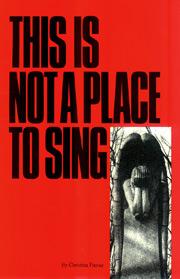
This Is Not a Place to Sing by Christina Pacosz

This Is Not a Place to Sing This Is Not a Place to Sing: poemsChristina V. Pacosz; West End Press 1987WorldCatLibraryThingGoogle BooksBookFinder

Polish-American poet Christina Pacosz traveled to the homeland of her father’s family in the mid-1980s, and the moving poems in this brief but powerful collection were the result. Published by West End Press in 1987, it’s long out of print, but last fall Christina announced that she had discovered a box of copies in her attic and I asked her to send me one. I’m glad I did. In just 26 poems, she makes the grand sweep of Polish history and many details of its contemporary landscape come alive for me, and I guess it’s the latter that make the former seem bearable, though she doesn’t go out of her way to suggest avenues for redemption.

The title, we learn from the acknowledgements, was something said by a woman in the Auschwitz Museum coffee shop, admonishing some overly boisterous schoolchildren. Pacosz wrestles with this idea throughout the book: how to sing in the face of so much needless suffering and death? “If I open/ my mouth/ I could/ drown,” says Baba Yaga, briefly imagining the life of a pious peasant woman (“Baba Yaga Speculates”). In “The Trumpeter of Krakow,” Pacosz translates the message of the trumpeter’s broken-note song:

Each of us
is invaded
daily, hourly,
minute by minute
by time
and its deadly
arrows.

How to sing
from the highest steeple
and warn the city
with the sounds
that live
in us
and the world?

“Rafting the Dunajec” begins with accordion-playing gypsies and the speaker so grateful they’ve survived the holocaust, she gladly tips them before stepping on the boat. Then:

We come to the gorge
and the wind off the high peaks
washes us with the odor
of spruce, rosemary, pepper.

I say to myself: If
I knew a song
I would sing
and then I hear
a raft of children

singing across the water,
and I am happy,
just like I am happy
when I hear
the water
as it meets
the rocks.

“The Jewish Cemetery, Warsaw” begins with an epigram from Psalm 137: “For there our captors required of us songs, and our tormenters, mirth, saying, ‘Sing us one of the songs of Zion!'” and begins: “Only the trees sing now…” In “Krakow Monument: Another View,” Pacosz notes: “There are always those/ who would kill/ the singer.” And the emotional climax of the book comes in a brief poem for the director of the Jewish Orphanage in Warsaw during the Nazi occupation:

For Dr. Janusz Korczak Who Was Not Afraid to Sing

At the end
of the line
he knew
what
to do.

Walking
from the boxcar
to the gas chamber
he led the children

singing.

Instead of songs and their inevitably inadequate words, Pacosz finds, there are often flowers — ubiquitous offerings, bouquets for every occasion. “Auschwitz: Oswiecim” begins,

We are leaving
flowers like messages
in this awful place:

what else to do
except fall down
with weeping
into a grieving
that will never
be done.

And how to live
in the world then?

So it is calendula
for memory, here
with the children’s
clothing they never
outgrew.

On the feast day for “The Assumption of the Blessed Virgin Mary, August 15,” bouquets are gathered to be blessed in church. Flowers partake of the Virgin’s own dual nature, Pacosz implies, but the blessed bouquets serve a practical purpose, too:

And when the next cow calves,
the dried bloom
will sweeten her
first drinking water,
and Mary’s blessing
flow from her udders.

The book ends with a visit to the speaker’s ancestral homeplace, suggesting the only way out is further in. It is, however, as tough and unsentimental a poem as any in the book. I am left with the music for Gorecki’s Symphony of Sorrowful Songs running through my head. Though the poems in this collection aren’t quite so uniformly mournful, Pacosz understands as well as Gorecki did the power of simplicity and an unflinching gaze.