Good Friday moment

Image hosting by Photobucket

I suppose people who were raised Christian can remember the first time they learned about the crucifixion, and what effect that had upon them as a child. For me, I think the real end of innocence was when I found out that we are killing the earth, that even the weather is no longer completely natural. This is an appalling fact, and it’s easy to understand why so many people would prefer to believe otherwise. No one wants to admit that we are capable of geocide, just as no Christian wants to admit that if Jesus were alive today, they would probably join the crowd baying for his crucifixion.

Stabat mater dolorosa
iuxta crucem lacrimosa
dum pendebat filius…

Ambition

Image hosting by PhotobucketLast Friday, I wrote semi-facetiously about my poetic ambition. It would be easy to infer from my relative lack of motivation for pursuing publication apart from this blog that I have little or no ambition for my writing – in fact, I’ve drawn that inference myself from time to time. Isn’t “poetic ambition” in fact something of an oxymoron for me?

But when I examine my motivations more carefully, I find no lack of that mix of supreme self-confidence and submission to the demands of craft and inspiration that adds up to ambition in other writers. And it’s not as if I haven’t made concerted efforts to seek publication in the past. A combination of laziness and arrogance convinced me that it simply wasn’t worth the time and effort: sending out 25 submissions for every one acceptance drains the budget for stamps and robs one of time that could better be spent reading, writing or – best of all – going out in search of new material. And the payoff – publication in literary magazines – isn’t really worth it to me, because I don’t happen to enjoy most literary magazines; they strike me as, by and large, pretentious, elitist, and not very much fun.

Image hosting by PhotobucketIn a way, I think I’m very ambitious for my work, in that I’m not content to be read chiefly by other poets. I want to be able to speak to the concerns of so-called ordinary people – at least, those among them who like to ponder the age-old questions about love, death, the place of humans in the cosmos, the nature of our relationship with the numinous, and so forth. A lot of practicing poets seem content to win the approval of their academic peers, or aspire to write truly difficult poems that will intimidate their competitors for a proliferating number of prizes, fellowships and honors. But I’m encouraged by the example of poets like Mary Oliver, Lucille Clifton, or Martin Espada, who refuse to retreat into a privileged world of private meanings and continue to risk everything for the possibility of reaching another heart. What insights they bring to their work are no less profound than the obscurantist ramblings of a Jorie Graham or the remote and threadbare visions of a W.S. Merwin – to say nothing of the nihilistic circle-jerk currently masquerading as an avant-garde. The difference is simply that they haven’t given up on the prime directive of good writing: to communicate in living language.

Image hosting by PhotobucketWell, O.K., I don’t really need to air my poetic prejudices here in order to make my point. Why do I write? At root, it isn’t about changing minds or even reaching other people; it’s about pleasing myself. And this is where the most audacious kind of ambition comes in. If I were ever completely satisfied with the work of any of my poetic masters, I’d have no need to write another poem. But through no fault of their own, they’re not quite writing the poems I want to read, so I have to write those poems myself. This impulse stems not from insecurity and competitiveness, but from a lust for the authentic insight, by definition unique and unrepeatable.

It sometimes seems to me that a world of pure inspiration exists, like another dimension in science fiction, parallel to the familiar world of the senses, and accessible to anyone who pays close attention. Paying attention to language – something almost every minimally competent poet learns to do – is only part of the equation. We also have to learn how to listen, how to see. We have to leave the scriptorium on a regular basis and risk an encounter with the Other, and bear witness to the way in which even the most ordinary things and occurrences can turn strange and slip from our grasp.

Image hosting by PhotobucketI do still aspire to print publication, but on my own terms. I think some of my most successful experiments here at Via Negativa have been those that blur the lines between prose and poetry, and many of what I consider my greatest hits involve a call-and-response combination of photos and text. But I know how expensive it can be to publish books in color. While I don’t rule out publishing a book-length collection of miscellaneous lyric poems, it no longer excites me the way it used to. I have specific ambitions for further narrative poems along the lines of Cibola and for thematically unified anthologies exploring specific questions, but whether they bear fruit will ultimately depend not so much on my desire to write them as on their need to be written. And therein, perhaps, lies the key to this whole puzzle. If there are good, true and beautiful things that can only come into existence through me, then it’s my responsibility to see that they get that chance. If there aren’t, hey – at least I’m staying busy!

513 years of mellow flavor

Image hosting by Photobucket

Christopher Columbus, log entry for November 3, 1493 (translated by Samuel Eliot Morison):

These islands are inhabited by Canabilli, a wild, unconquered race which feeds on human flesh. I would be right to call them anthropophagi [man-eaters]. They wage unceasing wars against gentle and timid Indians to supply flesh; this is their booty and is what they hunt. They ravage, despoil, and terrorize the Indians ruthlessly.

Excuse me while I spit.

Deadhead

She shaved her head to get closer to God, she said,
prompted by a line in a song by a band called Nirvana.
Or maybe that wasn’t the reason, & she simply
thought of it afterwards, running her trembling hands
over all that smoothness. God. Congealed light.
Stones rounded to a shine by ceaseless contact,
saplings stripped of their bark, that arresting blank
that fashion models cultivate in their stare.
White, white, sing a song of skeletons that dance.
She had followed the Dead for five years, she said,
& every concert was different & amazing. It was a lesson
in how to be natural, how to just be there. God
speaks through our impulses. If I get pregnant
or get AIDS, she said, it was meant to be.
She read omens in the flight of birds or the fall of a leaf.
This morning I saw a tree’s shadow lying on the lawn,
perfectly still, & thought about her
for the first time in years. What does it mean,
this absence remembered in the sun’s angular wake?
Is she still alive? Is she being looked after by men
in white coats? It ought to be possible to tell,
I think, suddenly superstitious. I scan the sky
over the ridge. A vulture can follow a rumor
for hundreds of miles without flapping its wings,
as close to God as any appalling truth.

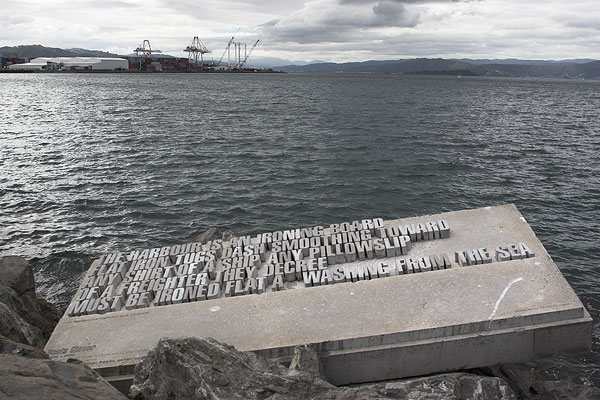
Jetsam

From a blog on the other side of the world
comes an unblogly thing:
a piece of poem set in a concrete slab
at the edge of the sea, cast up on the rocks
like the sole survivor from a wreck of words,
or as if the poet’s voice, like Alberti’s,
couldn’t take fresh water in its gills
& had to be restored to its native salt.

*

Something about a poem in a public place
disturbs me. Every time I’ve spotted one
among the advertisements on a city bus,
I’ve had to look away. It’s like
surprising a couple in flagrante delicto,
or overhearing someone’s cellphone conversation
with their therapist. At least with a reading,
merciful silence follows, & the bare podium.

*

Then there’s this business of objectification.
Poems grow like agates in the dark,
each according to its own mysterious rules.
Like agates, they are common & impossible to market.
But marketing needs the claim of uniqueness
more than anything, so poetry
gets pressed into service to provide ballast
on the ship of foolish products & bland commodities.

*

Poets, however, are taught to value the concrete.
Seeing such weighty jetsam,
I conceive a sudden ambition for my own work:
to see it published up on the ridge
on some ostentatious boulder, enough in the shade
that lichens of every crustose & foliose form
would find my lines ideal for a slow, private,
thoroughly absorbing read.

Woods and water

This entry is part 41 of 42 in the series Antiphony: Paul Zweig

I have been reading Paul Zweig, and responding to his poems with poems of my own. This is the next to last poem in the third (“Eternity’s Woods”) section of Zweig’s Selected and Last Poems, followed by my response. See here for details on this experiment in responsive reading.

Eternity’s Woods
by Paul Zweig

I
I have come to this house
Of soft angular stone, wondering
How much must fall away before I have nothing.

[Remainder of poem removed to avoid violating copyright]

* * * *

Water

I have sought to borrow inspiration
as others borrow comfort
from strange lovers. Let me

press my ear, I said, against
the scallop shell at the base
of your throat. Let me hear

the throb of the surf, & dream
of ships. What were we
talking about, again? I caught

nothing but a swallowed sob,
a corrosive drip. Compostela
remained a day’s walk away from
the Cape of the End of the Earth,

which was of course pure hype.
Right here in the hollow
where I grew up, I have heard
water trickling under the rocks,

& once my brother & I even dug
for it, four feet down through
a jumble of sandstone. When
we quit, the water sounded

just as loud as it had before
we started. I used to search
for a clearing in the woods
where, when the wind stopped,

the only sound would come
from a hidden spring. But
I didn’t want it ever to be found,

not even by me. Solitude
has since become my deadliest habit.
I don’t know what I am doing

here, talking to a dead poet as if to
my better nature, dreaming of poems
that would taste as good as water.

Why I love trash

Image hosting by Photobucket

Until I was five, we lived on an old farm in central Maine, near the town of Waterville. It was a great place, with a couple of derelict barns to explore, an old field, some woods – in short, not too different from where I live now. But one of the things I really missed after we moved down here were our visits to the Waterville town dump. Every month or so Dad would load up our red Volkswagen bus with everything we couldn’t compost, and Steve and I would clamor to go along. Once there, we’d race around looking for cast-off treasures. I think there was even a special area for this, where people would pile all the half-decent stuff that they no longer wanted or had room for, in case someone else might care to pick it up. It was the original Freecycle network. I don’t remember if we ever found anything really good at the dump, but the possibility was always there. This early childhood experience imprinted me with a strong notion that trash was fun.

You can learn a lot about a people by studying how they relate to their trash. My brother Mark, the geography prof, once described a field trip he’d led through East Texas. As soon as you drive into a town you can tell who lives there, he said. Tejanos like lots of flowers in their yards, and the shrines to the Virgin of Guadalupe are a dead giveaway. African-American yards tend to be neat but minimalistic: bare dirt swept with a broom, just like in West Africa. And Anglos? “You can tell the white neighborhoods by all the trash.”

Image hosting by Photobucket

So as hateful as the term “white trash” might be, like most stereotypes it didn’t come out of a vacuum. When we moved back to our ancestral homeland of Pennsylvania (albeit a little farther west than any of my grandparents had lived), we quickly and unthinkingly fell into the pattern of taking all our trash out to the old farm dump. It was just what people did back then. Dumps were usually located in the nearest patch of woods to the house; our neighbor Margaret’s old dump was less than a hundred feet from her porch. Our dump had been established maybe a hundred yards from the house, just beyond the powerline right-of-way. Two things about its placement seem baffling today: they threw their trash on what I think was originally an old charcoal hearth from the early nineteenth century, located right where the stream that drains the whole watershed emerges from the ground. Every hard rain, smaller pieces of trash floated downstream, along with god knows what seeping poisons. And the other weird thing was that the dump was right next to what had been, for three generations, the Plummer family picnic grove.

Image hosting by Photobucket

So on the one hand, before the environmental movement took hold in the mid 1970s, we rarely gave a thought to the toxic effect of some of the stuff we pitched out, such as batteries or almost-empty cans of Raid. But on the other hand, we didn’t necessarily regard trash as something to be shunned and avoided. Like many farm kids, my brothers and I actively sought out abandoned dump sites and attacked them with shovels, hunting for old bottles. Dad closed our own dump around 1975 and started taking our trash to the local landfill – a joyless place. But we continued prospecting in the dump for years, rewarded by the occasional, unbroken bottle from a hundred years ago, the glass wavy, spotted with bubbles and aged to a mellow purple. And though several large trees have fallen across it, and we’ve covered as much of the dump site as we can with dirt from various construction projects, ancient plastic toys and detergent bottles still do wash out and migrate downhollow during the occasional flood.

Image hosting by Photobucket

Raised without television, we were deprived of the allegedly educational benefits of Sesame Street. But thanks to an elementary school music teacher, I did learn the tune and some of the words to Oscar’s theme song:

I’ve a clock that won’t work
And an old telephone
A broken umbrella, a rusty trombone
And I am delighted to call them my own!
I love them because they’re trash

I still feel that way to a degree. While I no longer bring trash home, now that I own a camera, I have begun collecting again. Chris Jordan’s photos of landfills and recycling centers, mentioned in my post last Friday, made me think there might be some value in building my own photo exhibition of “intolerable beauty.” But while Jordan focuses on trash in the aggregate, in all its teeming splendor, I am more attracted to single pieces and small groups. And whereas Jordan’s perspective is unapologetically urban, I am much more interested in looking at trash as part of a human-impacted, semi-wild landscape.

To me, litter is a form of found art. When an object is discarded, it becomes free: free for the picking, yes, but also existentially free, no longer bound to one, narrow, utilitarian role. A well-situated dump is like a sculpture garden.

Image hosting by Photobucket

Old dumps are attractive in the same way that ruins are. Ask any volunteer at an archaeological dig: as things corrode and decay, they gain charisma. A great deal of our visual intake on any given day consists of the too-bright, too-good-to-be-true allurements of kitsch culture and advertising. But let those cheap plastic toys sit out in the sun for a few decades, let the tawdry billboards in “blighted” neighborhoods peel and flake and attract graffiti, and such objects – designed as trash – can attain a wholly unintended picturesque quality – even a hint of redemption.

Image hosting by Photobucket

Two very different types of people are attracted to the environmental movement: fans of cleanliness and order, who shudder with horror at all forms of pollution, and those of us who feel most at home in the apparent chaos of wild nature. Though able to form alliances around many issues, our priorities do sometimes divide us. For example, like Ed Abbey, I regard roadsides and especially highway median strips as the perfect place to store our trash, and view people who “adopt” sections of highways as part of the problem, not part of the solution.*

Litter is like a weed: obnoxious because it’s in the wrong place, because its virtues are under-appreciated, and/or because it is simply too numerous, and threatens to overwhelm the native inhabitants. A single, stray tire, rusty old bucket or whiskey bottle out in the middle of the woods hardly seems like litter at all.

Image hosting by Photobucket

Like Chris Jordan, I’m deeply troubled by our consumer culture and its effects on the planet. But I am less troubled than he seems to be by the potential of trash to entrance us. As mortal beings, ultimately we are what we throw away, and I think it’s good to be reminded of that. Time can ravage, but it can also illuminate with a wholly unexpected grace. It’s the “out of sight, out of mind” attitude that really enables the thoughtless impulse to throw the old stuff away and buy new – and at the same time leads us to disregard the harmful effects of anything we can’t see at all. We’re an intensely visual species.

Learn to appreciate the patina of age, and you’ll soon find yourself haunting junk shops and yard sales rather than the mall, and when you do have to buy new, saving enough money to buy high-quality stuff that won’t end up in the landfill. Or you may become like me (quel horreur!) – satisfied with the images alone, returning from the dump with a full memory card and a renewed appreciation for the stuff you already have. Hey, you say to yourself, that doesn’t look half-bad! At least it still works. Sure, it’s got some nicks or rust spots, but a little bit of elbow grease and it’ll be as good as new. Better, in fact.

Image hosting by Photobucket

__________

*Here’s my standard, anti-anti-litter rant, provided free of charge as a public service: We don’t need “cleaner” highways, we need fewer highways. Perhaps if they didn’t look so neat and uncluttered, people wouldn’t be so enthusiastic about building new ones. And what happens to the trash you “clean up”? Doesn’t it simply abet the spread of landfills, which are almost invariably located well out of sight and smell of major roads and population centers, often smack in the middle of wild areas? If you must indulge your neatnik impulse, why not adopt a railroad?

The love that dare not speak

Brokeback Mountain‘s financial and critical success may well mark some sort of societal progress toward greater tolerance for sexual nonconformists. But does it really represent progress in our understanding of what true love might consist of – or does it simply reinforce widespread, materialistic views? I have yet to see the movie – and being a contrary sort, the more I hear how important it is, the more resistant I become. But I must admit I’m curious about whether it offers any real challenge to the popular dogmas about love, i.e.:

1. Love is a feeling of strong attraction toward someone or something.

2. The quintessential expression of love is in romance, which derives from the desire for sexual union between two individuals.

3. Sex is a pleasurable form of self-indulgence whereby we seek gratification through mutual possession. Unless directed toward procreation or sublimated in romance, it tends to become anti-social and/or debased.

4. The highest form of love involves self-sacrifice.

It probably won’t surprise anyone to hear that, though my opinions about non-standard expressions of sexuality are thoroughly mainstream,* I’m an arch traditionalist on the subject of love itself. Which is to say, I cling to what had been more or less the consensus view in the pre-modern period, at least among mystics, believing that:

1. Love is the practice of uncalculating generosity, thoughtfulness, and respect for the integrity of others.

2. The quintessential expression of love is in the friendship of equals, and derives from the impulse to learn, to give, and to share.

3. Sex in the context of love can be a joyful form of self-transcendence in which bodies are continually re-discovered and re-created.

4. The highest form of love involves immersion in timeless, selfless Presence.**

Once upon a time in America, homosexuality was “the love that dare not speak its name.” If those days are finally coming to an end, I’m glad. I don’t believe that sex and spirituality are as antithetical as many traditional religious teachers assume; I’m cynical enough to suspect that the main reason for organized religion’s hostility toward sex is the desire of religious authorities to maintain a monopoly on self-transcending experiences. (How else to explain blanket prohibitions against alcohol and drugs?) But I worry that an excessive focus on sex, whether by religious people or by secular humanists, simply reinforces reductionist views about love and sex, and plays into the hands of those who seek to profit through the trade in bodies. We must beware the advertiser’s shell game: Are you lonely and insecure? You need more/better sex! And here’s a short cut. Buy this product.

In place of the pre-modern mysteries of soul, spirit and original sin, we are now taught to believe in such abstractions as personality, intelligence and sexuality. I’m not sure this represents a step forward. In either case, we are made to feel helpless without the intercession of experts. To my way of thinking, “soul” and “sexuality” are equally vapid concepts, the only difference being that “sexuality” is even less poetic. The ideologues of the market are all too happy to have everyone buy into the idea of self as bundle of desires. You are what you want. If you’re not in tune with your sexuality, you must be unhappy and repressed.

Well, fuck that! I’m less interested in the love that dare not speak its name than the love that dare not speak at all. True communion is always wordless, is it not? Past a certain point, language becomes not merely extraneous, but downright obscene.
__________

*I.e. that homosexual behavior is natural for those with that orientation; that pedophilia is as inexcusable as rape; and that bondage/discipline and sadomasochism, while acceptable between consenting adults, is awfully silly and somewhat repellant in its celebration of power and humiliation.

**It may be unclear from the way I set this up that I don’t intend the two definitions of love presented here to be mutually exclusive. Obviously, the fact that we have one word to encompass so many different things can both help and hinder clear thinking. It can help to remember that what the Greek Bible calls agape and caritas are not as separate from eros as we like to imagine, and that eros in turn may often be difficult to disentangle from caritas, etc. It reminds us to keep the passion in compassion, so to speak. But obviously this multiplicity of meanings leads to confusion if we forget to distinguish between them, and allow the eros component to overwhelm the others.

Walking on the crust

Image hosting by Photobucket

Geez, Ben, has it really been nine years since you checked out? It was late January, I remember that. Three or four days after getting the news, I was still consumed by violent fantasies of revenge against that unrepentant son of a bitch who got you hooked. I needed someone to blame, I guess. I went out for a walk around the mountain, which was a bit of a struggle due to a deep snowpack with an icy crust that wasn’t quite strong enough to hold me up. So I lurched along, trying hard not to slip and falling through at unpredictable intervals. I made a bet with myself: “If I can take twenty steps on top of the crust without breaking through, I’ll stop fantasizing about violence and try to forgive.” And what do you know? Twenty steps later, I still hadn’t broken through! So I amended it: “If I can make it all the way down this hill on top of the ice…” Damn, how’d I get so light all of a sudden? It was spooky! Finally, I said, “If I can make it all the way back to the house” – and I almost did. I guess it had just been a matter of concentration all along. I could see the smoke from my chimney rising straight up, lighter than the air.

Image hosting by Photobucket

You know, it’s funny – I’ve never actually sat on your bench. Well, it’s all wrong, the way they installed it facing away from the street. Probably when the plan for downtown benches was first put forth, someone in the Borough Council objected that they might become an inducement for the Wrong Element to loiter and scare people, so they compromised by putting in benches that no one would actually want to sit on for more than a few minutes – shoppers resting their weary arms, someone taking an important call. But your family did well in putting your name on the closest bench to the record store. You know, they have a new bus stop across the street, now. Big new library, too. And dude, right across from your bench, someone just opened a Jamaican restaurant! I heard it’s good.

Image hosting by Photobucket

The kids still sneak down into “Little New York” to drink. They think they’re gangbangers now – it’s pretty funny. You should see them walking along with their pants down around their knees, all rebelling in step. I’m sure it’s no easier than it ever was to grow up blue-collar in State College, PA. But these days, as every place gets more and more like every other place, probably the only towns that aren’t full of fake-ass shit are the ones that are just about dead. And State College is booming.

Image hosting by Photobucket

There’ve been a hell of a lot of changes in town and on campus in the last nine years, but one thing hasn’t changed: no matter where you go, in the borough or the surrounding townships, someone is always tearing something down or putting something up.

Image hosting by Photobucket

“Happy Valley” may have started as a tourism promotion campaign, but then people started to believe it. Penn State even runs its own retirement community now on a hill above the bypass. Who wouldn’t want to grow old on the frontiers of utopia? Somewhere in State College, there’s always a light left burning in broad daylight to reassure us that progress is on the way.

Image hosting by Photobucket

Proof that at least some people in State College can laugh at themselves: the State College Centennial Pigs. I guess you’d remember this. The official story is that the sculpture was based on an historic photo of a sow nursing two piglets right in the middle of College Avenue, but with the Penn State campus right across the street, the symbolism is pretty hard to miss.

Image hosting by Photobucket

The shoppes and restaurants downtown come and go, seemingly unaffected by all the new box stores on the outskirts. I’ve never seen so many upscale clothing stores and hair salons in one place. You can actually buy pre-ripped jeans now – imagine that! Instant authenticity! And there are more pizza places, coffee shops and tanning salons than ever. The owner of one tanning place just got busted for making secret videos of his patrons. Sick bastard.

Image hosting by Photobucket

There are not one, but two Wal-Mart Supercenters now, one for each end of town. A group of about forty local activists staged a protest outside of one of them last month, holding signs and handing out literature. The funny thing is, according to the article in the paper, nobody really gave them a hard time, and some people were downright friendly. Does anyone actually enjoy shopping in a place like that? Go into Wal-Mart and all you hear is stressed-out parents yelling at their kids. I think being greeted at the door by people who are paid to act cheerful sets the tone – the whole place stinks of humiliation.

Image hosting by Photobucket

Bouyed up the university, State College is still bubble-land surrounded by Bubba-land, metastasizing suburbs with no urban core, its bounty untroubled by the occasional small mutiny.

Image hosting by Photobucket

Anyway, I don’t want to bore you. I saw your bench sitting there empty next to the record store and thought I’d just say Hey.
__________

Please note that the last photo is not a double exposure, simply a shot of reflections in a store window to the inside of which a poster of John Coltrane had been taped.

Person of interest

Image hosted by Photobucket.com

The person of interest – not yet a suspect – has a slate-gray suitcase and a story full of holes. The person of interest is nobody you know. The person of interest has been known to express sympathy toward the enemies of the United States, to participate in assorted protests and boycotts, to eat falafel, to beg to differ, and to compare the private ownership of land with slavery. The person of interest goes for slow, apparently random drives in the country, taking numerous pictures of public infrastructure and commercial messages.

Image hosted by Photobucket.com

The person of interest, though a native-born citizen of the United States, has repeatedly expressed interest in “getting the fuck out of here,” with socialist countries such as Sweden, Canada and Moominland most often cited as desirable locations. The person of interest listens to public radio without ever becoming a member. The person of interest sometimes dresses in black and runs barefoot through the woods.

Image hosted by Photobucket.com

Last Tuesday, the person of interest discussed world affairs with an accomplice for about twenty-five minutes without a single mention of the War on Terror™. The person of interest is a regular user of the World Wide Web, viewing and contributing to little-read, heavily inter-linked “blog” sites in preference to more typical internet destinations such as E-bay, naked or nude xxx celebrities and Texas Hold’em. Though not yet a suspect, the person of interest is suspected of involvement in [REDACTED] and [REDACTED], “Old Faithful,” [REDACTED], Egyptian lentils – [REDACTED PARAGRAPH] chemical fertilizer as “a disaster waiting to happen.”

Image hosted by Photobucket.com

The person of interest is said to have a smooth, hairless spot the size of a silver dollar on his or her left buttock, though we have not yet been able to confirm this. The person of interest is not considered a candidate for special rendition at this time, though advocacy of ecoterrorist acts involving criminal trespass, as well as persistent defamation of the American Beef Council, may eventually lead to detention as an enemy combatant in order to protect the public and safeguard the Constitution from abuse as a cover for openly seditious acts. Worst of all, the person of interest has sought classified information under the Freedom of Information Act…

UPDATE: For those who might think I exaggerated a little about government surveillance, listen to this report.