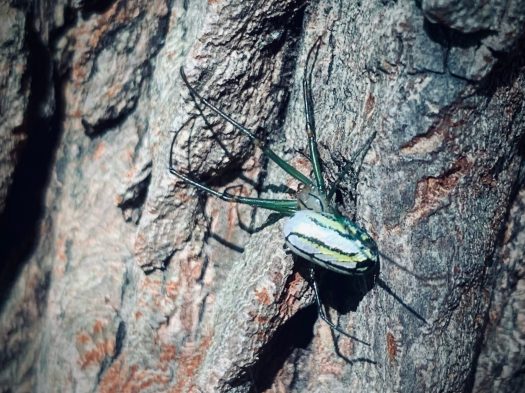
Starting with a thunderclap

morning thunder
a fawn dancing
with deer flies

***

Alaskan poet Erin Coughlin Hollowell posted a Joanna Klink poem to Instagram and I immediately went and dug out my copy of Excerpts from a Secret Prophecy, whence it came. The bookmark was only a third of the way in, but in my defense it had been my second Klink book in a row, and she is not a poet to read quickly.

But my impression from April is soon reaffirmed: she is a poet of unquestionable genius, one of our best. Terrance Hayes uses the term “Rilkean elegies” in his blurb and that’s not hyperbole. In fact Rilke does rather well by the comparison, I think. Here for example is a section of the poem “Novenary”, where my bookmark was parked:

***

roses
between the doe’s teeth
thorns and all

*

dark clouds
the robin revisits
his dawn repertoire

*

downpour
so many memories
smell like the earth

***

If I am only hull to what happens,
let me at least feel more deeply that flitting,
the dead light of stars over my hands,

into my throat. Oar of my body.
Things that were sensed but not known.
Joanna Klink

That’s how “Novenary” ends. And I am reminded that typing out another’s poem prompts a deep reading when you type as painstakingly as I do, with one clumsy finger, on my phone, as if with “the dead light of stars” indeed.

***

They’re still forecasting a high of 90 this afternoon—32C—but at the moment it’s 56F/13C and I am fighting the urge to put long johns on. “Rain stopping in 19 minutes.” That’s global weirding for you.

***

This morning’s earworm is from Blackwater Park, a masterpiece of an album by the progressive metal band Opeth, which I had on in the car last Tuesday. So much great music about serial killers! Bartok’s Lord Bluebeard’s Castle comes to mind.

A cheerful thing to hum while fixing breakfast.

***

One of the great climbing trees of my childhood finally gave up the ghost this spring. Red maples don’t live long but they also don’t die easily.

Enjoy the climb, Virginia creeper! You can’t help that your name makes you sound like a sex offender and an outsider. Hell, I was born in Virginia myself.

***

Stopping to write down a thought, I see that I left another thought unfinished and expand on that instead, forgetting what I had intended to write. As so often in life one redirects energy from one thing to another. Would I have been a more productive poet if I’d had a career, related or otherwise? Undoubtedly. But I always prioritized happiness in the moment.

lucky day
the coins I keep forgetting
in my pocket

***

blowing my nose
a maple leaf’s dry
underside

***

Half-way down the hollow, the sun comes out. And so, I’m afraid, do the midges. Black flies, I suppose we should call him, a call-back to the North Woods of my early childhood. But the white supremacy embedded in that common name makes me more than a little uncomfortable. As does this cloud of midges. Global weirding—what can you do? My nose begins to itch, a psychosomatic reaction as old as my earliest memories of being engulfed by small biting insects.

A small hole in the middle of the gravel driveway which I always thought was the entrance to a chipmunk bureau has filled with water. What an unexpected thing! (The dictation app heard burrow as bureau, and it’s just too perfect to change.)

I decide to head straight up the mountainside to escape the midges. I forget just how many spring wildflowers hide out on the steep slopes where no one ever goes. They’re past blooming now, of course, but it’s good to know they’re here. And I say no one, but in fact I did meet another climber on the way:

red eft

the hollow
between twin oaks
collecting leaves

midsummer—
rain-soaked ghost pipes
steaming

*

This crook-handled umbrella is the best: a cane when I need it climbing a hillside, or a stick to shake rain off vegetation before I walk through it. I was pleased to see, walking with my mother recently, that she uses her folded umbrella to deftly toss fallen sticks off the road just as I do.

*

ghost pipes
sweating through the longest
day of the year


via Woodrat Photohaiku

*

I’m seeing lots of evidence that this year’s much smaller cohort of spongy moth caterpillars has almost entirely succumbed to its main natural control, a fungus. Fingers crossed that oaks won’t be as stressed again as they were in 2020 for a long time—I’m convinced that’s what allowed the caterpillars to build up in sufficient numbers to cause last year’s widespread defoliation, because trees busy fighting drought, after a late hard frost had required them to re-leaf, would’ve had very little energy left over to produce their usual insecticides. Two years later, there are as many dead trees from that frost as there are from last year’s outbreak, though they’re not concentrated on the ridgetops like the latter, but here and there throughout the woods. In either case, just the sort of small openings that are great for overall biodiversity, as long as they don’t presage a new disturbance regime that will turn forest to savanna, as seems to be happening on Plummer’s Hollow’s southeast-facing slopes without oak-hickory cover, where things are kept at a weedy stage of succession—a kind of arrested development—by increasingly harsh ice storms in the winter and thunderstorms in the summer.

If/when sudden oak death aka Phytophthora ramorum arrives here, I may need to be put on suicide watch.

However, it has not escaped my attention that Disturbance Regime would be a great title for something. Or as we GenXers invariably like to joke: if you were ever in need of a rockin’ name for a garage band…

***

At 12:42 the midges find me on top of the ridge. It’s getting hot. The lucky coins are still in my pocket. My feet are damp but the rest of me feels pretty damn good.

The world is always ending somewhere. Today, so far, it’s not ending here and for that I am grateful. North America as a whole might get through the current economic state-change relatively ok, given our economic, natural and demographic advantages. But I fear for friends in other parts of the world. And for wildness and biodiversity dwindling everywhere.

A shadow of a red-tailed hawk passed over me as I was writing that.

(I love augury right up to the point where it stops being about the birds and starts being about us. How dull.)

When I got home, I found a stowaway on my sleeve:

An immature northern true katydid, if I’m not mistaken.

***

For the second day in a row I actually manage a mid-afternoon nap, which is great this time of year when the nights are so short but also so enchanting—and keep in mind that Shakespeare etc. never saw fireflies, which are such a feature of June nights here.

After supper, sitting on the porch to begin editing this post, a fringe of grasses at the edge of my weedy front yard, illuminated by the low sun, caught my eye:

Watch on Vimeo

When I knelt to shoot the video, I looked around to make sure there wasn’t any poison ivy. Instead, I was delighted to discover a baby tulip tree! I had been looking all over for seedlings to transplant a couple weeks ago, because they’re such excellent yard trees—grow straight and tall, are lovely in bloom, and can live for hundreds of years—but couldn’t find a one. So when I’m not looking, one appears. And in a very good spot, too.

I lost no time making a deer cage for it. Blog posts can wait!

Seeing in haiku, walk therapy, against harmony, shrieking owls

river in November light between bare woods and mountain

Surely part of the pleasure of reading haiku is to make the current moment more special. Literary critics probably even have a term for it: the way an especially vivid evocation of a particular time and place can lend radiance to another, so for example I can read

night snow
the silent rooms
of dreams
Ann K. Schwader, Modern Haiku 53.2, Summer 2022

and for a moment I see everything in its light, this lush green meadow and forest edge on a crystal-clear morning in June. By taking me briefly out of it the poem shows me more of what makes it unique and unrepeatable. I read, smile, look up and smile again.

***

Walking instead of talking. Going out instead of holding forth. It’s been a year since our nearly decade-long conversation trailed off into silence and the great ridgetop oak we got married under toppled over on a still evening in late June. That spot will be choked with early successional plants and then pole timber for a generation. It will be interesting to see how it shakes out, and what tree or trees end up dominating the local conversation with the sun—probably a black cherry or red maple, but with deer numbers way down from chronic wasting disease, a hickory or even another oak seems possible. Though what kind of world, etc.

To be fair, I may have found a way to keep talking despite all my walking: you’re looking at it. But in any case the idea was to spend the time I used to spend online outside instead; walking is just one option that I happen to enjoy. Sitting in the woods and reading or writing is another. Yesterday, since a breezy cold front had driven away the gnats and mosquitoes, I was even able to compile most of the weekly blog digest in the woods.

It occurred to me the other night that this is really just a return to the patterns of my childhood. Yes, I was a bookworm, but I can’t remember spending very much time in my room, or even indoors unless it was raining. I’m not sure I’ll go back to climbing trees, though. As nice as it’s been to recover the spring in my step, I can also feel autumn in my joints.

***

The harmony-with-nature folks seem nice enough, but I always feel awkward around them because, I don’t know, it feels terribly presumptuous somehow. Like, that tree didn’t ask to be hugged. You’re not part of the local food chain, and you’re a member of the single most destructive invasive species in ecological history, so your position relative to the rest of nature is in fact the opposite of harmonious. Should we not begin by acknowledging this extraordinary privilege?

I mean, unless you’re hearing-impaired, how can you walk through the woods and not hear how much you are feared? So many of those adorable-sounding chirps mean “Look out! Another fucking human!” Sure, if you stay still for a while, enough critters will forget you’re there or not notice you that you can pretend you’re having a harmonious moment, but you have to literally hide in some sort of blind, or set up remote cameras, if you really want to see what the nonhumans are up to.

Except of course for invertebrates, so many of which rush heedlessly through their days, allowing even the most impatient children to get absorbed in watching them. J. Henri Fabre’s Life of Insects series is a masterpiece of world literature, because invertebrates are kind of in that uncanny valley between critter (being with face) and robot. They’re absolutely alien and absolutely everywhere, and most people seem completely blasé about that. Freaky, man. Freaky.

The Japanese have this one right. That’s one of the things that has always drawn me to Japanese poetry, in fact: the healthy appreciation for, and close attention to, insects. It shows they’re serious about nature; they see other creatures as connected with us on a deeper cultural level than any of my own ancestors have experienced in the last thousand years.

Of course, none of this supposed nature reverence matters a whit in today’s hyper-capitalist economy, where other Japanese cultural traits, such as the avoidance of conflict in pursuit of a distinctly hierarchical harmony at all costs, make the excesses of capitalism especially difficult to oppose. Their wild areas are in even worse shape than ours.

***

I don’t know why Western Buddhists went with “enlightenment” at all, really—“awakening” is a much more powerful root metaphor, and I gather more accurate. It’s also more immediately relatable than most high-minded religious goals, I think. Oneness with the Godhead? Sounds dodgy, like an adolescent concept of bliss. Awakening, though? We’ve all had those rare days when we felt unusually alert and alive. It’s not a great feat of imagination to extrapolate from that.

Ecstasy, getting outside oneself: that’s what Eliade said Shamanism was all about. Complete projection: that’s what Eliade was all about. Escapism is a fantasy with, I’m sure, widespread adoption across cultures. But Buddhism, along with many other, traditional belief systems, prized the opposite of escape: attention.

Which I seem to have precious little of today. Too much getting in touch with my feelings to actually feel.

***

This post is less than half as long as it would’ve been had I not cut out much of the blather. Even still, I don’t think you could say it is entirely lacking in blather. But who wants to go through life on a blather-free diet? Not me. (I’m even back to drinking whole milk. Delicious!)

***

dead air
over the dried-up pond
the first bat

***

Coming down from the spruce grove through a narrow part of the meadow I hear a weird shrieking noise, which turns out to be juvenile barred owls, according to Merlin. There are three of them calling all around me, but it’s too dark to really make them out. Five minutes later, from farther down in the meadow I hear the parents talking back to them in chimpanzee voices. Nice to witness that bit of family interaction. They are always such great owls to have around.

I’m told there might be people who don’t have strong feelings about their various local species of owls, but I’m not sure I believe it.

Poetry Blog Digest 2022, Week 24

Poetry Blogging Network

A personal selection of posts from the Poetry Blogging Network and beyond. Although I tend to quote my favorite bits, please do click through and read the whole posts. You can also browse the blog digest archive or subscribe to its RSS feed in your favorite feed reader. This week found poets musing about downtime and leisure time, outsiders and Ozymandias, collaborating with photographers, the life history of hermit crab, and more. Enjoy.


My friend, John Rae, husband of my godmother Anne, has died. John collaborated with me on the book of this blog, sending me line drawings through the post during 2020 when we were in lockdown. The drawings were, and are, a source of joy. […]

I thought of other friendships that have come to an end, whether through death or separation. I felt sad. Nearly 50 years after first setting off for Norwich (see, I Arrive In Norwich) I finally went into the cathedral, experienced evensong. The music, the company of other Lizes, the stained glass – all these became a still point in my turning world. 

John was a skillful artist, architect and teacher. A humane man – much loved. After our book was published, I received notes through the post from many people asking to buy a copy. The majority of these were friends of John and Anne’s. All spoke of long friendships, with affection and admiration. 

With death comes ending, as well as a continuation of thought and feelings. My thoughts and feelings have, this past few months, been circling around ideas for next poems. I’ve written little down, but I must get onto this in order to grow a little more. I also need to work out how to put up a curtain pole so that the curtains I bought in Norwich hang straight. 

So without either a bang or a whimper, I end this blog here. 

I Am Read.

I Thank You.

Fin

Liz Lefroy, I Sense An Ending

fragrance in a time of sadness 
petrichor says the emerging sun as
all steams right with the world again
the scent of a rambling rose

Jim Young, a vignette

One thing I’ve been thinking about quite a bit the past few months working on my own is the concept of leisure. What is it? Is it important? What legally constitutes leisure activities and what does not? Do hobbies count? Maybe, but what if your hobbies are in some way like a job? It’s especially wrought and all wound up if you are an artist, since so much of your way of being in the world is a kind of work..you are never NOT being an artist, even if it’s just thinking like one?

Kristy Bowen, all work and maybe more work

Jan always makes each issue [of Finished Creatures] look and feel glorious. Getting a copy in the post is always a joy. The envelopes they come in are lovely things with a string tie on the back. The addresses are handwritten, and if you’re getting a contributor’s copy then your page is bookmarked for you.

I’ve already mentioned that there was some back and forth on my poem that went in the mag. Jan was very helpful and very understanding, and while I’m happy with the version we ended up with, the poem is one that I’ve worked on and tweaked since it was accepted.

So it was a bit strange to be reading the published version on Wednesday evening as part of the online launch. It’s obviously a bit weird to be reading in a “room” full of the kinds of poets in this mag. I mean look at this lot…sadly not every one could make it.

I was disappointed not to hear Arji Manuelpillai read any of his poems as one of his is after mine in the mag, but I did get to hear Alex Josephy read hers, and that’s the one that precedes mine. I also got to hear Rebecca Gethin, Amlan Goswami, Hilary Hares, Joanna Inham, Simon Madrell, Caleb Parkin, Sarah Salway,Penelope Shuttle, Paul Stephenson and Elżbieta Wójcik-Leese read. I was in a break out group with Anthony Mair and Julian Bishop, but sadly we didn’t get to hear their poems —FYI both are excellent.

A couple of the poets that couldn’t make it also had their work read out, one of which was me reading James McDermott‘s excellent ‘Wild Flowers’. I prefaced it by suggesting using the names of flowers in poems is cheating as it’s guaranteed to sound great, but I love this poem. There’s a lot going on in there around belonging and survival.

Mat Riches, **Slaps Forehead**Remembers about Finished Creatures #6

Today, I enter the pebbled shallows of a man-made lake.
My footsteps tear through the reflection of pine trees,
Warp their curve upwards with hill’s rise, their sun-bright
Branches greening the water’s mirrored darkness.

Christine Swint, Memoir as a Body of Water

I read a book of poems, book of short stories, and finally finished a novel that had sat on my coffee table with a bookmark halfway through it for maybe…a year? It was finally the right time to finish it. But my favorite reading lately has been The Book of Eels, nonfiction about…yes, eels. Fascinating creatures, about which we finally know a few things, but which remain mysterious. They are all born in the Sargasso Sea and then swim/drift elsewhere.

I have also been writing–a variety of things, including a script I got to see performed last night at the History Makers Gala, honoring 4 wonderful people in our community! My poetry feels on standby, but I do remember writing some, sending some out, and storing some in the weird, dusty drawers of my mind. Sometimes, when I am waiting for something to come out, everything feels on hold for a while. I just checked the mail. It isn’t here yet, but it’s still very, very hot out there. The poor mail carrier!

Kathleen Kirk, Down Time

This syllable
means death in Hebrew
but let’s prolong
hope’s steady drip.

A tor rises
from the hillside:
aspiring only
to keep existing.

Listen to the trill
of cricket opera
as my little boat
glides on.

Rachel Barenblat, Lake

Out there boats patrol the coast on the lookout for misunderstandings.

Out there the remains of failure are found, or so it is announced.

Out there an armoured military truck smashes into a car. The invaders cover everything like fog.

In here what can I tell you? This is the factory of the mind, of the poem, of the portrait.

In here I thought I could leave but the battle for the bridge over the ocean was too intense.

In here are hundreds, thousands, millions of languages.

Out there someone is saying No really, I insist.

Bob Mee, OUT THERE, IN HERE

Finding your own community when you are an outsider is hard and made harder by not being close to the usual networks of support in the extended family, neighbours you grew up with, being able to rely on a childhood friend during a mid-life crisis. Moving on and reinventing yourself often means cutting off your roots and learning to sustain the plant you’ve become in shallower soil while others regard you as a weed, something grown outside the formal lines of the original flower bed, leaving you unsure as to whether you’re going to be left alone or cut down to size. Both the individual poem and collection explore that theme of how to maintain or keep in touch with the culture you belong to while settling. It questions how far compromises can go and whether those compromises are worth it. From the specific lens of Portuguese-Americans, it asks universal questions about the status of those regarded as outsiders.

Emma Lee, “Through a Grainy Landscape” Millicent Borges Accardi (New Meridian Arts) – book review

Percy Shelley’s ‘Ozymandias’ is not exactly a neglected poem. It was an option in my GCSE anthology fifteen years ago. For all I know, it still is. It’s tempting to approach the poem as a kind of relic, like those ‘two vast and trunkless legs of stone’ standing in the desert, a monument that won’t really speak to us.

But Ozymandias does, literally, speak. Reading the poem again after several years away from it (and, more recently, several months of looking around ancient ruins) the first thing that struck me was the number of different voices involved. The poem is a kind of Russian doll, reported speech enclosed within reported speech enclosed within reported speech: Ozymandias on the plinth, the traveller and the narrator.

It all happens very quickly. And not just the grand sweep of history: two words into the second line, someone new is already speaking. Do you pause at ‘said’, or carry straight on? It makes the poem surprisingly difficult to read: you can’t recite it ponderously like some people imagine this kind of poem needs reciting. The play of tone and phrase within the sheer square block of the poem and its metre give ‘Ozymandias’ a kind of glassy, artificial quality, like the sort of stone you might make a statue out of.

Jeremy Wikeley, ‘Ozymandias’ (Percy Bysshe Shelley)

How do you get from
nowhere to nothing?
You follow directions,
the old monk said.

Tom Montag, TEN OLD MONK POEMS (71)

a brief morning rain
dances on the van
I follow my breath

Jason Crane, haiku: 16 June 2022

Last night was our experimentation with silence so we left the worship service in silence, except for the thunder that had been rumbling for hours. As I stared at the icon on my computer, I noticed that my west facing window was full of a strange light. I knew I could look at images of icons at any hour, but I wouldn’t ever again have this exact sunset with the light diffused by the gray clouds. I watched the sky for half an hour, but just something I do not do very often.

I didn’t even try to capture the light with my camera. I decided to use our experiment with silence as a prompt to be fully present to the light of the sunset, to the darkening sky, and to the presence of God.

Kristin Berkey-Abbott, Praying with Icons

Turning in the final copy of the book, as many writers will tell you, is stressful and involves a certain amount of “letting go”—you know, you can hold on to the book making tiny or large changes forever, and often making the book worse because of anxiety. A little like my garden—you can desperately edit, weed, fertilize, and at some point you will just make the garden worse with all your worrying. You have to appreciate the parts that are working, that are flourishing, like peonies, as much as you regret letting go of your four-year old rosemary. A good thing about turning in your book is that you can start working on your next book—I already have two manuscripts in progress going, still shaping them and writing new poems for them. I am hoping for the launch of Flare, Corona to be post-apocalypse—I mean, post-pandemic—and for next time this year to be peaceful, healthy, happy, with normal-ish weather and getting together with friends and family. I’m hoping.

Jeannine Hall Gailey, Gardening in the Rain and a Plethora of Birds, Turning in the Final Copy of Flare Corona to BOA, and Favorite Father Poems

The thing about Offcumdens is that a) it has the courage to work in the same territory as [Ted] Hughes and [Fay] Godwin and b) it rather wonderfully provides the reader with an appendix of detailed commentaries, in which Bob and Emma write about their involvement in particular poems. There’s one telling moment when Bob, writing about the poem Walking away, says

“Emma is called upon to be very patient while we’re out walking together. I see something in the landscape that I think will make for a good photograph, and go running off to find the right spot……I often see shapes and textures in the patterns of the clouds, imagining how they are going to look in black and white…”

Emma’s comment is that 

“It can get very cold waiting for Bob to take photos…this was in March with frost on the ground and a bitter wind”

I really like the sense of the to-and-fro of the collaboration in which sometimes the image will generate the poems, and at other times the photographer will work to respond to or illustrate the poem.

As Philip Gross writes in his endorsement on the back cover: “Each double page is a conversation” That’s it, exactly!

John Foggin, My kind of poetry: Emma Storr’s and Bob Hamilton’s “Offcumdens”

How easy has it been for you to move between genres (poetry to collaboration)? What do you see as the appeal?

I was living with a photographer for whom English is a second language and Korean the first. But it was even more complicated than that, he’s a photographer! There’s a line by the poet Rob Schlegel – “language is not my first language.” We had to find a way to communicate if we were going to stay together. You can fall in love with a lot of people but if you want to spend your life with someone you have to develop a language together. What was a necessity in my life became the necessary conditions of my work.

Collaboration is not a picnic. As I say this I remember that Young and I made a movie about a man and a woman having a picnic with a donkey – with an actual donkey. The donkey messed up every shot we planned, though we also planned the donkey’s messing up into the shooting script. When I say “collaboration is not a picnic” I mean it’s not a unity, it’s not a perfect marriage, and if it’s going to be interesting it can’t stay play or process forever. Collaboration surfaces misunderstandings and ruptures, it reminds one always of the distances one cannot travel. It can’t hide a power struggle even if it converts that into the making of something.

The appeal is that it’s real. Forrest Gander’s book Twice Aliveuses the word “combinatory” to describe this intuition, that one’s perceived aloneness is at least in part an illusion. I am not sure whether we are truly alone or truly collaborative beings. I do not know the nature of the great web of things, the way we might be connected to animals and plants and the earth, but I know I am involved with the question, sleeping or waking, paying attention to it or not.

rob mclennan, 12 or 20 (second series) questions with Katie Peterson

the words go back to change what the words once were
my DNA the same as another giant tortoise found in 1906

wild and precious life intertwined
I will be a fantastic giant tortoise in my next life, too

Gary Barwin, fantastic giant tortoise

We cannot bring about a more regenerative and compassionate future using the same language that got us here– the kind churned out by advertisers, pundits, and politicians. Poetry calls us to make big world-restoring decisions by listening to voices wilder and wiser than our own. What does sea ice say? How about honeybees, gray whales, storm clouds, bonobos, leatherback turtles? What do our ancestors, leading all the way back to the First Mother, have to tell us? What do the smallest children want us to know? The oldest people? Poetry doesn’t offer answers, it simply helps to tune our capacity to see, hear, and be. That’s a start.

Laura Grace Weldon, Finding Solace In Poetry

In between booster shots, orthopedists, and ordinary life tasks, I’m seeking a daily and weekly balance between literary chores and literary delights. I continue to query bookstores, podcasts, and the like, hoping to get more “eyeballs on books”–what a smart former student, now in marketing, says is the most important task for authors. That emailing and calling isn’t much fun, though, except in the rare moments when you make a real connection. I’m making sure I spend part of each weekday, too, focusing on poems themselves. I’m deep in revisions of the next poetry ms, trying to transform each poem, as well as the whole, as into powerful things.

I discovered in the process that I’ve only drafted 4 poems in 2022 so far. Normally there would be at least a dozen. On the bright side: I typically toss out at least half of my drafts, but these 4 all seem to be keepers. It’s an interesting shift; I wonder if it will be a trend in my writing life.

Lesley Wheeler, Eyeballs on books & minds between covers

Last fall, I was asked to deliver a keynote to open the 2021 Fraser Valley Literary Festival. I spoke about my mother’s dementia, and moments of social dislocation (Pandemic, anyone?) and how poetry can see us through. I was really pleased with the talk and hoped it might find a way to live on in print. It was a blessing, then, when a few months later the League of Canadian Poets asked if I could write them an essay for their Poetry Month series “On Intimacy.” The essay that resulted expanded on my lecture, and you can read it here: “Why? And Why Now?: On Poetry and Companionship.”

Rob Taylor, Four Essays

I remember the days of abalone ceilings, the yolk
of my belly nestled in porcelain ribs, nights
when we met the Pylochelidae in secret,
to whirl across the sodden dune,
showing off our spiral cloches.
We danced to forget that our shelters
would again abandon us.

Kristen McHenry, Poem of the Month: Hermit Crab’s Lament

What I didn’t know then
and what I know now
can be summed up by the same

question: aren’t we all
born of some catastrophe
authored by other bodies?

What did we have
to lose but our early
sense of self.

Luisa A. Igloria, A Palimpsest (8)

once again, i find myself awake in this bed—

this ambien labyrinth, this insomnia museum 3:13 a.m. bus stop to sudden wide-awakeness, all-night waffle house of tossing and turning, this zoo of doom, crusher of circadian rhythms, hippie commune of sleep apnea, truck-stop along the highway to hell, war zone of snores, tram ride to slam time, snotwad of snoozelessness, scheme of rusted bedsprings, 9-1-1 crank caller, off switch to sleep onset, enigma of pin cushions, bloated corpse of corporal punishment, this boxspring lobotomy, dante’s inferno with a pillowtop—

this bed, this bed, this head, this dread, this way station between sun and moon that won’t let me sleep…

Rich Ferguson, this bed

I remember the half light of the pantry, 
where I stole packets of cocoa powder 
from people who had been only kind to me,
and would have given them to me if I had asked.

If I had asked? Who knows how to ask? The wind
comes up suddenly from the darkened beach.
It was a weary long time, before I would think to ask.
A life of erratic tacking, whose only through-line

was a desperate desire 
to disappear as I was and to appear as I was not.

Dale Favier, Half Light

PP: What’s life’s focus these days, literary or otherwise?

AE: Managing my diabetes through changes in diet and exercise. I’m writing a poem series about diabetes. As a writer, I am forever curious and need to understand the history, etymology, science and culture in about just about everything I get involved in, I can’t help looking things up in order to learn. My brain doesn’t seem to be built for science, even though I’m fascinated by it, so I’ve been trying to learn more and understand the underpinnings of diabetes, the connection between blood sugar levels to food, exercise and sleep. This leads me down a rabbit hole of wonder and it excites me.  I might as well write about it.

A few days after the diagnosis, I began a blog: the Sexy Diabetic and from there I ended up starting to write poems. I have always written as a form of catharsis, connection, whimsy and exploration. Life and literary pursuits are usually not separate for me.

Pearl Pirie, Checking In: phafours poet: Amanda Earl

At the readings I gave when the book first came out in 2006, I made a point of including “Melissa’s Story” and “Bill’s Story” in my set pretty frequently. Reproductive rights had been a major issue in the 2004 presidential election, and I wanted to do my part to keep the issue front and center in whatever way I could. I wrote the poems after reading Back Rooms: Voices from the Illegal Abortion Era, edited by Ellen Messer and Kathryn E. May. “Melissa’s Story” is spoken by a woman who pays a doctor for an illegal abortion. “Bill’s Story” is spoken by a man some non-specified but significant number of years after his pregnant girlfriend was sent against her will, and against what the teen couple wanted for themselves, to what used to be called a home for unwed mothers, where she was forced to put the child they conceived up for adoption.

In practical terms at least, we are no doubt farther away from men having to live Bill’s experience than we are from women having to live Melissa’s. Given the particular form of Christian morality that is driving the anti-abortion movement, however, it would be naïve to think some version of homes for unwed mothers could never make a comeback. It was, and is, important to me to give voice to Bill’s experience because it represents a rarely acknowledged stake that those of us who can’t get pregnant have in reproductive autonomy.

Richard Jeffrey Newman, Three Poems Of Mine That Should Never Have Become As Relevant As They Are Now

let’s make it easier

I’ll write a poem about you
you write one about me

there are so many words
to describe
someone else’s life

Rajani Radhakrishnan, Anatomy of a poem

Death or glory
under the lights,
the sun, the stars,
we the mutualists,
the diggers and
the levellers
are bound in
a cargo net
of love that fills
the heart and stops
the breath. There’s
a joy you simply
cannot buy
in the moment
pledged towards
the shared self.

Dick Jones, MUTUAL AID

Why haiku are hard to write + another walk with the camera

So many otherwise competent contemporary poets struggle to write decent haiku, and it’s worth asking why. Part is miseducation, sure: academic workshops seem to be passing on a view of haiku that’s about 30 years out of date, relying on dodgy translations of the pre-modern masters and helping entrench misperceptions already out there in popular culture (morae=syllables, haiku is a poetic form rather than a genre, haiku must be written in three lines, haiku are easy exercises for beginner poets, etc.). There’s very little awareness that an English-language haiku and tanka tradition even exists. Most academic libraries don’t subscribe to haiku journals. And so on.

But observing my own difficulties even after trying to correct for all of that, I think there’s also a larger problem: modern lyric poets are acculturated into a mindset that is somewhat at odds with the mindset required to compose effective haiku. We’re trained to wrap things up for the reader, to be clever, to aspire to the sorts of insights that could be didactically expressed if need be. We’re better at talking than we are at listening, despite lip service to Pound’s dictum “show, don’t tell,” and many have only the most superficial knowledge of the natural world (to the extent that that’s still central to modern haiku). We’re also trained to look for metaphor and simile—not typically an overt feature of haiku—and to favor in our imagery what Bakhtin called the classical body over the vernacular body, which I think militates agains the kind of earthy realignment between self and other proposed by the best haiku.

Then there’s the problem of how we think of ourselves as writers, strongly favoring the Romantic ideal of a lone creator rather than a collaborator or better yet a participant in creative, game-like exchanges. It’s no wonder that modern haiku culture tends to attract experimental rather than mainstream academic poets.

***

The other day I said something about not being into haiku as a lifestyle. But I don’t know, giving up coffee for green tea and going on long walks whenever possible seems about as haiku-lifestylish as one can get. Maybe what I meant was I’m a loner. That might be true. And as I just alluded to, haiku composition is a fundamentally social art-form. That’s one reason why competitions proliferate, for the festivity and sociability of it. Group composition exercises and similar get-togethers were, and I think still are, at the heart of haiku school formation and publication culture in Japan, and I gather they’re also pretty important in the US, the UK and elsewhere. It’s not unusual for the editors of haiku journals to propose edits even to very well-established writers; the focus is on the haiku rather than the writer, which I quite like.

***

This morning was actually kind of pleasant for walking. The really crushing humidity didn’t come until mid-afternoon.

discovering
another pants pocket…
the sun goes in

vireo nestlings
yellow beaks open wide
for my shadow

via Woodrat Photohaiku

***

The true bards of this era are the advertising jingle writers and political sloganeers. They are the ones whose words infiltrate our dreams and shape our sense of the possible.

*

Thinking about how millennials made, like, a half-turn away from irony. They’re LARPing as sincere people.

(“Is that true, or did you just make it up?” I’m a poet. Take everything I say with that in mind.)

Poetry Blog Digest 2022, Week 23

Poetry Blogging Network

A personal selection of posts from the Poetry Blogging Network and beyond. Although I tend to quote my favorite bits, please do click through and read the whole posts. You can also browse the blog digest archive or subscribe to its RSS feed in your favorite feed reader. This week saw some sadness and outrage in the poetry blogs but on the whole the mood felt celebratory. As Jill Pearlman writes, “These are dark times, / Open the window, the sun shines today for 15 hours 10 minutes.” Opening windows is kind of what we’re all about, I think. Anyway, enjoy!


This morning, I woke up with a vague fear of abandoning my poet self. I thought about how I would feel 20 years in the future, if I stopped writing poetry, stopped submitting poetry. And then I wondered what led to this early morning quasi-panic.

I feel like I haven’t been writing poetry, but that’s not strictly true. In April, I did a lot with poetry for my seminary class project.  I’ve been continuing to experiment with my collection of abandoned yet evocative lines. I can’t write the way I once did because I have a broken wrist–or to be more accurate a wrist in a cast which limits my use of my dominant hand. 

I’ve had time periods before when I didn’t write. I’m thinking of the summer of 1996 where I wrote exactly one poem. That time was followed by a time of fertile poetry writing. […]

I think of other types of identity that are tearing the nation apart:  gender, sexual attraction, political affiliations. I think of religious identities that shape a person in deep and abiding ways. I don’t spend much time reflecting on these identities and what they mean to me. Is it strange that the writerly identity is the one that wakes me up at night with worries of losing it?

Kristin Berkey-Abbott, Poet and Other Identities

As soon as we arrived at King’s Cross and I felt that unmistakable London vibe; a mix of voices and languages and styles and music and smells and street food, I felt invigorated. The exhibition itself was just incredible. I am so glad I got to see it. I’d been wanting to do a research trip to the [British Museum] for the new poetry collection, and the non fiction book, so it was great to be able to combine a little day out with that very necessary part of my creative practice, which is to be physically present around the things I’m writing about. I was awed. I felt connected to the people who I have been writing about in a way that is hard to describe. This object in particular (below) which was found just outside Scarborough, at a place that I have visited several times, a place that I have written about and whose people I have tried to imagine being near and being connected to, I found particularly moving. Its use is uncertain but most likely it was used as a lamp, or as a ritual offering bowl, the light passing through the carved holes. It is the first piece in the exhibition, displayed simply, elegantly, with a plain background allowing the piece to speak for itself. I feel like I know these people who lived near where I live, and to see object, held in their hands, see it all the way down in London, in this enormous museum with all those people looking at it, admiring it as the opening feature of such a beautifully curated exhibition made me emotional.

Because the exhibition was so well organised I was able to linger around the artefacts and look at them from every direction, getting up close to the backs of them to see the way they were worked. One day I dream of having access and permission to engage with and look at things like the Star Carr headdresses (picture of one above) with no glass between myself and the object. Perhaps on a future project this might be arranged. But the next best thing is this elegantly put together exhibition that allows space and time to look at the objects owned by our ancestors.

There is something quite beautiful about writing the poems for the new collection. I am feeling, with these last series and sets of poems about ancestry that I am somehow drawing the collection together, like a string being pulled taut through the eyelets of a cloth bag.

Wendy Pratt, To London and the World of Stonehenge exhibition

Since the end of the semester, I have been trying to settle myself  into a routine of reading and writing and creating. Last night, I attended poet Michael Czarnecki’s weekly poetry sessions.  This session, Michael read a selection of his spontaneous poems and the opening of his lyrical memoir; then opened the reading to an open mic.  The poets and friends who attend these weekly sessions are some of my favorite people. Their poetry is stunning: lyrical narratives that embrace, history, mythology, identity, travel, cultures . . . I get goosebumps listening to each and every one.

I am so grateful to this community.

Since [the] end of May, I have been writing every day.  Have a fistful of poems now, a few 100 word stories, too. I think beginning each day with the intent to accomplish: gardening, writing, drawing, walking, daydreaming will restore my soul that has been banged up in the last 100 days.

M. J. Iuppa, June 2022: 100 Days of Healing

As a pastoral caregiver I know that both laughter and tears are normal in a hospital. (Not just in a hospital; always! But emotions are heightened at times like these.) Sometimes I could lift up and let the current carry me. Sometimes I sank to the bottom and crashed into the riverbed rocks. 

On erev Shavuot I joined, via Zoom, the festival service I had planned to co-lead. I sang Hallel very quietly. I may never forget singing לֹא הַמֵּתִים יְהַלְלוּ־יָהּ וְלֹ֗א כּל־יֹרְדֵי דוּמָה (“The dead do not praise You, nor all those who go down into silence,” Ps. 115:16) attached to a heparin drip and cardiac monitors.

Now I am home, learning about MINOCA (myocardial infarction with non-obstructive coronary arteries), and preparing to seek out diagnosticians who might be able to weave my strokes 15 years ago, my shortness of breath, and this heart attack into a coherent narrative with a clear action plan.

After my strokes, I saw specialist after specialist in Boston. Eventually I leaned into not-knowing, into taking Mystery as a spiritual teacher. But now that I’ve added a heart attack to the mix, I’m hoping anew for a grand unifying theory. For now, I remain in the not-knowing, with gratitude to be alive.

Rachel Barenblat, Heart

Where death is, I am not: where I am, death is not,
said Epicurus. But still the cognitive theorists aver
that an autopoietic system
cares for itself. Willy nilly. Say when.

Love comes late and untidy
bold and crumpled, crooked and strong:
it’s a tune now hummed under my breath: it needs
no voice.

Dale Favier, Deaf

How did your first book change your life? How does your most recent work compare to your previous? How does it feel different?

I think my first book, Punchline, which came out in 2012, gave me a sense of relief. Not validation necessarily, but I think it freed me to write when I wanted, rather than write as if life depended on it.  My newest book, The Forgotten World, is my third, and by far my most personal book, and my book most rooted in the real world, rather than any sort of metaphysical space. Being the Executive Editor of Atmosphere Press, which is not tied to the academic calendar, gave me the opportunity to explore the world more fully, and that exploration made for a book set in places, rather than in the one place of the abstract. […]

Where does a poem or work of prose usually begin for you? Are you an author of short pieces that end up combining into a larger project, or are you working on a “book” from the very beginning?

I’ve done both, and for The Forgotten World it became clear along the way that I was writing a travel book and a book about the intellectual struggle of being American while not in America, and respecting cultures that have been mistreated by people who look like me. Once I realized that that was the subject matter I felt compelled to write, I just had to spend the years it took to go the places I needed to go to learn. This book is a product of years of feet-on-the-ground research in a way my others weren’t. […]

What do you see the current role of the writer being in larger culture? Does s/he even have one? What do you think the role of the writer should be?

[…] I think one of the greatest roles of writing is to make the writer a more satisfied and content person. People often look to the value of a writer in relation to a reader, but I think the contrary view of what the writing does for the writer is more interesting. If all these writers weren’t writing, would they be less fulfilled individuals? Of course, the role of the reader is where this question would usually go, but as someone who helps writers every day with Atmosphere Press, it’s the satisfaction that writing can bring an individual that is at the forefront of my mind. Writing as art is a public service to the creator as much, if not more, than it is to the outside viewer of the creation.

rob mclennan, 12 or 20 (second series) questions with Nick Courtright

waves
the familiar anonymity 
of these thoughts

Jim Young [no title]

The collection is broken into seven sections and currently has 100 poems. It may have a few more or a few less as I continue to play with the sequence and figure out what can stay or go. I was fretting over the length of the book, but since this is likely my last full-length collection, I decided what the hell. 

There are selections from all of my previously published collections and chapbooks, but it leans more heavily on published-but-uncollected poems and never-before-published ones. It feels right, but there is still quite a bit of tinkering to do. We’re still on track for an Autumn 2023 publication date. Stay tuned. 

Oh, and the new header of this site and that I’ve used on my social media is not the cover of the collection. That’s simply a fun little placeholder while the final artwork is completed. 

Back in the early part of the spring, I had a massive infection in the scar tissue around the incision area for my cancer. Apparently, something bit me right behind my ear (where I still have no feeling) and it set up cellulitis. A trip to urgent care, an injection, and a round of antibiotics eventually cleared it.

I just passed the one-year anniversary of both my surgery and moving into the new condo (which I think I’m finally getting used to) and I’ve got another MRI and CT scan coming up in a couple of weeks to see if the cancer has metastasized to other parts of my body. Fingers crossed. 

I’m absolutely thrilled that Kate Bush’s “Running Up That Hill” – my favorite song – has topped the charts around the world 37-years after its first release thanks to its use in crucial scenes from Stranger Things 4. A whole new generation is discovering Kate’s music and it has been absolutely wild to see so much news and hear the song everywhere. I’ve contributed a brand new essay about Kate for the 40th anniversary issue of her fanzine “HomeGround,” which will be out any day now.

Collin Kelley, A small update on my work, health, and Kate Bush

as if the houses
were to be drawn across
the loose earth on which
they stand and go down
as if the trees that shield us
were to shake once
and follow the houses
roots up and branches down
each the mirror of the other
as if the sky already broken open
were to fold and fold
and swallow itself like water does
as if we were to stand on nothing
watching the symphony up
to its last echoes and wonder
what now
what to do
whether to step back
or step forward
or like the houses trees
and sky itself just fold
and fold and swallow ourself
like water does

Dick Jones, Dog Latitudes §16

So, I set about making some visual collages, adding Spongebob (ShvomBob) into what seems like perfect Ashkenazi tropes. I was also thinking of Gerard Manley Hopkins’ poetry. Why? Well, I’d listened to a couple podcasts about him (for example, the London Review of Books series about canonical poets.) I’ve also played with riffing off his poems, adding in internetspeak, colloquial language, and other contrasting tones. There’s a leaping electricity with playing with the contrast between his densely tactile hypercharged inscape-fueled language and other language which has its own world of associations. And so, I made the poem that appears below. It has a kind of Flarfy energy and, strangely, a bit of Celan-like sound to it. I also was intrigued to put the poem beside the image. It’s not quite an ekphastic poem — the poem doesn’t quite describe the image — but it does have a relation to it. That’s another kind of leaping.

Gary Barwin, All Shall Be Well with Spongebog Squarepant and Julian of Norwich.

Or the mouth keeps opening
in sleep, dreaming of bats
with indigo wings

opening and closing, closing
and opening with the uncertainty
of miniature parasols.

Luisa A. Igloria, A Palimpsest (4)

For a writer who has published over 30 books of poetry and prose in his native Germany, we have had too little of Durs Grünbein in English. Michael Hofmann‘s Ashes for Breakfast (Faber, 2005) introduced some of the earlier work and described Grünbein as possessed of melancholia, amplitude, a love of Brodsky, a love of the Classics, plus wide-ranging interests in medicine, neuroscience, contemporary art and metaphysics. John Ashbery praised Grünbein, identifying his subject as “this life, so useless, so rich” and the challenge to any translator is precisely this breadth and ambition. Happily, Karen Leeder is proving to be a really fine conduit for Grünbein’s work and here she triumphantly tackles his 2005 sequence of poems about the firebombing of his hometown, Dresden, by American and British planes in February 1945.

Porcelain is a sequence of 49 poems, 10 lines each, rhymed and grounded in Classical metre and given an air of Classical elegy by its subtitle, ‘Poem on the Downfall of My City’ (‘Poem vom Untergang meiner Stadt’). But if resolution, consolation or summing-up might be expected, this is, definitively, not what we get. The title, of course, refers to the Meissen pottery which, from the eighteenth century on, brought Dresden its great wealth and fame. But it is also a pun on the poet to whom the sequence is dedicated: Paul Celan. In Celan’s poem ‘Your eyes embraced’ there is an effort to swallow the ashes of genocide but they return to the throat as ‘Ash- / hiccups’, an image repeated in Grünbein’s opening poem: “It comes back like hiccups: elegy”. The sequence does indeed hiccup in the sense of its jerky shifts of tone, its multi-faceted images of Grunbein himself and in its close to choking articulation of the horrors of the Dresden bombing.

Martyn Crucefix, Ash-Hiccups: on ‘Porcelain’ (2005) by Durs Grünbein

Massive news for me: HappenStance Press will publish my second full collection in November 2023. I’m delighted/chuffed/overjoyed, etc, etc, to have the chance to work again with Helena Nelson, one of the best editors around.

What’s more, HappenStance books are gorgeous objects in themselves. Now to keep chipping away at my ms, only sixteen months to go…!

Matthew Stewart, My second full collection

I don’t take breaks from writing very often–hardly ever–I am a very diligent writer, since my time for writing is limited by the responsibilities of being a homeschooling mom of five kids, and my online adjuncting, and, and, and. There’s always something or other trying to nip away at any time I have for writing, so I typically hoard it pretty jealously and am loathe to give an inch of it.

However, writing 30 poems in 30 days plain wore me out! I ended up creating a chapbook out of it (which I just signed a contract for–hurrah!–and more info soon!), and I’m happy with the work I did, and the couple of poems I wrote in May.

I think I can get sort of bent on “output” and productivity as a poet though, and lose site of just letting myself sit, wonder, daydream. I need to refill with long walks and working in the yard and swimming in the neighborhood pool.

Renee Emerson, Summer Break

June that is succulent sin, the swell of mangoes,
the smell of wet mornings, the spell of every word
as it circles under a ceiling fan,
each word a world, finding an orbit, a speed,
each word with its own day and night
and horizon
and season for lovemaking.

Rajani Radhakrishnan, Till the end of June

Had the pleasure of reading Melissa Studdard’s new book from Jackleg Press, Dear Selection Committee. This is a book of exuberant, joyful, and heck, sexy and fun poems set into the framework of applying for a very specialized kind of job. Some poems are heartbreaking, taking on contemporary tragedies. It’s an inspiring book, too, making me want to write for the first time in ages.

Here’s a short excerpt from “My Kind,” the opening poem: “I am my own kind. I’ll learn to play piano. Like Helene Grimaud, / I’ll see blue rising from the notes. I’ll be an amateur bird watcher,/ a volunteer firefighter, a gourmet chef, a great/ humanitarian. I’ll plant a prize-winning garden,/ grow a pot farm. My hair is on fire. I’m running/ out of time.” The cover art by Karynna McGlynn is also amazing.

Jeannine Hall Gailey, Zoo Visits, Crowns, and Family Emergencies, Melissa Studdard’s Dear Selection Committee and Setting Boundaries in the Lit World

I wrote this poem in 2015. Seven years later the problem of children being killed by guns in America has only escalated. How much mental illness in fact begins with living in a country where it does not feel safe to go to the grocery store, first grade, 3rd grade, 4th grade, high school, college, a movie, a doctor’s office, your place of employment, a concert?

As poets we write about what we feel and witness. As poets we record-keep the actions of a culture. As poets we express in a few words the horror and beauty of this world. May the horror move you to action. May you find a way to preserve the beauty of this world, so that our children have the chance to bear witness to it.

Carey Taylor, Land of the Free and Dead

How come the preacher
is so good with a gun,
the old monk wondered.

Tom Montag, IN THE NEWS

These are dark times,
Open the window, the sun shines today for 15 hours 10 minutes.  

And windy, 
a piece of lettuce is blowing off my lunchplate.

Gesundheit, 
we say to the sneeze heard through the open window.

On my summer reading list is “In Defense of Ardor”
and intention to pronounce Zagajewski

Jill Pearlman, In Defense of Ardor

When I finally returned to a real, traditional classroom, I was reminded of what I did love about working in higher education, and why I returned, semester after semester, despite all of the other infuriating bullshit: sharing literature, talking about the craft of writing, connecting with my students. It was so much better than the asynchronous Blackboard discussion forums, where students and their instructor (*cough*) struggled to keep up, or even the synchronous Zoom classroom, where if I was lucky students would participate over the microphone, since almost no one participated with their cameras on.

So what I’m saying is that, well, it’s odd to be leaving for sabbatical after having just returned to some semblance of the before-times. (I had only one regular traditional class in the spring semester — everything else was some form of online teaching, due to student demand.) Of course, I’m still going to take sabbatical — I’d be a fool to walk away from this opportunity. And I’m hoping that when I return in spring 2023, more students will be turning away from the hellscape that is remote learning, and back in a classroom where we can make eye contact and speak to each other in the ways that humans were meant to communicate — face to face, person to person, focused brain to focused brain.

(That “focused brain” might be wishful thinking, for both my students and me.)

Sarah Kain Gutowski, See Ya, SuckYear 2021-2022; Hello, Half-Year Sabbatical. I’ve Been Waiting a Long Time to Meet You.

I walk another block past my grandpa’s
high school; I wore his graduation ring
on my pinkie for years,
marveling at his small hands.
My own hands are too big now.
It no longer fits.

Jason Crane, POEM: Hand-me-downs

I want to tell you that she was a good dog, as obituaries generally require us to speak well of the dead, but she was not, by most objective measures, a good dog. She paid attention to our words and wishes only when she wanted to, she was never reliably housebroken (not because she didn’t understand or couldn’t comply with the expectations, but because she really preferred, like the humans in her pack, to go inside), and she was notorious for getting her longtime companion, Rocky, all worked up over nothing. She was a fan of the grudge poop (middle of the hallway, where it couldn’t be missed), and she had no fucks to give about things we might have felt important that she did not.

Which just goes to show that you don’t have to be good to be loved–because love her we did, unconditionally and deeply. Sometimes we loved her more because she wasn’t “good,” and she had us laughing even as we scolded her (such as the time we caught her on the kitchen table, licking butter from the butter dish). She was funny, and strong-willed, and sassy. She did what she wanted. Lucky for us, one of the things she wanted all the time was to be as close to one of her humans as physically possible.

Aside from being with us, her favorite things were eating and taking a nap in a patch of sun. We could all learn a thing or two about living a happy life from her. (Take the nap. Eat with gusto. Love what you love without apology.)

Rita Ott Ramstad, Daisy May Ramstad, 2007-6/6/2022

It’s been a strange week, creatively speaking. The highlight of the Bearded Theory music festival, for me, was Patti Smith, especially when she read Ginsberg’s ‘Holy’ – I think I’m right in saying it’s the litany that comes at the end of Howl. Such a brave and committed thing to do, to recite that to a festival crowd who, let’s face it, aren’t there to hear poetry, although maybe these lines held some resonance:
‘Holy the groaning saxophone! Holy the bop apocalypse! Holy the jazzbands marijuana hipsters peace peyote pipes & drums!’
You’d think, spending last weekend at a festival, then having the week off work (half term) I’d be buzzing with ideas. However, as I said, it’s been strange, creatively speaking. I’ve jotted down about four haiku, one I like, the other three contrived and not really going anywhere. I’ve had a guitar lesson, but not given over enough time to practise. I’ve walked the dog, but dutifully, rather than enthusiastically. I know that’s how it goes sometimes. You just have to accept the peaks and troughs. And I know you can’t force a poem, although I do believe you can facilitate it. Writing this blog post, I’m trying to do that, because I realise it’s important to acknowledge success, especially when you think you’re hitting a fallow patch. So, I’ll leave you with this poem, which is one of three (I was amazed when they accepted three poems) recently published in the May edition of the British Haiku Society’s journal, Blithe Spirit:

dawn across the allotments
beads of coral spot
on last year’s pea sticks

Here’s hoping for further inspiration!

Julie Mellor, Tinywords etc

My colleagues in academic support–my university department–are still housed in the basement of the main classroom building. I miss them, and they envy the fact that I now have a window (and that it’s not freezing up here). But while I would never knock the value of a window after 15 years under the frost line, I’m happiest about having my work office located in my favorite building on campus: the library. Books make me comfortable. When I need a break from my computer screen or from meetings, I can take a deep breath and walk around the stacks in silence. It’s perfectly acceptable to be rather introverted in a library. And the people who surround me are as enthusiastic about books as I am.

I plan to take a short breather from blogging and work-related stuff to visit a far-away Best Beloved and am already plotting which paperbacks to pack for the tedious flights. I hope to avoid silverfish and viral stowaways. Wish me luck.

Meanwhile, embrace your inner bookworm!

Ann E. Michael, Thysanura

We mambo through rainbows laced along the Retiro
and two-step into the Garden of Earthly Delights,
where swallows burst through pink eggshells
and Adam plops down as though stupefied on the grass.
God, dressed in red velvet robes, stares at us
as he holds Eve’s wrist and takes her pulse.
We shed our clothes— drag queens expose
their statuesque torsos, and I reveal my pale potbelly,
my breasts like empty soup bowls. Here,
shame has drifted out to sea in a soap bubble.
Naked together, we are whippoorwills circling fountains
frothing with limonada, sangría, tinto de verano.
We are owls with pineapples on our heads,
symbolizing nothing, fizzing with delight.

Christine Swint, After the Pilgrimage, We Enter the Garden of Earthly Delights

The bad news is you will not become a marine biologist as planned. You’re too bad at math and too good at other things like words and books and that pretend play we call theater. Later, you will badly want to be a lawyer, a politician, or a psychiatrist. Then a teacher. You will read so much you never would have thought possible. The poems you wrote in your little blue diary with the lock, the ones you scribbled on pen pal stationery, they will become your own kind of gospel, and you will pick them up at intervals. In a year, you’ll typing a skinny poem on the electric typewriter you will buy in the next few weeks and sending out submissions. They will all be no’s, and you will get a lot of no’s in your life, so you’ll get used to it. College will be a lively time full of late night rehearsals and hours crouched in a cubicle in the library reading.

Kristy Bowen, letter to my 18 year old self

Chris James has a marvellous ability to create whole worlds in a few well-constructed lines. Each poem here carries with it subtle layers of experience and depth and ask questions that take it beyond whimsical fantasy. Some of the settings are stark, as in The Buddy Holly Fan Club of Damascus. We painted a pair of Buddy’s glasses on a twenty-foot portrait of Bashar-al-Assad./ Bombed out of our basement, we took to the hills… on every shattered tank, scratched True Love Ways.

Yes, there is a gentle humour in Sherlock of Aleppo but it’s another look at how in darkest times people have the capacity to invent escape routes, if only in the imagination. Their home is 221b Al Khandaq Street, a bombed out paint shop. Victor plays a violin with no strings. […]

As is usual in his work, there are characters here, endearing, sympathetic, sometimes psychologically strange. They do odd things – The Goldfish at the Opera begins: My grandmother took a goldfish to the opera; she let it swim in her handbag in a few inches of water. One of my favourites is Dorothy Wordsworth Is Sky-Diving: She emerges from a cloud,/at a hundred and twenty miles an hour./ In her black bonnet and shawl, she is/ a spider dropped from space. .. As she nears the ground, she’s a girl again/ in the house in Cockermouth, riding bannisters/ of sunlight, spilling down to the garden.

Bob Mee, THE STORM IN THE PIANO, New pamphlet by Christopher James

In twelve chapters, Lesley Wheeler discusses twelve poems. Her method is personal, though it’s also informed by her academic and poet cred. The reader feels immediately as though they are in good, capable, empathetic, poetic, and also nimble hands. The life of the writer is intertwined in the readings, and isn’t this the case for how most of us read poetry? If we spend a lifetime reading poetry, then our life is going to be brought to our reading a poem. I remember in poetry workshops back in my university days, where sometimes the entire critique or discussion of a poem would be about mechanics, when the subject of the poem was something incredibly heart wrenching. This was probably also at a time when “reader-response” was buried in favour of “critical theory” in the rest of the English department. I could never understand why we couldn’t have both…

In putting together this book, Wheeler says the process “helped me to consider what poetry is good for and how its magic operates.” I loved the discussion around “gut feelings” in the first chapter, where “gut feelings keep you whole and enrich your interactions with other people.” Wheeler says, “we should trust our guts about books, too.” All through Poetry’s Possible Worlds I felt as though I’d met a kindred spirit, someone who reads poetry in the same way that I do.

Shawna Lemay, On Poetry’s Possible Worlds by Lesley Wheeler

Yesterday’s programme of words and music was a celebration not only of Eliot’s great work but also of the collaboration and friendship of twenty four writers and performers, some of whom had never met in person before. Faces remembered from on-screen boxes turned into three-dimensional human beings with extraordinary skills. We have been working on this for the best part of a year, mostly on Zoom. The five editors got together twice in a cafe in Bath to work on a script collated by Sue Boyle, who has inspired and guided the project from its beginnings. Some excellent writing had to be omitted due to the limited performance time. I don’t doubt that it will find its place in the world.

Ama Bolton, The Waste Land Revisited

Kory Wells: One of the first things to strike me about Design is how color infuses this collection. The epigraphs introduce white and green through the words of Frost and Lorca, and soon the reader is drenched in color: the yellow of a magnolia goldfinch, a hosta “blue as a lung,” turquoise storefronts, the gray-greens of dreams, a burgundy dress, and so on. You even have several poems with color in the title—“Green,” “Embarrassed by Orange,” and “The New Black”—the latter of which I want to talk more about later!

So I really want to know: Is color as important to Theresa Burns the person as a whole as it is to Theresa Burns the poet? For example, what colors are in your home? Do your rooms mostly share a palette, or do they differ wildly? Do you dress in bright colors?

Theresa Burns: I love your question about color! It is important to me, and I think it’s become more so as I’ve gotten older. It’s probably rooted both in my kids’ enthusiasms when they were young and also what excites me in the landscape.

When my daughter was a toddler and we asked what her favorite color was, she genuinely couldn’t decide. “I love all the colors,” she’d say, helplessly. (Though I think she’s now settled on yellow.) The older I get, the more I’m with her on this. Why do we need to choose? My son, when he was young, loved purple most, then orange. The poem “Embarrassed by Orange” is about him helping me get over my adult need to push color away, blunt it somehow; he gets me to share his unabashed joy in it.

Color has a huge psychological impact on me. If I’m feeling a little depressed or dulled, I run out to find some orange to bring into the house. Orange tulips, a bowl of tangerines. And everyone in my house knows that if they spot an American goldfinch at the feeder, I must be summoned immediately. So colors make their way into the book, too.

Diane Lockward, Terrapin Books Interview Series: Kory Wells Interviews Theresa Burns

We were the beginnings of a Monet
bursting to be an O’Keefe:
vivid, exuberant, grabbing forever
in fistfuls.

Charlotte Hamrick, As glasses were raised

Following up on last week’s post about Polish poet Wisława Szymborska, I want to talk about another Eastern European poet, Charles Simic, who was born in 1939 in what was then Yugoslavia.  I first read his poems in about 1970, when I was just beginning to write seriously, and his work opened doors in my mind that I didn’t even know were there.  That first excitement only deepened over time.  The tone reminds me some of Szymborska’s in its humor in the face of great tragedy.  But Simic’s work also summons up the magic of fairy tales–the impossible described very matter-of-factly.  In addition to his numerous books of poetry, he’s also published several that collect his essays and memoir fragments, which I find as compelling as his poems.  He won the Pulitzer prize in poetry for a collection of prose poems, The World Doesn’t End, which remind me of Joseph Cornell’s boxed assemblages.  Simic wrote an insightful book on Cornell’s work, and I think of Simic’s poems as similar to those boxes. 

Sharon Bryan, Charles Simic

[Pearl Pirie]: How did you get first find to haiku and haibun?

[Skylar Kay]: This is actually kind of a fun story! So the university where I did my undergrad, Mount Royal University, had these events where they would take old books that nobody took out from the library anymore, or books that were being replaced, and would sell them for a dollar. During my second year I stumbled across a copy of Basho’s travelogues. Looking back, the translations were not the best, but it still got me totally hooked! I was just so enthralled with just how much could be captured by such a short and seemingly simple form. I began to view haiku almost more as a philosophy than just a poetic form, and let it take over my life completely.

PP: Wow, that is a cool encounter. How did the form help shape the manuscript?

SK: As with many collections of haibun, Transcribing Moonlight follows a chronological progression through the seasons, through shifting lunar cycles. This was a perfect opportunity to use these poetic tropes to reflect and augment my own experience as a transgender woman, allowing my own phases of transition to kind of be swept up into the changes that one sees throughout the year. Beyond that, however, I felt that I needed more than just haiku. While I love the haiku form, and think it can capture a lot, there are quite a few instances of my life that I could not totally put into a handful of words. The longer length of haibun allowed me to provide a bit more detail and express myself more fully than I could have done otherwise. It took me a while to learn to write the prose, but I think it was a great experience!

Pearl Pirie, Mini-interview: Skylar Kay

I was feeling a little let down before traveling because it is so so hard to get big media attention for a book, and I’d been pitching furiously. Then I read descriptions of exhausting, demoralizing book tours by bestselling authors in Hell of a Book and Sea of Tranquility–just a random coincidence, I chose the books for other reasons–and was reminded that big-time writerly success has drawbacks. When your work becomes “product” that makes money for corporations, it’s both lucky AND a ton of work and pressure (and media training–yikes). The gift economy less famous authors participate in has plenty of problems, but it’s also kinder. Mott’s and Mandel’s fictional writers, in fact, throw away the brass ring they’d grabbed in favor of the human connection they need to survive this stupid world. I notice that Mott and Mandel are not themselves making this choice!–but it suggests that both remember their former small-press careers with nostalgia, maybe even a little regret.

Lesley Wheeler, Tendrils, connections, & kindness in publishing

This is how it starts, dictating on my phone. It was going to be a short story, maybe a novella. A little bit of fun with an imaginary person that I throw into an improbable situation. Maybe a problem, maybe a puzzle. One day I will write a murder mystery, if I can bear to live with the idea of a murder for a year. It always takes me a year to write a book. That’s a long time to live with your imaginary friends. But on the other hand, it’s lonely without them. When you send them off to be published.

Rachel Dacus, Starting a New Book — Why Did I Do It?

Goodbye to the broken heart. Goodbye to the heart that crossdresses as death;

the heart that chases ambulances, cheats at Monopoly, plagiarizes skywriting.

Goodbye to the heart of fools gold and busted pianos, book burning and unlearning.

Goodbye to the heart that beats a crooked path in the blood.

Hello to the heart that beats a truer, steadier song.

Rise and continually repeat yourself.

Rich Ferguson, Goodbye/Hello

After oblivion

In bright moonlight, you can see clearly that a building is a blank to be filled in rather than a real presence, in the same way that fireflies actually make the shadows darker. You realize the moon is a clock that runs a little fast, the role model for every fruiting body. But the building resists its pull. The building has feathers of paint; it is a wingless bird. Its closest neighbor is a red cedar tree. They nestle, the two of them. Sometimes the tree dances slowly in the night, as if with a real partner. Tapping on the roof as if to massage away the emptiness.

***

I like the way Cynthia Cruz embraces poetic imperfection and incompleteness in her latest collection, Hotel Oblivion, with a number of poems titled “Fragment,“ few actually shorter than a page long. One ends:

Empty vessel, I take all of it in,
so I can give you this thing.
Beautiful, sometimes, but almost
always broken, and imperfect,
this poem, this song, this fragment.

That’s essentially how I feel about everything I write. I also like the “Hotel Letter” poems scattered throughout the book, with all the disorientation and attempts to cobble together a coherent self in the midst of a peripatetic existence, which feels sometimes devotional and sometimes reactive and brittle. Phrases reoccur in varying forms from one poem to another. The effect is one of thinking out loud, but at a higher level than most writers ever manage.

I am inside the parked sedan
outside the high-rise, waiting.

Nomadic, my entire life, I have been
packing my things and leaving.

In the hotel room
in the short black and white film,
I am the one,

the girl, the blur,
the pretty blonde
smear in the background.

Seeing one’s life as a black-and-white film feels like a throwback to the Cold War era. There’s just enough such subtle mythologizing in Hotel Oblivion to lend the poems a cinéma vérité or theatre of the absurd vibe, with Jean Genet regularly invoked as a sort of muse. It all makes for a very thought-provoking conjunction with her white working-class, midwest American background. Rootlessness is, after all, a central feature of our current social and environmental malaise, so I always appreciate being prompted to think about it more deeply.

By the time you read this
I will have walked off the stage
having long since lost
the words to this music.
The song is tremendous
because it has no words.
And disastrous, filled with a sweet
kind of violence. Alone in a room.
Marvelous, and it sounds just like this.
Cynthia Cruz, “Hotel Letter” (Hotel Oblivion, p. 36)

***

On Twitter, I am entranced by a viral video of a fledgling bird following a mealworm around with its mouth open, which as user @Rainmaker1973 comments, shows that

Crested mynas, as many other birds, are born altricially, which means young are undeveloped at time of birth, therefore fed by parents. When they grow up, they have to learn that food doesn’t simply jump into their beaks

It’s always interesting to see what nature-related content proves popular online. So often it’s photos and clips like this, which show other animals doing very human things. And while there’s always a risk that this will simply lead people to infantilize critters instead of trying to understand them on their own terms, on the whole I think it’s great because it takes us from a very alienated view of nature as fundamentally different from humanity to a more holistic recognition that pretty much all lifeforms have unique personalities, including, for many vertebrates, the same sorts of mental and emotional pitfalls that challenge humans.

So many traditional cultures around the world believe this; ours has been almost an outlier in rejecting that view until recently. The willingness of scientists to begin taking animal cognition seriously about two decades ago represented, i think, a sea change in Western thinking about nature. Even now, many scientists remain wary of anthropomorphism, as I suppose they should, but at least they no longer laugh out of the room any attempt to study non-human personality and emotion.

So it is that we can begin to understand what Buddhists grasped two and a half millennia ago: that higher wisdom is not simply a human thing, and that we can all learn from and help out our fellow beings, with whom we are bound together in a net of consumption and causality. (I don’t buy the rebirth bit.) Which of course is rooted firmly in what anthropologists used to call animism: a perhaps once nearly universal recognition that other beings too have personhood.

***

Planting a pair of witch hazel seedlings in the drier, rockier part of Mom’s lawn, close to the house. I’d been thinking we needed more shrubs in there, for wildlife mostly but also aesthetics, and was actually planning to transplant a couple from the woods when a friend offered me these: pure serendipity.

As wet as it’s been, this is a perfect year for such things. The hitch is that everything I plant must be protected from the deer, at least for a few years, and the price of fencing has quadrupled—when you can get it at all. Over the years, though, I’ve built up a number of rings of deer fencing that I keep moving about as trees and shrubs outgrow them. Most of them actually serve to protect volunteer seedlings—spicebush, silky dogwood, hawthorn, etc.—because why risk being wrong about where plants want to grow when you can just let them show you were they want to be?

Or so I naively thought until three years ago, when a volunteer tulip tree that I’d protected from the deer long enough for it to well outgrow their reach died anyway, for no good reason I could see other than the site it had chosen—or more accurately, that the wind had chosen for it—was too waterlogged.

And of course nature is not kind to young trees. Molds, bacteria, and other soil organisms will kill almost all seedlings, which is why the “nurse log” phenomenon exists for hardy pioneer species, such as birches, that can get started quickly without lots of nutrients. Stumps and logs act as nurseries not because they’re more fertile but because they are more impoverished. Starting out too well-off can ruin a tree for life.

***

You might not hear this from artists or composers, but summer can be a time for grieving, too. Especially if advertisers keep reminding you about Father’s Day. The sudden too-muchnesses of nature can feel simultaneously comforting and appalling in the shadow of a recent loss.

But why am I spelling out something I already expressed at the beginning of this post in a prose poem? Because I suppose there’s as much value in exploring the particular as there is in gesturing toward the universal. The fact that I like to separate these two things makes me a bit of an outlier as a contemporary American poet, I suppose, but not by much.

Ultimately, I think, for me personally, both blows of the past year—the dissolution of my marriage and my father’s death—were as clarifying as they were devastating. Like so many people these days, I have a new-found appreciation for the brevity and fragility of the good times. Learning how to grieve and also how to get on with it are such essential life skills. Though even to suggest that there might be an up-side to death seems monstrous.

When flowers fade, it’s sad, but there’s a fruit or seed on the way. If you choose your analogies carefully, you can make nature seem a source of solace. But death and entropy are integral to nature’s design. Only a fascist finds anything to celebrate in that. Grief is intertwined with the basic structure of reality, I think.

If this is a religious perspective, which I suppose it is, I am clearly a person of faith. I believe in an ultimate rightness to the cosmos which is completely unjustified by any evidence, simply an intuition that our severely limited understanding can never by itself create a justification for continuing to struggle, to live, to love. You just have to decide to believe in something greater than yourself and what your mind can encompass. And whatever secular language we might use for that, it still comes down to a leap of faith, doesn’t it?

***

When I get to Dad’s grave this afternoon, I notice a new red oak seedling less than two feet away from it. That seems highly unusual for a spruce grove.

Now, as I was saying earlier, most tree seedlings don’t survive. And this is not a great spot for an oak—it’s much too shady under the spruces, as Mom pointed out when I showed her the photo. But if it actually does make it past seedling stage, we could certainly transplant it to down around the houses, where we’d like more oaks.

So Mom agreed to let me put a little cage around it, just to give it a fighting chance. Hopefully we won’t get too sentimental about it.

Two ravens fly low over the grove just as I’m finishing up, one after the other, making high-pitched calls. I may already be too sentimental about this. A red squirrel comes out of hiding to scold me.

On the walk back along the ridgetop toward sunset, I’m stopped short by a couple colonies of moss illuminated by a stray sunbeam in the dark woods, sporangia glowing like the bright hopes they are.

The mower against gardens reading Tadić

Out of nowhere, the question came to me: Why are you not reading Novica Tadić right now? And you know, I didn’t have a good answer for that.

I’d been about to head out for a walk, but I’d just been mowing the lawn for an hour and a half, so it’s not like I needed the exercise; I just wanted to go up in the woods. So here I am in my favorite close-to-the-house spot in the oak forest—close enough to carry a camp chair—with three volumes of Tadić in my lap, two translated by Charles Simic—Night Mail and Dark Things—and one translated by Steven and Maja Teref, Assembly. A hen turkey is going past with some chicks, by the sound of it, less than 100 feet behind me, but I can’t see them among the lowbush blueberries. A red-eyed vireo drones on and on. When the wind blows in a certain way, one of the nearby trees squeals, rubbed raw by the fallen corpse of a comrade.

And so to Tadić. The first poem I open to reads almost like a translation of a modern tanka:

AS I WATCH

through smoke rings
I see a yellow tongue

a crested sparrow hawk
swoops down
Novica Tadić, Assembly, tr. Steven Teref & Maja Teref

Mosquitoes are beginning to find me, and I them. I doubt they appreciate my findings, which are very heavy-handed.

I’m guessing that poem was from Tadić’s 1990 collection, Sparrow Hawk. Simic also translated some of the poems from that collection, including “Apple”:

This morning
I cut an apple in half
and found there
the familiar signature
of the last
dictator

In the sky
a jet plane
was leaving a white trace
just then
Novica Tadić, Night Mail: Selected Poems, tr. Charles Simic

I love how effortlessly he suggests the analogy between airplane and animal emissions, and how it draws a literal and figurative line under the whole thing.

There’s a twin-prop plane going over right now, a sound I rather like—I guess because it triggers memories of happy summer days when I was a kid and no day of freedom could ever be long enough. A world away from the Yugoslavia of Tadić’s youth, I’m sure.

Still not keen on the sound of the lawnmower, but it’s a vast savings in time over hand methods to achieve my goals, which are to provide the garden with mulch and compost. For years we didn’t own a working lawnmower, just used the tractor and brush hog to whack down the grass in front of the parents’ house every few weeks. Two years ago when my brother was living with me he got Dad to agree to get a new push/powered mower, and initially I was not a fan, because I do much prefer looking at a weedy meadow to an utterly domesticated would-be monoculture. Only this spring did it occur to me to wonder whether the mower might have an attachment to catch mowed grass so I wouldn’t have to rake it. It might, and it does!

The thing wouldn’t run after only two years of sitting idle, but our neighbor Troy, who understands engines and anything mechanical in a Vulcan mind-meld kind of way, determined that the problem was the poorly formulated gasoline they sell these days with too much ethanol in it, so its carburetor needed some special magic which he took it away to perform. The mower was healed a few days later and has been working fine ever since.

I hadn’t mowed a lawn in decades, and had forgotten just how meditative it can be. I haven’t settled on a fixed time to do it but today the grass was plenty dry enough to cut during what I think of as my peak creative time, mid to late morning, which used to find me at my laptop but nowadays usually finds me on a walk. Well, mowing lawn with this kind of mower is a walk, too, albeit at one mile an hour.

And the finished product! So green and uniform (if you squint and ignore all the broad-leaved plants)! And two days later, if it’s a rainy summer, you’re already seeing unevenness creeping back in… I can see how the mania starts, this very American rage for order amid the increasing chaos of our lives.

Just heard a weird scream from up on the powerline right-of-way. Must go investigate.

*

Well, of course I didn’t find anything, so I filled a small collecting bag with sweetfern leaves and carried on with a walk. For one thing, I need breezier spots to stop and write now that the mosquitoes are out.

Today is not a day for photography. I don’t know why. Is this flatness I see in the light, or in my head?

Yellow cinquefoil — something else with fond childhood associations. I might be more of a forest creature now, but I clearly spent a lot of time in old meadows as a small child in Maine, but also here. I was pleased to notice, the other week when I was stalking the wild asparagus, that there’s still a half-acre of brome among the acres of goldenrod above the barn, where as kids we spent countless hours playing in the long grass.

Which of course refutes one of the prime arguments for mowing vast swathes of suburbia: the children need somewhere to play! Bullshit. Get them to download some good nature ID apps and send them on a scavenger hunt. Scavenger hunts helped preserve Mom’s sanity whenever we three boys became too much of a handful. And it was all field guides back then, in the waning decades of the second millennium.

I suppose any writer’s children would quickly become acquainted with the out-of doors, let alone a nature writer’s kids. We were doomed from the start.

*

I’m now at the high point on the southwest corner of the property, a maturing oak–black cherry ecotone. I had thought last winter I might like to have a bench up here, but now with the leaves out and everything alive with the wind, I like the spot I’d chosen much better as it is, a circle of trees with only a few clumps of native grass and some random seedlings in it. It looks like a high point should. A very low high point to be sure, but let’s allow it some dignity. I need to fight the urge to domesticate wild places.

*

Watching a male scarlet tanager at eye level 50 feet away. When he flies, I feel an almost physical pang. I might say I’ll never fall in love again, but how can that be true when I fall in love several times a day?

I find in reading Tadić some excellent guidance, as I thought I might:

SPADE

To live without any news
in the boonies
like any wretched, luckless person.

Go to town and buy a spade
as if intending to turn over a garden.

Instead, find your humble place
in the village graveyard,
swing high and dig yourself a grave.

Set it up, decorate it, write on it.

Find your humble place
in a world gone mad.
Novica Tadić, Dark Things, tr. Charles Simic

In the blues, I believe that state of mind is known as “down so long it looks like up to me.” And maybe that’s where I am, but you know, I feel fine. Like, yeah, that-R.E.M.-song fine. And the poem has an odd resonance of the videopoem-of-place I posted at Moving Poems this morning. My Father’s Bones by Zoe Paterson Macinnes, who grew up on the Isle of Lewis in the Hebrides and talks about knowing from an early age exactly where she would be buried.

I wonder sometimes if my life would’ve been more coherent if I’d chosen a more conventional lifestyle. As it is I’m resistant enough to herd behavior that I’ve never gone full lifestyle with any of my passions. For example I’m obviously very interested in Japanese short-form and diaristic literature as a model for my own writing, but I’m not going to go all Zen and turn my weedy front garden into the Daisen-In.

Though I would kill for the chance to visit Kyoto and see some of those temples again. It’s a myth that Zen played a major role in the haiku tradition, but certainly if you idolize Basho in particular, Zen might be a good fit for you. I was always way more of a Pure Land guy (to the extent that I was into Buddhism at all) because c’mon, Shinran was like a Japanese St. Francis, a truly inspired populist. Zen was for the Samurai oppressors.

*

I do have to smile at some of my parents’ choices of spots for their benches. Who else would place one next to a vernal pool, which in normal years turns into a damp spot in the woods by the end of June? Though last year it never dried up at all…

big ripple—
a tadpole trying out
its legs

Hiking with the Antichrist

descent path
of a regional jet
wild yarrow

Last night I watched it get dark from the bench at the top of the watershed—the head of the hollow where the old field meets the spruce grove. There’s a very misleading vista of forested ridges, which, because our own mountain is so low, manage to hide nearly all the valleys in between, creating the illusion of a Penn’s Woods with only a few scattered lights of cell towers and scattered farms. All of State College, a small city of around 40,000 in the summer, is hidden by the mid-valley ridge except for one water tower. It’s a good spot to watch the sky and imagine impossible things.

Learning what cumulonimbus clouds do at dusk on a June evening is of vital importance, just as it was earlier to watch the late afternoon light on mature-but-still-young oak leaves in the hollow among which a tanager and wood thrush were performing their greatest hits. I thought I’d spend the spring and summer hiking elsewhere, as I was doing last fall, but so far that hasn’t happened, between the garden needing regular attention and the high price of gas discouraging unnecessary trips.

What is truly necessary, then? Walking, yes, and sitting still from time to time. But when you’re lucky enough to have the run of a private forest two and half miles long, you don’t need to drive somewhere in order to walk. So many urban and suburban dwellers don’t have that privilege; I feel I should use it well and file these reports often.

*

Today, however, I decided to go hike my favorite stretch of Tussey Mountain — the part I see from the aforementioned bench looming off to the east, nearly 1000 feet higher.

dark forest edge—
sassafras extending
middle fingers

A popular spot to get high, judging by all the comfy-looking seats among the rocks. Good thing I’m not an influencer—I’d have to include myself in the photo, and the thing I like about this view is precisely the fact that I’m not in it.

Rock tripe. I love how they curl back as if ready to take flight.

Went off-trail among the ridgetop hemlocks for a while.

mossy rocks
as big as coffins
black-throated green

(That’s the warbler who allegedly sings Trees trees murmuring trees!)

It was worth going off-trail just to get up close and personal with all the contrasting shades of green. This is the true visual treat of late spring and early summer, more than anything blooming right now, even mountain laurel.

The main reason to go into wilder places is to be reminded that pretty much anywhere in the world will, given time, turn into a garden on its own. They’re out there, these aesthetically magnetic places. The fun is finding the small and unofficial ones. And in most cases keeping them to yourself.

What’s fun in the folded Appalachians — the Ridge and Valley section — is that all the places you know have echoes elsewhere, since habitat and forest use patterns tend to follow geology, which keeps running through the same, mostly edge-ways layers. Everything repeats—not necessarily in a Groundhog Day manner, but sometimes that, too. I can find analogues to our ridges at Plummer’s Hollow. In fact, I’m on one now. That’s what makes this so interesting to a stay-at-home nature freak like me: it’s the same but different. I can play detective as I walk, trying to guess the forest history.


Watch on Vimeo

There are an insane amount of black-throated green warblers along this stretch of ridge. I think it’s safe to say that if or probably when all the mature hemlocks succumb to the woolly adelgid, the black-throated greens won’t be nesting up here anymore. Then think of the countless acres of hemlocks as recently as 100 years ago, lost to the logging boom and never likely to come back, and all of the more boreal-type species that have declined or vanished as a result. Think about the trout streams that no longer held trout, and people puzzled that God’s bounty, as they saw it, might actually be contingent on good treatment of the earth and respect for wild and waste places just like it says in Leviticus.

Also, it’s interesting to watch forest succession in places with little history of recent human disturbance. My hiking buddy L. and I discovered this years ago at a very remote, nearly deer-free gorge full of dying old-growth hemlocks, the Tall Timbers Natural Area within Bald Eagle State Forest. It’s deeply sad that we’re losing some of these last fragments of eastern old growth to an introduced pest and a changing climate. But if you happen to have a lifetime’s knowledge of what forests in the Ridge and Valley tend to look like, you can still appreciate the specialness of a place where forest openings are filled not with ailanthus or mile-a-minute vine but mountain ash, sugar maple, or red oak.

Two military jets hurtle past a few hundred yards away, skimming the treetops. What an absolutely terrifying, inhuman howl.

I’m not a Christian but sometimes I think, you know, they might be on to something with the myth of Antichrist. Like, I don’t believe in Christ, but the Antichrist? That’s us. That’s our deathly hand around nature’s throat.

(No, I’m not listening to metal as i hike. That would seem blasphemous even to me!)

A large ground beetle goes into the ground, as is, one supposes, its wont.

I like to watch invertebrates simply because they make up an overwhelming majority of the critters I see on a day-to-day basis. Also they are cool as hell, obviously, and often terrifying if you make the mistake of looking at them through a hand lens. Even so I barely know a fraction of their names. Some of the more obscure ones may still be officially unknown to science, because taxonomy is hard and thankless work.

Damn, it’s chilly up here! Glad I decided to try out this longsleeved merino shirt.

I hate to sound like a fanboy, but I got this shirt for all the obvious practical benefits that people talk about only to discover the real reason for its popularity is that it’s such an unbelievably soft but smooth texture, almost like a second skin. When the wind blows, it feels amazing.

Maybe all athleisure wear is like this, and I’ve been missing out all this time? Too bad my nipples aren’t erogenous zones like a normal person’s. But it does mean less potential for embarrassment in the unlikely event I run into anyone else today.

It’s not silky but silk-adjacent, without the alien feeling of actual silk. It feels like something a mammal made.

Mostly I’m just happy for an excuse to deploy that hilarious, oxymoronic marketing term “athleisure wear.”

*

Garter snake sunning in the middle of the trail. You’ll just have to imagine it, curled into a single stripey loop—it looks much too comfortable to disturb.

I wonder when the last time was that someone went through? Certainly the clump of pale corydalis I found growing in the middle of the trail hadn’t been trampled. The Mid-State Trail may be part of the Great Eastern Trail network, but let me tell you, this ain’t the Appalachian Trail. I saw no one else all day. As usual.

*

We need to stop using the word “picturesque” for things that, upon examination through the back of a camera, turn out to have in fact no good pictures in them. That still trips me up, thinking that just because something looks cool that it’ll make a cool image. That’s like assuming that just because a person is good-looking, they’ll make a good model.

*

Because I’ve also hiked this trail at times when the leaves are down, stopping to take lots of pictures, I know there are way more cool old oaks, birches and hemlocks than i can see now. It definitely heightens the experience just to know they’re there. I mean landscapes are just like people in their uniqueness, aren’t they? No one expects to learn all there is to know about a person in just one visit. The world needs fewer travelers and more lovers.

Just tripped and nearly fell less than a hundred feet from the spot where I tripped and fell last fall. That’s some spooky shit.

I’M ALMOST OUT OF BATTERY. TELL ME GOOGLE HOW TO APPEASE THE UNQUIET GHOST OF A CLUMSY HIKER.

*

Cool, twisted old trees on my right, grouse exploding from dense cover on the left. That’s this hundred feet. It’s constantly changing, and I wish I could be present for the full wonder of it but wonder is exhausting so thankfully rare. I’m having a ridge experience, which is kind of the aesthetic equivalent of being in a perpetual low-level state of arousal due to one’s choice of shirt.

Found a boulder field to eat lunch on, sunning myself on the rocks like that snake, hunched over my sandwich. Boulder fields are cool and all, but these ridges would have fins like sharks had it not been for the icy breath of the glaciers fifty miles away for thousands of years.

Couldn’t find my second sandwich for a few seconds and I almost had a full-blown panic. I am not cut out for the wilderness.

I love the fast wolf spiders that prowl these rocks. I dream of seeing an Allegheny woodrat in the wild some day, but they’re so rare now, I might’ve missed my chance.

ridgetop wind
a black-and-white warbler
hisses back

“Light rain ending in 37 minutes.” If it weren’t for the excitement of failing batteries, technology would suck every last ounce of adventure out of a hike.

A view to the southwest of Plummer’s Hollow nearly hidden by curtains of rain.

Ah, the smell of cow manure, even this far above the valley! That’s how you know you’re in central Pennsylvania.

I hate whoever did this, no doubt choosing to camp under this ridgetop hemlock for its ambience, then carelessly building a campfire on its exposed roots.

Miraculously, it clings to life. Trees are tough up here.

I like trail registries if only for the surrealism of encountering a post office box in the middle of the woods.

My feet are tired but in a good way—that warm feeling they get after a good long hike. What did I learn today? Merino is amazing, and always bring the solar battery charger. Hiking with as much technology as possible is the way to go, really. I simply need to find a good dictation app so I don’t have to keep stopping to write down my thoughts. Then a 360° camera so I can record my hikes for a virtual reality experience. Then I’d be able to relive them someday when my knees are shot and the hemlocks are all gone.

Tell me we’re fucked without telling me we’re fucked

In American poetry as in our ordinary discourse, a kind of positivism reigns supreme, using language to expose, explore, and extract meaning. We bring this mentality to haiku in English and are thwarted, because in Japanese culture, language is considered to be such an inadequate vessel for conveying true thoughts/feelings that what isn’t said becomes at least as important as what is. (This is the point at which my own attempt to master Japanese faltered, as a young man in love with a certain style of discursive conversation. What’s the point of learning a language if you can never use it for robust arguments about ideas? I said to myself then.)

Haiku with its wealth of off-the-shelf natural imagery (kigo) represents an attempt to enlarge the overall cultural vocabulary for human feelings, which are considered much more recondite than most WYSIWYG Americans tend to admit. Suggestion and concision in haiku, tanka, etc., more than just arbitrary restrictions intended to spur inventiveness, represent openings for interpretive possibilities that require sensitivity and creativity to parse. So for American poets the challenge becomes “tell me X without telling me X”—a currently popular online meme formula. But rather than jokey photos, we work with two images or observations, a main one and a subsidiary one, joined by a semantic break in an almost kintsugi kind of way, mindful of the gap itself. According to the aesthetic values of Edo-period Japan, which still hold sway in traditional arts and crafts, in kintsugi “such ‘ugliness’ was considered inspirational and Zen-like, as it connoted beauty in broken things.” This wabi/sabi aesthetic finds parallels in a number of countercultural currents in the West, from Medieval monasticism and the whole Christian embrace of poverty and brokenness to the disruptive force of Eliot’s The Wasteland, and provides I believe the most reliable bridge between two otherwise quite different understandings of the limits and purpose of language..


There have been five upheavals over the past 450 million years when the environment on our planet has changed so dramatically that the majority of Earth’s plant and animal species became extinct. After each mass extinction, evolution has slowly filled in the gaps with new species.

The sixth mass extinction is happening now, but this time the extinctions are not being caused by natural disasters; they are the work of humans. A team of researchers from Aarhus University and the University of Gothenburg has calculated that the extinctions are moving too rapidly for evolution to keep up.

If mammals diversify at their normal rates, it will still take them 5-7 million years to restore biodiversity to its level before modern humans evolved, and 3-5 million years just to reach current biodiversity levels, according to the analysis, which was published recently in the prestigious scientific journal, PNAS.

Mammals cannot evolve fast enough to escape current extinction crisis

The brokenness of the world is far more urgent than it was in Basho’s day. If we don’t mind the gaps, they will soon swallow us and all our art and culture, because a world without beasts, a world where the immense creative power and resilience of nature are hidden for millions of years, is a world without poetry.


dancing flames—
a ruby-throated hummingbird
here and gone​

(via Woodrat Photohaiku)


There’s one wood thrush here with a markedly less pleasant song than the others. It’s sort of flat and minor key, and while still musically more interesting than most songbirds, simply does not meet the high standard set for wood thrushes. This thrush’s performances feel perfunctory, even dialed in. Two and a half stars.


I wonder whether I’d be more concerned about my legacy as a poet if I had planted fewer trees?

Descent

river in November light between bare woods and mountain

What happens when we stop thinking of evolution as a ladder leading to us, which it most definitely is not, and start thinking about it instead as the story of our ancestors? What Darwin called the Descent of Man. Because that’s what we are: descendants. The paramecium is my brother! Or my ten-thousandth cousin a million times removed.

Paramecium or Paramoecium is a genus of unicellular ciliated protozoa. They are characterised by the presence of thousands of cilia covering their body. They are found in freshwater, marine and brackish water. They are also found attached to the surface. Reproduction is primarily through asexual means (binary fission). They are slipper-shaped and also exhibit conjugation. They are easy to cultivate and widely used to study biological processes.

https://byjus.com/neet/paramecium/

I strongly advise clicking through and reading the entire bit about paramecium reproduction, for a strong sense of just how simple things have gotten for some of us. Here’s what follows the section on asexual reproduction:

Sexual reproduction in Paramecium is by various methods.

In conjugation, two complementary paramecia (syngen) come together and there is a transfer of genetic material. An individual has to multiply asexually 50 times before reproducing by conjugation.

In the process of conjugation, the conjugation bridge is formed and united paramecia are known as conjugants. Macronuclei of both the cells disappear. The micronucleus of each conjugant forms 4 haploid nuclei by meiosis. Three of the nuclei degenerate. The haploid nuclei of each conjugant then fuse together to form diploid micronuclei and cross-fertilization takes place. The conjugants separate to form exconjugants. They are identical, but different from the earlier cells. Each exconjugate undergoes further division and forms 4 daughter Paramecia. Micronuclei form a new macronucleus.

Paramecium also shows autogamy i.e. self-fertilization. A new macronucleus is produced, which increases their vitality and rejuvenates them.

Cytogamy is less frequent. In cytogamy, two paramecia come in contact but there is no nuclear exchange. Paramecium rejuvenates and a new macronucleus is formed.

A Paramecia undergoes ageing and dies after 100-200 cycles of fission if they do not undergo conjugation. The macronucleus is responsible for clonal ageing. It is due to the DNA damage.

Paramecium is a real chip off the old block! And it shows us that aging is a choice made by evolution, just as sex is. Not all microorganisms do age. Most of we consider to be universal truths don’t even apply to all species on this planet, let alone to whatever other planets might have produced.

This is the logical flaw in Christian Bök’s Xenotext project, genius as it is: assuming that any “intelligent aliens” who discover the code would even have the frames of reference to allow them to interpret it. I mean, it’s also anthrocentric nonsense to believe that anyone from another planet would even care that much about us, other than perhaps to eradicate us as an obvious menace to all other lifeforms on earth, but that’s become sort of a new, post-religious article of faith for many who “believe in science.” (Pro tip: believing in science is unscientific.)

Wanting to have fixed, would-be truths in which to believe strikes me as so juvenile. Properly educated religious people learn not to linger at that stage, but who advocates for intellectual flexibility among the post-religious aside from a few morally bankrupt corporatist pundits? Well, Teju Cole comes to mind. Rebecca Solnit. And a bunch of more academic or abstruse thinkers who will never go viral for anything.


I wish I had more precise descriptors than “insects” for the winged creatures going back and forth in front of the porch this morning—all Diptera, I’m sure, but the lack of a general term for anything larger than a gnat but smaller than a cranefly is frustrating. And of course it’s telling: this is how much English speakers in aggregate pay attention to the natural world. Apart from entomologists and trout fishermen, who cares about a bunch of wee beasties (Scots English FTW) looking less like Victorian children’s book fairies than refugees from a painting by Hieronymus Bosch.


cool forest
a sunlit glade buzzing
with house flies


Having a ridge experience means, for example, getting to the top and forgetting to pause because no scenic vista is half as interesting as cool old trees growing among the rocks. What’s my destination today? I’ll know it when I see it.

Just stopping to type that, I’ve upset a hairy woodpecker. I look up and yep, there’s a tree with nest holes beside the trail.


I don’t want to get a better camera in part because not being able to capture quite everything is still a pretty good goad to write.

summer evening
a certain slant
of Dickinson

LOL.


stiltgrass
a black ichneumon wasp
thinner than death

(Ichneumons are the ones whose eggs hatch out inside living caterpillars—the inspiration for the Alien movie universe. There are tens of thousands of species, each specializing in one species of caterpillar.)


The evil impulse is such a great teacher, as long as you ignore its instructions. I refuse to elaborate.


Trying to take more artsy photos on my walk today, instead of just spontaneously reacting to what I heard and saw, dissatisfaction led to frustration led to boredom. Eventually I stopped taking pictures altogether, and began gathering yarrow tops for beer.