Paths of infection

trail

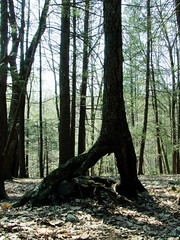
In a few more years, the path in this picture will be two centuries old. That’s fifty years older than any of the buildings in the hollow. They’re the healed remains of the roads the colliers built when they first clearcut the mountain, with results that must have been catastrophic for the hollow: floods, fire, massive loss of topsoil. But now, chances are if you come to visit in any other season than winter, our moss-covered trails are one of the things you’ll most remember about the place. They’re beautiful. In spring and summer, before the leaves fall and turn every step into a loud whisper, it’s possible to stalk through the forest as quietly as a burglar.

I always confuse the path with the destination. Don’t you? I start out intending to go somewhere, but then something catches my eye and I slow down for a closer look. Then I notice more. An hour hour later, I’ve only made it half a mile from the house.

laurel leaf

Nothing draws the attention quite like someone or something with a disfiguring disease. Whatever is decimating the mountain laurel here begins with colorful eyespots: brown rimmed with red and yellow, like targets in reverse. With certain kinds of sickness, yes — the leading edge of infection is marked by unnatural brightness. That fever glow.

rash

I found a black gum tree with a bad case of warts. Each wart is a hermit’s cell for an Eriophyid mite, a microscopic, two-legged relative of spiders. It goes through a mere two larval instars, and manages to have sex while maintaining its immaculate separation from others of its kind:

Mites do not mate with each other; sacs that the male leaves lying around on the leaf surface fertilize the female as she walks around.

Freedom from sexual contact can be liberating. Some species of Eriophyid mites alternate all-male generations with all-female generations. Very little is known about them beyond these basic facts. Some 90 percent of Eriophyidae have yet to be named and classified by taxonomists, so I suppose chances are good that this is one of them.

For the tree, the galls aren’t the sickness, they’re the treatment. The tree would say, with some justification, that each mite is walled in to keep it from spreading. But the mite, like thousands of other gall-making arthropods, is in fact practicing a kind of ju-jitsu, using the tree’s defenses against itself. The feeding chambers are not only ideal for solitary contemplation, if such be the bipedal mite’s inclination, but keep out most predators, as well.

After they attain adulthood, the Eriophyidae abandon their chambers. This is the time when accidental sex may occur. Many of them also take to the wind and float for miles, like the Daoist sages of legend. Some of them, no doubt, end up in my lungs.

bear tree

This black gum bears the scars of somewhat larger animals — bears and humans. When I painted a trail blaze on it seven years ago, I can’t remember seeing the other marks there, but judging from the depth of scar tissue, bears have been carving up this tree for some time. Though they much prefer electric and telephone poles to communicate their “Kilroy was here”-type messages to other bears, any conspicuous tree, living or dead, will do. For hikers, this is a useful reminder that they aren’t the only ones using the trails. For bears, it is perhaps a gratifying reminder of the fact that our paint marks are no match for their claw marks. Bears often destroy human-made things left in the woods — it’s as if they regard us as some kind of enemy.

For the tree, unless and until the trunk is completely girdled, none of this is a real impediment to continued growth and prosperity. Black gum trees are masters at walling off wounds with thick scar tissue. They almost all rot out at an early age, making them impossible to date by ring counts. But the outer shell of a mature black gum is hard as iron.

charred

White pines fight disease with tars, which can sometimes keep them standing after death for as long or longer than they stood as living trees. A century after the forest fire, a short-lived path that the flames took up the trunk of a pine tree is still marked with charcoal and a livid blaze.

News from the ‘Hood

faith-based initiative

Yesterday was a lovely day in my virtual neighborhood. A new edition of the Festival of the Trees went up at Earth, Wind and Water, honoring the 150th anniversary of the publication of the theory of evolution by natural selection. Tai Haku wrote a full paragraph for almost every link, placing the trees in ecological or cultural contexts. My favorite entries included a post on the bizarre and beautiful Common Screwpine; a great overview of mangrove forests by artist Carel Brest Van Kempen, who is putting together a traveling group show of mangrove art to raise money for their conservation; and a page on the Ginkgo trees that survived the atom bomb blast at Hiroshima, which I somehow missed on my visit to the city 20 years ago.

The first of the month also means posting a new nature column over at my mom’s site, this one illustrated as we often do with some of my old photos: Sunday, Sweet Sunday. It should give you a good sense of what Plummer’s Hollow is like this time of year — and why we are grateful to live in a conservative Christian area despite being what you might call secular humanists (and believers in “evil-lution,” needless to say). Sundays really are much, much quieter.

Finally, we announced the next bimonthly theme at qarrtsiluni: Transformation, with guest editors Jessamyn Smyth and Allan Peterson.

We are looking for work exploring transformative instances of all kinds with an emphasis particularly on the change itself — the dynamics inside the chrysalis rather than a static image of the butterfly emerged; the moment of Daphne becoming a laurel.

And within an hour the most highly motivated poets (yes, they exist!) began sending in submissions, much to my wonder. It should be another interesting issue.

A non-plague of non-locusts

egg-laying cicada

The locusts are, it must be said, a bit of a plague on the locusts. The males call “Pha-roah! Pha-roah!” in a slow southern drawl while the females plunge their scimitar-shaped ovipositors into the thorny twigs, sometimes so deep that they break. All along the top edge of the field, the black locusts are acquiring a pruned and chastened look, as if they were the victims of some very localized storm.

cicada damage

Of course, 17-year “locusts” are really cicadas (see Brood XIV). According to some sources, when early European settlers first encountered periodical cicadas in eastern North America, the only parallel they could think of for such an extreme insect outbreak was the plague of locusts in the Bible, so “locusts” they became — despite the fact that, as members of the order Homoptera, they could scarcely be more distantly related to true locusts, which are grasshoppers, Orthoptera. According to the Locust entry in the Wikipedia, however, the conflation goes much further back, to “the Vulgar Latin locusta, which was originally used to refer to various types of crustaceans and insects.” The English essayist Thomas Browne was bemoaning the confusion between locusts and old-world cicadas as early as the 17th century. And obviously the popular description of the call of Magicicada septendecim as “Pharoah” shows the unabated influence of Exodus 10:4-15.

However, it would be a great exaggeration to say of these “locusts” that “they covered the face of the whole earth, so that the land was darkened; and they did eat every herb of the land, and all the fruit of the trees which the hail had left: and there remained not any green thing in the trees, or in the herbs of the field, through all the land.” Here’s what the folks at Cicada Mania say:

Question: Will the cicadas kill my trees, shrubs and flowers?
Answer: Possibly. Cicadas don’t kill flowers and shouldn’t damage shrubs, but they can do damage to young, wimpy trees like ornamentals. If you have wimpy little trees, you can net them to keep the cicadas off. Tree species that aren’t native to North America won’t fare as well as native species. Trees that lose a lot of branches typically revive after a year or two, but they will be ugly in the mean time. Cicadas actually are a benefit to trees, as they destroy the weaker branches. Please don’t use pesticides — you’ll destroy the good bugs as well as the “nuisance” bugs, and ultimately do your garden and the environment a huge disfavor.

Of course, as larvae, cicadas do subsist on tree sap, but given that cicadas and deciduous trees have evolved together, I doubt that they do much to weaken the trees. Though the science is inconclusive, it’s likely that their extensive tunneling benefits the trees by aerating the soil, and possibly by creating macropores for new roots and fungal mycelia. An AP article quotes a Dr. Frank Hale from the University of Tennessee:

The holes from which they emerge aerate the soil around the tree roots, Hale said. The millions of decaying cicada bodies supply nitrogen and other nutrients, which rain washes down the holes to the tree roots.

However, a Penn State Ag School publication for orchardists assumes the worst, and considering the unique stresses on heavily pruned and sprayed trees in monocultural plantations, it may well be on-target with its recommendation to prevent egg-laying at all costs. It also emphasizes netting if feasible, and mentions the harmful effects of pesticides on beneficial insects.

cicada in scrub oak

Do the various Magicicada species vary in their arboreal preferences? I’ve mentioned black locusts as a favorite for swarming and egg-laying activity (see my video at the Plummer’s Hollow blog), but I suspect that’s largely because of their location in the field-forest ecotone. The cicadas here do show an affinity for forest edges and openings, regardless of where they originally emerged. I don’t know if the fact that locust trees are nitrogen-fixing legumes makes them any more attractive as adoptive mothers to cicada larvae. We have noticed relatively few cicadas in the black walnuts that surround the main house, which might seem logical given the toxicity of walnut roots to many other plants, but it seems that if we had the rarer third species, Magicicada septendecula, that might not be the case:

Within the same brood, the three species are always perfectly synchronized, but they are separated microspatially by having different habitats within the same woodland. Magicicada septendecula prefers ovipositing in hickories and walnuts, and emerges in higher proportions under those trees than under comparable oaks. Both M. septendecim [the “Pharoah” species] and M. septendecula occur together in upland woods, but septendecim exhibits much less host specificity than septendecula. The latter species is much rarer than septendecim; it can usually be heard chorusing in local patches within a woods occupied by septendecim. Magicicada cassini is a species of floodplain woods, and characteristically can be seen to replace septendecim and septendecula as one moves down a wooded slope leading to a stream. Over much of the eastern United States, however, the original forest has been extensively disturbed. Periodical cicadas survive and reproduce surprisingly well in cutover, scrubby second growth. Tree species characteristic of floodplains, like American elm, are often a component of upland second growth, and, especially in such situations, cassini, septendecim, and septendecula become intermixed though they remain reproductively isolated. The present lack of microspatial separation in many situations, then, is an artifact of human disturbance.
—Henry S. Dybas and Monte Lloyd, “The Habitats of 17-Year Periodical Cicadas (Homoptera: Cicadidae: Magicicada Spp.),” Ecological Monographs, Vol. 44, No. 3 (Summer, 1974)

That might explain why the M. cassini cicadas are so much louder and more numerous around Canoe Creek State Park, much of which is floodplain or early-succession second growth. At our annual Audubon Society picnic last week, they were nearly deafening. In fact, a friend just told me that the dog-day cicadas are usually very numerous there, too — and regardless of the species, they make excellent fish bait, he said. Hardly the stuff of plagues.
__________

Today is the deadline to submit links to the next Festival of the Trees. Details are here.

None dwell in their tents

tent caterpillar on black birch trunk

Let their habitation be desolate; and let none dwell in their tents.
Psalm 69:25 (KJV)

Eastern tent caterpillars (Malacosoma americanum) are a common sight this time of year, especially in their last instar, after they abandon their tents. They stray onto the porches and wander over the furniture, looking for protected places in which to pupate. On a visit this past Monday, my three-year-old niece Elanor decided that they were cute — not typically my own reaction — and began petting them, prompting the caterpillars to arch their heads back like housecats. Yesterday afternoon, I watched one crawling up the neck and across the face of a box turtle, which merely shut one eye while the caterpillar took its measure.

tent caterpillar tree (black cherry)

The tents began appearing at the end of April in unusual numbers, especially on black cherry trees, which are the favorite food source for tent caterpillars and occur in unnatural abundance across Pennsylvania due to 150 years of clearcut logging practices and the reversion of old fields and pastures. Black cherry is a common first-succession tree species in many forest types, and thanks in part to its relative unpalatability to white-tailed deer, it can form almost pure stands in many areas that would have formerly hosted oak-hickory, beech-hemlock, or mixed deciduous forests. Here in Plummer’s Hollow, many of our southeast-facing slopes are dominated by black cherry stands, and I figured they’d be completely defoliated by this time.

blossoming black cherry

Instead, Sapsucker Ridge is white with blossoms, filling the air with an ambrosial scent. One finds only a few black cherries as badly defoliated as the one in the second photo; the tree above is more typical. Though dotted with tents, only scattered branches have actually been stripped of their leaves.

dead tent

A closer look reveals that most of these tents are filled with dead caterpillars. The few still alive twitch spasmodically. What happened? I’d guess that the unusually cold, wet weather over the past few weeks is at fault. Nighttime temperature routinely dropped into the low 40s this month, and sometimes even into the high 30s; daytime temperatures rarely exceeded the mid-50s; and rain was almost constant for the first three weeks of the month. Not only would the cold have shut down their temperature-sensitive digestive systems for prolonged periods, but the rain would have kept them confined to their silken tents, and the two together would’ve made them much more susceptible to starvation and disease. According to the Wikipedia article on tent caterpillars,

The tent is constructed at a site that intercepts the early morning sun. The position of the tent is critical because the caterpillars must bask in the sun to elevate their temperatures above the cool ambient temperatures that occur in the early spring. Studies have shown that when the body temperature of a caterpillar is less than about 15 °C [59 °F], digestion cannot occur. The tent consists of discrete layers of silk separated by gaps and the temperature in these compartments varies markedly. Caterpillars can adjust their body temperatures by moving from one compartment to another. On cool mornings they typically rest in a tight aggregate just under a sunlit surface of the tent. … Later on in the spring, temperatures may become excessive at mid day and the caterpillars may retreat to the shaded outside surface of the tent to cool down.

Entymologist Vincent G. Dethier’s wonderful and evocative classic, The World of the Tent-Makers: A Natural History of the Eastern Tent Caterpillar (University of Massachusetts Press, 1980) describes in Chaper 13 (appropriately enough) the battery of predators and diseases that keep this native insect in check. He details the spread of a deadly virus from colony to colony, then adds:

As if that were not enough the unusually wet late spring had been kind to molds, mildews, smuts, blasts, and bacteria. A particularly virulent spore-forming species of bacterium struck many of the colonies. … The enormous population of tent caterpillars had been cropped by weather, starvation, ants, bugs, parasites, fungi, viruses, bacteria, and misadventure in general. It had been a particularly trying year. Summer had hardly begun and the die had already been cast for the year to come. There would be fewer moths, fewer egg masses, and fewer colonies of the next generation.

So a spring that spells bad news for many farmers is good news for the wood products industry, which relies heavily on black cherry in Pennsylvania. Unlike fall webworms, which come too late in the season to have much of an impact on the trees they defoliate, tent caterpillars can greatly stress the trees they defoliate during their periodic outbreaks.

As global climate change plays hob with our weather patterns, it will be interesting to watch the effects on insect outbreaks, and over the long term, on forest succession. For example, if black cherries continue to predominate as many foresters would like, more-frequent icestorms would have a much greater impact than they would if less brittle species such as red oaks and tulip poplars took their place. Warm winters are said to promote the spread of pest insects, but what about warm winters followed by cold springs? I’d heard that the state was due for some pretty large gypsy moth outbreaks this summer as well, but here in Plummer’s Hollow, at least, their caterpillars are few and far between.

Cross-posted to the Plummer’s Hollow blog.

Trees of life


Flowering Crabapple, from the Undiscovery Channel

There’s always something a bit paradisaical about a fruit tree in flower, abuzz with insects of every description. The aural and visual stimuli combine with the heavy scent and the electric atmosphere to create an almost overwhelming impression of superabundance. How can the world not be good, we think. I’m sure someone who grew up in the Midwest would argue with me on this, but I just don’t believe one can experience the same kind of gestalt in a field of wheat.

It’s worth recalling, perhaps, that for a very long time our main vision of paradise was arboreal. The central truth of the Garden of Eden story is that the loss of paradise was and remains wholly preventable, and that it finds expression most often in the misuse of trees. Nowadays, of course, for all but the willfully ignorant, evolution teaches that we are primates, descended from the trees: a not incompatible truth. One way or another, the wholesale destruction of forests is something that few human beings can regard with equanimity. And quite often, as in the mythical Eden, it dooms us.

Consider landslides. Hundreds of thousands of people, at the very least, have been buried alive after the slopes above their houses were logged, from Oregon, to China, to the Philippines, to Indonesia and various parts of the Himalayas.

Officials in the wildlife and forest department of Azad Jammu and Kashmir, (AJK) are of the view that an estimated 30 percent of the 87,000 people who died in the magnitude 7.6 earthquake [in 2005] could have been saved if there had been fewer landslides.

The officials, who declined to be named, blamed deforestation of the area for the huge landslides that contributed to a death toll that has risen to 43,399 people and left 31,069 others injured in the AJK districts of Muzaffarabad, Neelum, Bagh, Rawlakot and Palandri.

Then there are storm surges. The loss of coastal mangrove forests in parts of south and southeast Asia appears to have greatly magnified the destruction of the 2004 tsunami, according to a peer-reviewed study in the journal Science.

“The tsunami left a horrific human tragedy in its wake but also some lessons. Among them is the tremendous importance of mangroves, which are one of the world’s most threatened tropical ecosystems,” said Faizal Parish, director of the Global Environment Centre in Malaysia and co-author. “While no one could have prevented the tsunami, we can use this experience to prevent some of the destruction future events will cause.”

Unfortunately, that experience didn’t come soon enough to protect tens of thousands of Burmese villagers from the storm surge associated with last week’s cyclone. There, too, it appears that the destruction of coastal mangrove forests was as much to blame for the heavy death toll as the storm itself.

If only knowledge and experience by themselves were sufficient! But as the Garden of Eden myth suggests, we know just enough to be dangerous, rarely enough to be wise. Here in the U.S., we’ve understood the tight relationship between forests and water for over a hundred years. George Perkins Marsh’s hugely influential Man and Nature, published in 1864, used the historical example of forest destruction around the Mediterranean to finger deforestation as the leading cause of desertification. The catastrophic landslides, floods and fires that followed widespread clear-cutting in the latter half of the 19th Century here in the eastern United States seemed to many people to bear out Marsh’s prophesies, and led directly to the founding of the U.S. Forest Service. Yet today, most administrators of the USFS define “conservation” as “getting out the cut.”

The Pennsylvania state forest system, like the Adirondack Forest Preserve in New York, was established with the principal goal of preventing floods and erosion, protecting navigable waterways, and guaranteeing a clean water supply for the residents of the state. The link between intact, older forests and a steady supply of clean drinking water was very well understood, and countless studies since have only served to reinforce this insight. Preserving wide forested buffers along streams and rivers, for example, has become a standard water purification strategy, albeit one honored most often in the breach. But professional foresters are still advising municipal water authorities around the state to log portions of their watersheds “for the health of the forest” — defining “forest” solely in terms of saleable timber, and “health” in terms of profitability — with a deterioration in water supply as an inevitable result. Perhaps they figure that, since everyone buys water in plastic bottles now, it doesn’t really matter.

Marsh was right in more ways than he could possibly have imagined. Deserts are on the march all over the world, their progress greatly accelerated by, if not wholly attributable to, the cutting of trees. And as I mentioned last week, unlogged forests are an essential part of the global carbon cycle as well. I’ve seen widely varying estimates of the contribution of deforestation to global warming, but one of the most recent and conservative, again published in Science, asserts that “nearly 20 per cent of carbon emissions [are] due to human activities.” How much more evidence do we need that trees are essential to our continued life on this planet?

I am, quite obviously, a tree hugger: one of those soft-headed people who actually thinks trees deserve to live for their own sake, and who recognizes that they are the keystones of complex ecosystems supporting millions of species besides Homo sapiens, each of which has as valid a claim on the planet as we do. You can disagree with my value system all you want. The simple point I’m trying to make here is that even from a purely anthropocentric perspective, deforestation is one of the quickest, surest tickets straight to hell.

*

Don’t forget to submit tree-related links to the Festival of the Trees, hosted next month at the inimitable Wrenaissance Reflections. Details are here.

Carbon credit accounting

Science is beginning to confirm what many of us have long suspected: that older forests are better at sequestering carbon than younger ones, contrary to what some foresters would have us believe. My father has been wondering lately whether our own few hundred acres of forest are enough to offset the carbon we produce as a family. If you know my dad, you won’t be surprised to hear he’s got it all more or less figured out.

We are coming under intense pressure here in the Appalachians to clear every ridgetop forest for wind turbines, but I suspect that we can make the biggest difference simply by leaving the forests the hell alone. Certainly the best thing we could do for the forests themselves would be to end all extractive uses and employ foresters and loggers to conduct taxonomic surveys and ecological monitoring instead. Considering how much we still don’t know about Appalachian biodiversity, and how much we stand to lose as a result of global climate change, those are the kind of “green jobs” most desperately needed right now.

Back to Rickett’s Glen


Going in Circles, from the Undiscovery Channel on Vimeo.

Gnats circle our heads without biting as we climb up and down the rock steps with cameras or strip down to bathing suits to swim in the plunge pool, each attentive in our way to the mysteries before us. The stone face beside the waterfall stares unrecognized from a thousand vacation snapshots.

walking birch

walking birchThis is one of the most popular places to go walking in Pennsylvania; even the trees seem to want to join in. Black and yellow birches balance on stout root-legs, the stumps on top of which they sprouted having long since disappeared, like crutches thrown away after a visit to the healing waters of some sacred spot.

The understory shrubs known as hobblebush, or witch-hobble, lean out over the water to escape the ministrations of the white-tailed deer. They’re already in radiant bloom, with their heart-shaped leaves only half-grown.

hobblebush

“Deer Park,” says the label on the plastic water bottle bobbing below the falls. But deer numbers in the park must be low, or there’d be no hobblebush at all, and far fewer of the wildflowers that carpet the ground: trillium, foamflower, trout lilies.

lichen on hemlock

Twigs shed by the hemlocks are covered in arboreal lichen, as one would expect from an old-growth forest. I try not to focus on the unnaturally thin and grayish foliage on some the trees — a sign that the hemlock woolly adelgid has reached North Mountain, and in a few more years all the hemlocks here may be dead. If and when that happens, it will be catastrophic for lichens and the invertebrates that feed on them. Cold-water stoneflies, brook trout, and other species dependent on the cooling properties of hemlock groves will suffer, as will some of the songbirds that reach their highest densities in old-growth conifer forests: Acadian flycatcher, Blackburnian warbler, black-throated green warbler, and blue-headed vireo. All but the flycatcher have returned from their winter vacations in the tropics for another breeding season, and sing from the treetops.

truck in the woods

Brook trout dart across the bottom of sunlit pools in Kitchen Creek, seemingly oblivious to the traffic on the two-lane highway. I think I know why some people find fishing addictive: staring at the water and the fish moving through it is a passport to another, more timeless dimension.

We’re on our way home from a funeral for a great aunt, the last of her generation. My paternal grandmother, her husband, and most of her extended family are buried within fifteen miles of here. My ancestors have been making the circuit hike of the glens probably since before Rickett’s Glen was a state park, and my parents courted here back in the days when couples still courted, putting over from Bucknell University on Dad’s motor scooter. Somehow without really intending to I end up visiting at least once a year myself. It’s beginning to feel almost like a pilgrimage.

Festival das Árvores

Juliana writes,

Pela primeira vez o Festival é sediado num blog de outra língua diferente do inglês e eu prometi tentar com meus básicos conhecimentos gerar o blog totalmente bilíngüe diretamente de São Paulo-Brasil! […]

For the first time, the festival is hosted by a blog from a language other than English and I promise to try, with my basic knowledge, to generate a fully bilingual edition directly from Sao Paulo, Brazil!

As I wrote in the announcement post at the Festival of the Trees coordinating blog, it’s hard to find a country more closely associated with trees and forests in the international imagination than Brazil.

Aside from the bilingualism, other special features of this month’s edition of the FOTT include the “be a tree” poems at Read Write Poem (a prompt specifically inspired by the Festival of the Trees — thanks, Juliet!); on-going coverage of a busy beaver in Missouri; a two-part post on how to cure an ailing coconut palm in Tamilnadu; and the greenest street in the world. Go look.

Medicine tree

My grandmother had a reverence for the sun, a holy regard that is now all but gone out of mankind. There was a wariness in her, and an ancient awe. She was Christian in her later years, but she had come a long way about, and she never forgot her birthright. As a child she had been to the Sun Dances; she had taken part in those annual rites, and by them she had learned the restoration of her people in the presence of Tai-me. She was about seven when the last Kiowa Sun Dance was held in 1887 on the Washita River about Rainy Mountain Creek. The buffalo were gone. In order to consummate the ancient sacrifice — to impale the head of a buffalo bull upon the medicine tree — a delegation of old men journeyed into Texas, there to beg and barter for an animal from the Goodnight herd. She was ten when the Kiowas came together for the last time as a living Sun Dance culture. They could find no buffalo; they had to hang an old hide from the sacred tree. Before the dance could begin, a company of soldiers rode out from Fort Sill under orders to disperse the tribe. Forbidden without cause an essential act of their faith, having seen the wild herds slaughtered and left to rot upon the ground, the Kiowas backed away forever from the medicine tree. That was July 20, 1890, at the great bend of the Washita. My grandmother was there. Without bitterness, and for as long as she lived, she bore a vision of deicide.

N. Scott Momaday, The Way to Rainy Mountain (University of New Mexico Press, 1969)

Legerdemain

leaf hand

I was dealt a singular hand, & learned
to do tricks with the light:
sun sugar, bittering
at an insect’s approach.
I donned a conjurer’s robe of air plants.
Below ground I have discovered
the prosthetic tooth of a glacier,
round & granitic, & I hold it
like hard candy in my mind,
that ultimate rope trick of rootlets
& mycorrhizal hyphae
that never quite touch.
__________

In response to the Read Write Poem prompt, “be a tree.” Other responses are here.

(UPDATE) Hyphae, also called mycelia, are the “roots” of fungi; mycorrhizal means they are symbiotic with plants. See here:

In the ectomycorrhizal symbiosis between fungi and trees, the fungus completely ensheaths the tree roots and takes over water and mineral nutrient supply, while the plant supplies photosynthate. Recent work has focussed on gene expression in the two partners, on the effects of global change and nitrogen deposition rate on the symbiosis, and on the role of mycorrhizal fungi in connecting individual plants to form a ‘wood-wide web’.