April Diary 10: on not following myself

This entry is part 10 of 31 in the series April Diary

yesterday for the first time I tracked myself on one of those hiking apps which is a weird experience. the app was already on my phone so i thought what the hell. i wanted to verify that the distances i thought i was walking were accurate and they were. but!

it was somehow very distracting, like even though my phone was in my pocket i couldn’t stop thinking about my progress on a virtual map

until the actual world around me began to seem abstract, even a little unreal

but i thought i’d do it again today just so i could measure the alternate-day version of the hike when i go up the other ridge from the bottom, though the distance is bound to be within a tenth of a mile of the other route

halfway down the hollow i noticed i somehow hadn’t the gotten the app working properly and as it was too late to go back i shut it off. immediately i felt a huge wave of relief.

i walk for pleasure, inspiration and healing—to feel connected with the cosmos. everyone who’s into fitness claims their ultimate goal is to feel good but they’ve got some mighty strange ideas about how to get there

a few hours later i got a message from my cellphone carrier that i was almost out of data so it’s a good thing i fucked up today’s attempt to follow myself


questions that popped into my head while walking down the hollow:

how have the past 9+ years of making erasure poems changed the way i write?

how have the past 9+ years of making erasure poems changed the way i read?

i guess i thought if i wrote them down like that i’d have answers by this time. but it’s getting late and my brain is barely working. I’ll have to come back to this — and no doubt i will but it’s funny how i had so much to say about erasure poetry during the first couple of years of the Pepys Diary project when i really didn’t know what i was doing stylistically, but ever since i kind of figured out where i was going with it i don’t think i’ve written another thing, other than the occasional response to someone’s comment or question


another day of intermittent showers, even colder than yesterday

i sat in the sun against a tree and read fewer than 10 pages (Charon’s Cosmology again) before the dark clouds came up and a cold wind began to blow so i packed up and walked a mile and a half along the ridge through several very brief showers to the bench without wifi by which point the sun was shining again

so there i am sitting in the sun, gazing across the valley toward the other mountain disappearing into rain as I drink my sassafras tea

six crows fly over emitting duck-like calls: fish crows! (confirmed by comparing with audio from an online library). my brother the birder who lives in town later tells me he’s seen them along the river near the bottom of the mountain so i guess the species is moving into our area now, like black vultures before them and Carolina wrens before that — southern species moving north. next it’ll be Carolina chickadees i suppose

between showers
six fish crows
and the sun

made a somewhat experimental photo haiga out of that one since earlier in the day i’d posted a more standard haiga for a somewhat experimental haiku. i get bored of doing things the same way all the time


Have salt in yourselves, and have peace one with another.

Mark 9:50

happened across this quote, which i must’ve read more than once but somehow never paid attention to, whilst coming the Bible for quotes about peace that might fit on a gravestone or memorial marker (my dad, who died last September, was a peace scholar). don’t think we’ll use this one but as general advice it’s kind of perfect

the good ol’ KJV may not be the most reliable translation of the Bible but it is for sure the most poetic


Dear April yesterday i walked through a three-minute sleet storm. today it was graupel. the weather is becoming more opaque

April Diary 9: sapsuckers, beginner’s mind, and Phoebe Giannisi

river in November light between bare woods and mountain
This entry is part 8 of 31 in the series April Diary

a day of bright sun and sudden showers

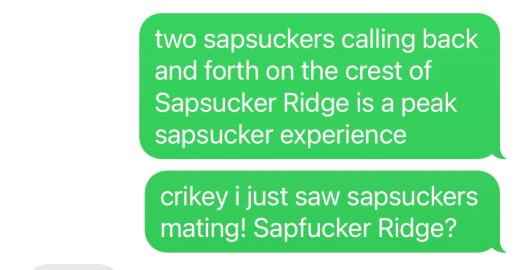
a day for Louisiana waterthrushes and yellow-bellied sapsuckers

I wrote a haiku about the former, posting it from the trail, and texted my birder brother about the latter

i’m picturing one of those 16th-century fonts where lower-case S’s look like F’s


I had one rule for this diary: to compose and post it entirely on the phone and I broke that rule on April 1, more fool me

what is it about poets and the need to set arbitrary rules which we honor mainly in the breach

the point of the rule was to enforce brevity (I type very slowly and poorly on it) but perhaps my laziness will serve the same function

is it a diary or zuihitsu though really

as British poet Cheryl Moskovitz put it

Zuihitsu is neither prose poem nor essay although it can sometimes resemble both. To ‘follow the brush’ suggests a certain not-knowing of what will happen, that whatever might result from the process will be down to discovery rather than plan. There is a strong sense in zuihitsu writing that the creation of order depends on disorder. Zuihitsu demands as its starting point, juxtapositions, fragments, contradictions, random materials and pieces of varying lengths.

so should I take Sei Shonagon for my guardian spirit, or the monk Kenkō, author of Essays in Idleness?

What a strange, demented feeling it gives me when I realise I have spent whole days before this inkstone, with nothing better to do, jotting down at random whatever nonsensical thoughts that have entered my head.

Donald Keene, Essays in Idleness: The Tsurezuregusa of Kenkō

that’s how the grumpy old priest begins

the equally curmudgeonly Shonagon began her Pillow Book like this (in Ivan Morris’ classic translation):

In spring it is the dawn that is most beautiful. As the light creeps over the hills, their outlines are dyed a faint red and wisps of purplish clouds trail over them.

she goes on to say that in summer is it the nights, in autumn the evenings and in winter the early mornings that are most beautiful

and i’m thinking that might be true in central Pennsylvania too


back at the end of March I attended a reading at Penn State Altoona by a couple of friends who teach there, both of whom had new books to launch: Todd Davis (Coffin Honey) and Erin Murphy (Taxonomies)

they both read very well and each is at the top of their game – so far so good. but should i stay for the rest of the reading, an open mike that i knew would be dominated by students with little more than one or two poetry classes under their belts? yikes i thought but i did stick around anyway

and actually it was kind of awesome. for one thing nobody hogged the mike. the audience was large but respectful and the work they shared had plenty of surprise

it occurred to me that listening to beginner poets is an exercise in recognition: recognizing what is salvageable, what is already brilliant, how true poetry and the received wisdom of the tribe are sometimes interchangeable. recognizing true insights no matter how encumbered by cliche

recognizing one’s own best moments with Beginner’s Mind

it’s also always valuable for those of us who have been immersed in poetry for most of our lives to get these periodic reminders of how newcomers to the craft might perceive it


most male birds aside from ducks lack penises, so copulation consists of what ornithologists refer to as a cloacal kiss

without the distraction of any kind of penetration one can see clearly that sex is at base a form of communication and perhaps its quintessence: a making in the sense of the Greek poeisis. DNA not unlike computer code to which it is often compared has the power to bring things about, like a sorcerer’s spell

the sapsuckers were certainly noisy about it too with that weird vuvuzela-like sound they make

here’s how the Cornell Lab of Ornithology website describes yellow-bellied sapsucker sounds:

The Yellow-bellied Sapsucker’s signature call is a scratchy, nasal mewing that is often repeated. They also have a squealing call, a repeated quee-ah, quee-ah, that’s territorial and often heard in breeding season. And they make a waa call when disturbed or to alert others to danger.

Other Sounds

Like other sapsuckers, the Yellow-bellied Sapsucker’s drumming is slower and more irregular than other woodpeckers. Its stuttering cadence can sound like somebody tapping out morse code. In addition to trees with good resonance, Yellow-bellied Sapsuckers also drum on metal surfaces—like street signs or chimney flashing—to amplify their territorial messages. Most drumming is done by males during breeding season.

a stuttering cadence suggests code or language because I suppose our ears are trained to recognize speech-like patterns, even in inanimate things like thunder or or the wind

i imagine birds hear a lot of sounds as potential birdsong, including human voices


i’m working my way through Greek poet Phoebe Giannisi’s book Cicada as translated by Brian Sneeden. the three epigraphs at the very front of the book are by J. Henri Fabre, Plato, and Basho so i figured the book would kick ass and it mostly does

like much of the poetry i read (and nearly everything i write) these are minimalist poems without a fixed narrator. according to the publisher’s description

Giannisi is a poet internationally known for her idiosyncratic ecopoetics, her poetic multimedia works and performances, and most of all, her brilliant vision glowing at the borders of language, voice, place, and memory.

i particularly like how she envisions ecdysis as an act of giving birth to oneself (not sure that image would’ve occurred to a male poet) but let me share instead the opening poem both because it is short and because it sort of fits with what i’ve been talking about:

Leaves

Inside these articulations
the beginnings of language
outside of yes and no
inside only the I want
the soul with the body meeting
in all the openly
meteoric leaves
and now, see:
one of them falls slowly
to the earth

Phoebe Giannisi

more davebonta.com tagline possibilities

  • mouth-breather, poet
  • son of Bruce
  • fairly good egg
  • #amwriting #butpoetrysonobodyreadsit
  • young codger

April Diary 8: talking mushrooms, Utnapishtim, dead poet society

river in November light between bare woods and mountain
This entry is part 9 of 31 in the series April Diary

8:30 am. Dear April this is pushing the definition of “showers” rather far don’t you think? But we need the rain and I probably need to give my walking muscles a rest… at least until mid afternoon


Previous research has suggested that fungi conduct electrical impulses through long, underground filamentous structures called hyphae – similar to how nerve cells transmit information in humans.

It has even shown that the firing rate of these impulses increases when the hyphae of wood-digesting fungi come into contact with wooden blocks, raising the possibility that fungi use this electrical “language” to share information about food or injury with distant parts of themselves, or with hyphae-connected partners such as trees.

But do these trains of electrical activity have anything in common with human language?

Mushrooms communicate with each other using up to 50 ‘words’, scientist claims

half an hour before I saw this article in my Twitter feed believe it or not I had just been wondering whether fungal communication could be considered a language, and thinking how vital it is regardless for anyone trying to write ecopoetry to grapple with the role of fungi in an ecosystem

“the interpretation as language seems somewhat overenthusiastic” says University of Exeter professor Dan Bebber about the new research. what an absolutely classic British put-down

whether language can exist without the sort of consciousness that members of the animal kingdom possess seems more a question for philosophers than for scientists

but “hey, let’s ask a philosopher about this!” is about as common a reaction as “let’s send a poet into space!” — something that would’ve seemed dead obvious under any past civilization, but, you know…


fungi are not just algae farmers (forming lichens) and essential partners for most plants (forming the wood-wide web) they are also the planet’s main engines (along with some bacteria) for fermentation, digestion, and decomposition

and you can’t have composition without decomposition. for one thing there’d be no room

last night as I was heading for bed an amusing concept for a sci-fi novel occurred to me: organisms in the human microbiome become sentient and start going on strike, demanding that everyone eat as much as physically possible

don’t think i’ll ever write a novel but if i do, it would probably start out as satire and just get successively stranger with each chapter until eventually it switches to cuneiform and the reader hurls it across the room in disgust


and now the sun is shining through the pouring rain

April why are you torturing me


speaking of cuneiform I did some quality wool-gathering earlier while sitting on the porch watching the rain come down. here’s the seedy fleece:

introducing Utnapishtim Press: distilling the world’s great literature onto clay tablets before everything goes kabloobie!

Utnapishtim Press makes essential collectibles for any cultured survivalist — priceless artifacts of human civilization that could survive for millions of years and delight alien archaeologists

porcelain isn’t indestructible but manufactured in sufficient quantities and spread around the globe, the chances are good that something would survive

its major project would be an open-ended, multilingual Book of Life with a poem for every known species with whom we’ve shared the planet

a decentralized network of potter-printers could work independently, downloading whichever portions of the vast, Creative Commons-licensed corpus would be appropriate to their bioregion

this is one of those big ideas i can’t quite seem to banish despite my commitment to dilettantism. i ain’t no Utnapishtim (Babylonian Moses) and if human civilization is going to collapse under the weight of our greed, hubris and brutality, maybe we need to just let all of it go. let decomposition take place… so completely new compositions can arise

after all such total erasure of cultures is nothing new, even without genocide. “oral literature” sounds oxymoronic with the way literocentrism is baked right into the word literature, but at least 99% of all works of oral literature that have ever existed are lost. whole languages are winking out all over the globe under the pressure of colonial, consumerist monoculture

so why would poets want to contribute to that monoculture by in effect creating a new canon in the form of a potential new sacred text, spread in differing versions all over the globe? just what the world fucking needs


I finally got out for a walk around 3:00 when the rain slackened into mist with occasional sprinkles. Other than when i scramble up a steep slope, it’s no trouble to hike with an umbrella. that makes it much easier to stop and jot down thoughts

though today nothing much came and i suspect that’s because i have only so much creative energy in a given day and i’d already shot it on two erasure poems not to mention all the B.S. above


a fellow former student of my original poetry mentor, Jack McManis, happened across my 2004 blog post about him and emailed me with some of his own recollections. he took a couple of Jack’s classes back during the period when I was regularly hanging out in his office as a high school student. i asked permission to quote from the email:

Jack got assigned — against his will — to teach a freshman English comp course in 1980. By luck of the draw, I ended up in his section. As a rebellion, he threw out all of the required BS essays freshmen were supposed to write and let us write whatever we wanted. I’ll never forget him saying “Writing is writing.” So I turned in poetry, short stories, rants about things that bothered me, song lyrics. 

I got an A, and took his poetry writing class after that.

He loved one of my poems I submitted in the poetry class. It was about the shallowness of my classmates. At first they didn’t get it, but he had me read it a couple of times. And he asked the class questions. As people got it, it made some folks angry and others uncomfortable. He was delighted. I was proud. And scared. He labeled it as “powerful.”

He had me submit it to the Central PA Festival of the Arts (or something like that), where he was a judge along with two other people. He recused himself from voting since he knew me. He later told me one judge said it was shit. The other judge said it should win first place. He worked out a compromise and I got an honorable mention.

He made a great impression on me, as here I am 40 years later thinking about him and writing to you.

Chuck Hall

my friends who are teachers will appreciate that sentiment i’m sure. though it does seem like a bygone era indeed when professors could actually get away with letting students feel uncomfortable in class. the horror!


here are some lines by Jack (from my original post; go there for more samples of his work)

So the twenties, time of the great gestures! And whose
were greater than yours, St. Slapstick? You who spun truth
in crazy pantomime, though it’s half-past mayhem, time for me
to return to the missing persons bureau of the eighties, before
the onrushing manifest planet spill me in the whistlestop dark,
my keepsakes scattered in cinders, let me spin off the rods
not in mourning but laughing far down in my bones, tickled
by you, old holy pie thrower!

Jack McManis, from “Child of the Twenties in the Eighties”

four decades on and i think we can still say Amen to that!

April Diary 7: wolfish

river in November light between bare woods and mountain
This entry is part 7 of 31 in the series April Diary

Dear April your daffodils are as late as I’ve ever seen them

their yellow buds ease open like swimmers dipping a toe into the cold and the wet

I’m sitting on the ridgetop and as i wrote that last line two deer came up behind me caught my scent and bolted, bounding down the steep, rocky slope toward I-99

Dear April today is a moss and lichen day, the tree trunks dark with rain under heavy skies and the gray-green sleeves of their upper limbs


It’s almost axiomatic i think that any place where you have a close encounter with a charismatic creature becomes forever marked by your memory of its presence. approaching this stone seat where i had a brief staring contest with a coyote a month ago, i noticed a somewhat wolfish piece of old lichen-encrusted pine

earlier, standing in the kitchen i’d started humming that song “the bare necessities” from Disney’s original animation of the jungle book and a few lines of a new bear poem came to me:

as for the bare necessities
Balu I am still looking

I have been unbearable
to some but like you

I am a sluggard
I go to the fancy ants

my tongue works far
harder than my teeth

yeah I thought i’d just throw in a fun little riff on a Bible quote there because I have an imaginary audience of fellow KJV nerds. oh hell yeah


Dear April I read one poem in the course of half an hour sitting in the woods. is that good or bad? Charon’s Cosmology still

there aren’t too many poets so brilliant that a practiced reader can’t anticipate where a poem is going from one line to the next but Simic is one of them

there are natural landscapes like that, so full of surprise that even a practiced hiker can’t imagine what’s around the next bend. we call such places old growth if they’re forest

if we truly pay attention they confound every effort at an easy narrative

there’s nowhere i’m really going with this thought but feel free to expand upon it at your leisure


but there is a terrifying arbitrariness to our choice of narratives isn’t there

what does this mean in the age of the novel and the TV script that it might not have meant in the age of the ballad and the epic, i wonder. in slower times people might’ve had more time to think their own thoughts but history suggests that many if not most of those thoughts, especially where war was concerned, were utter dogshit

in a time of war we are reminded of the immense destructive power of official narratives, our propaganda more insidious than Russia’s because, at least in its liberal version, so few members of the professional/managerial class even recognize it as propaganda

and so we are being memed and emoted into a war that could end nearly all life on earth


Dear April there was a raccoon on my Mom’s back porch late this afternoon when i got back from my walk and at first we were excited because, you know, not really all that many raccoons up here

but then we noticed how skinny and how scroungy her fur and she seemed to have a limp no wait she’s staggering oh hell poor thing must be rabid

and our neighbor came over with a shotgun because all i have are rifles and a shotgun is the right tool for this grim but necessary job but the raccoon had disappeared probably under my house

Dear April i won’t lie: seeing that raccoon stagger felt like a haiku moment

poets are monsters


I don’t want to end on such a dark note so let me instead leave you with a haiku by a living master of the art, John Stevenson

this is from his 2004 collection with Red Moon Press quiet enough (one of the two books that came yesterday from bookshop.org)

leaves budding
a little girl
spinning in her dress

John Stephenson

such a pure, perfect, timeless moment. with that is-it-or-isn’t-it-a-metaphor frisson I get so often with Buson

April Diary 6: freedom, haiku, and Roscoe Holcomb

river in November light between bare woods and mountain
This entry is part 6 of 31 in the series April Diary

Dear April to read Japanese haiku is to become enmeshed in a centuries-old matrix of allusions and traditions

as a modern free-verse poet i find the reliance on stereotyped images from the natural world somewhat stifling, and am glad we don’t have any equivalent tradition

it leaves us free to invent our own traditions, though who knows how stifling that might prove for future generations, should there be any kind of poetry in the far grimmer times that lie ahead


or so at least i wrote at 4:00 in the morning after reading Ozawa Minoru for a while, his Well-Versed: Exploring Modern Japanese Haiku which does present a very broad cross-section of styles and approaches

it’s an invaluable addition to the literature on haiku in English. i like the author’s down-to-earth style of literary analysis. I’ll share a couple of examples in a moment. i have two major frustrations with the book. one is that they included a literal translation and a Romanization of the Japanese but not the original. and this would’ve been a big help because my second frustration is that the main translations while workmanlike are sprawling messes. i usually end up attempting my own which is why i’m only halfway through despite having started it months ago.

i wrote down a couple of my efforts to share here. but first the translator Janine Beichman’s versions

after pondering this for a while i came up with

bindweed flower —
surely there must be
some electric current?

how about:

‘Stand up, bow,
take a seat!’ Green leaves
stirred by the wind

or even if we follow Beichman otherwise, surely “wind blowing” would’ve been a better second line

i don’t think it sounds stilted or excessively telegraphic to imitate in English the subject and verb tense indeterminacy, even if we can’t also for example leave it open whether we mean singular or plural nearly as easily. but this is all of a piece with the brevity: leaving as much to the reader’s imagination as possible after first drawing them into a particular time, place and mood

a haiku is an engine for reverie

from this perspective books like Ozawa’s might seem superfluous but of course in many cases the brevity can only work because of a shared cultural understanding which we lack, not to mention contextualizing with relevant natural history or literary information for a contemporary urban Japanese audience

(my photos don’t include the bio of each poet at the bottom of the page which collectively paint a scene of incredible richness and complexity)


Fay Aoyagi’s blog Blue Willow Haiku World is a much better way into modern Japanese haiku though. she’s an excellent bilingual haiku poet in her own right and I almost never have any thought of improving her translations. also she always shares the original text. here’s today’s haiku


listening to Roscoe Holcomb on the way home from my big biweekly shopping trip. that high lonesome sound. i love how on tracks like “Little Birdie” he sings at dirge speed against a fast banjo with an effect familiar from black metal, slow high-pitched vocals over blast beats. it’s the hillbilly way


o bookmark traveling from book to book — with most of my collection bought second hand what pages have you lain between and with whom


in today’s mail two books i’m really excited about but i’ll tell you about them tomorrow


DaveBonta.com tagline possibilities

  • mildly experimental poet
  • crow-botherer
  • poetry wallah
  • cock-eyed pessimist
  • game changer
  • troll farmer
  • non-fungible poet

April Diary 5: Dutchman’s breeches, sorcery, glutes

This entry is part 5 of 31 in the series April Diary

Dear April today a fat porcupine led me to an early-blooming patch of Dutchman’s breeches so it was a very good day

also i climbed a new-to-me mountain and met a lot of fantastic trees and rocks

(i’m not even kidding, i still get genuinely excited by cool-looking trees and rocks)

i’ve read maybe six poems today; mostly i was walking and snapping photos

the walk did generate some haiku but i thought maybe for once i’d hold them back and, i don’t know, maybe even submit them somewhere

as an inveterate online self-publisher i feel a little dirty even admitting that


during bouts of insomnia i’ve been reading a tome about Viking-age sorcery and last night I was struck by some of the translations of Sami magic specialists:

Types of Magic-Workers

according to Neil Price

  • one who harms by sorcery
  • one who harms and cures by sorcery
  • one who cures with the help of conjurations
  • one who performs wonders
  • one who bewitches people’s sight
  • one who knows a thing or two
  • one who creates illusions
  • one who whispers
  • one who dreams

The book by the way is The Viking Way: Religion and War in Late Iron Age Scandinavia

Neil Price is a brilliant historical anthropologist but if you’re not up on Viking studies this text wouldn’t be the best way in

you still have to just start with Egil’s Saga and have your mind blown

(Snorri’s Egil Skallagrimson is for my money the most compelling portrayal of a poet in all of world literature. poet and part-troll. but really more of a gangsta rapper, let’s be honest)


ever since I decided that boredom was no longer my enemy it simply vanished (tweet from yesterday)

can’t decide which sounds better, “gluteus maximus” or “butt muscle” (tweet from today)

April Diary 4: immersion

This entry is part 4 of 31 in the series April Diary

Dear April where were you today it was inclement in a distinctly wintry fashion

i was mostly indoors on my day of rest immersed in poetry, writing it reading it reading about it

except for a lunch break on which i indulged another guiltier pleasure: some nihilistic comedy on YouTube

i find it oddly restorative

it occurred to me as i was assembling the Poetry Blog Digest that butchers get a hell of a bad rap

that’s a comedy thought rather than a poetry thought but could work in either

anyway after all that i felt nearly drained of words so i went for a walk in the woods

i stopped at the biggest of the ephemeral woodland pools at the top of the mountain as i usually do and stared into its murky shallows

i find it oddly restorative

the sun set with little fanfare between storm clouds and a rose of grief blossomed in my chest

i remembered this morning in the trash burner how the flames had danced together so deliriously and then… just embers and ashes

returning across the field I saw the new(ish) moon through a hole in the clouds

Poetry Blog Digest 2022, Week 13

Poetry Blogging Network

A personal selection of posts from the Poetry Blogging Network and beyond. Although I tend to quote my favorite bits, please do click through and read the whole posts. You can also browse the blog digest archive or subscribe to its RSS feed in your favorite feed reader. This week, with the start of Poetry Month in the US and Canada (and everywhere else that poets join in trying to write a poem a day), I’ve decided to highlight what people are reading and how we’re thinking about that, as well as sampling from the various writing projects that bloggers are taking on this month. (Me, I’m doing a diary of sorts, inspired by some of my favorite poetry bloggers. We’ll see how confessional I actually manage to get, though. Probably not very much.)

It’s sometimes tricky to know whether or how much to excerpt from people’s NaPoWriMo exercises, since some will undoubtedly get unpublished, re-written, and submitted elsewhere. So please do let me know if you’d rather I not post excerpts from your poems this month. Regardless, enjoy the digest.


As we begin National Poetry Month’s twenty-sixth year, my thoughts turn to the tiny bit of extra attention poetry and poets receive during this time. In April, Poets Laureate revel in their brief moments in the sun, coming up with creative ways to force poetry into the attention of unsuspecting citizens. When I was Poet Laureate of Los Gatos, California, I asked local businesses to display poems on cardstock in their windows, and roped some volunteers into handing out poems printed on slips of paper to people on the street.

When I look back on those activities now, they seem less like fun and more like desperation. I’ll never forget the looks on people’s faces when I walked up to them and asked if they’d like a poem. Most were polite, a few enthusiastic, even touched, and one man backed away from me as if I’d tried to hand him a dead rat.

Erica Goss, Some thoughts as we begin National Poetry Month #26

Every April I challenge myself to read one poetry book per day—tackling all those books I’ve impulse-bought or been given by friends over the past year. Last year, I went all-out at the blog (see my post about Kathleen Flenniken for a great example), contacting many of the poets and asking questions about how their books were created. This year, I’m scaling down, but I still want to share with you what I’m reading, and at least a poem and some links for each poet. Rather than a review, you might think of these as “appreciations.”

Bethany Reid, It’s National Poetry Month!

This weekend we celebrate National Poetry Month at my church with Poetry Sunday, a sharing of favorite poems and original poems by members of the congregation. We’re a small progressive church, a safe place for all kinds of seekers, and a good bunch. We’re in between pastors right now, with guest speakers from all kinds of places, plus us, so, as one of our resident poets, I’m helping out and have chosen poems for all the readings, recitations, and prayers. Wendell Berry, Mary Oliver, Christina Rossetti,  James Wright, Louise Gluck. If I’m brave enough, I will also share a recent poem of my own, about the day my dad had a heart procedure.

I’m still writing a poem a day for Lent, and, now that April has begun, another for that, in an annual poem-a-day-in-April tradition. I’m glad I will have a jillion drafts to work on all year, plus the handwritten poems in a notebook that keep surprising me by even existing. Also reading a lot of poetry, as usual, most recently Self-Portrait with a Million Dollars, pictured above (cover art: Darn by Mary McDonnell) and available at Terrapin Books, here. Part way through Blood Weather by Alice Friman. These two poets will be reading at my local library, via YouTube Live, on Tuesday, May 17, 7-8 p.m. central time! Join us! And the library has acquired these two books. Perfect for our ongoing Adult Reading Challenge, as April’s challenge is to read a book of poetry. Beautiful array of them, along with April raindrops, on display on the main floor!

Kathleen Kirk, Poetry Sunday

When it first came out, I read Seamus Heaney’s Beowulf, but probably wasn’t in the right place for it at the time. I’ve just re-read it and have finally found myself in the right place to appreciate it. I’m still not in a position to argue over the merits of reading this ‘poetic translation’ over reading the original. Heaney covers this in his introduction (as well as the experience of students studying it at university – I was not alone.)

What I have done this time is loved the language and the story, and seen how the best works transcend time, and in the following passage, I think you’ll see what I mean

‘A Geat woman too sang out in grief;
with hair bound up, she unburdened herself
of her worst fears, a wild litany
of nightmare and lament: her nation invaded,
enemies on the rampage, bodies in piles,
slavery and abasement. Heaven swallowed the smoke.’

Sue Ibrahim, Beowulf today

Shakespeare collaborated, in this play, with an impecunious young playwright by the name of Thomas Painte: Shakespeare was to take a couple of the silliest romances of the age and write the poetic speeches for them, and Painte was to fill in some touches of continuity and plausibility. But poor Painte died of a sudden ague before the work had fairly begun, and — King James having hinted that he wanted something new — the play was rushed to the stage without Painte’s work. “Never mind,” said William. “The audience will never miss it. I’ve got some songs that will knock their socks off.” And so we have Cymbeline.

A ghostly Spring comes: faint clouds of new green appear, in some lights, around the bare branches; fruit trees and tulip trees lay out enormous sums on gorgeous designer outfits, which will be ruined by the first good rain. None of it seems real to me. Here, too, we miss the work of young Thomas Painte. One thing was supposed to be connected to another. One Spring was supposed to promise another. Winter was supposed to yield, not to vanish. At any moment Summer is going to stumble onto the stage with his wig askew, blurt out a few lines, and exit, pursued by wildfire. 

Dale Favier, The Death of Thomas Painte

The outlandish pink trees
shake their stiff crinolines
and the whole theater stirs.
The audience feels
loved like brides
in a world of divorces.
Too frilly,
too old-fashioned,
the critics huffed.
The management closed the show,
closed the whole theater.
Only the caretaker
sees the pink trees dance.
They still dance,
so out of hand,
so outlandishly beautiful,
to the wind’s applause.

Anne Higgins, Our college reunion is coming up this weekend

I remember being introduced to Charles Wright’s poetry in Intro to Creative Writing. Those enigmatic long lines, phrased in such a way that almost everything sounds so wise, like haiku.

I’m rereading A Short History of the Shadow, and I still enjoy his poetry. I think that there’s this kind of Tennessee drawl to the long lines, a pausing and repeating that you can hear in the dialect. Feels homey to me.

Two things I wonder about his writing though—1. Why does he bring Italy into everything, like a Hemingway expatriot, instead of just letting Tennessee be, with all its Tennesseeness. 2. Why the heavy repetition of syntax / lineation patterns in multiple poems throughout his work—is just style or a rut.

Obviously, Charles Wright’s writing works; else he wouldn’t be Charles Wright. If you haven’t read him, you should! (but be careful not to read one more than one of his books in a row—he’s one of those writers that stains your hands if you’re a poet too.)

Renee Emerson, Reading Charles Wright

The latest from poet Mikko Harvey, following the full-length debut, Unstable Neighbourhood Rabbit (Toronto ON: House of Anansi, 2018) [see my review of such here] and collaborative chapbooks Idaho Falls (with Jake Bauer; SurVision Books, 2019) and SkyMall (with Ashley Yang-Thompson; above/ground press, 2020), is the full-length Let The World Have You (House of Anansi, 2022). A Canadian poet living in Western Massachusetts, Harvey predominantly composes poems in first person lyric narratives that float across the boundaries of concrete image. “Wherever you are is a country.” he writes, at the mid-point of “Wind-Related Ripple in the Wheatfield,” “Touch it softly / to make it stand still. Your hair getting caught / in my mouth all the time, like a tiny piece / of you calling – like a tree trying to speak / to a rock by dropping a pinecone on it. / It is my intention to listen, but my hands / keep giggling while reminding me / I don’t get to be a human being / for very long, as if this were the punchline to a joke / whose first half I missed. I arrived too late.” There is an odd melancholy throughout, and Harvey’s is a lyric of held breath, and structurally echo a loose thread of lyric narratives I’ve seen over the past few years from American poets including Bianca Stone, Hailey Higdon, Hillary Gravendyk, Emily Kendal Freyand Emily Pettit: sharing a consideration for long, single stanzas, and their subversion of the short phrase. “I don’t / want you / to be / nervous.” He writes, to open the poem “For M,” “Maybe / thinking of / a walrus / would help.”

rob mclennan, Mikko Harvey, Let The World Have You

Mikko Harvey’s wry observations and surreal vignettes pose recognisable situations that ask indirect questions about what the reader notices and decides to take away. There are no wrong answers, but at its heart “Let the World Have You” is concerned with connections, how readers move and relate to each other and their environments, real, imagined and psychological.

Emma Lee, “Let the World have You” Mikko Harvey (House of Anansi Press) – book review

On a spring day as far from ‘late in dour October’ it would be harder to imagine, James Schuyler’s The Bluet surprises and delights. It’s the poem that has kept me going these last few desperate weeks, and not just because it features the bright blue of the Ukrainian flag.

At first glance it is a poem of escape, a wander through the woods to get away from it all. But as Carl Phillips has argued on the Poets House blog, there is more than enough in the poem’s manoeuvres to link it with Schuyler’s familiar presentation of the world as essentially social: the tiny bluet flower is a ‘Quaker lady’; ‘the air crisp as a/ Carr’s table water/ biscuit’; leaves that ‘are deep and oriental/ rug colors’.

But the word that catches my eye is ‘stamina’, placed at the end of the poem’s first line. Stamina seems so unlikely an epithet for a tiny blue flower.

Anthony Wilson, Lifesaving Lines: The Bluet, by James Schuyler

I’ve been turning over in my mind what it is I mean by ‘my kind of poetry’. Because there was a time when I wouldn’t have thought that today’s guest was ‘my kind of poet’. Indeed, there was a time, not all that long ago when I would have been puzzled by the idea that poems could be ‘life-saving. Bear with me.

For years and years poetry was always on the periphery for me. There were exceptions. When I was 16 it was the Metaphysicals….sardonic, clever, witty, sexy. Everything I wanted to be and wasn’t. At 18 the Augustans spoke to me. Clever, cool and witty. And I like the craft of couplets. At 20, briefly, it was Hopkins. What they all had in common was visible craft. At 22 I heard Robert Speaight’s recording of The Wasteland’ and it opened my ears and mind to TS Eliot. You can listen to it via YouTube in all its melancholy thespian RP musicality. It jars in a way that it didn’t, 57 years ago. Our ears become accustomed to different vowels and stresses. It occurs to me that it also opened my ears to Shakespeare, for which I shall be eternally grateful. […]

And so it went. As a teacher I liked the textures and evident emotion of Hughes and Heaney, but as  a reader it was mainly documentary and revisionist history that spoke to me: ballads and broadsheets, social realism. The 19thC Novel, Orwell. When I was asked to read Robert Lowell I fought it. I wasn’t interested in introspective, reflective late Romanticism (as I saw it). It wasn’t for me. I thought it was self-indulgent. Which is ironic, now I come to think. Anthony [Wilson] notes something in his post that chimes : 

“I have also been reminded of Seamus Heaney’s dictum in The Government of the Tongue that ‘no lyric ever stopped a tank’.”

I used to think that was an unanswerable argument to a question I never fully worked out. But now I say of course it can’t. And your point?  No tank ever made me happy or illuminated a mystery. A wren landed on the window sill earlier today, and just for a second it stopped my heart. So it goes. The thing was, what I wanted in poetry was stuff that could fill a room, like Shakespeare, that was memorisable and memorable. Most poetry was never ‘lifesaving’, and what I wanted was unlikely to be understated and quiet. We didn’t match. I didn’t miss it. I just didn’t get it..or it didn’t get me.

Something changed, about 15 years ago. Something shifted and if you wonder about ‘my kind of poetry’ it’s what the great fogginzo’s cobweb has been sharing for the last eight years. What strikes me is that while I’ll never have the apparently encyclopaedic knowledge of/familiarity with contemporary and 20thC that Anthony Wilson shares with you in his wonderful book Life-saving poems I’ve gradually being made more open to voices that one time I’d have dismissed. Life changes us.

John Foggin, My kind of poetry: Anthony Wilson’s “The Afterlife”

Alaska poet Keriann Gilson launched her brand, spankin-new collection of poetry today, places I never want to see again (Gnashing Teeth Publishing, 2022). It’s this beautiful road-rambling follow of a relationship’s ebbs and flows. I appreciate Keriann’s experimentation with haibun, especially its form and how it meanders down the page. She also explained today that the enjambment is a clue into the relationship. When lines flow and haiku are more elegant, the relationship is at its zenith. In contrast, the existence of short, choppy, stilted lines suggests there are problems afoot. It is a fine read, one that should land on a lot of bookshelves for a future reading once it’s been savored. Cheers to Keriann, and not only for this fine read, but also earning her MFA. Exciting news all around!

Kersten Christianson, You Gotta Get This One!

Karen Paul Holmes: I’ve dog-eared so many pages in this beautiful book, A Cartography of Home. Please tell us how this collection came about. I note a thread of homestead/weather/growing things that almost feels pioneer-like, but in a modern sense. And you do, after all, live on a farm. But there are other-located poems too: mini-market, hotel, church, for example. What can you tell us about the sectioning of the book into four parts? How much of the choosing and ordering of poems throughout the collection was purposeful and how much intuitive? Did you write any of the poems for this book specifically or did you assemble poems already written?

Hayden Saunier: I’ve been thinking about place for a long time. I’m a southerner who moved north into cities for theatre opportunities, but I grew up attached to a rural landscape and with an awareness of the innumerable lives that have inhabited a place long before me. Moving to the farm where my husband grew up reignited that deep connection to a particular landscape, but I also wanted to expand on the ideas of home and place to the those “other-locations” you mention (superstores, mini-markets, churches, press conferences, customer helplines) that have become our current and shared cultural landmarks. And when you walk the same fields and woods every day you are confronted by how time is stacked up in layers in a place, like tree rings and soil, so writing about place and home naturally becomes writing about time. That’s been given as an argument for art: It’s a means to stop time. Or a means to enter a single moment and that feels like stopping time.   

I love sectioning a book because I think a reader needs a place to rest between poems. I know I do. The way a bench is situated on a walking path to allow a moment to consider the view or tie your shoes or just sit. In A Cartography of Home, the first section begins with concrete considerations of home and habitation, and then those ideas ripple outward in the second and third sections, returning to the concrete and actual by the end. The way a walk works when the mind loosens and makes wider associations between the fixed points of beginning and end.

Diane Lockward, Terrapin Books Interview Series: Karen Paul Holmes Interviews Hayden Saunier

Yesterday morning, I went to a local library to attend a writing workshop on the theme of ‘home.’ […]

I found it hard to say where my home is. Maybe it’s imaginary? Portable? I used to daydream about living in an Airstream trailer. Though I’d need a second one just for books… […]

Which brings to mind something one of the workshop attendees said about feeling at home in a library. Several of us nodded in agreement, and he added that the library–the public library–functions as a kind of matrix. I would add that’s true for one’s private library, as well, books providing a kind of collage of interests and influences and teachings that can be seen as a kind of matrix to the book-collector’s consciousness, loves, and interests. Speaking strictly for me, in this case.

The house I have inhabited for nearly 25 years now, the house my Beloved and I designed, helped to build, inhabited, raised our children in: this is as close to a ‘true home’ as I have ever had. And yet: is it my home, my rooted place, my last place, the dwelling-in I must have to feel stable and secure and surrounded by love and nature? I’m not so certain about that.

It’s beautiful here, especially in springtime. Yet as I consider friends and students and strangers who have had to pick up and leave on short notice, possibly never to return–it would be hard, but I could leave home. And, for now at least, I still have a choice to go or stay.

Ann E. Michael, Home is where?

Visiting the Azores has a strange fusion of ‘Here I am’ and ‘Where am I?’.   Call it a confused familiarity.  Our host on the island of Terceira presented us with a golden loaf of sweet bread  — kissing cousin to the sweet round on Ives Street at the Silver Star Bakery!  Back home in Fox Point, Azores banners hang from car mirrors, fisherman sell me their silvery catch from the back of a truck.  Living in RI, we’ve been imprinted with the nostalgia of others, our largest immigrant population from Madeira and the Azores.   

But the encounter with the archipelago has its own suspended reality — nuit blanche, arriving without a night’s sleep in the middle of the Atlantic on an unknown island.  Under the airport roofs birds were singing.  A city called Angra do Heroísmo, low church bells intoning.  Misty bay, veils of rain.  Whatever I was expecting, (small villages, old men and women collecting vine cuttings, tending their fig trees) was superimposed on an impeccable, chromatic seaside capital.  White and pastel houses alternate, holding each other from tumbling into the sea.  Air playful, soft, doing little arabesques over the dashing Atlantic. A man was etching in the sand a giant heart with the words Ukraine atop.

Jill Pearlman, Azores, Déjà Vu and Olà

I don’t know myself, but it’s not the result of an unexamined life. On the contrary, it is a life so examined that the fabric has been teased apart. I am a collection of discrete elements. And I am trying not to panic.

I recognize something in the line above; I am a loose collection from a poem I wrote in 2016. From the book I wrote wherein the translator described the poetry as my “late style”. I read that as a curse.

How have I survived rattling around these past years? Wide-open, and pinched simultaneously. A sack of bones.

At 4 am yesterday I was focused: writing. At 4 pm I crashed and splattered like a water droplet. Every time this happens I wonder if I will walk away for a day or two. Or for a year or two. Or more.

Identity is a complex issue. Language. Nationality. What they call the “formative years”. The America that shaped my formative years is not the America of today. I have lived here for more than half my life. For more than thirty years. And yet when people meet me they still ask me where I am from. As though answering that tells them anything about me.

I am from roach clips, milk lines, and Stranger Danger
I am from paisleys and bean bags, tv dinners and moon pies
I am from fire & brimstone, and inappropriate touches
I am from kerosene lamps and cinderblock walls
I am from scholastic books order forms and second-hand clothes
I am from guns and gophers and bloody chickens
I am from photographs cut carefully around the shapes of bodies
I am from sudden disappearances, fresh starts, and new names

But I say something like, the West Coast mostly, I moved around a lot. Then they tell me about all the times they have visited America, or the relatives they have there, or how much they love or have much they hate the culture. “Americans are…” and they begin to shape me.

And I go home and dig a little more deeply into the ditch that separates me from the world. I am still too easily twisted by casual contact.

Ren Powell, A Loose Collection of Mixed Metaphors

It’s been one year since my cancer diagnosis and I had a checkup with my surgeon this week. He said everything is looking good but it might be another nine months to year before I see any results from the nerve graft in my face. There’s another procedure that could be done, which requires taking a length of muscle from my thigh and threading it through my face to help restore symmetry, but that sounds horrific. I might explore botox. The droop face really is depressing. 

My six month cancer scans in December were clear, but I’ll be having more in June. Fingers crossed for the continued “all clear.” I think I’ll feel and even bigger weight of my shoulders when those results come back.

I’m slowly but surely getting the new & selected together collection. Publication is planned for September 2023. 

Collin Kelley, A new poem and a health update

Tuesday morning, the moon startled me on my morning walk.  It was just before dawn, and the moon as it was rising looked huge in the very dark sky.  It’s at the end of a waning phase, so it looked hollowed out.  As I walked, I came up with some lines for a poem, and I repeated them throughout my walk, so that I could remember.

Wednesday morning, I wanted to see if I could see the moon again, but because it’s a day later, moonrise was later, 6:28 a.m.  So I headed to South Lake, where I thought I would have a better view of the moon as it rose.  South Lake looks out towards the part of the beach with fewer highrises.

I got there at 6:34, which I thought gave me a good chance of seeing it, but at first I didn’t see anything.  I walked slowly around the lake, and just when I was about to give up, I saw it, a narrow sliver of a moon in a red-orange sky, just before sunrise.  It looked much more apocalyptic than it did when it was in a darker sky.  

I stood and stared for a moment.  If I hadn’t been paying attention, I likely wouldn’t have noticed the moon–it was just too close to sunrise and too cloudy.  I walked to North Lake where I could still see the moon, but it was barely visible as the sky had gotten much lighter.

I have all but ceased sending out poems just now, so let me post the poem that I wrote after my moonwalk mornings.  Is it done?  My younger poet self would have put in a lot of references to social justice issues.  My younger poet self would have made every connection glaringly obvious.

Kristin Berkey-Abbott, Moonwalking

It looks like that,
the old monk said,

because that’s always
how you see it.

Tom Montag, TEN OLD MONK POEMS (61)

Speak to any writer and they will tell you that it is difficult to force creativity, especially poetry which is a medium of translation – events, pain, love, happiness – into art. I feel I have burned myself out through striving to get to a place that is perhaps non-existent and more about my need to be recognised as valuable, than about my need to create. All the striving has, though, allowed me to climb high enough that I am now on a platform that I can, to a certain extent, control. I can sit on this platform and grow into myself and my writing. Right now I am working on myself. I feel like I am undoing myself, peeling away long papery layers of habit and compulsion and sitting with each version of myself, asking her what she needs and what I need to do to validate her. I’m addressing all sorts of things, both personally and in my writing. I mentioned recently that my next collection has been put back a year, which feels like a terribly long time but, actually I feel this might be fate playing a hand for me. Without the pressure of the imminent end of year deadline, I have been able to allow the poems to come when they come. I’ve used the last of my Society of Author’s work-in-progress grant to take the time to write when I need to; a change from what I initially planned, which was to set a big chunk of time aside to write write write, which just didn’t work for me. I always felt I worked best under the pressure of a finite time scale, but it turns out that my procrastination is a lack of confidence, the ‘working well to a last minute deadline’ is a way of avoiding having confidence in myself and my work, a way to ‘trust the gods’ and have an excuse if I didn’t do as well as I wanted. The truth is, we don’t always do as well as we want, that’s just part of it. Some things work, some things don’t.

Wendy Pratt, Creativity and the Slow Life

I’m trying to write a poem a day, since I haven’t been writing as much lately, and seeking inspiration inside the world that’s still in a pandemic and a war. So I wanted to connect with some friends via phone and explore neighboring Kirkland, which has a beautiful waterfront with Lake Washington, and seems buzzing and friendly, at least when the sun shines.

I’m not healthy enough to travel or get in big crowds yet but I am, as you may see, making an attempt to get back into the world while covid levels here are low enough. As the UK and Asia struggle with another surge, I’m sure one is coming this way too, but for now, I’m getting out when it’s sunny (even when it’s not warm) and enjoying the flowers. I’ve enjoyed talking to friends this week about AWP as well as their travels and travel plans. Being immune compromised, I can’t be quite as adventurous, but I’m glad to get the news of the outside world, adventure by proxy. Meanwhile, I’m exploring different neighborhoods, capturing signs of spring.

Jeannine Hall Gailey, Happy April – National Poetry Month (and My Birthday Month,) and Seeking Inspiration

Everything feels unfinished. Every thought that comes to mind is a sentence half-spoken. I jot down one clause — “the death of a parent casts a long shadow” — and then I don’t know where to go from there. 

Pesach is coming sooner than I think. I start a seder menu, then my efforts trail off. I’ll have one vegetarian, one picky eater, and one diabetic. I can’t think of a good main course to suit all of us.

I open a book I’ve read before, Black Sea, by Caroline Eden. It’s a travelogue with recipes. She writes about how surprisingly Jewish the food of Odessa is. Tsimmes and forshmak are Ukrainian foods.

She describes sunny afternoons, the still air of quiet museums, pastel-colored architecture slowly decaying, literary stories of ice cream. Today the streets are filled with sandbags and barricades

At the end of the Odessa chapter she offers a recipe for black radishes and carrots with caraway and cider vinegar and honey. I have those things! But what to eat them with? I run out of steam again.

Rachel Barenblat, Unmoored

In 2017 I launched a collaborative performance practice called the Improv Poetry Orchestra (IPO). It’s a simple enough set-up – a poet writes improvisatory poetry on a laptop at a desk onstage, which is projected onto a screen behind her. Musicians onstage read the writing as it’s being generated, and they improvise in response to—and in tandem with—her. […]

Improvisatory writing—and any form of creative improvisation—can be a profoundly connective process. It draws disparate people and/or ideas together (connective), and it’s centered around the act of creation (process) rather than around artistic intentions or a final product. 

And unlike other skills which you must master from the ground up, you already have a lifetime of experience with improvising. Each day when you have a conversation with another person, you generate sensible, interesting statements spontaneously. Creative improvisation is similar—it just requires a little courage to be both nonsensical and unimpressive (yet occasionally amazing!), a few tools, and some practice. 

Improvisatory Poetry: Making it up as you go along – guest post by Elisabeth Blair (Trish Hopkinson’s blog)

Like most people I put up with Zoom readings and events when it was the only thing allowed, and I hadn’t realised how much I loathed it until I started to contemplate the horror of online poetry events becoming a permanent thing. The ‘Zoom factor’ is having a detrimental effect on my decision about whether to return to the University of York to finish my MA later this year: as long as there is any chance whatsoever that seminars will be moved online, I can’t honestly contemplate returning.

Ironic really: twenty-five years ago, as an internet newbie I was basking in the excitement of what the Web had to offer, online for hours every night (this was in the US, where it was free!) and making friends across the globe (yes, actual people – some of whom I got to know in real life). I then spent the best part of twenty years working in online marketing and speaking, teaching, advocating and writing books about the power (and brilliance) of the internet for business, for communities and for communication generally.

And now? After nearly three months ‘resting’ from Twitter, I’m wondering just how much I missed it, if at all

Robin Houghton, At last, some (a)live poetry events

I have always maintained that the raw material for poetry is all around us but that most of the time we don’t realise it. A poet is a person who sees the possibilities and who tries to respond to them. Last Saturday I had the idea that the air is teeming with poems, they circle like airplanes waiting to land. This is what I did with that idea:

Poems Are Everywhere

a complex holding pattern
keeps the free range poems airborne
invisible they circle the world
we are oblivious […]

Paul Tobin, FREE RANGE POEMS

On a day when engaging with the world feels too much like loving a damaged man, I stand underneath our willow’s blossoming canopy and look up. It is like being in another world, one with a sky made of flowers, and I remember that this is how it is:

There is only one world, and we stay because of moments such as this.

We stay because leaving means leaving all of it, not just its barrage of bad news, and we cannot give up spring afternoons when the sun is the right kind of warm and tulips are leaning toward us as if we are the light and passing strangers smile and tell us how lovely our corner of it is. We stay because we see how it might be, how it could be, how, for brief moments, it is, and we let ourselves believe that–if only we love it carefully enough–it can be (it will be) like this all the time.

That we are wrong doesn’t make the moments any less beautiful or true.

*****

This week my students and I read Naomi Shihab Nye’s “Making a Fist” together, from which I borrowed a line to use as the title of this post. I turned away from much of the news this week, but I made myself stay with “Inside Mariupol,” which also contributed to this micro-essay.

Rita Ott Ramstad, Clenching and opening one small hand

I have almost forgotten childhood now. Sometimes I’ll remember something that happened when I was a boy, but I am not sure if I really remember it, or if I have told the story of it enough times that it is really only the story I remember, and not the thing itself. What happens next? Will I also forget how it was to be a man? And then when I die, will I have had a life at all? Memories of memories. Perhaps I was never a boy. Perhaps I was never a man. I could just be a random thought in time and space. Friend, what a wretched thing it is to be getting old and not even know what is real and what is not. 

James Lee Jobe, the forgotten childhood

or how at certain times in my life parts
of my body went numb in spring the black
tailed deer chewed honeycrisp apples in the snow
in front of my house her body
the color of elephant tusks

on Shrove Tuesday I ate the cake purple
and gold straight through to the plastic baby
clack clack on my tooth and kayakers
dotted the Stillaguamish River 
like swift primary flags like standards
bright narrow countries
yet to be discovered

Rebecca Loudon, April 2.

Euridice’s footfalls so quiet on the rocky path. We should have sung together. I could have listened. What singer needs sight to know?

My Euridice. Dew on early morning lawn. Sandwich meat in the ancient world’s most beloved deli. Lips like an asp bite. Joke maker. It was she who charmed them, though I was a good opener, with my lyre, sweet rhymes, my boy pretty face.

Her ironic bright-light grace. Even when alive she seemed a beam, glinting, as if she’d passed between Lucretius’s atoms as through a beaded curtain or the rain. Euridice, bioluminescent in the dark deep sea.

Gary Barwin, over-the-shoulder beholder: SOMETHING ORPHEUS SAID

Have you seen the dancers who talk while they
dance, no, who talk with their hands, oh, so loud,
in unison, dancing deaf Greek chorus?
How goes the war? Did they clear the streets

of the dead? How many did they silence?
What are the words that stab, cut, slice, fillet?
What are the words soft as the edge of feathers
of steel […]

PF Anderson, Questions

I gather together all the foolish words I’ve uttered.

Give them baths, scrub away the grime, wash their hair, clean away the dirt behind their ears.

I brush their teeth, check their eyes, bandage wounds, provide blood transfusions when needed.

Then I dress them in cleaner clothes, offer each a pat on the head and send them back out into the world—

hoping my words will serve me better next time.

Rich Ferguson, Second Skin

You could open
many things
with a fragment

How easily
it slips into
your hand

Beautiful
detritus
Vascular

scoria
of tiny hidden
cavities

In each one
a constellate
a branching

Luisa A. Igloria, Bricolage

You sense the famine in the empty veins of leaves. Bone-birds summon you from frozen wires. Your restless need for banquets may not be logical, but you understand the hollow tuck in their frail and downy wings. You carry smoke and bells with grace. When faced with complex factors, you draw down mica and paint spirals on all locked gates in sight. Your friends call you ghost orchid, amethyst, cleric of water wheels and bright fat plums. Some are puzzled by your sprawl of bread and lilacs, but still consume your bounty. It’s your nature to know the genus of every hunger, to shimmer in the distance without effort. For you starvation is abstract. If necessary, you will grind the hulls yourself.

Kristen McHenry, Poem of the Month: Themes

a sunbeam
sliding down a cobweb
coffee time

Jim Young [no title]

The author was born in a rainstorm, the sky raven dark. The clouds thick and winged over the midwest. The author couldn’t sleep, at first, for all the thunder. but under the author, the forest writhed in moss and peat. Tethered itself to the author like ship. At night, she’d sail it through and the trees. The author, at first had no mother, no father, only the thin lip of daylight at the horizon. Only a slip of wind to guide her. She’d stack the broken limbs and build a fire and the ghosts would gather.  The author would rest, but only in the heart of of an immense, hollowed out oak, where she’d play house with the dark and marry it again and again.  Would carry its children up and down the ladder each morning. Would hush them to sleep, each night.

Kristy Bowen, napowrimo #1

A woman is killed as she tries to feed starving dogs.
I try to shake myself free but the image
and my imagination growl and tighten their jaws.
This is not about me, I say, it’s about the dead woman.
The woman is dead, says the image.
You can do nothing for her now.
Her death has invaded your life.
You must live with it.

We pass the cottage where the old couple lived.
In winter they came out one at a time
for they shared the same pair of shoes.

Now it’s home to a woman with winter-coloured skin
who paints a poem called Still Life With Anger.

In the distance we see the towers of the city.
The Government buildings, grey as rain-clouds
where people stand in line in the hope of leaving.

Bob Mee, THE REUNION AND OTHER POEMS

if i return to rest in a seed :: won’t my fields come searching for me

Grant Hackett [no title]

April Diary 3: stag beetle, wolf spider and fly

river in November light between bare woods and mountain
This entry is part 3 of 31 in the series April Diary

Dear April when I open my laptop this morning Poetry Daily which i have set as my home page has a poem by George Szirtes called Stag Beetle

beginning with a rhyming quatrain and switching into prose like an inside-out haibun but it works because whatever Szirtes writes tends to work because the man’s a genius and I say this based on years of reading his blog and social media posts — probably the most prominent poet I know to regularly share rough drafts online as Luisa and I do

I love love love poems that evoke the lives of other beings a la Francis Ponge who’s kind of the gold standard for that but there are many more and “Stag Beetle” is a great new addition to that corpus—

When propped up at 45 degrees it suggested a renaissance nightmare, the perfect rejection of humanism, but now, in my palm it simply sat like a philosophical problem.

I’ve met George socially a couple of times but it’s not surprising in a country as small as the UK that we have friends in common and let’s be honest sometimes the poetry scene in the US and Canada feels pretty small and familial as well

albeit a mafiosa family riven with rivalries some of them pretty bitter but the family will take care of you if you take care of it (and I don’t)

so I open my inbox and am happy to see that my friend Patricia aka PF Anderson is once again doing NaPoWriMo, kicking it off with a narrative poem about domestic violence and refugees called Imagine

I subscribe to Patricia’s blog Rosefire Rising for just that reason seeing her poems appear in my inbox every day in April I don’t do this for many poets but hers is a valuable voice of witness and the sort of poet all too often overlooked in our culture that tries to pigeonhole people: someone highly educated in the craft but employed in an unrelated field, who has to be extremely disciplined about setting aside time to write and rarely has any time left over to send work out

but at least there’s blogging

the next poem in my inbox is from another old blogger Risa Denenberg — Cul-de-sac at Autumn Sky Poetry DAILY also a narrative poem and beautifully done

one of the unique things about this periodical is the editor’s note at the end of each poem, just a sentence or two by Christine Klocek-Lim saying what she loves about it

Editor’s note: This poem lures the reader inside the narrative with calm imagery and the speaker’s quiet lawn rebellion until halfway through, when everything crystallizes into a sharp, piercing moment of clarity.

this is a feature I haven’t seen anywhere else but it gives the magazine such a down-home feel

and I admire how she embraces the informality of social media in her editorial style and how she recognizes the utility of blog software for releasing content DAILY

and her capitalization of DAILY suggests maybe a bit of frustration with other poetry editors who persist in releasing periodic content dumps because they can’t break themselves of a print-based scarcity mentality despite the fact that blog software has been with us for 20 years and every other sort of magazine understands how to release content in the digital age </rant>

two emails up it’s the latest daily offering from Rattle and this time I don’t know the poet one Jackie Bartley an evocation of a mother, with the sort of deep empathy one looks to poetry for

Rattle‘s thing is to include a short statement from the author instead of a bio at the end and I am all for this — it reflects an editorial focus on what would be of most interest to the reader rather than what serves the writer

so today Jackie Bartley writes

The hum of my mother’s Singer as the bobbin filled was as soothing as a Tantric chant, a single note resonating with and giving rise to layers of sound. I still relish that sensation: sound and sense in synchrony; word and idea unwound and rewound to form a poem, a compact and tightly layered version of story or state of mind.

my final poem of the morning before i head out for a hike is Luisa’s latest at Via Negativa which went up overnight: Binuro which I love because pickled foods fermenting in underground darkness is extremely my thing

the poem works as a lyrical definition of the title I think based on three minutes of web searching binuro


yesterday found me reading under an umbrella to protect the book from graupel

then i noticed what the poem was saying

i’m being cagey about the author because i ended up finding the poems not to my taste

the term high-brow nonsense poetry came to mind

i will give it another try though at some point


today i’m sitting in the woods on another mountain, on a haiku-collecting mission but this is my lunch break

it’s warmed up to where the flies can buzz and that’s important for two reasons:

  1. there’s a lean and hungry-looking wolf spider prowling the leaves around my feet
  2. i’m re-reading Charles Simic

and flies are to Simic as angels are to Blake

Simic at least in his early books is so full of genuine wisdom, one feels, even if the precise lessons may be hard to articulate

they’re quite like Sufi teaching stories in that regard

so they bear re-reading every few years which is why I’ve been filling in the missing titles in my collection, including this one, Charon’s Cosmology, his third with Braziller after Dismantling the Silence and Return to a Place Lit By a Glass of Milk (yes i’m reading them in order)

such ugly covers! such beautiful paper, binding and printing! truly a pleasure to open, in part so i no longer have to look at that ugly-ass cover

even though i’ve never owned this book i remember parts of nearly every poem

but which parts? maybe only the most obvious ones i think obsessively re-reading “The Elders”

which does begin “I go to great troubles” so perhaps I should

and then wouldn’t you know it I’m joined by another reader

an open book with a housefly on it snd the beginning of Charles Simic’s poem “The Elders”

April Diary 2: talking frogs and brush strokes

river in November light between bare woods and mountain
This entry is part 2 of 31 in the series April Diary

Dear April should I turn autocorrect back on or risk orthographic anarchy

for isn’t this what writing and publishing have become: apps instead of editors

search engine web crawlers are our most attentive readers and social media algorithms our most merciless critics

dear April I am typing this on my porch listening to the morning chorus and thinking about Ki no Tsurayuki’s 10th-century Preface to the first great imperial anthology of Japanese poetry the Kokinshu

We hear the bush warbler singing in the flowers or the voice of the frogs that live in the water and know that among all living creatures there is not one that does not have its song

(tr. Burton Watson, From the Country of Eight Islands)

that holistic vision in which humans are just one of a myriad sort of beings that have in common a fundamental drive toward song-making seen first and foremost as a spontaneous expression of joy

because to be natural is to be spontaneous in the Sino-Japanese conception of things. culture is therefore identified closely with constraint, such as the rules governing song/poetry

and since birds etc. also sing that means they also have culture (which many scientists would now agree with)

none of which has kept modern Japanese from wrecking the natural environment both at home and abroad, ancient forests of Borneo dating back to the Mesozoic logged flat to make disposable chopsticks and wrapping paper

the endless and beautifully tasteful packaging required by the cult of kirei — cleanliness and beauty


last night my phone glowed in the darkness like a florescent tombstone as I listened to the spring peepers all three of them making the loudest poem they could

night vision is incompatible with reading and it bothers me that i have to choose between gazing into the actual darkness and gazing at a printed or digital page

using night vision for revision is also impossible unless one can work entirely in one’s head like an oral poet

but light text on a dark background strains the eyes, most texts use dark fonts on a light background so in a sense the act of reading almost always entails parsing the darkness


on the 29th day of the twelfth month in 1308 the Japanese monk Nanpo Jomyo, having predicted that he would die on that very day a year earlier, picked up his ink brush for the last time wrote the following poem and allegedly croaked on the spot:

To hell with the wind!
Confound the rain!
I recognize no Buddha.
A blow like a stroke of lightning—
the world turns on its hinge.

tr. Yoel Hoffmann, Japanese Death Poems

say what you will about Hoffman’s translation it’s a hell of a lot less wooden than this one I just found on the web:

I rebuke the wind and revile the rain,
I do not know the Buddhas and patriarchs;
My single activity turns in the twinkling of an eye,
Swifter even than a lightning flash.

tr. Isshu Miura and Ruth F Sasaki, Zen Dust

a lightning flash illuminates the night for a second or two but who would risk such a potentially destructive vision

i like that he went out cursing though

I don’t know about frogs but for sure birds like crows know how to curse